


Editor’s note: This article is part of an ongoing series examining organizations in the United States named in the infamous 1991 Muslim Brotherhood Explanatory Memorandum, outlining a “Civilization-Jihadist Process” to destroy Western civilization from within. With renewed U.S. government focus on Brotherhood networks and recent congressional scrutiny, this series investigates the documented connections between these groups and their historical advancement of Brotherhood strategic objectives in America.
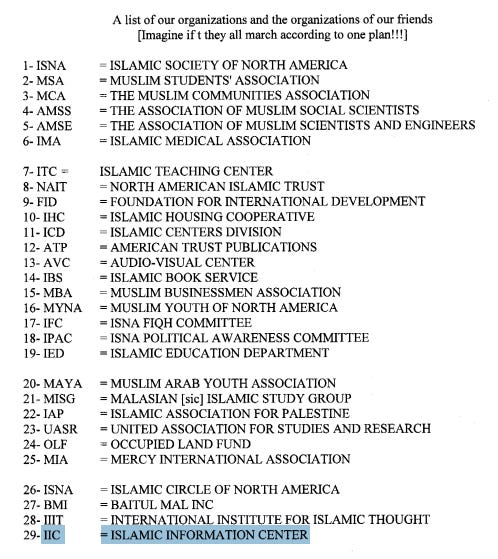
The Islamic Information Center of America (IICA), a Chicago-area Islamic outreach organization that currently lists a Des Plaines mailing address and that older public references placed in Prospect Heights, appears to correspond to organization #29 — ‘IIC = Islamic Information Center’ — in the appendix to the 1991 Muslim Brotherhood Explanatory Memorandum.
The organization was founded by Dr. Musa Qutub, a geography professor at Northeastern Illinois University, who authored content advocating the implementation of Islamic law, while the organization’s website states that it is “not affiliated with any political entity or religious movement.”
That tension between IICA’s public disclaimer and its apparent inclusion in the memorandum’s appendix raises questions about how the organization’s public posture relates to the broader strategic concepts described in the 1991 document.
The organization’s founder has published explicit calls for Americans to embrace Islam “before it is too late,” advocating for a society that “operates and implements the laws of God.” Yet IICA’s public-facing mission emphasizes interfaith dialogue, educational outreach, and community services—activities that can be read alongside themes in the memorandum, including ‘absorption,’ outreach, and engagement through mainstream institutions.
The Organization Today
IICA describes itself as an organization "established in 1982 with the mission to invite to the cause of ALLAH (SWT) (THE GOD) to non-Muslims and Muslims." The organization lists its address as PO Box 4052, Des Plaines, IL 60016—a Chicago suburb—and provides information about Islam through various community activities.
The organization pursues its stated goals through hosting mosque tours for middle school, high school, and college students; participating in interfaith dialogue; providing speakers for churches and Christian conferences; reviewing books about Islam for publishers; and offering media appearances on television and radio. IICA also provides marriage, counseling, and divorce services for the Muslim community, and operates an Islamic Reconciliation Council to resolve disputes among Muslims and Muslim business partners.
The organization’s website includes a prominent disclaimer: “IICA is not affiliated with any political entity or religious movement in and outside of the United States. We do not receive any contributions from governmental agencies or religious parties in and outside of the United States.”
The Founder: Dr. Musa Qutub
Dr. Musa Qutub, who reportedly founded IICA in 1983, served as a professor of geography and earth sciences at Northeastern Illinois University. According to Garbi Schmidt’s 2004 book “Islam in Urban America,” Qutub took pride in the number of people who had converted to Islam through IICA’s outreach efforts, stating that “many now accept Islam over the phone” proved to him that Islam was “a religion of proof” appealing to the human intellect.
In an article titled “Islamic Salvation: The Only Deterrent to Social Disorders,” published on IICA’s website, Qutub argues that Islamic law should be implemented in American society.
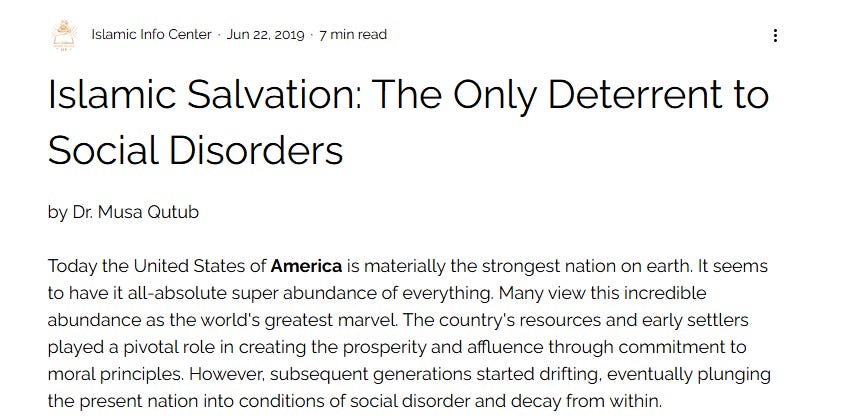
“We should aspire and pray we can institute a God-conscious society, a society that operates and implements the laws of God,” Qutub writes. He presents Islamic governance as “the comprehensive Islamic solution to the social disorders” facing America, arguing that “Islamic societies do not suffer from such social disorders and family disintegrations.”
Qutub’s article advocates for specific Islamic legal punishments: “Islam prohibits drinking totally and punishes those who drink. This translates to no drunkards in Islamic societies.” He continues: “Fornication, adultery, prostitution or any other promiscuous behaviors are all publicly and sternly punished in Islamic societies. No escape from punishment.”
The article concludes with a direct call for Americans to convert: “We urge and invite the people of this land to reflect on the current status of the social disorders and to sincerely study Islam and Islamic salvation before it is too late. God will not send another prophet.”
On IICA’s ‘Why Islam?’ page, attributed to Dr. Musa Qutub, the text states that Islam is the ‘true religion’ and that it “will prevail over all religions that were fabricated by mankind.”
The 1991 Muslim Brotherhood Memorandum
The Muslim Brotherhood’s Explanatory Memorandum, authored by Mohamed Akram and dated May 22, 1991, was introduced as evidence in the Holy Land Foundation terrorism-financing trial—the largest such prosecution in American history. The document outlined the Brotherhood’s “General Strategic Goal for the Group in North America.”
The memorandum describes the Brotherhood’s work in America as “a kind of grand Jihad in eliminating and destroying the Western civilization from within and ‘sabotaging’ its miserable house by their hands and the hands of the believers so that it is eliminated and God’s religion [Islam] is made victorious over all other religions.”
In an attachment titled ‘our organizations and the organizations of our friends,’ the document lists 29 organizations, including ‘IIC = ISLAMIC INFORMATION CENTER.
The memorandum discusses the concept of “absorption”—presenting Islam through mainstream American civic institutions while maintaining coordination with other Brotherhood network organizations. The document discusses ‘coalitions,’ ‘absorption,’ and ‘cooperation’ in advancing what it calls the settlement process.
Jewish Onliner previously reported that the Islamic Society of North America (ISNA)—listed as #1 in the same memorandum—was identified as an unindicted co-conspirator in the Holy Land Foundation trial, with evidence showing ISNA’s bank accounts funneled hundreds of thousands of dollars to Hamas leaders.
Strategic Interfaith Engagement
IICA’s current emphasis on interfaith dialogue and educational outreach appears to align with themes discussed in the Brotherhood memorandum. The 1991 document explicitly discusses adopting “the art of ‘coalitions’” and “the art of ‘absorption’” while emphasizing the importance of presenting Islam through mainstream American institutions.
The memorandum states: “We need to adopt the principle which says, ‘Take from people ... the best they have,’ their best specializations, experiences, arts, energies and abilities.” It emphasizes the importance of “winning” both Muslims and non-Muslims to the Brotherhood’s settlement project through community engagement and cultural integration.
IICA’s activities—such as mosque tours, interfaith events, and educational outreach—are broadly consistent with the memorandum’s emphasis on engagement through mainstream civic and religious settings, while also reflecting the organization’s stated mission of inviting people “to the cause of Allah.”
The Broader Network
The 1991 memorandum suggests an organizational ecosystem spanning educational institutions, professional associations, media organizations, and community centers, all established during the same period of Brotherhood organizational expansion in the 1980s.
The 1991 document emphasized the importance of creating organizations that would serve as “the axis of our Movement” and the “base for our rise” while becoming integrated into American civic life. It specifically discussed the need for Islamic centers to become “a seed ‘for a small Islamic society” that would eventually transform into comprehensive organizational structures advancing the Brotherhood’s vision of Islamic governance.
Current Status and Open Questions
IICA continues to operate in the Chicago suburbs, presenting itself as an educational and interfaith organization while offering community services and Islamic outreach. At the same time, important questions remain unresolved, including its current leadership structure, its funding base, and whether it maintains any relationship with other organizations named in the 1991 Muslim Brotherhood memorandum.
Those questions carry added relevance amid renewed U.S. scrutiny of Muslim Brotherhood networks. In November 2025, the White House directed the State and Treasury Departments to consider designating certain Muslim Brotherhood chapters, and on January 13, 2026, Treasury and State announced designations targeting the Egyptian and Jordanian branches as Specially Designated Global Terrorists and the Lebanese Muslim Brotherhood as both a Foreign Terrorist Organization and a Specially Designated Global Terrorist.
What remains unresolved is not IICA’s historical significance, but the nature of its present-day posture. The organization’s founder promoted Islamic governance, and an Islamic Information Center appears in the appendix to the 1991 memorandum; at the same time, IICA today presents itself as an unaffiliated educational and interfaith organization. That gap between documented history and current self-description is precisely why the organization continues to warrant scrutiny.