


Editor's note: This is the inaugural article in a series examining alleged Muslim Brotherhood front groups in the United States—the 29 organizations listed in the infamous 1991 Muslim Brotherhood Explanatory Memorandum outlining a "Civilization-Jihadist Process" to destroy Western civilization from within. With renewed U.S. government focus on Brotherhood networks and recent congressional scrutiny, this series investigates the documented connections between these groups and their historical advancement of Brotherhood strategic objectives in America.
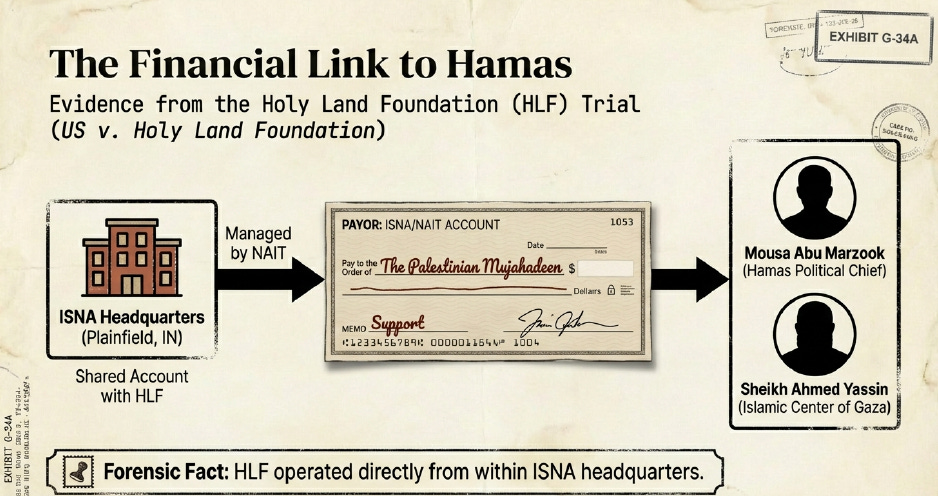
The Islamic Society of North America (ISNA), one of the largest Muslim organization in the U.S., was identified as an unindicted co-conspirator in the largest terrorism-financing trial in American history. The case involved the Holy Land Foundation (HLF) and revealed that ISNA's bank accounts funneled hundreds of thousands of dollars through the organization to Hamas leaders. The checks were made payable to "the Palestinian Mujahadeen," Hamas's military wing."
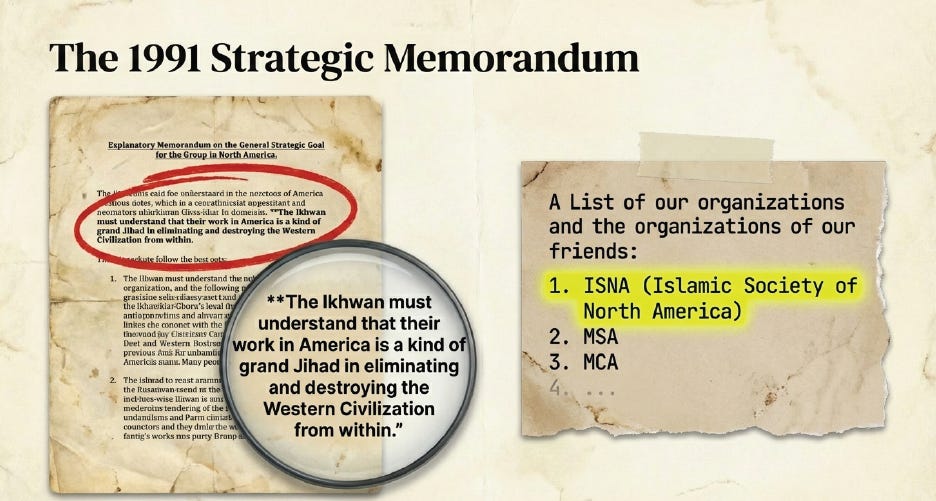
Despite ISNA's public denials, declassified FBI memos, internal Muslim Brotherhood documents, and federal court evidence trace the organization's origins to a 1980 strategy. The goal was to make ISNA "a nucleus for the Islamic Movement in North America." In a 1991 strategic memo, ISNA was ranked #1 among 29 Brotherhood organizations in a 1991 strategic memo describing a "grand Jihad in eliminating and destroying the Western Civilization from within."
Today, ISNA operates as a 501(c)(3) nonprofit, hosting annual conventions drawing thousands, running educational programs and interfaith initiatives, while maintaining deeply intertwined relationships with other alleged Muslim Brotherhood-linked groups including CAIR, NAIT, and MAS through overlapping leadership boards and coordinated activities. The organization's CEO Azhar Azeez, appointed in January 2026, oversees an operation that maintains partnerships with government agencies and academic institutions while denying its documented Brotherhood origins.
Who They Are: America’s Largest Muslim Gathering
The Islamic Society of North America describes itself as an organization promoting “fostering the development” of North American Muslims. Based in Plainfield, Indiana, ISNA hosts what is considered as one of the largest annual Muslim gatherings in North America—its 62nd convention drew an estimated 20,000 people to Rosemont, Illinois in 2025, with the 2026 event scheduled for Detroit over Labor Day weekend, Sep. 4-7.
Beyond its flagship convention, ISNA maintains an active schedule of regional events. On January 31, 2026, ISNA is hosting a conference in St. Louis featuring Mehdi Hasan as a keynote speaker. Hasan, a former MSNBC host, was previously exposed for calling atheists and non-Muslims animals and “people of no intelligence” in resurfaced remarks, raising questions about ISNA’s speaker selection and messaging.


The Founding: “Conquest Through Dawa”
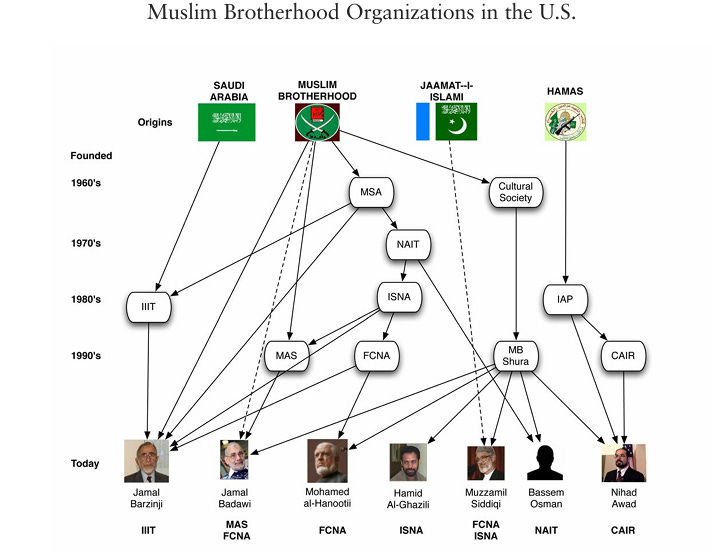
ISNA’s origins trace to the early 1960s, when three Iraqi Kurdish Muslim Brotherhood members—Jamal Barzinji, Ahmed Totonji, and Hisham al-Talib—arrived in the United States and founded the Muslim Students Association (MSA) in 1963. The “Three Kurds,” as they became known, were connected to Yusuf Nada, the Muslim Brotherhood’s global financier, and helped channel millions of dollars annually from Gulf donors through the SAAR Foundation.
In 1973, these same individuals founded the North American Islamic Trust (NAIT), which later purchased the land and property for ISNA’s headquarters. Jewish Onliner previously reported that NAIT now owns over 400 Islamic centers and mosques across North America, operating as the real estate arm of the Brotherhood network.
According to the Hudson Institute, an internal 1980 Muslim Brotherhood document—later introduced as trial evidence—explicitly stated the strategy: "In 1980, the Muslim Students Union was developed into ISNA to include all the Muslim congregation from immigrants and citizens, and to be a nucleus for the Islamic Movement in North America."
Yusuf al-Qaradawi, the Muslim Brotherhood’s spiritual leader until his death in 2022, publicly confirmed the Brotherhood founded MSA, stating in a 1995 Ohio speech: “Conquest through dawa, that is what we hope for… We will conquer Europe, we will conquer America, not through the sword but through dawa.” He specifically named MSA as founded by those who came to fight “the seculars and the Westernized.”


Key founding figures included Dr. Ahmed Elkadi, whose father-in-law was a Muslim Brotherhood leader, and who became the Brotherhood’s treasurer. Ahmad Zaki Hammad, described as Egyptian Ikhwan, was elected to ISNA leadership in 1986. Sami Al-Arian, later convicted on terrorism-related charges for Palestinian Islamic Jihad fundraising, was also among ISNA’s founding members.
By 1991, the Brotherhood's ambitions were codified in the Explanatory Memorandum authored by Shura Council member Mohamed Akram. The document described the Brotherhood's work in America as "a kind of grand Jihad in eliminating and destroying the Western Civilization from within" and listed 29 organizations—with ISNA at #1—as partners working toward this objective. The list included NAIT, the Occupied Land Fund (HLF's original name), and the Islamic Association for Palestine.
The Palestinian Mujahadeen Checks: ISNA’s Hamas Connection
The most damning evidence emerged during the Holy Land Foundation trial—the largest terrorism-financing prosecution in U.S. history, which resulted in convictions of five HLF leaders for funneling $12.4 million to Hamas.
Government prosecutors revealed that HLF—originally called the Occupied Land Fund—operated from within ISNA’s Plainfield, Indiana headquarters in the 1980s, where HLF CEO Shukri Abu Baker was employed. HLF maintained a joint bank account with ISNA and NAIT.
“ISNA checks deposited into the ISNA/NAIT account for the HLF were often made payable to ‘the Palestinian Mujahideen,’ the original name for the Hamas military wing,” prosecutors stated. “From that ISNA/NAIT account, the HLF sent hundreds of thousands of dollars to Hamas leader Mousa Abu Marzook,” Hamas’s political bureau chief, as well as to Sheikh Ahmed Yassin’s Islamic Center of Gaza and other Hamas-affiliated entities.
The Network Web: Interlocking Leadership
ISNA's 2026 leadership structure reveals a pattern of control across the Muslim Brotherhood front group network. A small circle of individuals maintains this influence through interlocking board positions
At the center sits Imam Mohamed Magid, ISNA’s past president, who simultaneously serves on CAIR’s board—another organization named as an unindicted co-conspirator in the Holy Land Foundation trial. Dr. Ingrid Mattson, ISNA president from 2006-2010, sits on ISNA’s Founders Committee while serving as an ex-officio NAIT board member. Muzammil Siddiqi, NAIT’s former chairman, was also the director of ISNA and served on ISNA’s governing board—creating a circular governance structure where the same individuals control both the organization and its property-holding trust.
But ISNA’s public “Founders Committee” obscures a darker history. The actual founders—Barzinji, Totonji, al-Talib, Ahmad Zaki Hammad, Ahmed Elkadi, and Sami Al-Arian—are conspicuously absent from official materials. Al-Arian openly acknowledged he was a member of the Muslim Brotherhood in 1981, the year ISNA formed.
Abdurahman Alamoudi, who served as ISNA’s Washington representative, was convicted on terrorism-financing charges in 2004 and sentenced to 23 years after being arrested with $340,000 in cash.
ISNA Today: Mainstream Face, Brotherhood Core
Despite overwhelming documentary evidence—including wiretapped 1993 Palestine Committee meetings where participants discussed using “ISNA as official cover”—the organization maintains its denials.
After the HLF verdicts, ISNA issued a statement claiming it “never was, and is not now, affiliated with or influenced by any international organizations including the Muslim Brotherhood.”
Federal prosecutors disagreed. When ISNA moved to have its name removed from the co-conspirator list, the government successfully opposed the motion, noting that “numerous exhibits were entered into evidence establishing both ISNA’s and NAIT’s intimate relationship with the Muslim Brotherhood, the Palestine Committee, and the defendants in this case.”
The court denied ISNA’s motion, concluding there was ample evidence supporting the designation.
ISNA's current operations—from its massive annual conventions to its government and academic partnerships—align precisely with the 1991 Brotherhood memo's vision of a "comprehensive organization" advancing long-term objectives through mainstream American civic engagement. The organization has successfully embedded itself within institutional structures that provide both legitimacy and cover for activities rooted in documented Brotherhood strategy.
Thank you for doing this work. I’ve saved it for future reference. A valuable addition to a too small world of factual reporting.