


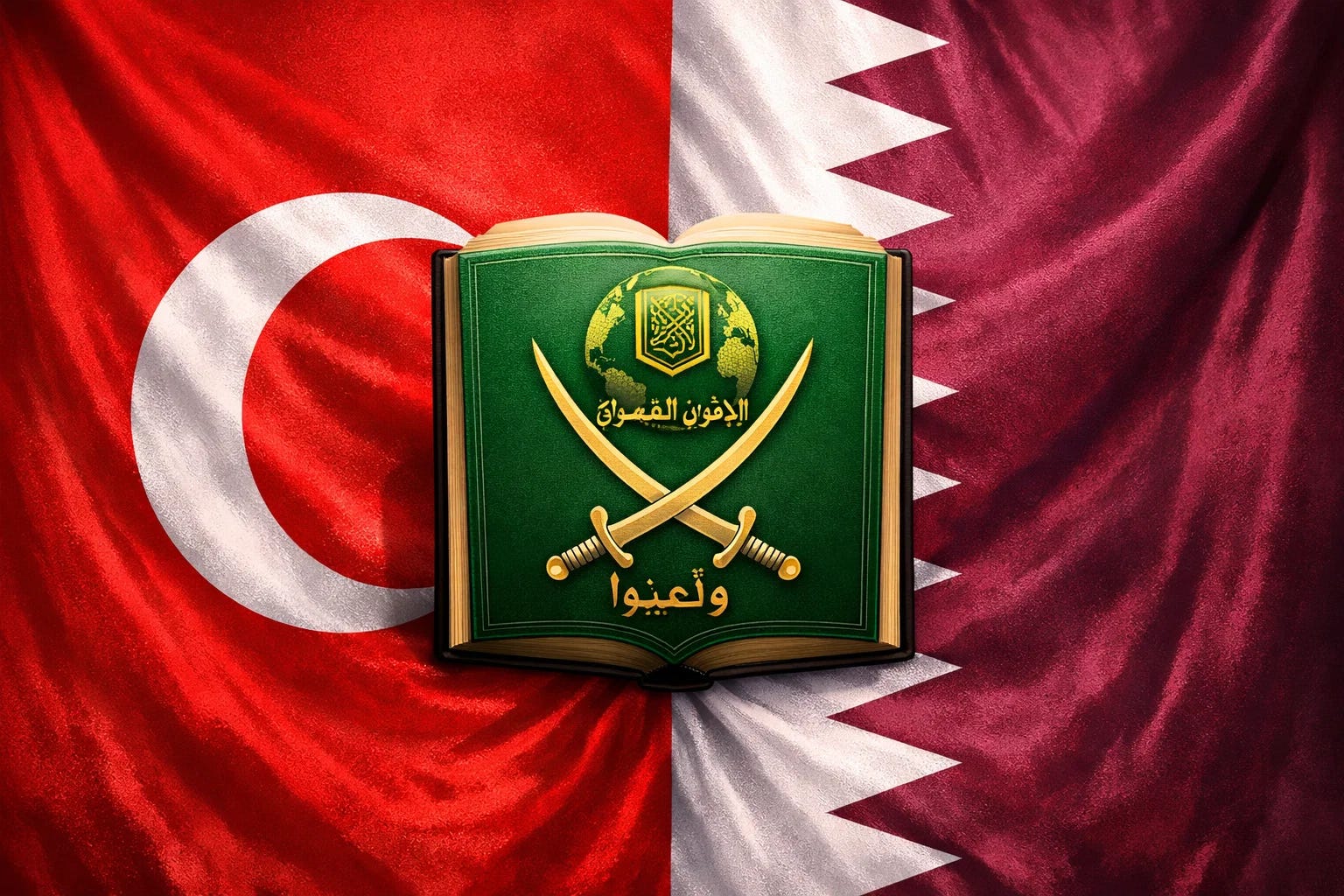
On January 13, the United States designated three Muslim Brotherhood (MB) chapters as terrorist organizations, in what officials described as the opening salvo of a broader counterterrorism campaign. The Lebanese branch was targeted for launching rocket attacks into Israel in coordination with Hezbollah and Hamas, while the Egyptian and Jordanian branches were designated for providing material support to Hamas.
The U.S. government emphasized that the action represents “the first actions of an ongoing, sustained effort” that could include “additional terrorist designations.” The action freezes assets and prohibits U.S. persons from conducting business with the entities.
The designations mark the first time the U.S. has formally targeted Muslim Brotherhood branches under counterterrorism authorities, signaling a potential policy shift. Questions remain about whether future designations will extend to transnational Brotherhood organizations allegedly headquartered in Turkey and Qatar, where counterterrorism analysts have documented that the Muslim Brotherhood global leadership resides, leading critics to ask why Qatar and Turkey were not targeted.
Sebastian Gorka, Deputy Assistant to the President and Senior Director for Counter Terrorism at the National Security Council, clarified on social media that the designations target specific organizations, not countries. “The ‘O’ in F.T.O. Terrorist Designation stands for ‘Organization,’” he wrote. “The Muslim Brotherhood is an organization. Not a country.” He also hinted at future action, telling followers to “stay tuned.”


The Muslim Brotherhood’s potential designation has drawn increased attention in the United States, fueled in part by a 1991 internal Brotherhood memorandum that describes its work in America as a “Civilization-Jihadist Process” and “a kind of grand Jihad in eliminating and destroying the Western civilization from within.”
Although the movement is often described as decentralized, some analysts argue it retains a coordinated leadership structure that provides strategic direction—including religious rulings (fatwas)—to MB affiliated organizations, activist groups, and NGOs in the United States, reinforcing the significance of designation debates.
Qatar’s Connection to the Muslim Brotherhood
Qatar has served as the Muslim Brotherhood’s primary sanctuary for over six decades. The Gulf emirate granted citizenship to Yusuf al-Qaradawi, the spiritual leader of the Muslim Brotherhood and personal spiritual teacher to members of the Qatari royal family, in 1969 and provided him a global platform through Al Jazeera’s Sharia and Life, which reached an estimated 60 million viewers at its peak. Qaradawi issued a fatwa allowing the killing of all Jews, and in 2004, issued a fatwa calling for the killing and kidnapping of American civilians in Iraq. He additionally issued a fatwa permitting women to become suicide bombers.
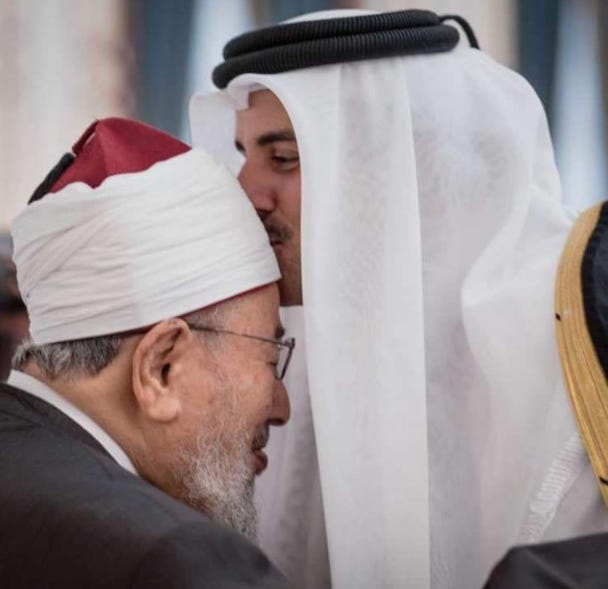
The Qatari government has protected Brotherhood leaders, including Qaradawi, from extradition despite multiple international arrest warrants. When pressed in 2017, Qatar’s foreign minister stated that Qaradawi was “a Qatari citizen” and could not be asked to leave.
Doha also hosts the political office of Hamas, which the U.S. has designated as a Foreign Terrorist Organization since 1997. While American officials have defended this arrangement as necessary for diplomatic channels, critics note the contradiction: the U.S. sanctioned Brotherhood chapters for Hamas support while exempting the country that provides Hamas’s leadership with diplomatic protection.
The Qatar-Based IUMS
One of the most prominent Brotherhood organizations is the International Union of Muslim Scholars (IUMS), a Qatar-based Brotherhood-affiliated organization that Saudi Arabia, Egypt, the UAE, and Bahrain have all designated as a terrorist entity since 2017.
The IUMS was founded and led by Qaradawi until his death in 2022. Ali al-Qaradaghi succeeded Yusuf al-Qaradawi as the chairman of the IUMS. The Investigative Project on Terrorism described al-Qaradaghi as now seen by “much of the Islamist world” as the Brotherhood’s “de facto spiritual leader,” as the successor to Qaradawi, and noted he replaced Qaradawi as the featured imam on Al Jazeera’s “Sharia and Life” program.
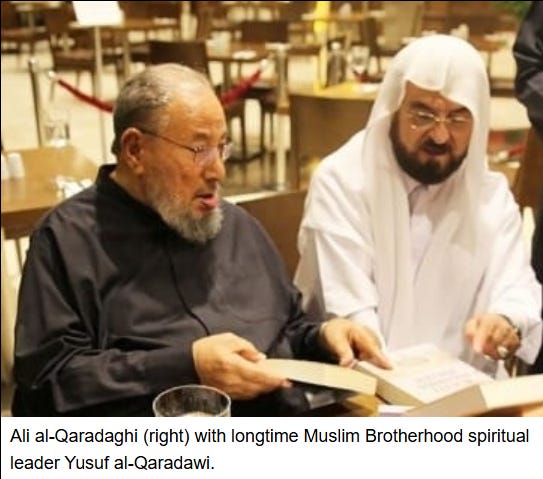
On April 4, 2025, IUMS issued a fatwa calling for all Muslim nations to form a military coalition against Israel and wage holy jihad. The decree, signed by IUMS president Ali al-Qaradaghi and amplified through Qatari and Turkish state media, declared armed jihad “obligatory” and urged Muslims in Western countries to “exert pressure on the U.S. and Western governments” to cease support for Israel. The fatwa represents a direct call for political pressure campaigns targeting the United States—precisely the kind of activity that typically triggers counterterrorism scrutiny.
Turkey’s Connection to the Muslim Brotherhood
Since 2002, President Recep Tayyip Erdoğan’s government has systematically integrated Brotherhood networks into state institutions, particularly through the Diyanet (Religious Affairs Directorate), which controls over 90,000 mosques and 140,000 employees. The Diyanet is the centralized religious authority in Turkey, under the control of Erdoğan. All weekly sermons are drafted and unified across the country, as well as all religious education content.
The Nordic Monitor watchdog group reported that the Diyanet, “originally founded as a secular state body to counteract radicalism in Turkey, has undergone a profound transformation under Erdoğan’s 23-year rule,” and that it “has increasingly become an instrument for promoting political Islam aligned with the ideology of the Muslim Brotherhood both domestically and internationally.”
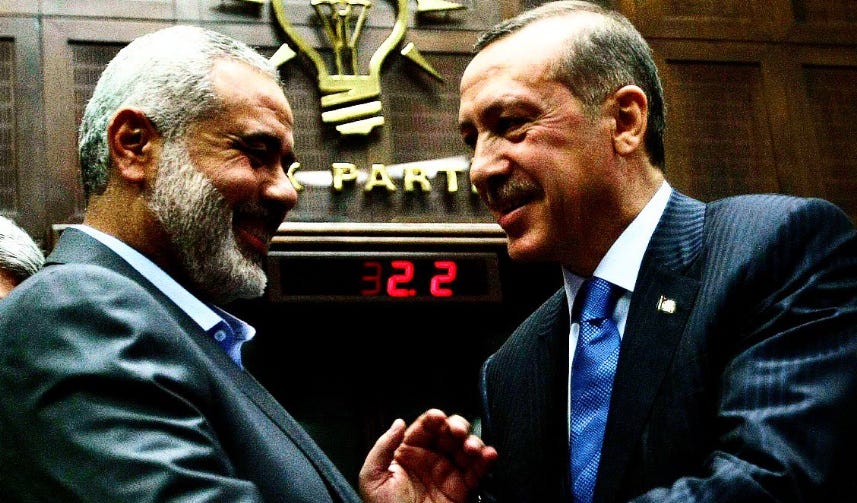
At an August 2025 conference of Islamic scholars in Istanbul attended by Diyanet head Ali Erbaş, participants endorsed a declaration expressing support for Hamas’ armed struggle against Israel and issuing a call for global jihad. Erdoğan has repeatedly refused to designate Hamas as a terrorist organization and in May 2024 publicly declared that “Hamas is not a terrorist organization, it is a liberation group.”
The International Organization to Support the Prophet of Islam
In October 2021, Turkish authorities facilitated the launch of the alleged Muslim Brotherhood Organization, the International Organization to Support the Prophet of Islam (IOSPI) in Istanbul. Nordic Monitor reported that the network “seeks to recruit new followers for President Erdoğan’s proxies, expand his government’s reach, bolster Turkey’s global influence campaigns and raise funds by exploiting Muslim communities’ sensitivities for political purposes.”
The ceremony featured Hamas political bureau chief Khaled Meshaal as keynote speaker. Meshaal is under the protection of Turkish intelligence agency MIT whenever he travels and stays in Turkey. On January 17, 2026, the IOSPI X account posted on X quoting a jailed Muslim Brotherhood leader, stating Hamas attacks on Israel were not a mistake and likened them to the actions of their prophet Muhammed.

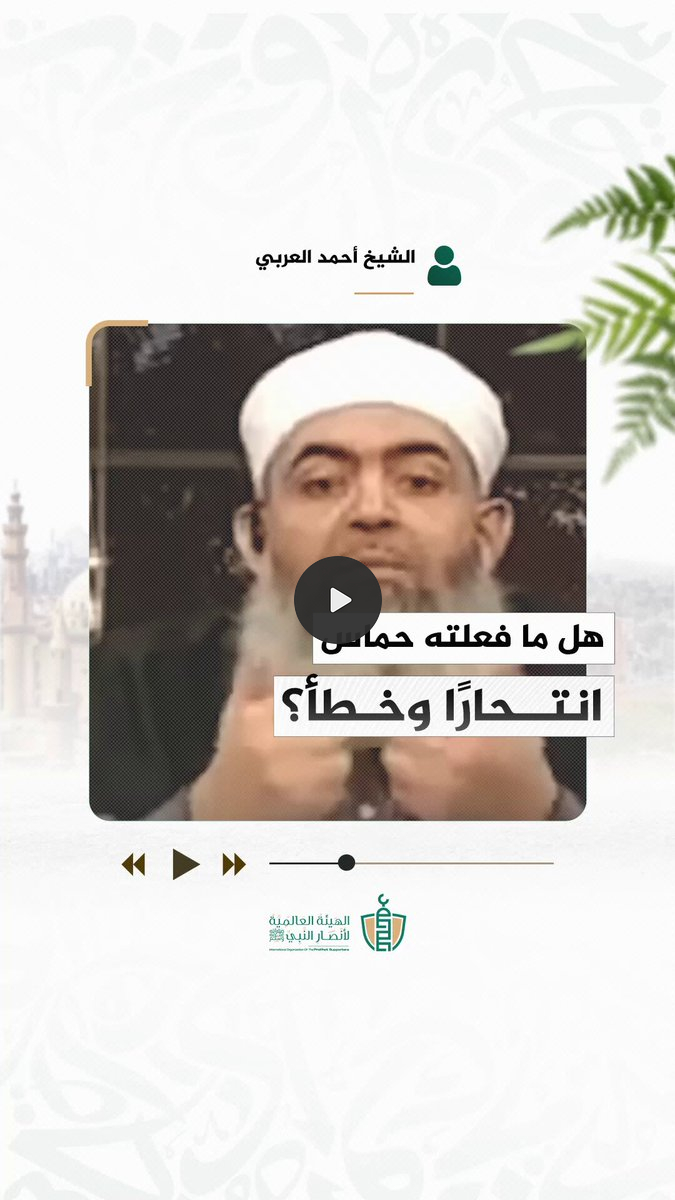
IOSPI operates under the leadership of Mohamed Al-Sagheer, an Egyptian Muslim Brotherhood figure with direct access to Erdoğan. Al-Sagheer has 1.6 million followers on X and regularly preaches to his followers through social media platforms. The IOSPI made headlines after fall of Bashar al-Assad in Damascus and the power grab by jihadist leader Ahmad al-Sharaa (al-Julani). On January 30, 2025 al-Sagheer issued a letter congratulating al-Julani for what he described as an Islamic conquest bestowed by God and encouraged him to establish Islamic Sharia law in Syria.
In February 2023, IOSPI honored Abdul Majeed al-Zindani, a Yemeni cleric whom the U.S. Treasury had designated in 2004 as a “Specially Designated Global Terrorist” for having “a long history of working with bin Laden.” Al-Zindani passed away in Istanbul in April 2024.
IOSPI’s founders include three figures who represent the merger of Turkish state power and Brotherhood ideology:
Yasin Aktay, who was serving as deputy chairman of Erdoğan’s Justice and Development Party (AKP) and managing the party’s external relations at the time of IOSPI’s founding, is the chief advisor to Erdoğan on Arab affairs. Aktay “considers the Turkish president to be a caliph and views the Muslim Brotherhood as a soft power arm for the Turkish state.


Mehmet Görmez, former president of the Diyanet from 2010 to 2017, is another founder of IOSPI. Nordic Monitor stated that Görmez “effectively transformed the Diyanet, with billions in funds and control over some 90,000 mosques in Turkey and abroad, into a stronghold of the Muslim Brotherhood network.”
Ali al-Qaradaghi, the IUMS secretary-general and current de-facto spiritual leader of the Muslim Brotherhood who issued the April jihad fatwa, is also an IOSPI founder. Nordic Monitor reported he “has long resided in Turkey, where he has been granted VIP treatment in government protocols.”
The organization does not appear to be officially registered under Turkish law, as there is no record of it at the Interior Ministry. Yet it receives financial backing, logistical support, and political protection from the Turkish government.
Strategic Calculations
The January 13 designations establish a clear legal precedent: Brotherhood entities that provide material support to Hamas or coordinate violent activities can be designated as terrorist organizations. Organizations like IUMS, which have issued explicit calls for military jihad and urged Western Muslims to pressure their governments, operate in the same category of conduct that triggered the Egyptian, Jordanian, and Lebanese designations.
Treasury’s explicit language about an “ongoing, sustained effort” suggests additional designations are under active consideration. The administration appears to be building a systematic case against Brotherhood networks rather than pursuing a single comprehensive action. This methodical approach allows for diplomatic engagement with host countries — like Qatar and Turkey — while maintaining pressure on terrorist financing and incitement networks.
For states that have already designated Brotherhood entities for years, the January designations represent meaningful progress. The question now is whether the U.S. will extend the same legal framework to transnational Brotherhood entities operating from Turkey and Qatar, completing the architecture needed to disrupt the movement’s financial and ideological networks globally.