



Since 1976, American Trust Publications (ATP)—listed on North American Islamic Trust’s website as one of its organizations—has published Islamic literature for Muslim audiences across North America. NAIT was also included on the government’s “unindicted co-conspirators and/or joint venturers” list filed in the landmark Holy Land Foundation case. Critics and researchers say some of these titles contain themes that appear to endorse or normalize jihadist violence, Islamic supremacism, and antisemitic tropes.
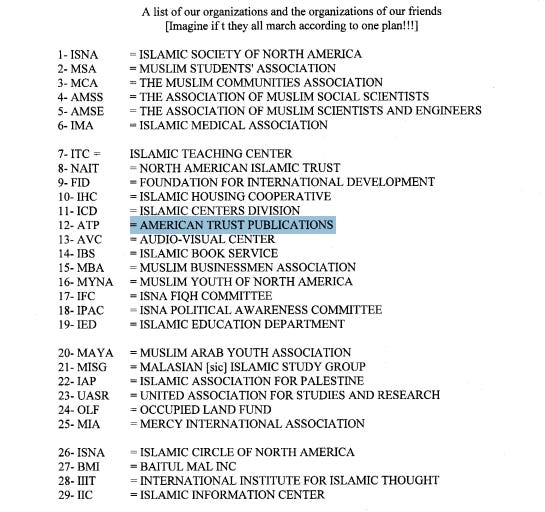
American Trust Publications (ATP) is listed as organization #12 in the Muslim Brotherhood’s 1991 “Explanatory Memorandum,” which enumerates groups described as part of the Brotherhood’s network in North America. Some researchers interpret ATP’s role in that ecosystem as a publishing vehicle for disseminating extremist-aligned ideology.
Unlike its parent organization the North American Islamic Trust (NAIT), which holds title to over 300 Islamic centers in 42 states nationwide, ATP operates in relative obscurity.
Through children’s textbooks, adult religious guides, and scholarly works, ATP has published more than 100 titles, including works by Hassan al-Banna, the Muslim Brotherhood’s founder, and Sayyid Qutb, the Brotherhood ideologue whose writings influenced al-Qaeda. Many of these titles have been sold through the Islamic Book Service. These titles can potentially function, in practice, as a vehicle for Muslim Brotherhood–aligned ideas within U.S. religious communities, especially where NAIT-affiliated institutions appear to rely on the same publishing and distribution channels.
Born from the Brotherhood Network
ATP’s origins are closely connected to what some researchers and investigators describe as an alleged Muslim Brotherhood–linked ecosystem in the United States. The organization traces its roots to the mid-1960s, when the Muslim Students Association (MSA)—itself founded by Brotherhood members—established the Islamic Book Service to distribute literature to Muslim students. When the alleged Brotherhood operatives who controlled MSA created NAIT in 1973 as a waqf (Islamic trust) to hold mosque properties, they established ATP in 1976 as its publishing division.
According to a comprehensive 2007 report by Global Muslim Brotherhood Watch examining extremism-related concerns involving Islamic Society of North America, the organizations’ early headquarters complex was funded with $21 million from Muslim Brotherhood figures Yusuf al-Qaradawi and Youssef Nada, along with support from the emir of Qatar.
The same individuals who built the organizational infrastructure also appear to have shaped its ideological output. Similar overlap appears across several organizations named in the 1991 memorandum
A Catalog of Extremist Literature
The publishing house has published feature works by “Muslim Brotherhood luminaries” including Hassan al-Banna, the Brotherhood’s founder who established the organization in 1928 with the explicit goal of establishing Islamic rule.
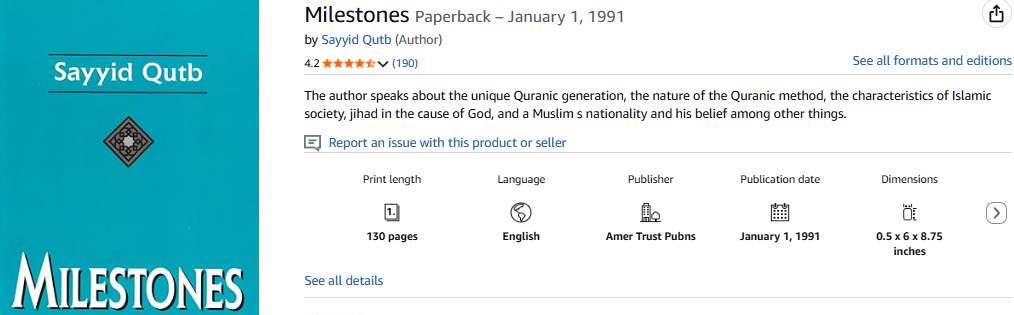
At the top of the extremist list sits “Milestones” by Sayyid Qutb, the Egyptian Brotherhood ideologue whose writings directly inspired al-Qaeda and other jihadist movements. In this ATP publication, Qutb declares that “Islam has the right to destroy all obstacles in the form of institutions and traditions” and that “bringing about the enforcement of Divine Law cannot be achieved only through preaching. When obstacles are put in its way, it has no recourse but to remove them by force.”
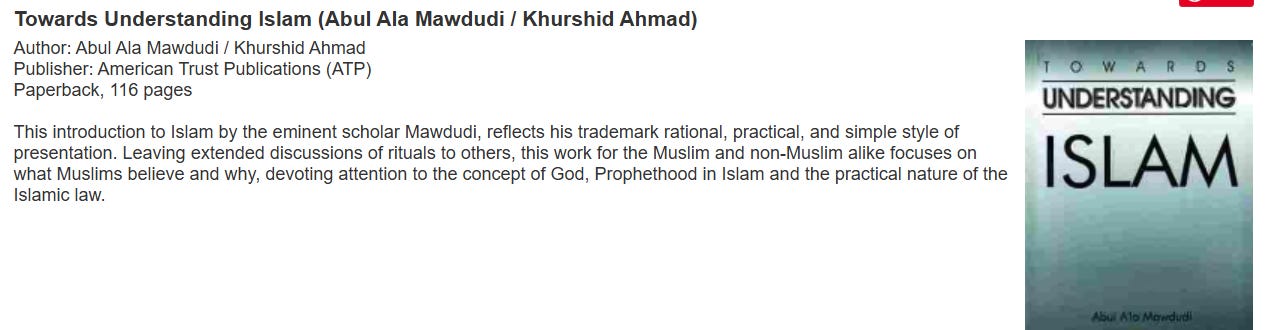
The catalog also includes books by Syed Abul Ala Maududi, the Pakistani Islamist who founded Jamaat-e-Islami and advocated for Islamic state governance. Maududi’s ideology paralleled the Muslim Brotherhood’s, calling for the complete Islamization of society and the establishment of sharia-based government systems.
ATP also publishes works by Yusuf al-Qaradawi, the Brotherhood’s spiritual leader until his death in 2022 who publicly supported suicide bombings against Israeli civilians and U.S. troops. In a 2009 statement, Qaradawi declared:
“Throughout history, Allah has imposed upon the Jews people who would punish them for their corruption. The last punishment was carried out by Hitler. By means of all the things he did to them - even though they exaggerated this issue - he managed to put them in their place. This was divine punishment for them. Allah willing, the next time will be at the hands of the believers.”

The Network Effect
ATP appears as one node in a broader ecosystem referenced in the 1991 Explanatory Memorandum. The memo lists ATP alongside NAIT (#8), Islamic Book Service (#14), ISNA (#1), and International Institute of Islamic Thought (#28), and the ISNA Fiqh Committee (#17), indicating an overlapping organizational network.
Researchers argue that the network structure described in the 1991 memorandum could enable ideas to circulate through multiple institutional layers: ATP publishes titles; Islamic Book Service and other retailers sell them; and, where adopted by communities associated with NAIT-held waqf properties or promoted through ISNA events, those materials may reach broad audiences. Past ISNA annual conventions have been reported as attracting roughly 40,000 attendees.
ATP’s own website publicly states that it produces Islamic literature for children, youth, and adults, including textbooks with teacher guides, study questions, and worksheets, and that it also aims to provide non-Muslim audiences with literature “about Islam.” In the view of some critics, this kind of publishing infrastructure resembles the “civilization-jihadist process” described in the 1991 memorandum.
In a 2009 statement, Qaradawi declared:
“Throughout history, Allah has imposed upon the Jews people who would punish them for their corruption. The last punishment was carried out by Hitler. By means of all the things he did to them - even though they exaggerated this issue - he managed to put them in their place. This was divine punishment for them. Allah willing, the next time will be at the hands of the believers.”
Of course. The always reliable “the Holocaust didn’t happen and the Jews deserved it”.