


Editor's note: This article is part of an ongoing series examining the 29 organizations listed in the infamous 1991 Muslim Brotherhood "Explanatory Memorandum" outlining a "Civilization-Jihadist Process" to destroy Western civilization from within. With renewed scrutiny of Brotherhood networks in America, this investigation traces the documented connections between these groups and their role in advancing Brotherhood strategic objectives on U.S. soil.
The Fiqh Council of North America (FCNA) appears to function as the religious ruling arm of the sprawling network of alleged Muslim Brotherhood front groups operating across North America, issuing Islamic rulings based on Sharia law. The council has operated as a 501(c)(3) nonprofit organization since its 1986 reconstitution. This status grants it tax-exempt privileges.
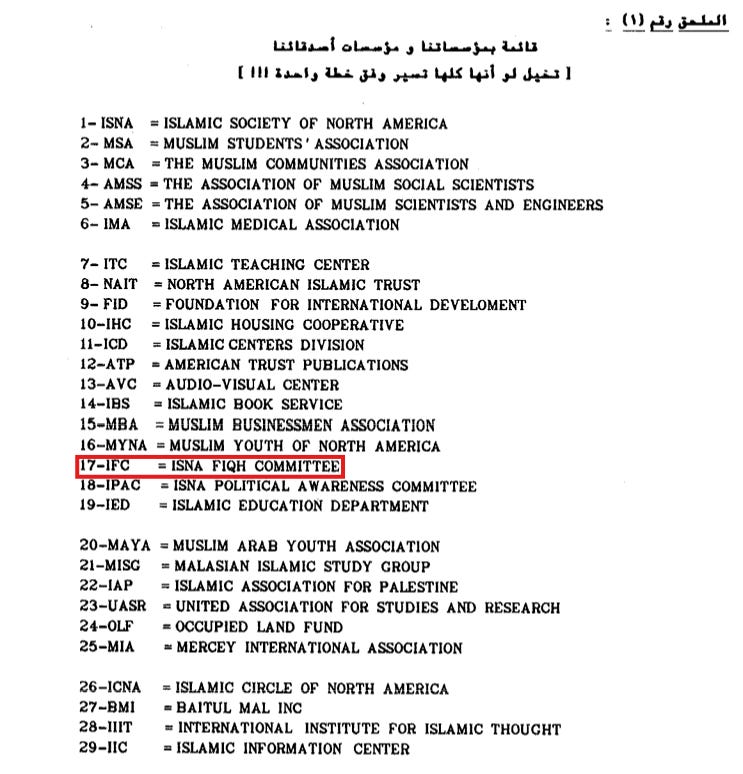
However, the organization seemingly serves as the jurisprudential authority for groups that appeared on a controversial 1991 Muslim Brotherhood memo. That memo listed Brotherhood organizations and their offshoots, and outlined what it described as a "grand Jihad in eliminating and destroying Western civilization from within." The Fiqh Council of America appears as number 17 on the MB list under its previous name— ISNA Fiqh Committee (IFC).
The council’s current executive committee is an influential group of scholars who publish religious guidance. It includes individuals who have been described in government filings or court records as having Muslim Brotherhood affiliations. In immigration proceedings, some of their public remarks have been characterized as advocating violent uprising. Yet the Fiqh Council operates openly, issuing religious edicts that shape everything from financial transactions to medical decisions across the Brotherhood’s institutional ecosystem.
Brotherhood Origins and the Illusion of Independence
The Fiqh Council’s own website traces its lineage directly through the Muslim Brotherhood’s North American infrastructure: from the Muslim Students Association (MSA). The MSA was founded in 1963 by three Iraqi Kurdish Muslim Brotherhood members—Jamal Barzinji, Ahmed Totonji, and Hisham al-Talib—who arrived in the United States in the early 1960s with connections to Yusuf Nada, the Muslim Brotherhood’s global financier.
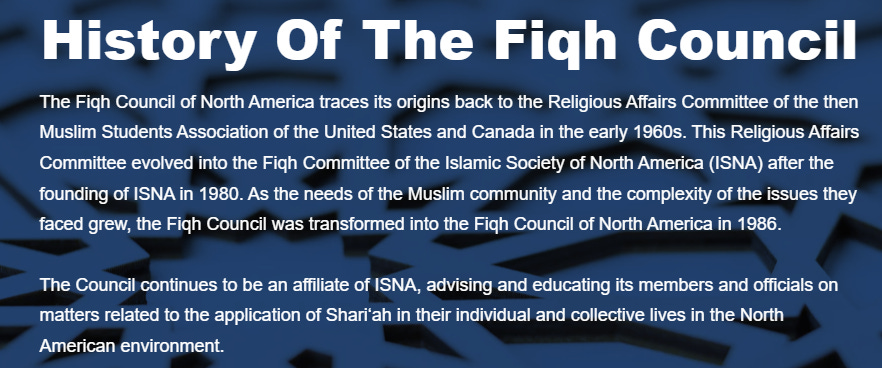
From this MSA foundation, the Brotherhood’s North American religious infrastructure evolved through deliberate stages: MSA’s Religious Affairs Committee in the 1960s handled fiqh matters for Muslim students, which became the ISNA Fiqh Committee (IFC) in 1982 when ISNA was established to serve as “a nucleus for the Islamic Movement in North America,” before finally reconstituting as the independent Fiqh Council of North America in 1986.
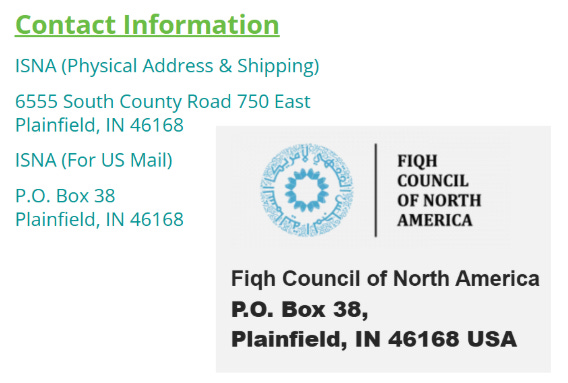
However, the council’s claims of independence ring hollow when examined against physical reality: FCNA uses the same mailing address—P.O. Box 38, Plainfield, IN 46168—as ISNA headquarters, which is located at 6555 S County Road 750 E on property owned by NAIT, the Brotherhood's alleged real estate wing.
This evolution mirrors precisely the Brotherhood’s documented strategy of creating ostensibly independent organizations that maintain operational unity through forming a closed ecosystem where the Brotherhood controls the physical infrastructure (through NAIT), the organizational structure (through ISNA), and the religious authority (through the Fiqh Council).
The same leadership sits on multiple boards, issuing religious rulings that govern the very institutions whose property they control and whose operations they oversee—a self-reinforcing system that federal investigations and academic research identify as the Brotherhood’s deliberate strategy for embedding its influence in American society.
The Individuals Issuing Religious Rulings
The scholars composing the Fiqh Council’s executive committee wield enormous influence over Muslim Brotherhood-affiliated institutions nationwide, yet several have backgrounds that raise serious questions about their suitability as moral authorities.
Dr. Mohammad Qatanani, listed on the council’s executive committee, has allegedly belonged to the Muslim Brotherhood from 1985 to 1991, according to court documents. A federal appeals court dissent in 2025 noted that “from 1985 to 1991, Qatanani was an active member in the Muslim Brotherhood, which led to Israeli suspicion that he was a member of Hamas.” The same judge highlighted that “Qatanani met with Sumai Abu Hanous, whom Qatanani himself described as the ‘military leader of Hamas.’”


Even one of Qatanani’s own lawyers told The New York Times in 2008 that her client “was a member of the student chapter of the Muslim Brotherhood” in Jordan and that immigration officials denied his permanent residency application “because he has relationships with people including his brother-in-law Mahmoud Abu Hanoud, a senior Hamas military leader who was killed by the Israelis.”
At a 2017 rally in Times Square protesting President Trump’s recognition of Jerusalem as Israel’s capital. In the immigration proceedings, DHS argued that Qatanani’s remarks amounted to incitement, and the Board of Immigration Appeals (BIA) characterized his call for a “new intifada” as advocacy for a violent uprising.
Qatanani delivered a speech stating: “No peace process and negotiation without liberation in Palestine. [Oslo] has to be stopped and finished. We have to start a new intifada. Intifada, intifada!’” the judge wrote. Qatanani then led the attendees in a call and response exchange of “Intifada, Intifada!”. The crowd responded with chants of “With our soul, with our blood, we will sacrifice [these] for you, Al-Aqsa.”
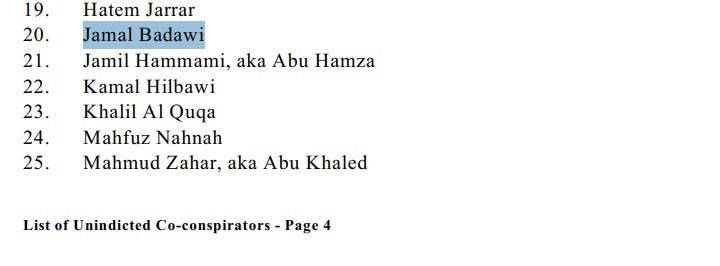
Dr. Jamal Badawi, another executive member, appeared by name on the government’s “Attachment A” list of unindicted co-conspirators and/or joint venturers in the Holy Land Foundation case—the largest terrorism-financing prosecution in U.S. history, which resulted in convictions for funneling $12.4 million to Hamas.
Dr. Yasir Qadhi, the council’s chairman, serves as resident scholar at the East Plano Islamic Center (EPIC), which is attempting to develop a controversial Muslim-centered development project in Texas known as EPIC City. This development has drawn scrutiny from the DOJ and state officials over allegations regarding discrimination and “Sharia law,” though the investigation closed without charges. The Houston Chronicle documented that the plan was meant to establish a 402-acre center. Imam Zaid Shakir, an American Muslim scholar, stated it would be a "sign that our community has arrived."
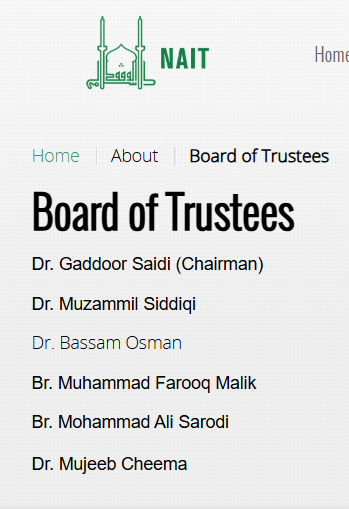
Dr. Muzammil Siddiqi occupies a particularly revealing position in the Brotherhood network: He serves simultaneously on NAIT’s board and the Fiqh Council while having previously directed ISNA. This interlocking leadership creates a circular governance structure where the same individuals control both the organizations and their property-holding trust.
Siddiqi’s public statements on jihad and Islamic law implementation have been extensively documented. He has lectured that “when people really carry on Jihad, they carry on the Islam in its peak” and warned that “no people have ever neglected Jihad except they became humiliated.” In a 2001 online dialogue, he stated that “once more people accept Islam, Insha'Allah, this will lead to the implementation of Sharia in all areas.”
Coordinating With Global Islamist Jurisprudence
The Fiqh Council’s operations extend far beyond issuing local religious guidance. According to the council’s own literature, “FCNA also closely monitors outside Islamic legal opinions of other Muslim juristic bodies and benefits from the scholarly works of renowned jurists everywhere.”
This admission raises the question: Is FCNA monitoring and coordinating with global Islamist jurisprudential networks to ensure alignment?
Other Muslim Brotherhood Fiqh and Fatwa councils operate worldwide. These include the European Council for Fatwa and Research, which was chaired until 2022 by Yusuf al-Qaradawi. Al-Qaradawi was the Muslim Brotherhood’s spiritual leader who issued fatwas calling for the killing of U.S. soldiers in Iraq.
Another such body is the International Union of Muslim Scholars (IUMS). In March 2025, the IUMS issued a fatwa for all Muslims to engage in jihad against “Zionists and their collaborators.”
Operating in Plain Sight
The Fiqh Council continues operating without significant scrutiny, its executive committee issuing rulings that shape Muslim religious practice across North America. The council’s chairman, Dr. Yasir Qadhi, maintains academic appointments and media presence. Dr. Muzammil Siddiqi sits on multiple organizational boards. Dr. Mohammad Qatanani leads a prominent New Jersey mosque despite his documented Brotherhood membership and calls for intifada.
This arrangement persists even as momentum builds against Muslim Brotherhood networks in America. In January 2026, the U.S. State Department designated three international branches of the Muslim Brotherhood as Foreign Terrorist Organizations. At the state level, multiple states have enacted legislation restricting the application of Sharia Law with total bans or within state courts, with Florida, Arizona, Alabama Kansas, Louisiana, North Carolina, South Dakota, and Tennessee among those having passed on introduced such measures.
Yet the Fiqh Council continues issuing religious guidance based on Sharia law from its shared mailing address in Plainfield, Indiana, operating as it always has: as the religious authority for a network that the Brotherhood’s own documents describe as working to destroy Western civilization from within.
Yikes!