


Editor’s note: This is the latest article in a series examining alleged Muslim Brotherhood front groups in the United States—the 29 organizations listed in the infamous 1991 Muslim Brotherhood Explanatory Memorandum outlining a “Civilization-Jihadist Process” to destroy Western civilization from within. With renewed U.S. government focus on Brotherhood networks and recent congressional scrutiny, this series investigates the documented connections between these groups and their historical advancement of Brotherhood strategic objectives in America.
The Islamic Medical Association of North America (IMANA) operates today as a prominent medical relief organization with approximately $7.8 million in total assets, according to ProPublica’s compilation of IRS Form 990 data. According to its own materials, the organization deploys volunteer physicians to conflict zones, including Gaza, Syria, and Yemen. The group describes itself as “a leading resource and network for American-Muslim physicians, dentists and other health care professionals,” hosting annual conventions and coordinating humanitarian medical missions that have treated millions of patients worldwide.
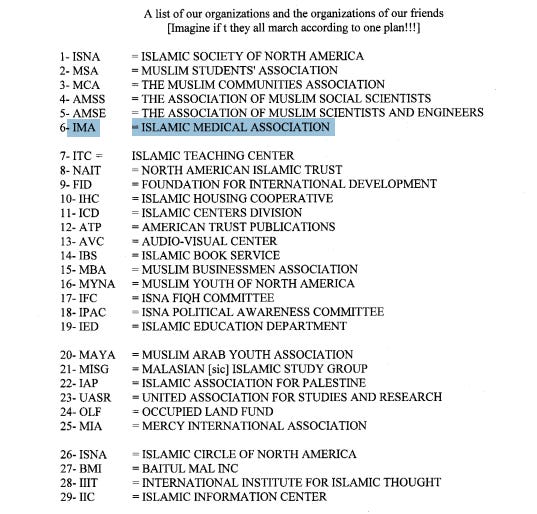
But IMANA’s own history, together with the 1991 Explanatory Memorandum cited by researchers of Brotherhood-linked networks, places the organization’s early development alongside institutions later associated with that milieu. The organization appears as #6 on the 1991 Explanatory Memorandum, listed as “IMA = Islamic Medical Association” among 29 organizations identified as part of what the memo’s author described as “a kind of grand Jihad in eliminating and destroying the Western civilization from within.”
IMANA’s Medical Relief leadership has publicly acknowledged partnering with HEAL Palestine, which a 2025 Jerusalem Post investigation linked, through its founder’s earlier work and related networks, to entities involved in terrorism-financing cases.
IMANA board members have shared social media posts supporting the Columbia protest movement and other hardline pro-Palestinian messaging, including content that appeared to echo pro-Hamas narratives. The organization also shows longstanding historical and leadership overlap with ISNA, which was listed first in the 1991 memorandum and was later named by federal prosecutors as an unindicted co-conspirator or joint venturer in the Holy Land Foundation case.
From MSA to IMANA: The 1967 Founding
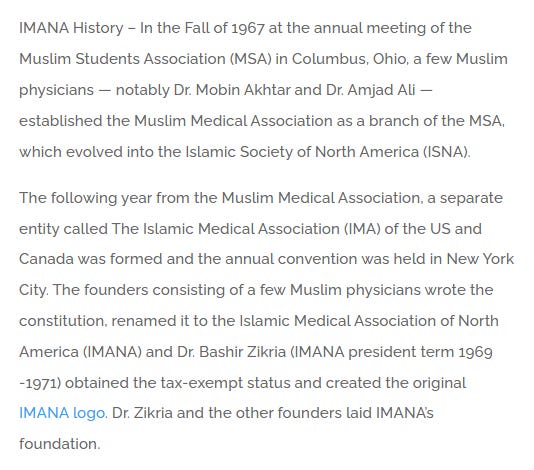
IMANA’s own history page traces the organization’s origins to the Muslim Students Association (MSA), an institution widely described by researchers and watchdogs as part of the early Muslim Brotherhood-linked milieu in North America. In the fall of 1967, at the annual Muslim Students Association (MSA) meeting in Columbus, Ohio, Muslim physicians Dr. Mobin Akhtar and Dr. Amjad Ali “established the Muslim Medical Association as a branch of the MSA.”
The MSA was founded in 1963 and has been described by scholars and watchdogs as heavily influenced in its early years by activists linked to the Muslim Brotherhood and Jamaat-e-Islami. As Jewish Onliner previously documented, the MSA helped give rise to major parts of the U.S. Brotherhood-linked institutional infrastructure, including ISNA, NAIT, and a range of affiliated professional associations.
IMANA’s website explicitly states that MSA “evolved into the Islamic Society of North America (ISNA).” Federal prosecutors later included ISNA on a public list of unindicted co-conspirators and/or joint venturers in the Holy Land Foundation case.
By 1968, the Muslim Medical Association became a separate entity, renamed the Islamic Medical Association (IMA). Dr. Bashir Zikria, who served as IMANA’s president from 1969-1971, obtained the organization’s tax-exempt status. The group has operated as a 501(c)(3) nonprofit since 1999 under Tax ID 36-4166125.
The Explanatory Memorandum: #6 on the List
The Muslim Brotherhood’s strategic ambitions were codified in the 1991 Explanatory Memorandum, authored by Shura Council member Mohamed Akram and later introduced as evidence in the Holy Land Foundation trial. The document identified IMA—the Islamic Medical Association—as the sixth organization among “our organizations and the organizations of our friends.”
A 2009 Hudson Institute report by Steven Merley confirmed that IMA was among the “vocational organizations affiliated with the Students Union” created as Brotherhood “front organizations.” The report stated that IMA, alongside the Association of Muslim Scientists and Engineers (AMSE) and the Association of Muslim Social Scientists (AMSS), became “founding constituents” of ISNA in 1983.
Internal Muslim Brotherhood documents, including a 1988 Shura Council spreadsheet referenced in the Hudson Institute study, explicitly listed IMA as part of the U.S. Brotherhood infrastructure. The document described these professional associations as part of the “covert organizational infrastructure” built to achieve what the Explanatory Memorandum called “settlement,” embedding Islam within North American civic and institutional life.
Dr. Ahmed Elkadi: From Muslim Brotherhood Treasurer to IMANA President
At the center of IMANA’s early leadership was Dr. Ahmed Elkadi, a cardiothoracic surgeon who served as both an IMANA president and the treasurer and later president of the U.S. Muslim Brotherhood itself.
Elkadi’s father-in-law, Mahmoud Abu-Saud, was an early Muslim Brotherhood leader in Egypt and a pioneer in Islamic banking. According to a 2004 Chicago Tribune investigation, when Elkadi married Abu-Saud’s daughter in Egypt in 1963, Egyptian intelligence questioned the couple specifically about their Brotherhood ties. “They asked my husband, ‘Couldn’t you find anybody else to marry except Mahmoud Abu-Saud’s daughter?’” his wife recalled.
Elkadi lived in Graz and Vienna from 1963 to 1967, the same period when Yusuf Nada, the Muslim Brotherhood’s global financier, resided in those cities. The Hudson Institute report notes it is “highly likely that Nada and Elkadi were acquainted” given their overlapping Brotherhood connections and geographic proximity.
Elkadi went on to found the Akbar Clinic, an Islamic medical center in Florida funded by a Luxembourg bank managed by his father-in-law. He died in 2009, but his role in IMANA and in the broader alleged Brotherhood-linked milieu helped establish an enduring overlap between professional medical organizing and Islamist institutional activism.
The ISNA-IMANA Leadership Pipeline
Multiple IMANA leaders have also held positions within ISNA, reflecting a pattern of leadership overlap between the two organizations within what researchers and critics have described as a broader Muslim Brotherhood-linked network in the United States.
Dr. Faroque Ahmad Khan, who served as IMANA president from 1986-1988, was elected to ISNA’s Majlis Shura (Shura Council) and served as president of the Islamic Center of Long Island. He also sat on ISNA’s governing board, embodying the leadership overlap between the medical and umbrella organizations.
Dr. Husain Nagamia, an IMANA past president who founded the International Institute of Islamic Medicine (IIIM) in 1992, was publicly identified by ISNA as a member of ISNA’s Founders Committee—the group that controls the organization’s strategic direction.
Dr. Mohammed Al Shroof, a former IMANA president, also served on ISNA’s Board of Directors and received IMANA’s “Dr. Ahmed El Kadi Award” at an IMANA banquet—named after the very Muslim Brotherhood treasurer who helped establish the organization.
Taken together, these examples suggest that IMANA has long functioned within the same institutional orbit as ISNA and other organizations that researchers and critics have associated with Brotherhood-linked networks in North America.
The HEAL Palestine Connection
In October 2025, IMANA Board Member and Chair of Medical Relief, Dr. Ismail Mehr posted publicly on Facebook: “Transparency is key when choosing organizations to support; Islamic Medical Association of North America - IMANA has begun delivering the largest single shipment of baby formula in Gaza to date.” He thanked “HEAL Palestine for all you do.”
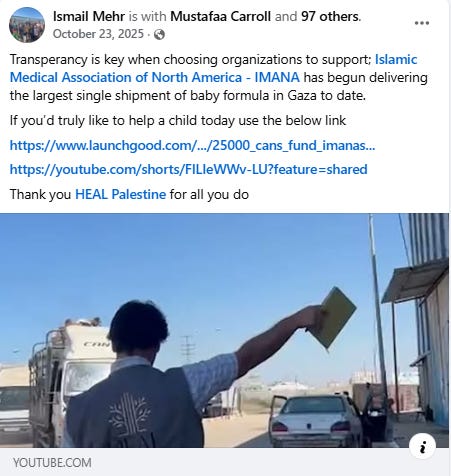
Multiple posts from Dr. Mehr explicitly acknowledge IMANA’s partnership with HEAL Palestine, including a December 2024 Facebook post stating: “Islamic Medical Association of North America - IMANA has delivered 6,200 + 19,680 = 25,880 cans of baby formula” and noting “HEAL Palestine has been our partner on the ground tirelessly supporting efforts.”
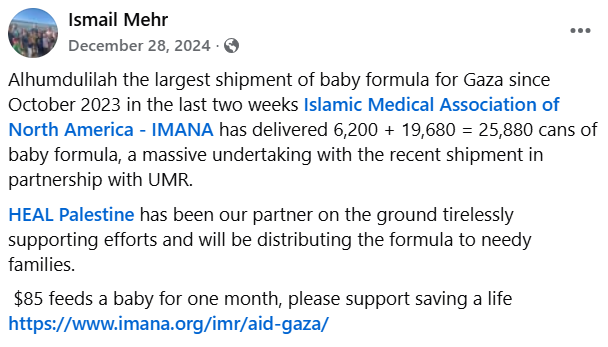
An August 2025 investigation by The Jerusalem Post reported that HEAL Palestine, through its founder’s earlier work and related networks, had historical links to entities involved in terrorism-financing cases.
The Holy Land Foundation (HLF) – Designated a terrorist organization in 2001, with five leaders convicted of aiding Hamas. HEAL founder Steve Sosebee (who previously ran the Palestine Children’s Relief Fund) conducted joint fundraising with HLF in 1996, splitting proceeds 60/40. HLF’s main donor was Mousa Abu Marzook, Hamas’s first chairman.
The Global Relief Foundation – Raided and closed by the U.S. government in 2001 for funding terror groups. The PCRF (Sosebee’s previous organization) listed it as an “assisting organization.”
International Islamic Relief Organization – Raided by the FBI for funneling money to al-Qaeda and Hamas, also listed as a PCRF “assisting organization.”
Hamas Ministry partnerships – A 2003 U.S. Department of Justice bulletin stated that “the unofficial Hamas website contained a hyperlink to the official Hamas site, as well as to several United States-based charities, including the Palestinian Children’s Relief Fund.” In 2021, the PCRF partnered with Hamas’s Social Development Ministry to distribute aid packages.
Additionally, The Jerusalem Post reported that HEAL Palestine filed IRS Form 990-N in 2022 and 2023, a filing typically used by tax-exempt organizations with $50,000 or less in annual gross receipts. The report noted that this is difficult to reconcile with HEAL’s public claim of raising more than $4 million, highlighting an apparent discrepancy that could warrant further scrutiny or explanation.
Board Members’ Public Messaging on Gaza and Campus Unrest
Dr. Azeem Elahi (Vice President of the Board), a pulmonologist in North Carolina who shared Macklemore’s song “Hind’s Hall” on Instagram in May 2024 with the caption: “Macklemore’s ‘Hind’s Hall’ is now available on all streaming platforms. Download now to show your solidarity with the innocent victims of oppression in Gaza & Palestine. All proceeds are pledged to UNRWA!”
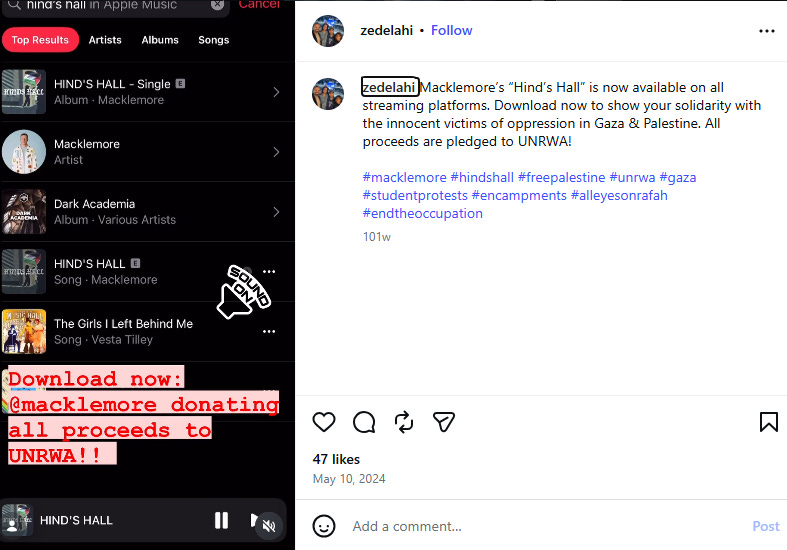
The song celebrates the April 30, 2024 occupation of Columbia University’s Hamilton Hall, where protesters broke windows, barricaded doors with zip ties, and renamed the building “Hind’s Hall.” The occupation resulted in nearly 100 arrests and significant property damage.
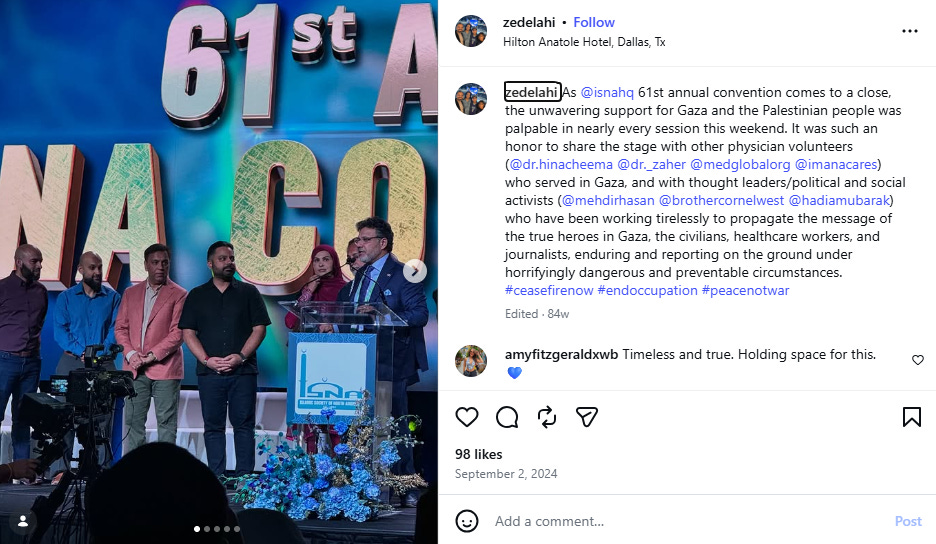
In September 2024, Dr. Elahi appeared on stage at the 61st Annual ISNA Convention in Dallas, posting that “the unwavering support for Gaza and the Palestinian people was palpable in nearly every session this weekend.” He praised “thought leaders/political and social activists” who “tirelessly propagate the message of the true heroes in Gaza.”
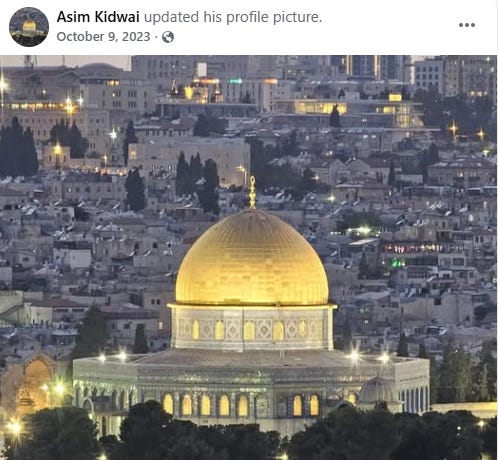
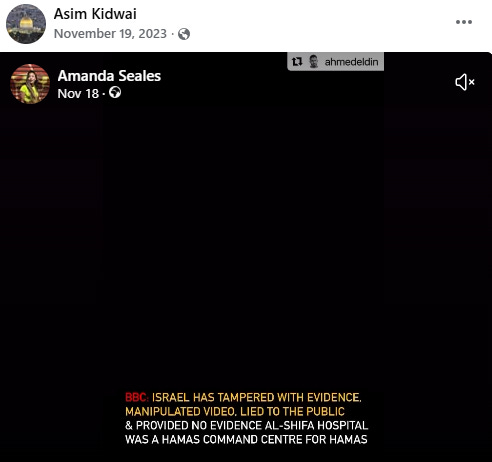
Dr. Asim Kidwai (Board Member), a family medicine physician in Georgia, changed his Facebook profile picture to the Dome of the Rock/Al-Aqsa Mosque on October 9, 2023, just two days after the October 7 Hamas massacre, while terrorists were still inside Israel and hostages were still being taken.
On November 19, 2023, Dr. Kidwai shared a post claiming: “BBC: ISRAEL HAS TAMPERED WITH EVIDENCE, MANIPULATED VIDEO, LIED TO THE PUBLIC & PROVIDED NO EVIDENCE AL-SHIFA HOSPITAL WAS A HAMAS COMMAND CENTER.” This repeated a claim that was later undercut by declassified U.S. intelligence assessments stating that Hamas and Palestinian Islamic Jihad had used the Al-Shifa complex for command-and-control purposes and to hold hostages.
More Than a Humanitarian Medical Organization
Taken together, the record suggests that IMANA is not simply a neutral medical charity operating apart from politics or ideology. Its own historical account, its appearance as #6 in the 1991 Explanatory Memorandum, its longstanding leadership overlap with ISNA, and the public conduct of some of its current leaders point instead to an organization whose humanitarian work exists alongside a deeper Brotherhood-linked institutional legacy.