


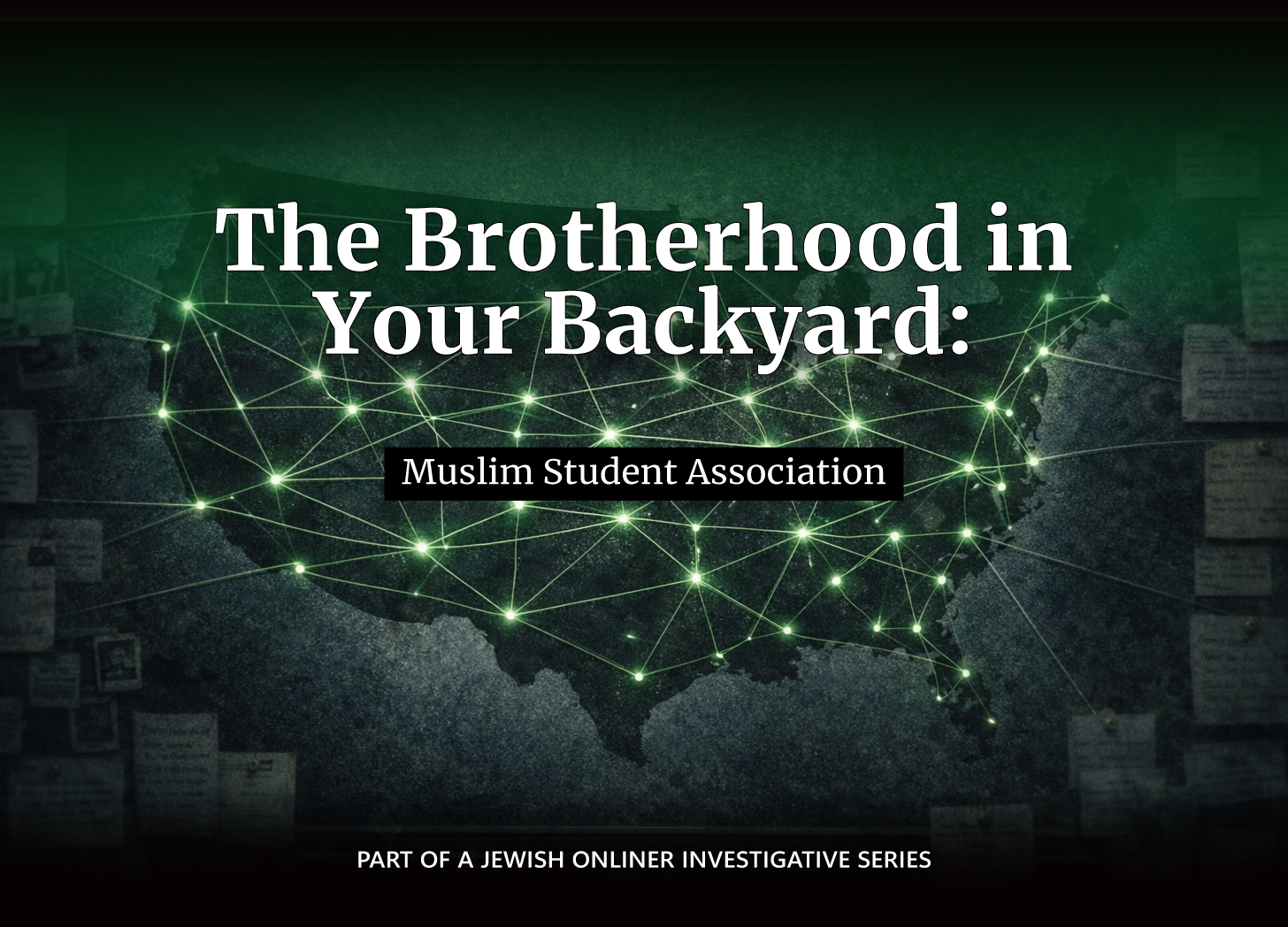
Editor's note: This article is part of an ongoing series examining the 29 organizations listed in the infamous 1991 Muslim Brotherhood "Explanatory Memorandum" outlining a "Civilization-Jihadist Process" to destroy Western civilization from within. With renewed scrutiny of Brotherhood networks in America, this investigation traces the documented connections between these groups and their role in advancing Brotherhood strategic objectives on U.S. soil.
When the Muslim Brotherhood outlined its strategy for "eliminating and destroying Western civilization from within" in the infamous 1991 Explanatory Memorandum, it listed 29 American organizations working toward this goal. But the Brotherhood's American infrastructure didn't begin in 1991—it began nearly three decades earlier with a single student group.
The Muslim Student Association (MSA), founded at the University of Illinois in 1963, was the Brotherhood's first organization in America. According to internal Brotherhood documents introduced as evidence in the Holy Land Foundation terrorism-financing trial, MSA was deliberately designed as a recruitment pipeline. The organization indoctrinated students who would later establish the sprawling network of groups named in the 1991 memo. All of these organizations work toward what the Brotherhood document describes as "supporting the establishment of the global Islamic State wherever it is.
Today, MSA National operates 162 affiliated chapters serving students from high school through university, hosting leadership summits, conducting tarbiyyah (Islamic education) retreats, and collaborating with other alleged Brotherhood-linked groups including the Council on American-Islamic Relations (CAIR), Students for Justice in Palestine (SJP), American Muslims for Palestine (AMP), and the Muslim American Society (MAS). According to their 2024 annual report, over 6,000 students attended MSA’s national conference, where the organization trained 170 MSA leaders through regional retreats and provided more than 120 hours of leadership consultancy.
Brotherhood Roots Run Deep
The MSA’s Brotherhood origins are well-documented in internal Muslim Brotherhood documents from Holy Land Foundation terrorism-financing trial. According to these materials, “In 1962, the Muslim Students Union was founded by a group of the first Ikhwanis [Muslim Brothers] in North America.”
The following year, three Iraqi Kurds—Ahmed Totonji, Jamal Barzinji, and Hisham al-Talib—formalized the structure at the University of Illinois, establishing what a George Washington University Program on Extremism report describes as “a sort of parallel structure of the Brotherhood.” It was listed second on the list of 29 organizations on the 1991 brotherhood document.
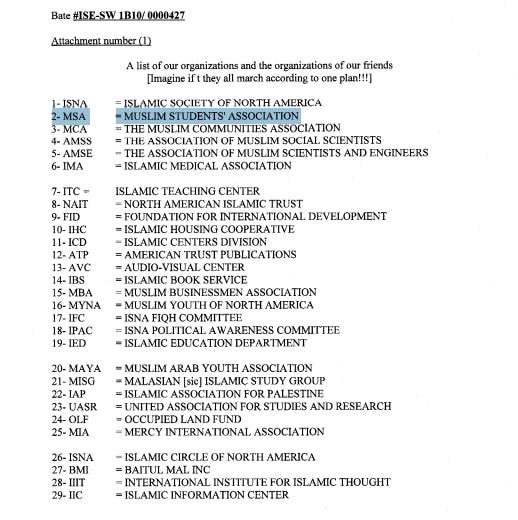
From its inception, MSA distributed English translations of writings by Hassan al-Banna, the Muslim Brotherhood’s founder, and Sayyid Qutb, its most influential ideologue. Arab Muslim members who adopted these ideologies would then be recruited into the Brotherhood itself.
The Brotherhood’s spiritual leader, Yusuf al-Qaradawi, publicly confirmed the connection in a 1995 Ohio speech, naming MSA as founded by those who “came to fight the seculars and the Westernized.” In the same speech, Qaradawi confidently declared: “We will conquer Europe, we will conquer America, not through the sword but through dawa.”
Strategic Evolution: From Students to Settlement
By the 1980s, Brotherhood leaders recognized that relying solely on transient student groups was limiting. Internal documents reveal their strategic shift toward “settlement of the dawa”—creating permanent infrastructure. MSA’s founding members then established what would become the Brotherhood’s “adult phase” organizations: the Islamic Society of North America (ISNA) in 1981 to serve as “a nucleus for the Islamic Movement in North America,” the North American Islamic Trust (NAIT) in 1973 to hold property, and the International Institute of Islamic Thought (IIIT) in 1981 to advance the “Islamization of knowledge.”
It appears that MSA became a dissemination system for Brotherhood ideology, where students are indoctrinated with Islamist concepts before graduating into leadership positions across the broader network.


Today’s Programming: Workshops and Radicalization
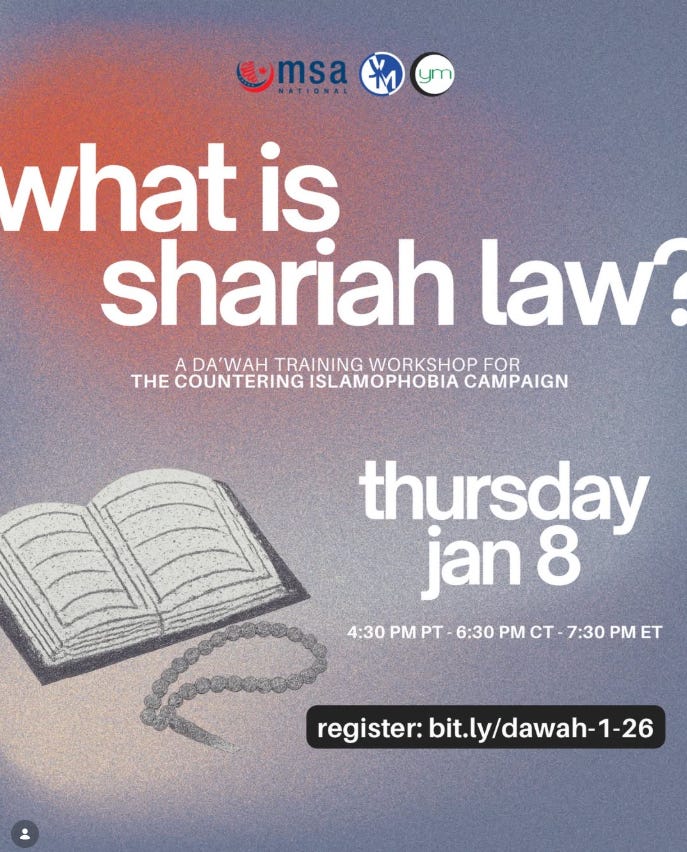
MSA’s current activities reflect this ideological mission. The organization hosts workshops on Shariah law and the “importance and beauty of hijab,” and promotes calls to abolish Immigration and Customs Enforcement (ICE). These programs are not merely educational—they advance a worldview fundamentally at odds with Western democratic values.
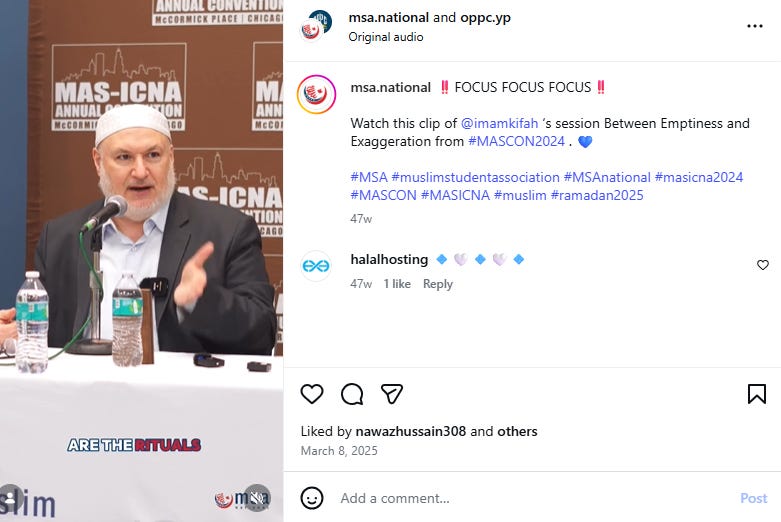
The organization’s leadership choices raise further concerns among critics. Omar Suleiman serves as MSA National’s board chair while simultaneously functioning as co-founder and CEO of the Yaqeen Institute, which recently released a controversial series explicitly paralleling modern Israel with medieval Crusaders and seemingly presented armed conquest as “the solution to our crisis today.” MSA has also shared a video of Imam Kifah Mustapha, who worked for the Holy Land Foundation before its conviction for funneling $12.4 million to Hamas.
Among the more disturbing incidents was the October 2025 incident at two Virginia high schools, where MSA chapters posted videos depicting mock kidnappings—students hooded, thrown into car trunks, and dragged away in bins—just weeks after organizing protests on the second anniversary of Hamas’s October 7 attacks.
The Pipeline Continues
The Muslim Brotherhood, which spawned Hamas and whose members founded MSA sixty years ago, recently had three of its international chapters designated as terrorist organizations by the United States government, with hints of more to come. As congressional scrutiny intensifies, MSA’s alleged role as the original and ongoing recruitment mechanism for the Brotherhood’s American network becomes increasingly clear.
With nearly 600 affiliated chapters actively nurturing Islamist ideas among next-generation American Muslims, MSA continues fulfilling the founding purpose as outlined in the 1991 memorandum: transforming American students into carriers of an ideology that, in the Brotherhood’s own words, seeks to eliminate Western civilization “from within.”
Editors note: a previous version of this article incorrectly stated that Imam Kifah Mustapha was speaking at an MSA-ICNA event. He spoke at an MAS-ICNA event, and a clip of him speaking there was shared by MSA National. The article has been corected accordingly.
Ladies and gentlemen, cool boys and girls, folks — listen up, folks.
Get your fucking act together.
This is important, and greetings from Washington, DC, your ally since the days of Admiral de Lafayette in the 18th century, from our office five minutes from the White House, across Lafayette Square.
The Marxists and the Islamist Hezbollah terrorists destroyed the Paris of the Middle East. The Levant was a Judeo-Christian oasis. It is the place where the parents of my mentor were married.
Soon, back to Paris 2.0. Peace is on its way. The Abraham Accords will be finalized, and the Saudis have been given no option not to sign — or else the families in those palaces will be simply and gently removed. Folks, it is time to use the ballot box and stop the Marxists, and everyone who aims to destroy our Judeo-Christian, freedom-loving peace and family unity.
This house stands for signal over noise. Our Founder and Principal has engaged with Peace Through Strength and America First for over 40 years. Until today he operated below the waterline. Now he has surfaced.
Pascal, my mentor, told me two days ago over his Starlink line from deep inside old Europe, from his 14th-century abbey summer hideaway:
.
"Jemima, we are fucked if those Marxists come to power in the United States, on both sides of the Atlantic."
.
I totally agree.
So does my colleague here at his office, Yael R. Eastman, our Head of Research. Watch this space. His private intelligence unit is non-profit, non-NGO, accepts no donations or favors of any kind, and by his design does not talk to any press or social media channel.
His firm speaks to the world and gives you signal over noise. It is you, the audience, who must decide whether to take the left or the right at each forward marker we present.
For free. And make no mistake, we could not care less about likes or other social media dopamine via clicks. Pascal Najadi does not need them. We do not need them. We are happy here and we do this work pro bono, with passion. He started all of it to reach the ones who matter most: the kids.
The cool teenage boys and girls out there who want to shape the world before it shifts, because they already know nothing comes easy — and certainly not from some stupid MBA or whatever degree, but from hard work and thinking.
Pascal operated in places where real white-feather-winged angels don't dare to venture. Now he has surfaced, taking it easy, for the first time in his life since 1985. What a cool time to be alive. We say that to each other here on K Street.
And he has only just begun to declassify, in sync with the Trump administration and with their full support. Now his boat has surfaced in the same harbor he took it down in. Washington, DC. He never left.
Over 40 years, protecting his true mission, because for him the mission always comes first — to map the Marxists, and the networks of political Islam vectoring into the base of the lunatics in Tehran.
What our great late friend Senator Lindsey Graham called the mothership of global terrorism. May God rest his soul. He is greatly missed, and his void cannot be filled. Such is the sadness. But his legacy lives on.
So does the legacy of Pascal Najadi's late father, brutally assassinated in broad daylight by two 9mm rounds fired at close range by a Chinese assassin.
Epic Fury 2026 took good care of those responsible, hiding in a bunker deep under downtown Tehran, on 28 February 2026.
Our Next Sortie: Rigged For The Dive
https://pnajadi1967.substack.com/p/our-next-sortie-rigged-for-the-dive
Enjoy the Epic Summer of 2026. Much more to come.
The fun has only just begun.
Signal over noise.
Caroline Jemima Adler
Public Affairs Desk
GeoStrat Agency LLC
1500 K Street NW
Washington, DC 20005
United States