


Jewish Onliner is an independent publication. If you find our work valuable, please consider becoming a paid subscriber.

Editor’s note: This is the latest article in a series examining alleged Muslim Brotherhood front groups in the United States—the 29 organizations listed in the infamous 1991 Muslim Brotherhood Explanatory Memorandum outlining a “Civilization-Jihadist Process” to destroy Western civilization from within. With renewed U.S. government focus on Brotherhood networks and recent congressional scrutiny, this series investigates the documented connections between these groups and their historical advancement of Brotherhood strategic objectives in America.
When federal agents seized a 1991 Muslim Brotherhood strategic memorandum from an Annandale, Virginia residence in 2004, the document listed 29 U.S.-based organizations under the heading “our organizations and the organizations of our friends. In a passage describing the “comprehensive Settlement Organizations” the Brotherhood would need to build in North America, it specifically prescribed the creation of an “Economic Organization” comprising three arms: an Islamic central bank, Islamic endowments (waqf), and “investment projects.”
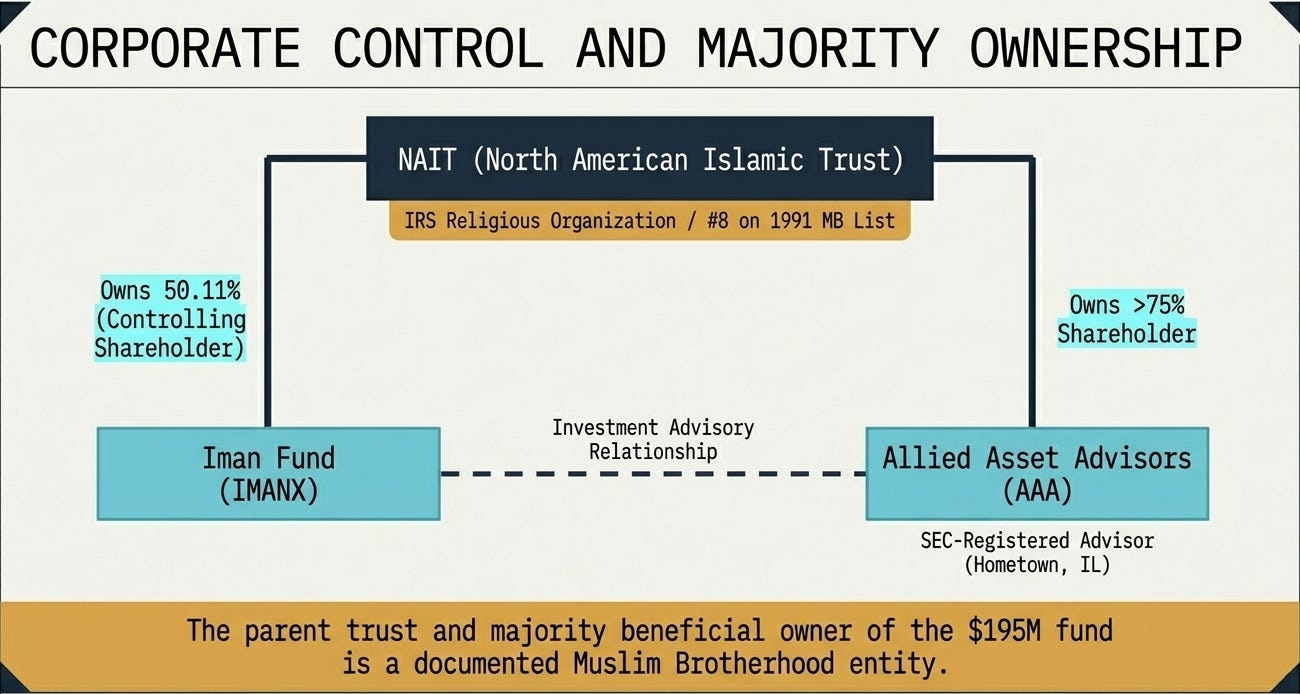
NAIT, which describes itself as a national waqf organization, appears as item #8 on the 1991 memorandum list, and the subject of a previous article in this series. Nearly a decade later, Allied Asset Advisors launched the Iman Fund, a Sharia-compliant U.S. mutual fund, through an advisor controlled by NAIT. According to the fund’s most recent statutory prospectus dated September 30, 2025, NAIT controls Allied Asset Advisors, the Iman Fund’s investment advisor, and was listed as owning 50.11% of the fund’s outstanding shares of record as of Aug. 31, 2025 — meaning the Brotherhood-memorandum-listed trust controls the fund’s investment advisor and is listed in fund filings as owning 50.11% of the fund’s outstanding shares, making it the majority record shareholder of a $195 million mutual fund available through major brokerage platforms.

A $195 Million Mutual Fund Owned by an Alleged Brotherhood-Linked Trust
The Iman Fund is offered by Allied Asset Advisors, Inc. (AAA), an SEC-registered investment advisor based in Hometown, Illinois. Per AAA’s Form ADV filings, NAIT is the 75%-plus shareholder of the firm. The fund’s counsel is K&L Gates in Chicago; its distributor is Quasar Distributors. As of May 31, 2025, the fund held $195 million in net assets across 110 positions, with top holdings in Microsoft, Apple, Nvidia, and Taiwan Semiconductor.
The 2025 prospectus discloses that AAA pays NAIT a separate annual fee equal to 0.10% of the fund’s daily average net assets — roughly $195,000 per year at current levels — for “Shariah compliance” consulting services that NAIT itself provides under a Consulting Services Agreement. NAIT, classified by the IRS as a religious organization, is not required to file IRS Form 990, meaning none of this revenue stream is visible in any public charity filing.
At Least Five of the 29 Brotherhood-Memo Entities, Represented Across One Mutual Fund Network
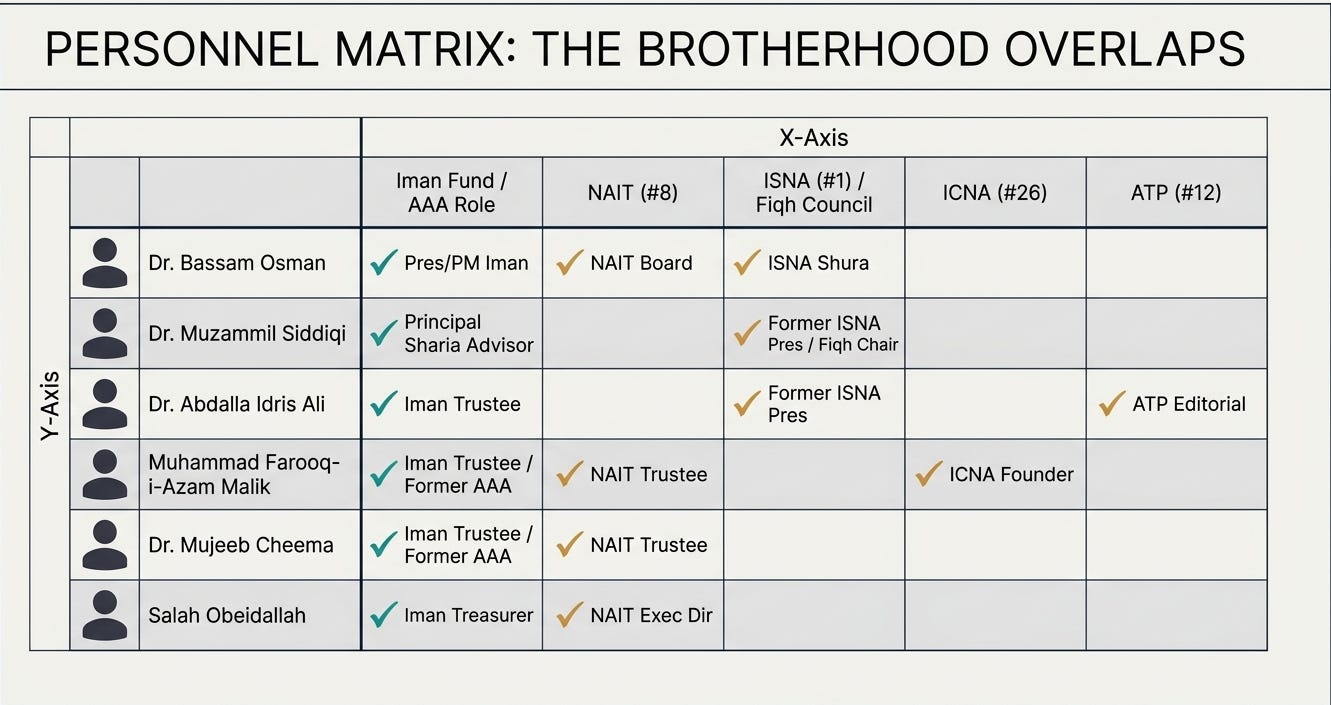
The fund’s Board of Trustees, officer roster, advisor leadership, and Shariah-advisory network overlap with individuals tied to at least five of the 29 entities named in the 1991 memorandum. Iman Fund President and portfolio manager Dr. Bassam Osman also sits on NAIT’s Board of Trustees (#8 on the 1991 list), chairs the Council of Islamic Organizations of Greater Chicago, and is a member of the ISNA Shura (ISNA is #1). Osman previously served as director of the Quranic Literacy Institute, which a federal court found liable in a $156 million civil judgment for aiding Hamas in the 1996 murder of American teenager David Boim.
The fund’s principal Sharia advisor, Dr. Muzammil Siddiqi, is the former president of ISNA (1996/1997–2000) and currently chairs the Fiqh Council of North America — the successor entity to item #17 on the memorandum, the ISNA Fiqh Committee. Iman Fund trustee Dr. Abdalla Idris Ali is a former ISNA president (1992–1997) and a former editorial board member of American Trust Publications, item #12 on the 1991 list and the subject of a previous article in this series. Iman Fund trustees and former AAA officers Muhammad Farooq-i-Azam Malik and Dr. Mujeeb Cheema are current NAIT trustees; Malik was a founding member of the Islamic Circle of North America, item #26.
Iman Fund’s Treasurer and a Mosque That Sponsored a PFLP Speaker
Salah Obeidallah became Iman Fund Treasurer in 2022. Fund filings list him as president of Allied Asset Advisors beginning in June 2015 and describe his NAIT executive-director service as running from March 2015 to September 2022, while AAA’s current website identifies him as executive director of NAIT. He is currently the executive director of NAIT, succeeding Mujeeb Cheema in that role. Obeidallah also co-founded and served for ten years as president of the Islamic Center of Passaic County (ICPC) in Paterson, New Jersey, whose imam Mohammad Qatanani admitted being convicted in Israel of Hamas membership and publicly defended supporting the families of suicide bombers in a 2004 Herald News article.
According to NGO Monitor, in April 2025 ICPC was one of five official sponsors of the Palestinian American Community Center’s annual conference in Clifton, New Jersey, which featured Wisam Rafeedie — described by the Ramallah-based Palestinian Museum as one of the most prominent leaders of the Popular Front for the Liberation of Palestine (PFLP), a U.S.-designated Foreign Terrorist Organization since 1997. At the prior year’s event, Rafeedie defended Hamas’s October 7 attacks and stated that “the only solution is one democratic Palestinian state on all Palestinian land, which will end the Zionist project.” Congressman Josh Gottheimer wrote to the Department of Justice on April 6, 2025, requesting an investigation into the conference’s sponsors for potential material support of terrorism.
A Sharia Board Under Pressure
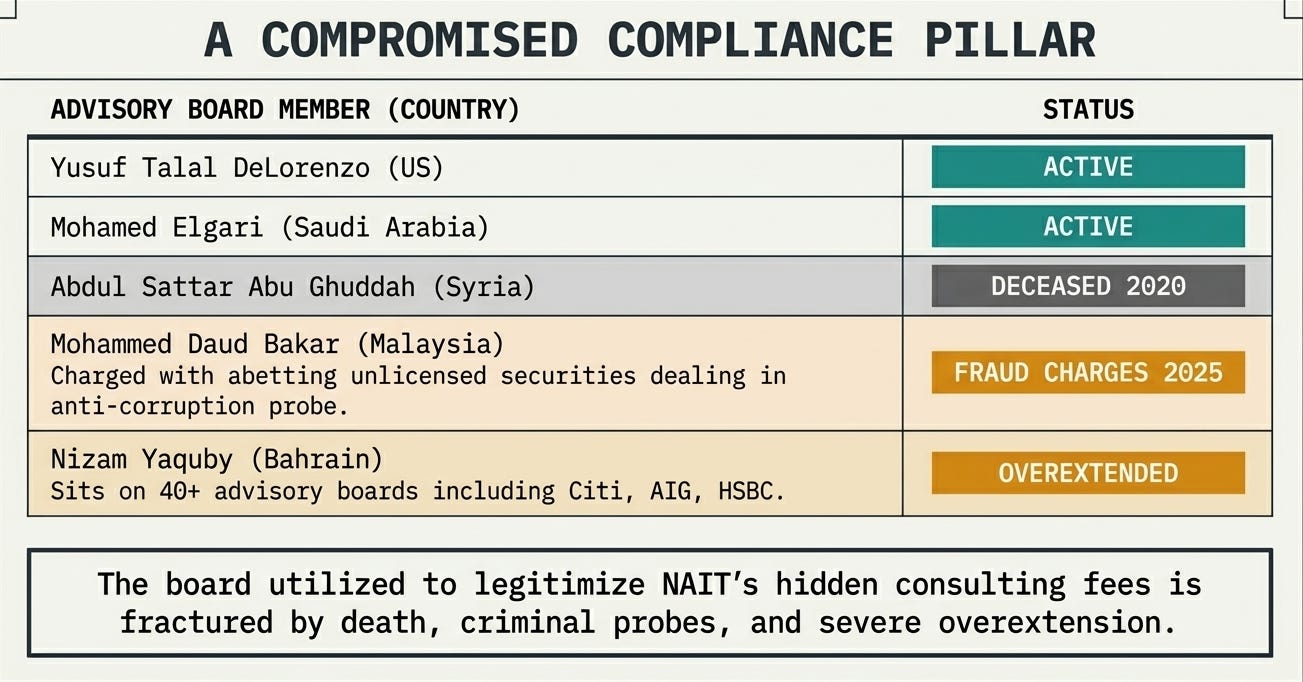
The Iman Fund’s published scholarly board lists five international scholars: Nizam Yaquby (Bahrain), Mohammed Daud Bakar (Malaysia), Mohamed Elgari (Saudi Arabia), Abdul Sattar Abu Ghuddah (Syria), and Yusuf Talal DeLorenzo (United States).
Abu Ghuddah died in 2020. Daud Bakar was charged in 2025 with abetting unlicensed securities dealing in connection with an alleged investment fraud probe by Malaysia’s anti-corruption commission. Yaquby sits on the advisory boards of more than forty financial institutions including Citigroup, AIG, and HSBC.
Renewed Scrutiny of the Brotherhood’s Financial Architecture
In the Holy Land Foundation case, federal prosecutors named NAIT — the Iman Fund’s controlling shareholder — among entities they described as members of the U.S. Muslim Brotherhood’s network. Egypt’s Islamist Movements Portal, a major Arab-world tracker of Brotherhood activity, lists NAIT among Brotherhood-affiliated entities operating in the United States, alongside CAIR, ISNA, MSA, ICNA, and IIIT.
The 1991 memorandum described the settlement project’s success as requiring the Brotherhood to “possess a mastery of the art of ‘coalitions,’ the art of ‘absorption’ and the principles of ‘cooperation’” — and to build institutions that could “absorb” Muslims and non-Muslims alike into mainstream American civic and financial life. Of the financial structures the document prescribed, the Iman Fund is the one that today carries the most retail investors and the least public scrutiny. As the Trump administration targets certain Muslim Brotherhood chapters for FTO and SDGT designations, renewed scrutiny is falling on the U.S.-based organizations identified in historical Brotherhood-linked documents — and on the financial vehicles they continue to operate.