


Jewish Onliner is an independent publication. If you find our work valuable, please consider becoming a paid subscriber.
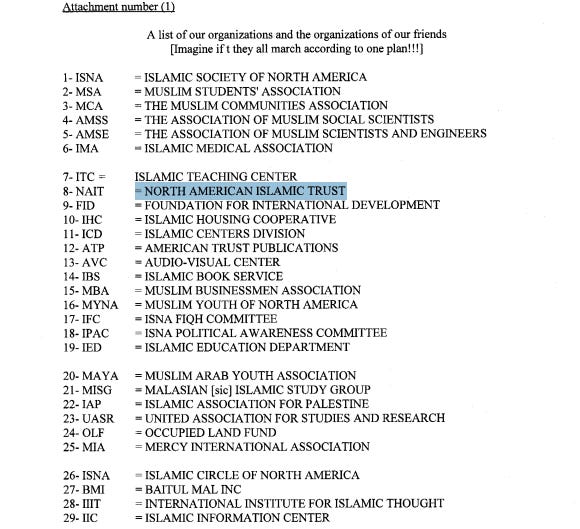
Editor’s note: This article is part of an ongoing series examining the 29 organizations listed in the infamous 1991 Muslim Brotherhood “Explanatory Memorandum” outlining a “Civilization-Jihadist Process” to destroy Western civilization from within. With renewed scrutiny of Brotherhood networks in America, this investigation traces the documented connections between these groups and their role in advancing Brotherhood strategic objectives on U.S. soil.
The North American Islamic Trust (NAIT) was listed by name in the 1991 Muslim Brotherhood Explanatory Memorandum. Federal prosecutors later identified NAIT in Holy Land Foundation case filings as an entity that “are and/or were” part of the U.S. Muslim Brotherhood.
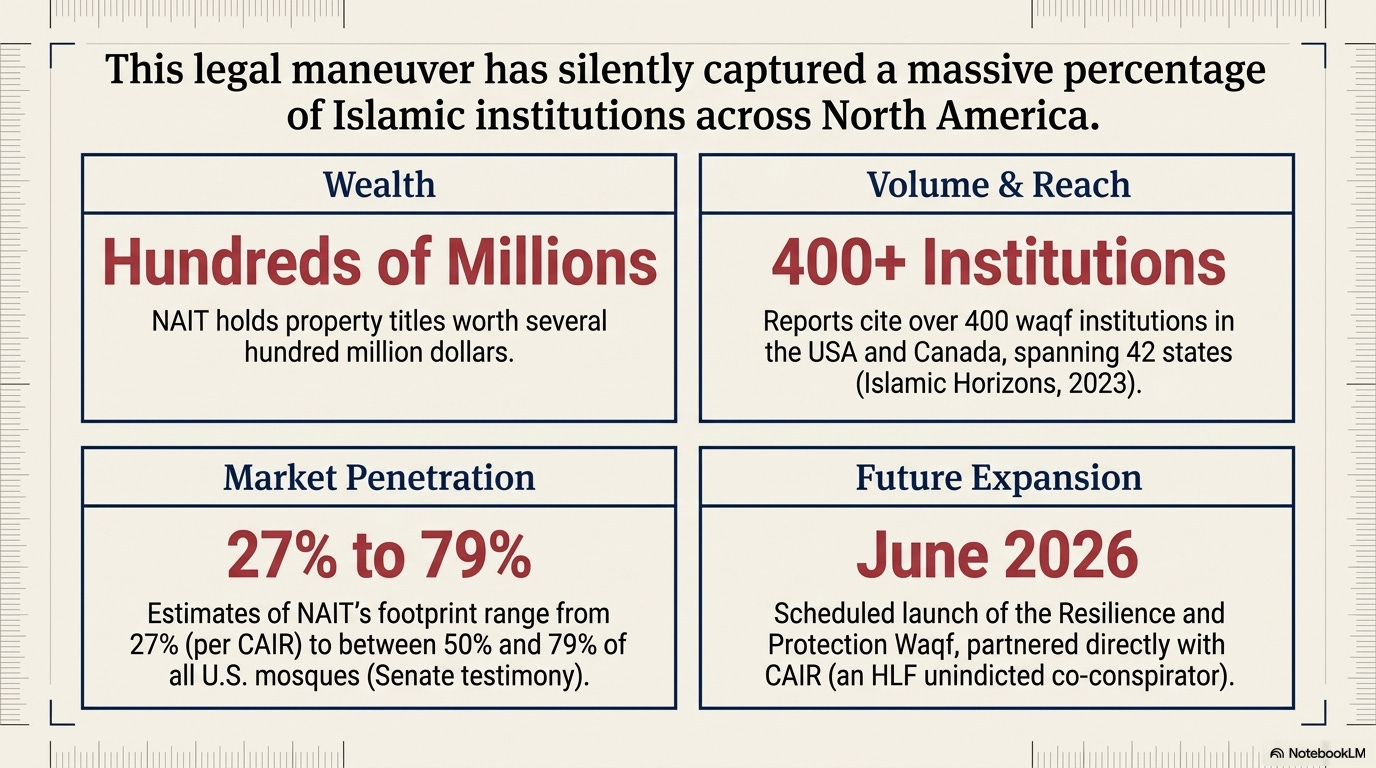
NAIT operates a religious-endowment program called the Islamic Centers Waqf. Under that structure, NAIT says Muslim communities have entrusted mosque and Islamic-center property titles to the organization across 42 states. Those properties are dedicated in perpetuity for their donor-designated Islamic purposes. NAIT’s own homepage lists one of its central purposes as reviving the prophetic tradition of waqf.
NAIT’s waqf doctrine page presents the model through the classical example of Umar ibn Al-Khattab’s Khaibar endowment, which included “jihad” among the charitable uses listed in that tradition. The same NAIT page also states that waqf proceeds have historically been used for “socio-economic, military, or political purposes.”
Two state court cases, in Minnesota and Ohio, offer a public window into how NAIT waqf agreements operate once a mosque signs on. The separate Holy Land Foundation litigation shows how NAIT later appeared in federal terrorism-financing case filings.
What a Waqf Is
NAIT defines a waqf as “the permanent dedication of a portion of one’s wealth for the pleasure of Allah,” in which “ownership thus passes from the waqif/a (person making the waqf) to Allah.” Once made, the property is restricted “on a perpetual basis.” NAIT also acknowledges that historically the proceeds of a waqf may be applied to “socio-economic, military, or political purposes.”
The doctrinal page cites publications of the Islamic Research and Training Institute of the Islamic Development Bank in Jeddah — a Saudi-headquartered multilateral Islamic-finance body — as its authoritative source.
How NAIT’s Waqf Works
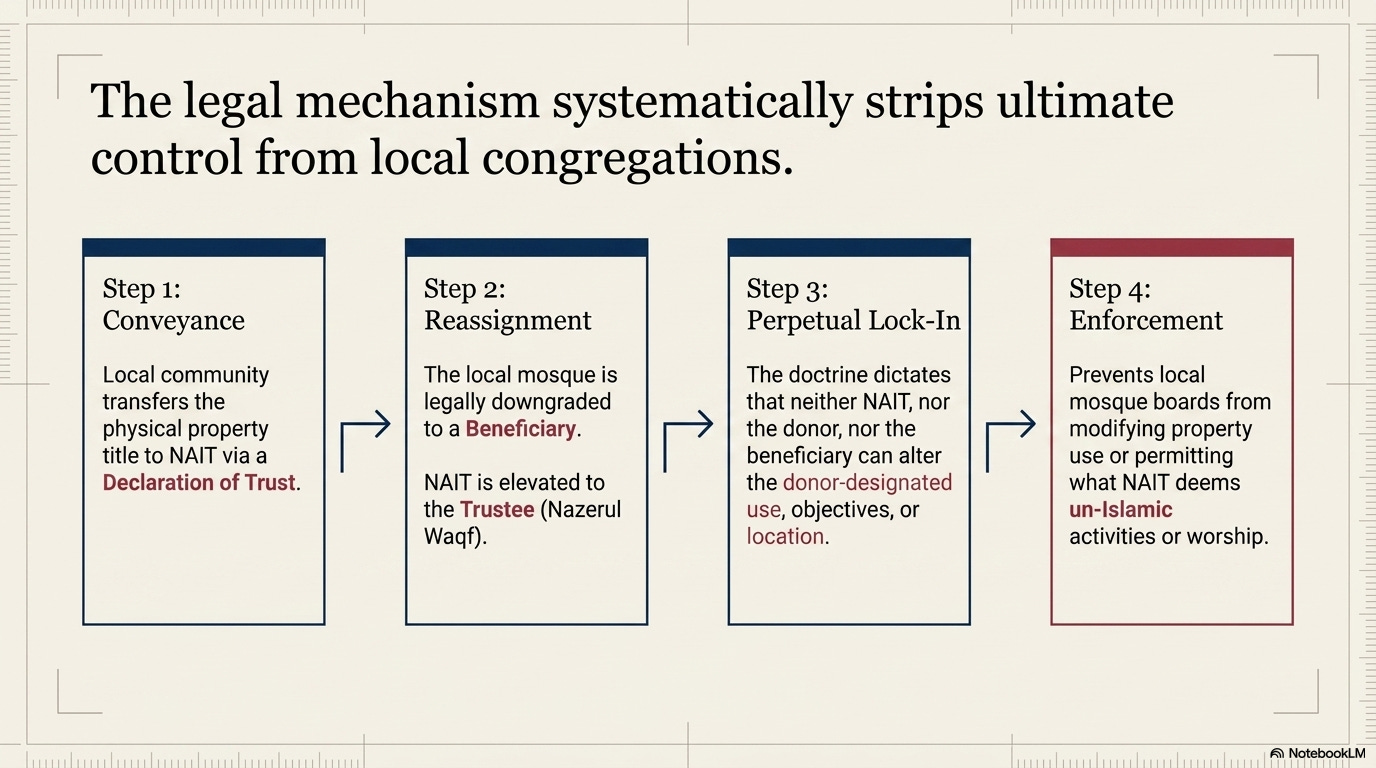
When a mosque joins, the local community conveys the title of its property to NAIT under a “Declaration of Trust.” The mosque becomes the beneficiary; NAIT becomes the trustee — what NAIT calls the “Nazerul Waqf.” NAIT states that “neither NAIT, nor the donor, nor the beneficiary can alter the donor-designated use, objectives and location of the Waqf property.” NAIT also warns that local mosque boards may be “tempted” to change a property’s use, prohibit “universally accepted” worship, or permit “un-Islamic” activity — concluding that “none of such actions would be feasible if the property is part of the NAIT Waqf Family.”
The Minnesota court record revealed that the declaration of trust at issue required disputes over “appropriate use of the property, successor trustees, and successor beneficiaries” to be submitted to a “FIQH Committee of reputable Muslims in the United States.”
Even Muslim community attorneys have flagged concerns: a 2017 MuslimMatters guide advised mosques to “review their status” with NAIT, warning the model is “merely a relationship between two vulnerable organizations.”
In Ohio, the trust clause said that such a committee would be appointed by the trustee and that its decisions would be final and binding. Separately, FCNA’s own history places it inside the ISNA institutional ecosystem: FCNA says it evolved from the ISNA Fiqh Committee, became the Fiqh Council of North America in 1986, and continues to be an ISNA affiliate.
A Shared Address in Plainfield
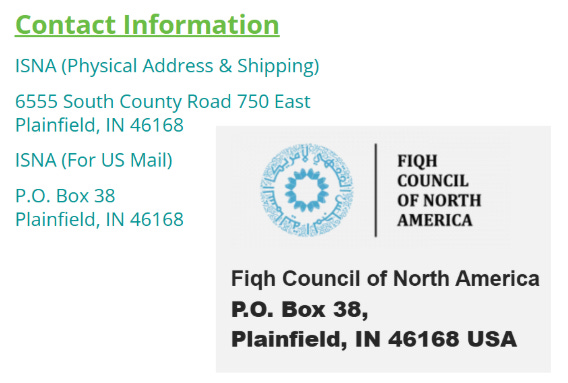
The Fiqh Council operates from P.O. Box 38, Plainfield, IN 46168 — the same mailing address used by ISNA's headquarters at 6555 S County Road 750 E. That Plainfield compound, purchased in 1976 and built out in 1978 explicitly "to house the North American Islamic Trust.” That Plainfield institutional cluster has long been central to the NAIT, ISNA, and FCNA ecosystem.
Leadership interlocks reinforce the structure: Dr. Muzammil Siddiqi serves simultaneously on NAIT's board and the Fiqh Council, while having previously directed ISNA. Dr. Jamal Badawi, listed by FCNA as a council member, also appeared on the government's HLF Attachment A list of unindicted co-conspirators.
In effect, a mosque that signs a NAIT waqf agreement may agree to route specified disputes over property use, trusteeship, or beneficiary status through a religious-arbitration mechanism tied to the NAIT trust framework. That framework sits within a broader NAIT, ISNA, and FCNA institutional ecosystem that appears in both the 1991 Muslim Brotherhood memorandum and later HLF case filings.
NAIT’s Stated Goals
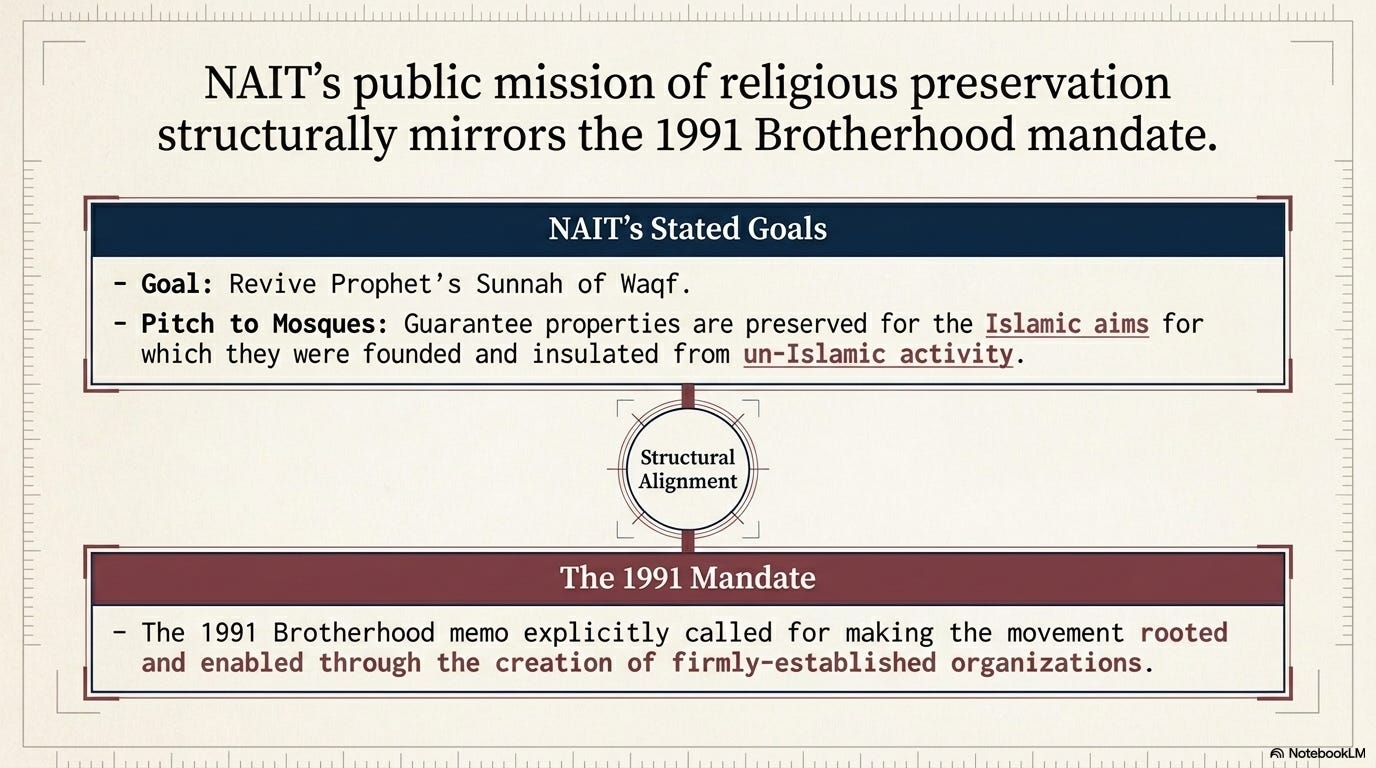
NAIT’s homepage lists four organizational purposes. The first is to “Revive Prophet’s Sunnah of Waqf.” NAIT’s “Why Join” page pitches the waqf as a guarantee that mosques will be preserved “for the Islamic aims for which they were founded” — language that closely mirrors the 1991 Brotherhood memorandum’s call to make the movement “rooted” and “enabled” through “firmly-established organizations.”
The 1991 memorandum, authored by Mohamed Akram, listed NAIT among 29 Brotherhood-aligned organizations the memo described as “our organizations and the organizations of our friends,” part of “a kind of grand Jihad in eliminating and destroying the Western civilization from within.”
Current Operations and Holdings
NAIT says Muslim communities have entrusted titles to properties in 42 states with a market value of several hundred million dollars. Islamic Horizons reported in 2023 that NAIT’s network included “400+ waqf institutions in USA and Canada.” In 2003 Senate testimony, Stephen Schwartz cited a CAIR-stated figure, reported by the St. Petersburg Times, that NAIT owned about 27 percent of roughly 1,200 U.S. mosques. In separate Senate testimony that same year, J. Michael Waller testified that NAIT was “reported” to own between 50 and 79 percent of mosques on the North American continent.
In June 2026, NAIT announced a “Resilience and Protection Waqf” and separately announced a strategic safety partnership with CAIR to arrange regional safety trainings.
A 2015 New York Post investigation tied NAIT’s property role to several mosques that later surfaced in terrorism-related cases, including cases involving the Chattanooga shooter, the Boston Marathon bombers, and 9/11 hijacker Hani Hanjour.
Bridgeview, Illinois, shows how those property arrangements could shape control on the ground. After the mosque’s deed was transferred to NAIT in 1981, the property became part of a broader struggle over the institution’s direction. Reporting on the dispute described how hardline leaders, including current imam Jamal Said, later listed by the government in the HLF case as an unindicted co-conspirator and/or joint venturer, consolidated influence over the mosque.
Litigation Exposes the Mechanism
In United Islamic Society v. Masjed Abubakr Al-Seddiq, the appellate record exposed the actual language of a NAIT declaration of trust executed on March 12, 2012, by then–executive director Mujeeb Cheema. The agreement designated the Rochester mosque as “waqf property” and required disputes be sent to a NAIT FIQH Committee.
In Al-Foutiyou v. NAIT, Ohio’s Tenth District Court of Appeals affirmed the denial of NAIT’s request to stay the case for arbitration. The mosque alleged that NAIT had obtained a 50 percent property interest through an unauthorized quitclaim deed, while NAIT argued that a 2012 trust agreement gave it title rights. The opinion documented NAIT’s effort to block the property’s sale and seek transfer of 100 percent of legal title. It also quoted the trust’s arbitration clause, which called for disputes over specified Islamic-law provisions to be decided by a FIQH Committee or Fiqh Council appointed by the trustee. The court held that the sale and fraud dispute fell outside that narrow arbitration clause and affirmed the trial court’s denial of NAIT’s motion.
In United States v. Holy Land Foundation, U.S. District Judge Jorge Solis wrote in 2009 that the government had “produced ample evidence to establish the associations of CAIR, ISNA and NAIT with HLF, the Islamic Association for Palestine, and with Hamas.”
The Minnesota and Ohio records show how the structure works in practice: title held by NAIT, perpetual-use restrictions, limits on sale or transfer, Islamic-conduct provisions, and religious arbitration through a FIQH Committee or Fiqh Council. The HLF litigation adds the federal-terrorism record. In that case, Judge Jorge Solis wrote that the government had produced “ample evidence” of associations among CAIR, ISNA, NAIT, HLF, the Islamic Association for Palestine, and Hamas.
That combination is what makes NAIT’s waqf structure significant. It is not merely a property arrangement. It is a durable trust mechanism under which hundreds of mosque and Islamic-center property titles have been entrusted to an organization listed in the 1991 Brotherhood memorandum and later identified in HLF filings under the heading for entities prosecutors described as “members of the US Muslim Brotherhood.”