


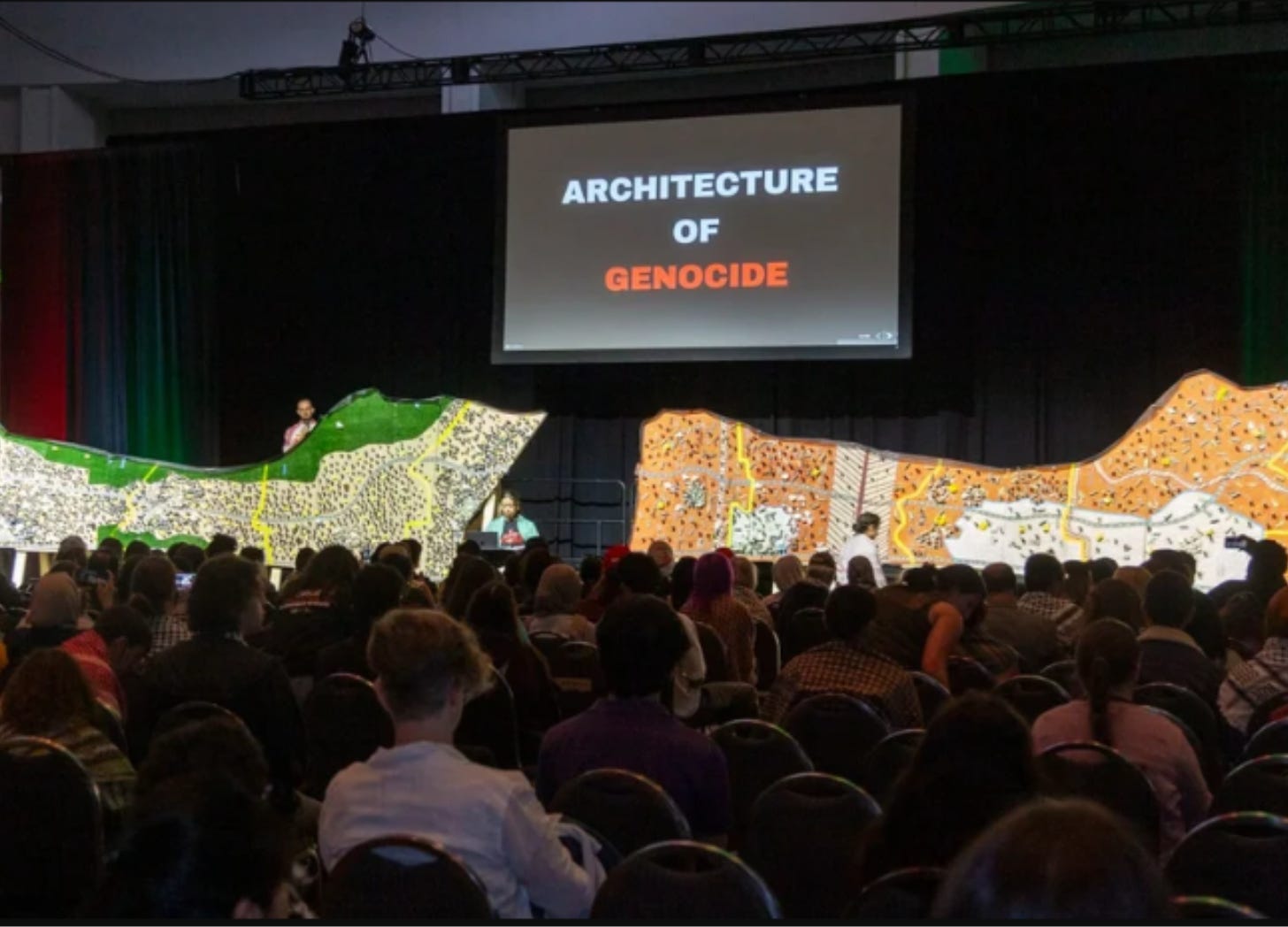
The Islamic Society of Orange County (ISOC) will jointly host an exhibition titled "Architecture of Genocide" with the Palestinian Youth Movement LA-OC-IE beginning February 14. According to watchdog groups, ISOC—led since 1981 by Dr. Muzammil Siddiqi—has functioned as an apparent incubator of extremist ideology and a platform for figures connected to terror-finance networks and the 1993 World Trade Center bombing.
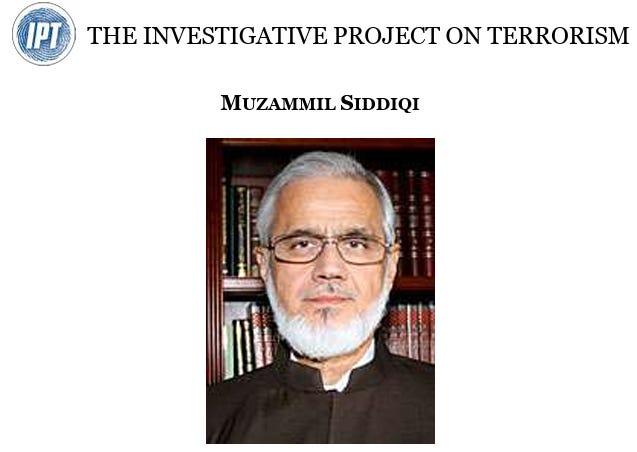
Siddiqi also held longtime leadership positions within the Islamic Society of North America (ISNA), which federal prosecutors listed as an unindicted co-conspirator in the 2008 Holy Land Foundation trial—the largest U.S. terror-financing prosecution on record.
The Mosque’s Ties to the “Blind Sheikh”
ISOC’s alleged connection to extremism traces back to the early 1990s. In 1992, Dr. Siddiqi invited Sheikh Omar Abdel Rahman—widely known as the “Blind Sheikh”—to deliver a lecture at the mosque, according to the New Yorker. Siddiqi personally translated the speech, during which Abdel Rahman dismissed nonviolent interpretations of jihad as weak.
One year after appearing at ISOC, Abdel Rahman was arrested. He was later convicted for his connection to the the 1993 World Trade Center bombing, for which he received a life sentence. He died in federal custody in 2017.
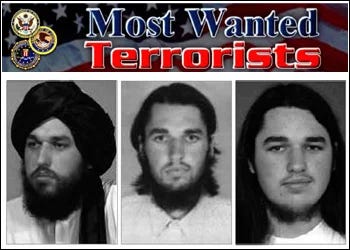
The pattern did not end with Abdel Rahman. In the mid-to-late 1990s, an American convert named Adam Gadahn began attending ISOC, where he was reportedly radicalized under the influence of individuals connected to Abdel Rahman’s circle, including Khalil Deek and Hisham Diab. ISOC staff briefly hired him as a security guard, but he was later fired and no longer remained at the mosque.
By 2006, Gadahn had risen to become Al-Qaeda’s English-language propaganda chief—a position earning him the designation “Azzam the American.” He was indicted on treason charges in 2006 and killed by a U.S. drone strike in Pakistan in 2015.
Platforming of Unindicted Co-Conspirator in the 1993 WTC Bombing
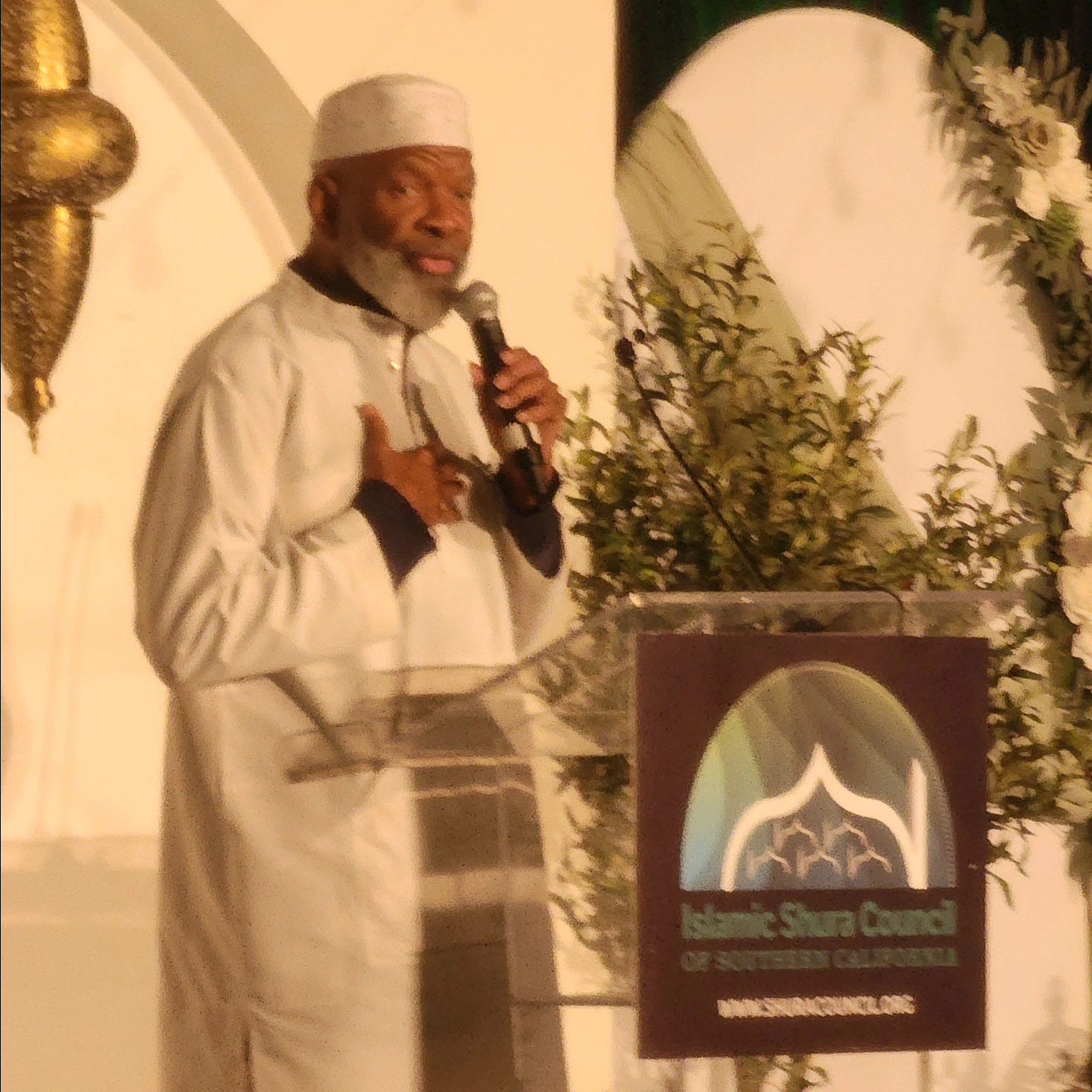
ISOC’s recent programming demonstrates the mosque continues hosting figures with documented terror-network associations. In 2017, the mosque invited Siraj Wahhaj, a prominent Brooklyn cleric, to speak at a fundraising event. Wahhaj was named an unindicted co-conspirator in the 1993 World Trade Center bombing case by federal prosecutors. Notably, Wahhaj has publicly defended Abdel Rahman, referring to him as a “respected scholar.”
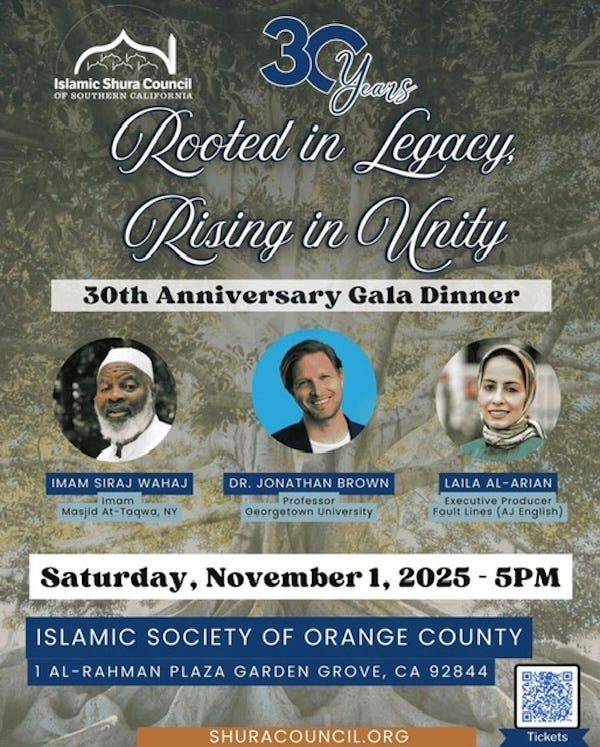
ISOC hosted Wahhaj again in November 2025 during an Islamic Shura Council of Southern California event. The gathering included Laila Al-Arian, a journalist and documentary producer at Al Jazeera English and daughter of Sami Al-Arian, who was convicted of financing Palestinian Islamic Jihad (PIJ), a designated terrorist organization.
Also attending was Laila Al-Arian’s husband, Jonathan Brown, an Islamic studies scholar at Georgetown University who holds the Alwaleed bin Talal Chair of Islamic Civilization. Brown was placed on administrative leave in June 2025 following a social media post expressing support for Iranian military action against American military bases.
Recent Programming Raises Additional Concerns
In November 2023, merely one month following Hamas’s October 7 attack on Israel, ISOC hosted a community “teach-in” featuring Hussam Ayloush, the Los Angeles director of the Council on American-Islamic Relations (CAIR). Ayloush made remarks that explicitly justified terrorist violence.
He stated that: “The only ones who have the right to defend themselves are the occupied. In this case, the Palestinian people.” Ayloush further declared, “Israel should be attacked,” and characterized armed resistance as a “legitimate right” when deployed against Israel.
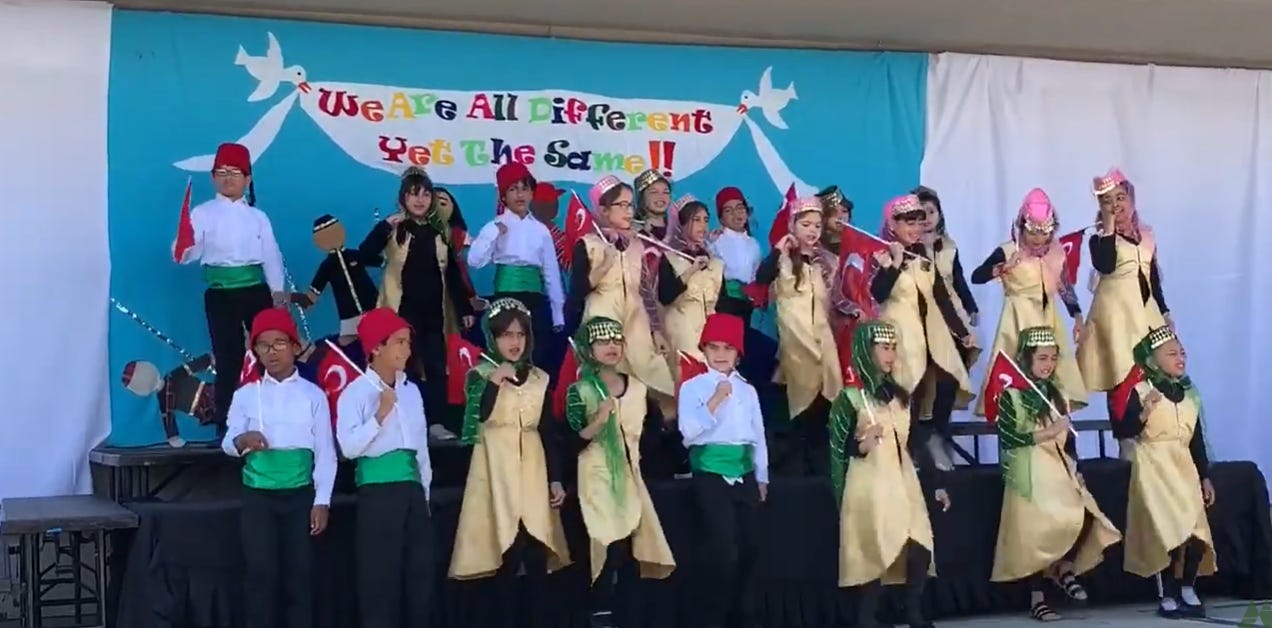
The mosque’s educational arm has also drawn scrutiny. The Orange Crescent School, ISOC’s full-time institution, participated in an unusual 2019 celebration of Turkey’s government. During an “International Day” event, students waved Turkish flags and performed campaign songs dedicated to President Recep Tayyip Erdoğan—propaganda material widely distributed by his ruling party.
Coordinated Strategy Behind Pro-Palestine Activism
Recent scholarship on pro-Palestinian activism in American institutions suggests a pattern of organized coordination rather than spontaneous grassroots mobilization. A study by Dr. Kobby Barda documents how pro-Palestine messaging has deliberately shifted away from religious or partisan language toward universal values—human rights, anti-colonialism, and social justice—tracing this strategic shift back to Muslim Brotherhood organizational blueprints from 1991.
The February 14-15 event at ISOC featuring groups such as the Palestinian Youth Movement reflects this broader context. ISOC’s historical record—including its connection to unindicted co-conspirators in major terrorism cases and its provision of platform to figures associated with designated terror organizations—demonstrates how organizational infrastructure established decades earlier continues to facilitate modern pro-Palestine political advocacy.
Please consider avoiding using the term Pro-Palestine, or anything that begins with "pro" to describe these hate mobs. Why? I find Jonathan Haidt’s Elephant and Rider model really useful for thinking about this. It explains why using the term “pro-Palestinian” is counterproductive.
The Elephant is fast, emotional, and associative. The Rider is slow, analytical, and rationalizes after the fact. People’s judgments are always driven by the Elephant first (see also the book by the Israeli-American psychologist Daniel Kahneman, "Thinking, Fast and Slow")
When the Elephant hears terms like "pro-Palestinian,” it immediately registers a humanitarian signal: supporting an oppressed people. That emotional framing kicks in before any critical analysis happens.
At that point, the Rider isn’t evaluating the movement neutrally, it’s already trying to justify a morally positive frame. That’s how these labels grant automatic moral cover. From a messaging standpoint, this is disastrous. We’re letting the hate movement control the Elephant’s reaction by repeating its preferred branding.
Our goal is to cue the "Elephant" differently and force the Rider to engage with the movement’s actual behavior instead of rationalizing its self-image (or, as Kahneman would describe it: we want "System 1", the fast, instinctive and emotional system to stop; and "System 2", the slower, more deliberative, and more logical system to kick in).