


Jewish Onliner is an independent publication. If you find our work valuable, please consider becoming a paid subscriber. You can also subscribe to us on WhatsApp and Telegram. Follow us on Instagram, Discord, and X.

A Muslim technology summit set to take place in New York City this month is bringing together figures from Mayor Zohran Mamdani’s political network, Islamic religious institutions with alleged Muslim Brotherhood connections, and organizations tied to foreign governments or facing congressional scrutiny.
The HabibiTech Summit, scheduled for September 26 at Civic Hall in Manhattan, currently advertises 60 speakers working at what organizers describe as the intersection of AI, Islam and global impact. Its agenda extends beyond startups and technology, with sessions on Islamic jurisprudence governing artificial intelligence, the use of AI to issue religious rulings, political governance and Muslim investment.
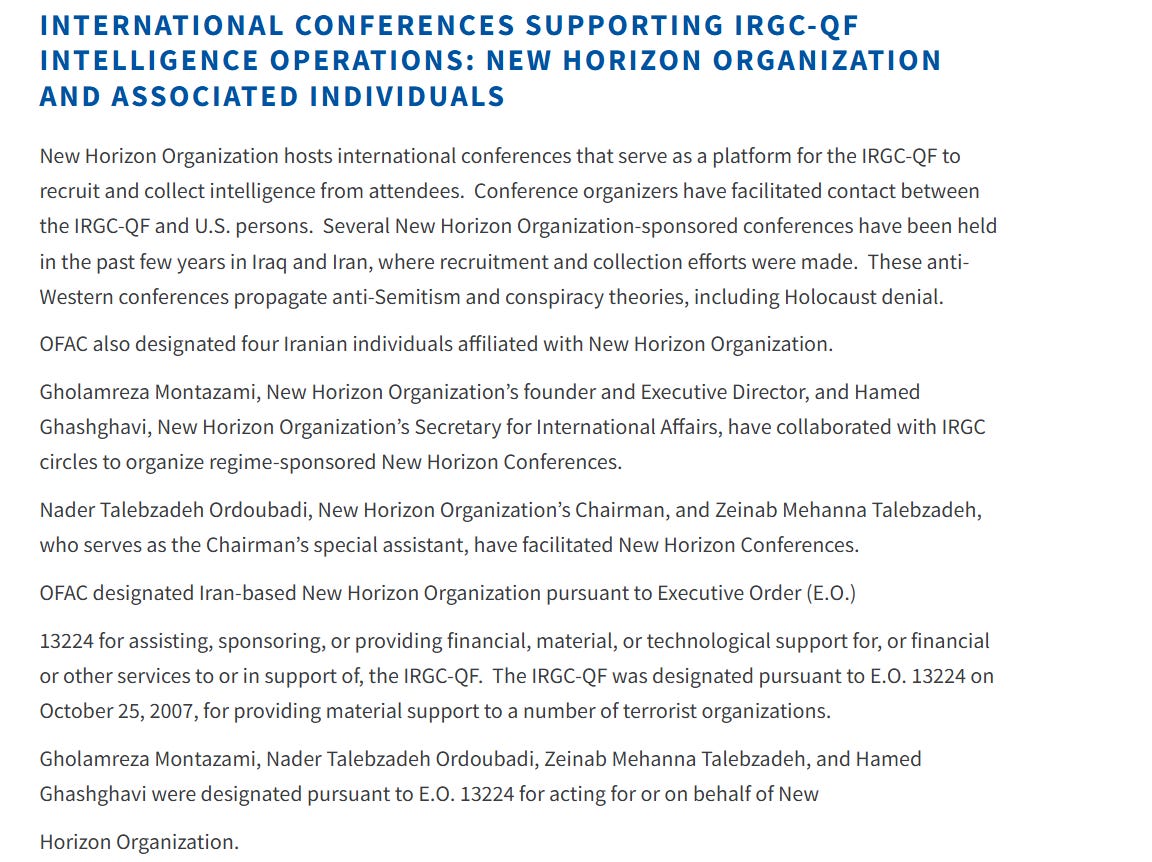
A Jewish Onliner review found that participants include Yasir Qadhi, chairman of the Fiqh Council of North America and a member of the Qatar-based International Union of Muslim Scholars; Mamdani-linked figures Ali Najmi and Yasser Salem; an Egyptian parliamentarian; and a former CAIR-New York official who attended the 2014 New Horizon Conference in Tehran. Five years later, the U.S. Treasury sanctioned the Iran-based New Horizon Organization for supporting Iran’s Islamic Revolutionary Guard Corps-Quds Force.
According to HabibiTech’s website, the summit is an initiative of the AI Sustainable Development Group, a New York-based nonprofit registered as a 501(c)(3). AISDG separately lists Islamic Relief USA, Wahed Invest, Ethar Relief and Qahwah House among its “Partners & Collaborators.” The group says the list covers relationships across HabibiTech and its other programming, meaning the designation does not necessarily establish that each organization is financing or formally sponsoring the September summit.
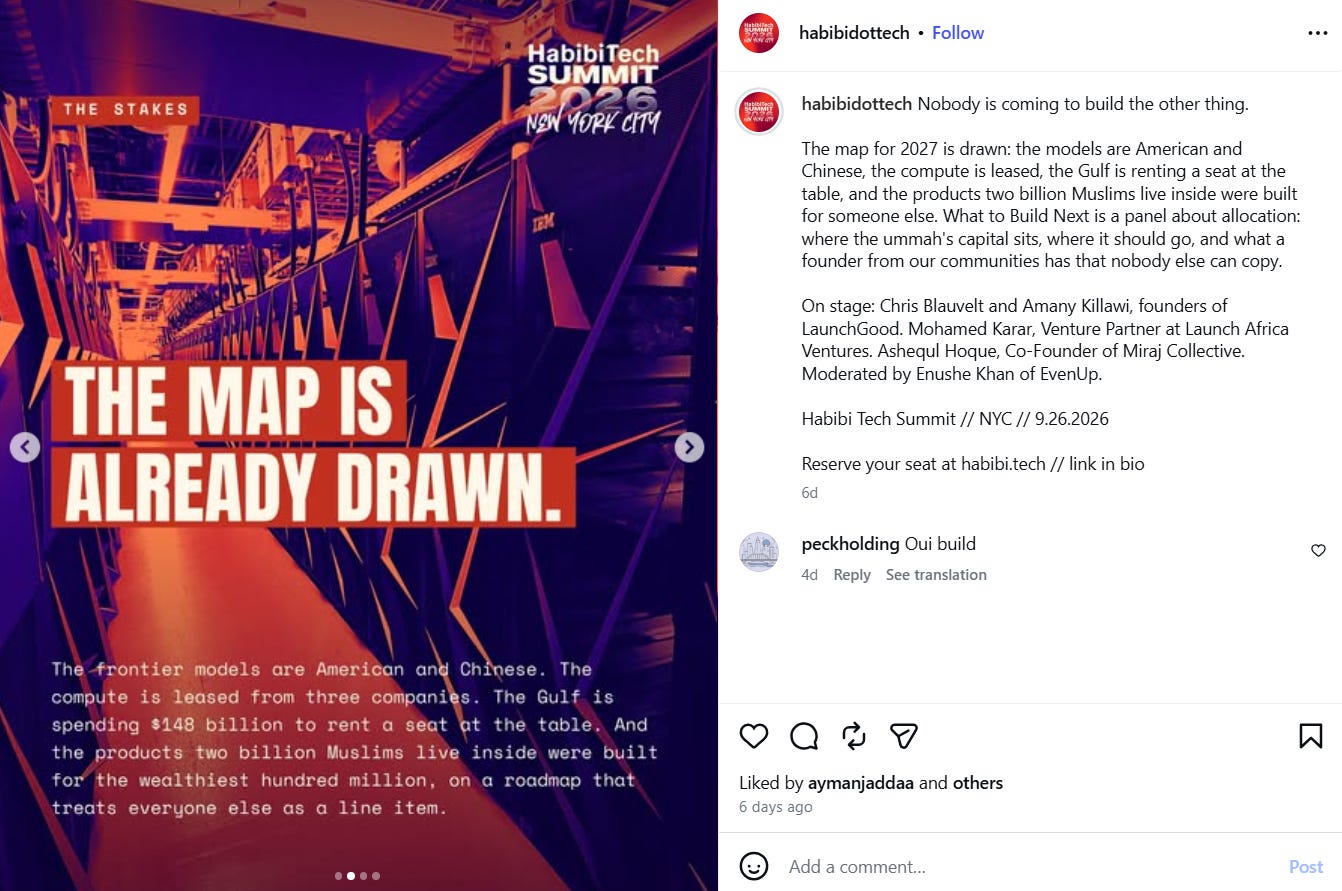
HabibiTech’s own promotional material also frames the technology race in explicitly transnational Muslim terms. In one post, the summit says that “the models are American and Chinese” while the technology used by “two billion Muslims” was “built for someone else,” before advertising a discussion about “where the ummah’s capital sits, where it should go.” Another declares that the summit will establish “seven stands that define Muslim leadership on AI,” telling followers, “We are not subjects of this technology. We are its authors.”
The rhetoric presents the global Muslim ummah as a distinct constituency seeking its own technological influence, investment strategy and representation, even as the summit itself is being held in New York City during UN Week.
Alleged Brotherhood-Linked Institutions Appear in the AI Program
One of HabibiTech’s most prominent religious speakers is Yasir Qadhi, who will deliver a keynote titled “What We Owe the World We Build.” The conference is also programming discussions on the role of Islamic jurisprudence in emerging technology, including a session explicitly titled “Future of Fiqh: Using AI to Issue Fatwas.”
Qadhi currently serves as chairman of the Fiqh Council of North America, or FCNA. The council’s own history says it began with the Muslim Students Association’s Religious Affairs Committee, which evolved into the Fiqh Committee of the Islamic Society of North America, or ISNA, before becoming FCNA in 1986. FCNA says it remains an affiliate of ISNA.
That organizational history intersects with the 1991 Muslim Brotherhood “Explanatory Memorandum” previously examined by Jewish Onliner. An attachment to the memorandum listed what it called “our organizations and the organizations of our friends,” including ISNA, the Muslim Students Association, the Islamic Circle of North America, Muslim Youth of North America and “IFC,” the ISNA Fiqh Committee, the institutional predecessor identified by FCNA itself.
Qadhi also has a second connection to a major transnational Islamic organization. As Jewish Onliner reported earlier this month, Qadhi publicly identified himself as a member of the International Union of Muslim Scholars, or IUMS, in a June 2025 social media post.

IUMS says it was established in 2004 with the “pivotal contribution” of Yusuf al-Qaradawi, who became its founding president. The organization later moved its headquarters to Doha, Qatar. Qaradawi was widely described as a spiritual guide to the Muslim Brotherhood.
Qadhi therefore occupies roles in two institutions with distinct historical connections to Brotherhood networks: he chairs FCNA, whose institutional predecessor appears in the 1991 Brotherhood memorandum, while also identifying himself as a member of the organization founded with Qaradawi’s pivotal involvement.
He is not the only HabibiTech participant whose background overlaps with organizations named in the 1991 document.
Ozair Hasan, who will join Qalam Institute founder AbdulNasir Jangda for the AI-fatwa session, currently serves as Qalam’s head of IT and previously worked as an AI software engineer at Yaqeen Institute. HabibiTech says Hasan was raised in Dayton, Ohio.
ISNA records from 2016 identify an Ozair Hasan of Dayton as a Midwest regional program chair for MYNA. ISNA’s 2018 national convention program subsequently identifies “MYNA President Ozair Hasan.” That program also lists Qadhi and Jangda in MYNA programming.
MYNA, the Muslim Youth of North America, is another organization specifically named in the 1991 Brotherhood memorandum’s organizational attachment.
The institutional overlap extends further. Qalam founder AbdulNasir Jangda and Yaqeen scholar Mohamed AbuTaleb both appear on the current ICNA-MAS Annual Convention speaker roster. HabibiTech’s religious programming therefore brings together figures with leadership roles, employment histories or speaking appearances across FCNA, IUMS, ISNA, MYNA, ICNA-MAS, Qalam and Yaqeen while discussing how Islamic law should interact with emerging artificial intelligence.
Mamdani-Linked Figures Take the Stage
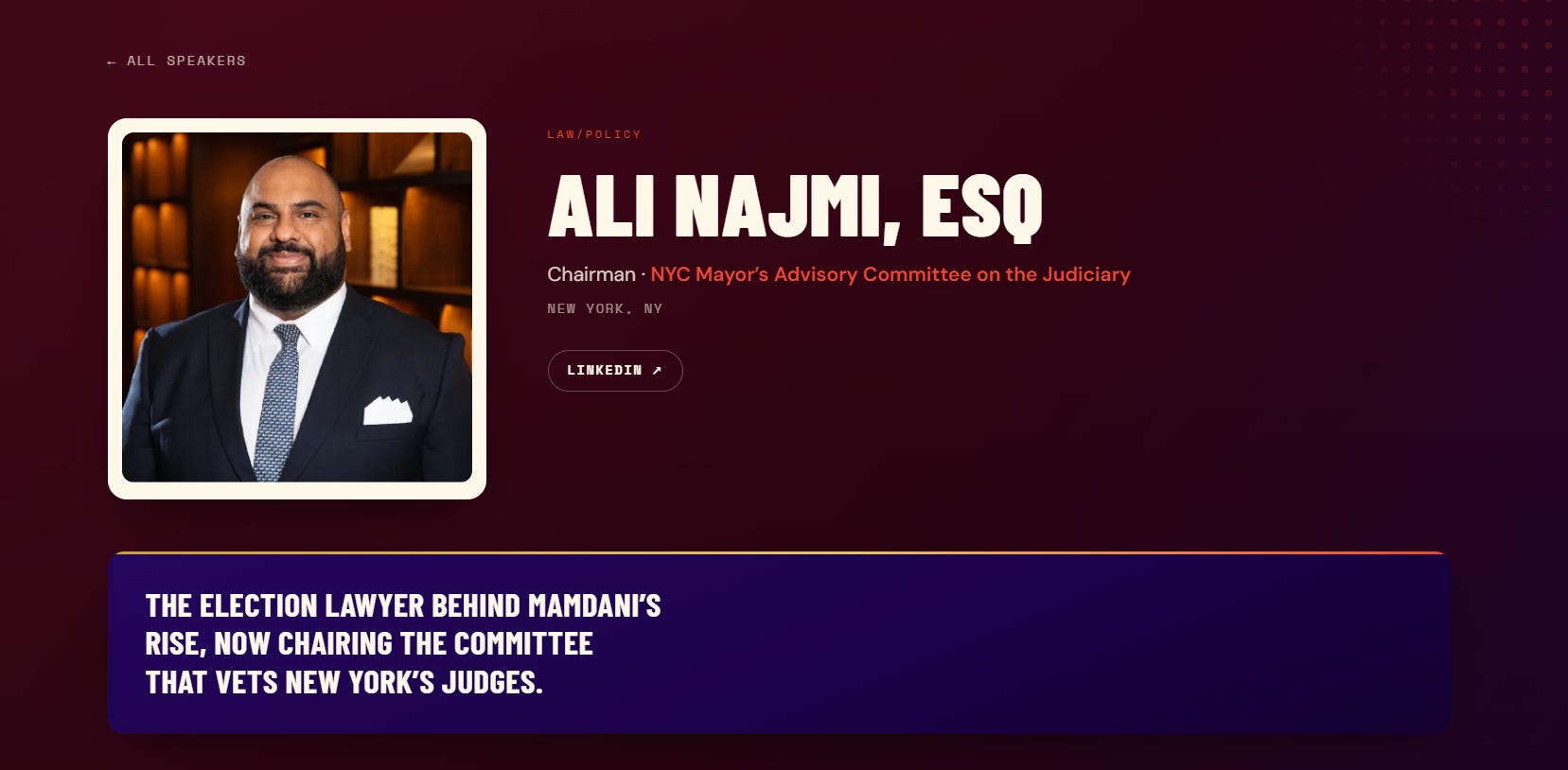
The summit also features figures with direct ties to New York Mayor Zohran Mamdani. Attorney Ali Najmi is scheduled to appear on HabibiTech’s “Reimagining NYC & Urban Innovation” panel. In January, Mamdani appointed Najmi chairman of the Mayor’s Advisory Committee on the Judiciary, which recruits and evaluates candidates for judicial appointments. Mamdani said at the announcement that he had known and admired Najmi for more than a decade. Najmi is also a co-founder of the Muslim Democratic Club of New York, a Muslim political organization operating in the city.
Appearing on the same HabibiTech panel is Yasser Salem, founder of OneNYC. HabibiTech itself describes Salem as someone who brought more than 70 CEOs together with New York’s new mayor before joining Mamdani’s transition team.
A 2026 OneNYC coalition report lists Salem, Najmi and HabibiTech Executive Director Ramy Noaman alongside Afaf Nasher, executive director of the New York chapter of the Council on American-Islamic Relations; Sherif Ahmed, executive director of the Muslim American Society of New York; Arman Chowdhury, national executive director of the Muslim Ummah of North America; Oussama Jammal, secretary general of the U.S. Council of Muslim Organizations; and Tariqur Rahman, president of the New York chapter of the Islamic Circle of North America, among the coalition’s signatories.
Foreign Connections Extend Beyond the Speakers
AISDG’s partner list also includes organizations with significant foreign state-backed financial ties.
The nonprofit lists Wahed Invest among its partners and collaborators. Wahed itself describes the company as backed by Saudi Aramco’s Wa’ed Ventures and Qatar Development Bank.
Saudi Aramco describes Wa’ed Ventures as Aramco’s venture-capital fund. In 2023, Aramco increased the fund’s size to $500 million as part of its strategy to develop Saudi Arabia’s technology ecosystem.
Qatar Development Bank separately invested in Wahed, with a QDB report saying the investment helped the U.S.-based Islamic wealth-management company establish a regional office in Qatar.
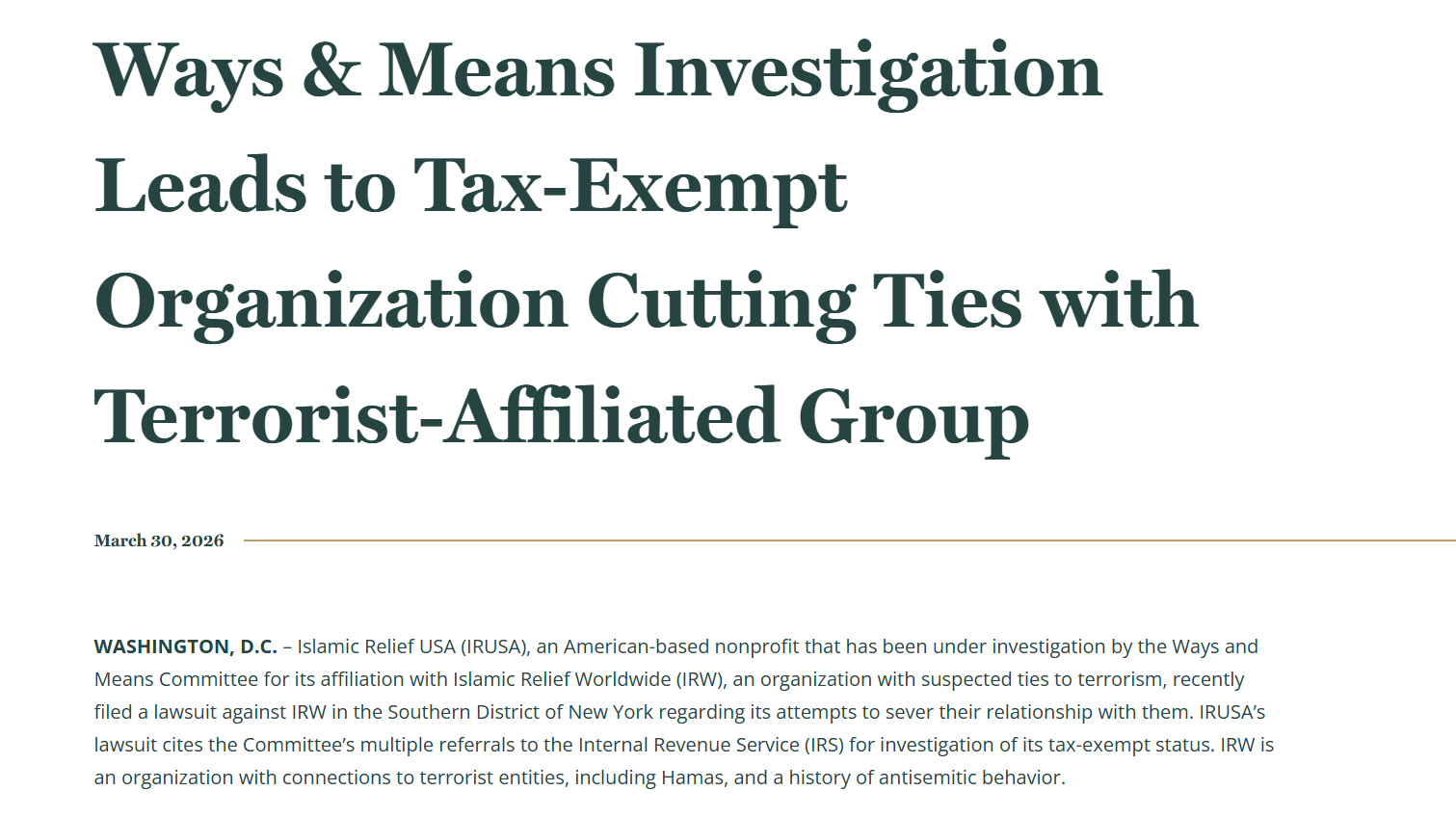
Another AISDG-listed partner, Islamic Relief USA, has faced congressional scrutiny over its financial relationship with Islamic Relief Worldwide. The House Ways and Means Committee said IRUSA gave IRW £67 million in 2022, equal to 29 percent of IRW’s income that year, and made multiple IRS referrals concerning IRUSA’s tax-exempt status. IRUSA later severed ties with IRW, citing “transparency and compliance concerns,” and filed a federal lawsuit against the organization. On September 12, IRW expelled IRUSA from its federation with immediate effect.
Foreign political connections also appear directly on HabibiTech’s speaker roster.
Sahar Albazar is deputy chair of the Foreign Affairs Committee in Egypt’s parliament and serves as secretary for foreign relations of Egypt’s Mostaqbal Watan party. HabibiTech has placed her on a session about governing and building artificial intelligence “from Queens to Cairo.”
Another speaker, Cyrus McGoldrick, is a former CAIR-New York official now based in Istanbul. An academic CV published by Ibn Haldun University lists McGoldrick as a presenter at the New Horizon Conference in Tehran in September 2014.
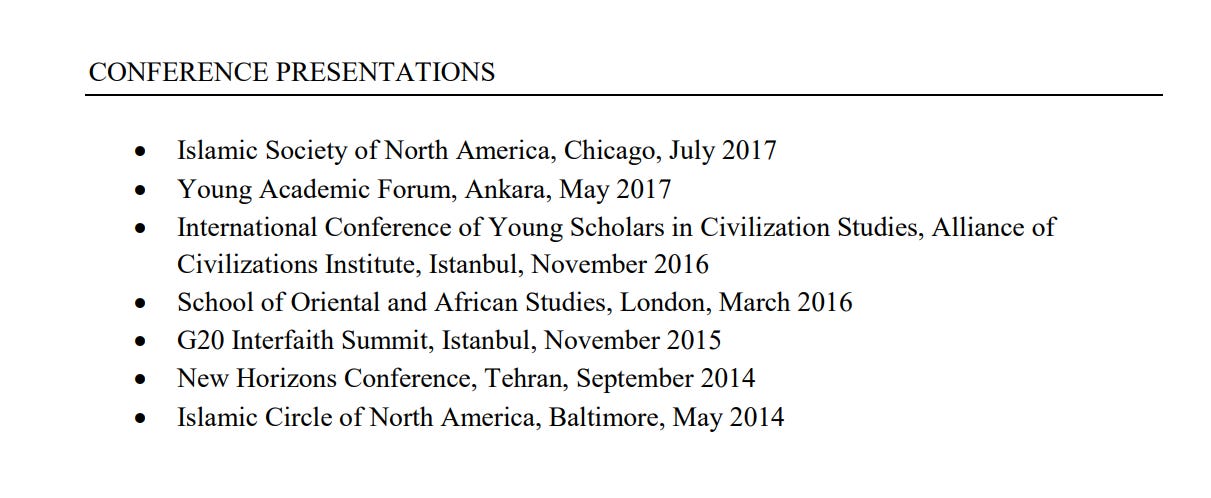
Five years later, the U.S. Treasury designated the Iran-based New Horizon Organization under Executive Order 13224, saying its conferences supported IRGC-Quds Force efforts to recruit and collect intelligence from foreign attendees, including Americans.
From Tech Summit to Influence Network
HabibiTech is billed as a technology summit, but its agenda points to something much broader. The September 26 event brings together political figures, Islamic institutions, foreign-linked organizations and speakers focused on shaping how Muslims engage with AI, capital and governance.
The result is not simply another industry conference. It is a platform for building political, religious and financial influence around technologies that are rapidly becoming central to public life.
The Statue of Liberty should be holding a sign, "Our Founders are Rolling In Their Graves."
When are we going to shut these organizations down?!