


Founded in 1965 by leaders of the Muslim Students Association, Islamic Book Service began as a distributor of Islamic literature for Muslim students in North America and at times advertised itself as the largest Islamic bookstore in North America. Decades later, NAIT’s own publications describe IBS as its oldest division, working in coordination with American Trust Publications to distribute thousands of titles through online platforms and major retailers.
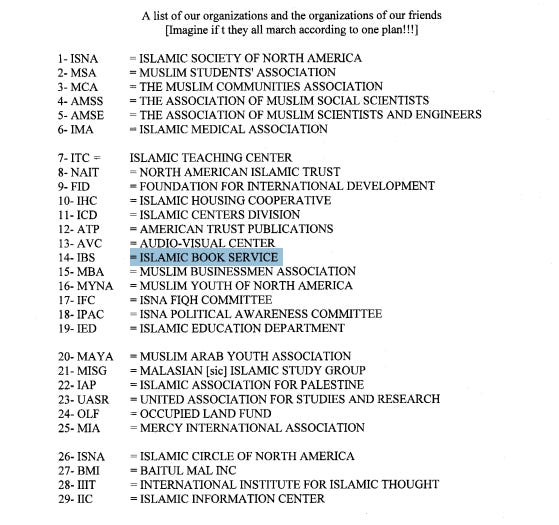
IBS appears as organization #14 on the Muslim Brotherhood's 1991 Explanatory Memorandum—a strategic document seized by the FBI and entered as evidence in federal court. The memo describes the Brotherhood's work in America as "a kind of grand Jihad in eliminating and destroying the Western civilization from within and 'sabotaging' its miserable house by their hands and the hands of the believers so that it is eliminated and God's religion is made victorious over all other religions."
The document explicitly lists IBS alongside 28 other organizations as comprising "our organizations and the organizations of our friends." The memo adds in excited annotation: "[Imagine if they all march according to one plan!!!]"
Today, IBS appears to operate as a division of the North American Islamic Trust (NAIT), which was also named in the 1991 Brotherhood memo and listed as an unindicted co-conspirator in the landmark Holy Land Foundation terrorism-financing case.
The memo lists several interconnected institutions, while NAIT’s own materials describe IBS and ATP as part of its publishing-and-distribution infrastructure.
NAIT’s Oldest Division
According to NAIT’s own 50th-anniversary publication in Islamic Horizons magazine, IBS is described as “NAIT’s oldest division,” operating “in coordination with” American Trust Publications. The publication states that together, “NAIT published and sold over 2,600 book titles” which are “now printed on demand and available through online platforms.” Those online platforms include Walmart, which features a dedicated brand page for Islamic Book Service, offering categories including “General Islamic Books,” “Islamic Rituals & Practice Books,” and “Koran & Sacred Writings.”
NAIT’s own historical account confirms that IBS was among “several valuable pioneering projects” that were “reorganized” before NAIT’s formal establishment in 1973. The infrastructure grew systematically: NAIT established the Audio Visual Center in 1981 to produce AV materials, then set up “the world’s largest Muslim-owned commercial audio cassette duplication facility” in 1983, with a production capacity of 1.2 million cassettes per year, which enabled NAIT to “reproduce the tapes required for Quranic albums and Islamic recordings.”
NAIT’s own materials describe IBS as a division rather than a standalone organization, and GuideStar says NAIT is not required to file an annual IRS return because it is a religious organization. Historical references place Islamic Book Service at 2622 E. Main Street in Plainfield, Indiana, while ISNA lists its physical address in the same town at 6555 S. County Road 750 East, Plainfield. This indicates that IBS and ISNA were historically based in the same Indiana hub.
Because NAIT is not required to file an annual IRS return as a religious organization, publicly available financial detail about IBS itself is limited. That makes it difficult to assess IBS’s standalone revenue, expenses, and funding streams from public filings alone.
The Jihadist Reading List
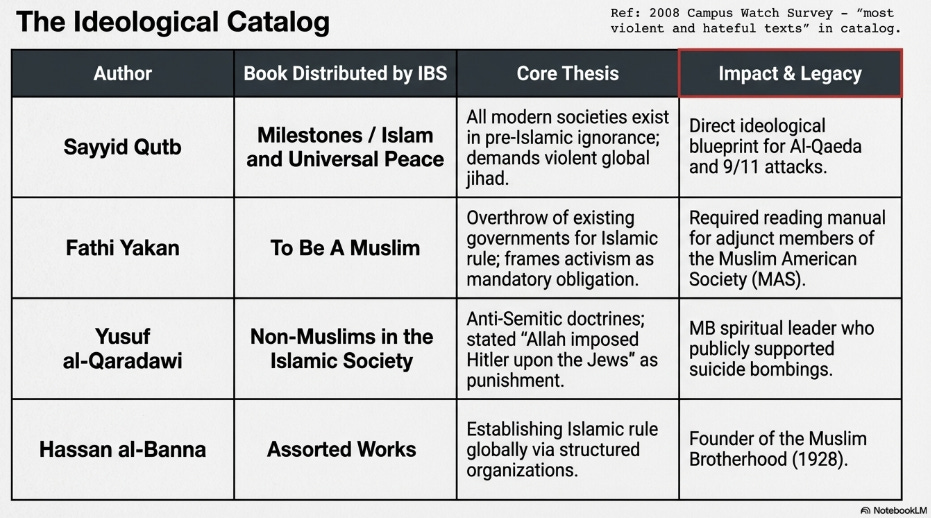
A March 2008 survey by Campus Watch documented the extremist titles featured in IBS’s catalog, revealing what appears to be a systematic effort to distribute Muslim Brotherhood ideological works. According to Campus Watch, IBS features “the most violent and hateful texts” in its catalog, functioning as what the Muslim Brotherhood viewed as “a potentially valuable ally in the pursuit of the Brotherhood’s aforementioned mission, given IBS’s ability to disseminate widely, through its publications, the ideas and worldviews necessary to help galvanize a pro-Islam, anti-West movement.”
At the top of the extremist list sits “Milestones” by Sayyid Qutb, the executed Muslim Brotherhood ideologue whose work has been described by The New York Times as penned by “the philosopher of Islamic terror.”
Published by American Trust Publications under ISBN 0892590769, Qutb’s writings directly influenced al-Qaeda leadership, including Osama bin Laden and Ayman al-Zawahiri, and academic research has documented Qutb’s influence on the 9/11 attacks.
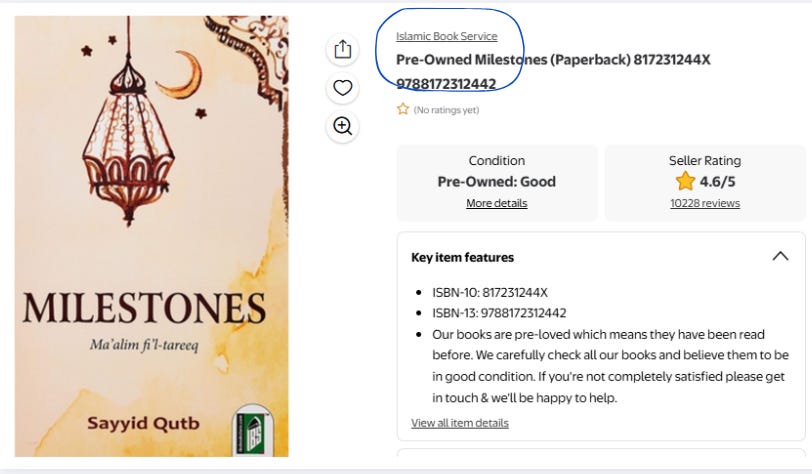
In “Milestones,” Qutb declares all modern societies—including Muslim-majority nations—as existing in a state of pre-Islamic ignorance (jahiliyyah) and calls for violent jihad to establish Islamic rule globally. The Counter Extremism Project notes that “Sayyid Qutb’s extremist theories have helped inform the tenets of an ideological umbrella under which Al Qaeda and the Islamic State operate.” Walmart currently sells “Milestones” through third-party marketplace sellers, listed under the IBS title.
IBS also features “Islam and Universal Peace” by Sayyid Qutb, which the service describes as explaining “the Islamic concept of peace and its universal nature.” The author’s writings are so popular among jihadists that some have labeled Osama bin Laden a “Qutbist.”
The catalog includes works by Hassan al-Banna, the Muslim Brotherhood’s founder, who established the organization in 1928 with the explicit goal of establishing Islamic rule. The 1991 memorandum references al-Banna’s organizational model, stating that “the pioneer of the contemporary Islamic Dawa’, Imam martyr Hasan al-Banna” established “organizations with all their kinds: economic, social, media, scouting, professional and even the military ones.”
Another featured author is Yusuf al-Qaradawi, the Muslim Brotherhood’s spiritual leader until his death in 2022 who publicly supported suicide bombings against Israeli civilians and U.S. troops. IBS distributes “Non-Muslims in the Islamic Society” by Qaradawi, who in a 2009 statement declared that “Allah imposed Hitler upon the Jews” as punishment and that “Allah willing, the next time will be at the hands of the believers.”


Required Reading for Extremism
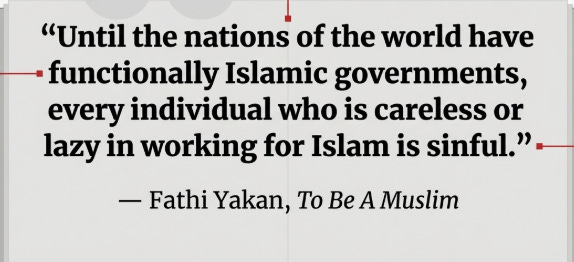
Among the most disturbing titles in IBS’s catalog is “To Be A Muslim” by Fathi Yakan, which serves as required reading for all adjunct members of the Muslim American Society (MAS). The book explicitly advocates for the overthrow of existing governments and their replacement with Islamic rule. In Part II of the text, under the section titled “The Compulsory Nature of Islamic Activism,” Yakan writes: “Until the nations of the world have functionally Islamic governments, every individual who is careless or lazy in working for Islam is sinful.”
The book’s second part, subtitled “Living for Islam,” focuses entirely on “the responsibility to become an activist for Islam and participate in the Islamic Movement” and “explains the nature of this movement and its goals, philosophy, strategy, and tactics.” Yakan explicitly describes the Islamic movement’s “general task” as “Universal Outreach” and outlines detailed organizational structures, strategic planning, and the “tools of the Islamic Movement.” The text frames Islamic activism not as a voluntary religious practice but as a mandatory obligation for all Muslims, stating that the purpose is to work toward establishing “functionally Islamic governments” worldwide.
Yakan has publicly accused the Bush Administration of “naked aggression against Muslims” and “systematically destroying Islamic infrastructure” while urging “Muslims everywhere to unite in an effort to defeat America.” This book, distributed by IBS and required by the Muslim American Society—itself an organization with alleged Muslim Brotherhood connections—essentially serves as a manual for advancing the same “civilization-jihadist process” outlined in the 1991 memorandum.
Banned in Los Angeles Schools
One of the most significant controversies involving IBS’s catalog occurred in 2002, when ‘The Meaning of the Holy Quran’—a Quran translation with commentary distributed by IBS—was removed from Los Angeles Unified school libraries after officials found anti-Semitic commentary in the notes.
Nearly 300 English and Spanish-language copies were permanently removed from Los Angeles public school libraries after officials reviewed the footnotes and found them objectionable. The donated copies, provided by the Omar Ibn Khattab Foundation, featured commentary that the school district determined crossed the line from religious text to anti-Semitic propaganda.
According to the Chicago Tribune, officials discovered the problematic commentary after a parent complained. The Los Angeles Times reported that school officials decided the translation’s notes were “anti-Semitic,” leading to the books’ removal and replacement with a different translation. This incident revealed how IBS’s distribution network could place extremist-aligned materials into mainstream American institutions, including public schools, under the guise of providing religious resources. The fact that the book had been accepted and catalogued by school librarians demonstrates the challenge of identifying ideologically problematic content when it arrives dressed as religious scholarship.
The Brotherhood’s Media Strategy
The 1991 Explanatory Memorandum explicitly outlines the Muslim Brotherhood’s plan for a comprehensive “Media and Art Organization” as part of its settlement strategy. Under the section titled “Comprehensively [The Media and Art Organization],” the document lists objectives including a daily newspaper, weekly and monthly magazines, radio stations, television programs, audio and visual centers, print and typesetting machines, a production office, a photography and recording studio, art bands for acting and chanting, and a marketing and art production office.
The organizational evolution followed the Brotherhood’s incremental approach: MSA founded IBS in 1965 to serve Muslim students; those same MSA leaders established NAIT in 1973 as a waqf (Islamic trust) to hold mosque properties; NAIT then founded American Trust Publications in the 1970s as its publishing division; and IBS became NAIT’s distribution arm, described in NAIT’s anniversary publication as working “in coordination with” ATP.
From Student Organization to Walmart
IBS’s trajectory appears to align with the Muslim Brotherhood’s documented strategy of building American institutional infrastructure. Later scholarship identifies Ahmad Totonji, Jamal Barzinji, and Hisham al-Talib as key early MSA figures and important Brotherhood-linked activists in the United States. These three figures arrived in the United States in the early 1960s and maintained ties to Yussuf Nada, widely described as a key financier for the Muslim Brotherhood. These same individuals appear throughout the organizational network named in the 1991 memorandum, with Barzinji and al-Talib listed among NAIT’s founding board members.
The 1991 memorandum’s organizational list reveals the interconnected nature of the Brotherhood network. Organization #1 is ISNA (Islamic Society of North America), #8 is NAIT (North American Islamic Trust), #12 is ATP (American Trust Publications), #14 is IBS (Islamic Book Service), and #17 is IFC (ISNA Fiqh Committee, now Fiqh Council of North America). All five organizations appear to share overlapping leadership, common addresses, and coordinated functions.
ISNA provides the institutional umbrella and convenes annual conferences that have reportedly drawn tens of thousands of attendees. NAIT holds title to over 400 properties across the United States and Canada. The Fiqh Council issues religious rulings. ATP publishes the books. And IBS distributes them—through Islamic bookstores, community centers, and now through major retailers like Walmart and Amazon.
Renewed Scrutiny
In January 2026, the State Department designated the Lebanese Muslim Brotherhood as a Foreign Terrorist Organization, while Treasury designated the Egyptian and Jordanian branches as Specially Designated Global Terrorists.
Multiple states have enacted or introduced legislation restricting Sharia law application, with Florida, Texas, and Oklahoma taking action against Brotherhood-affiliated entities. Yet IBS continues operating as it has for nearly six decades: distributing ideological literature through a network that the Brotherhood’s own documents describe as working toward civilizational jihad.