


Jewish Onliner is an independent publication. If you find our work valuable, please consider becoming a paid subscriber. You can also subscribe to us on WhatsApp and Telegram. Follow us on Instagram, Discord, and X.
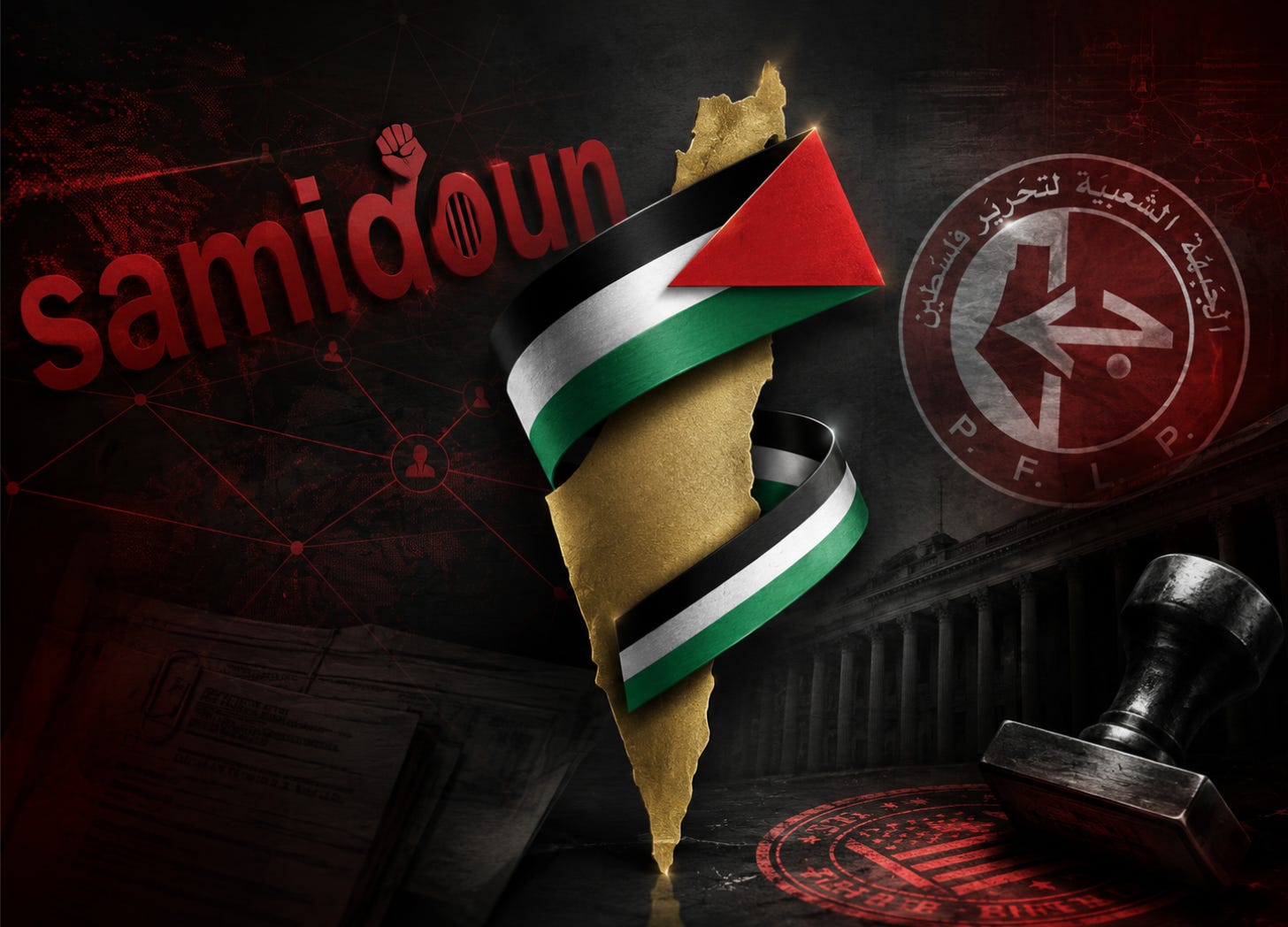
The U.S. Treasury Department sanctioned Masar Badil and two of its senior leaders on Wednesday, formally determining that the transnational movement operates as a front for the U.S.-designated terror group, the Samidoun Palestinian Prisoner Solidarity Network.
The action corroborates findings covered by Jewish Onliner since its inaugural article on November 12, 2024, which traced the shared personnel and activities connecting Masar Badil to Samidoun. On May 20, 2026, a second Jewish Onliner investigation identified Masar Badil as a likely sanctions target after OFAC designated Mohammed Khatib and Jaldia Abubakra, both Samidoun officials and members of Masar Badil’s executive committee. Three months later, OFAC designated the movement itself and two additional leaders.

Treasury also sanctioned the UK-based Palestine Action and Italy-based digital infrastructure provider Autistici Inventati as part of an enforcement package targeting what the department described as violent far-left terrorist networks.
“Far-left extremists, their fronts, and their enablers should be on notice,” Treasury Secretary Scott Bessent said, adding that the department would continue cutting the groups’ financial lifelines.

Treasury Formalizes the Samidoun Connection
The Office of Foreign Assets Control designated Masar Badil under Executive Order 13224 for being owned, controlled or directed by Samidoun, or for acting on Samidoun’s behalf.
In October 2024, the United States sanctioned Samidoun, while Canada listed it as a terrorist entity. Treasury described Samidoun as a sham charity serving as an international fundraiser for the Popular Front for the Liberation of Palestine (PFLP). The United States has designated the PFLP as a Foreign Terrorist Organization (FTO) since 1997.
Treasury described Masar Badil as “inextricably linked” to Samidoun and noted that one of its senior leaders had characterized the organizations as components of the same political project. According to the department, they share fundraising mechanisms, senior officials and members of their respective executive committees.
The overlapping personnel include Khaled Barakat, Mohammed Khatib and Jaldia Abubakra, all of whom Treasury previously sanctioned. OFAC’s latest action added Germany-based Zaid Abdulnasser and Brazil-based Rawa Alsagheer to the sanctions list for serving as leaders or officials of Masar Badil.
The designation blocks all property and assets of Masar Badil, Abdulnasser and Alsagheer that are in the United States or in the possession or control of U.S. persons. Entities owned, directly or indirectly, 50 percent or more by one or more blocked persons are also blocked. Unless authorized or exempt, transactions by U.S. persons or within the United States involving their property or interests in property are generally prohibited.

PoE Report Maps Masar Badil’s International Network
The Program on Extremism, housed at George Washington University, also published a 49-page report on Masar Badil in August 2026. The study examined how the movement has built an international network around armed resistance advocacy since its founding in 2021.

Researchers found substantial overlap with sanctioned entities through leadership, coordinated messaging and public calls for support. The report noted that Masar Badil’s platforms have hosted senior officials from Hamas, Hezbollah and the Houthis, memorialized deceased terrorists and promoted designated organizations and their campaigns.

Masar Badil claims to have conducted more than 1,000 “political and mass activities” since its founding. Its organizing has included international conferences, prisoner campaigns, political education, campus activism and the creation of youth and student networks.
The GWU study examined Tariq El-Tahrir, a youth and student network described by its organizers as Masar Badil’s “mass and organizing arm.” The network focuses primarily on universities in the United States, Canada and Europe. It does not publicly identify a separate legal entity, governing body or financial structure, while its website is linked directly from Masar Badil’s main navigation and uses an email address on the organization’s domain.


Researchers also found that Masar Badil’s public messaging became more explicit following the October 7 attacks. Its calls expanded from demonstrations and boycotts to “direct action,” strikes, blockades, civil disobedience and sustained confrontation.
The report concluded that Masar Badil was using campus partnerships, political education and international exchanges to move younger activists from general solidarity into an organized movement that normalizes designated terrorist organizations and accepts violence as a means of pursuing political objectives.
The Wider Network Now Faces Scrutiny
The designation shifts attention to the wider ecosystem Masar Badil has built across Europe and North America. The GWU report identified Tariq El-Tahrir, Nidal, Al-Ahrar Palestinian Prisoner Support, Alkarama and SUPER-UW among the movement’s affiliated, aligned or collaborating organizations. Masar Badil’s placement on the OFAC sanctions list may affect how financial institutions, online services, universities and foreign authorities assess fundraising, joint events and shared infrastructure involving these groups.


Their personnel overlaps and coordinated campaigns now warrant closer examination, particularly given the possibility that sanctions pressure will push the network to obscure its operations through lesser-known affiliates or newly created front organizations.