


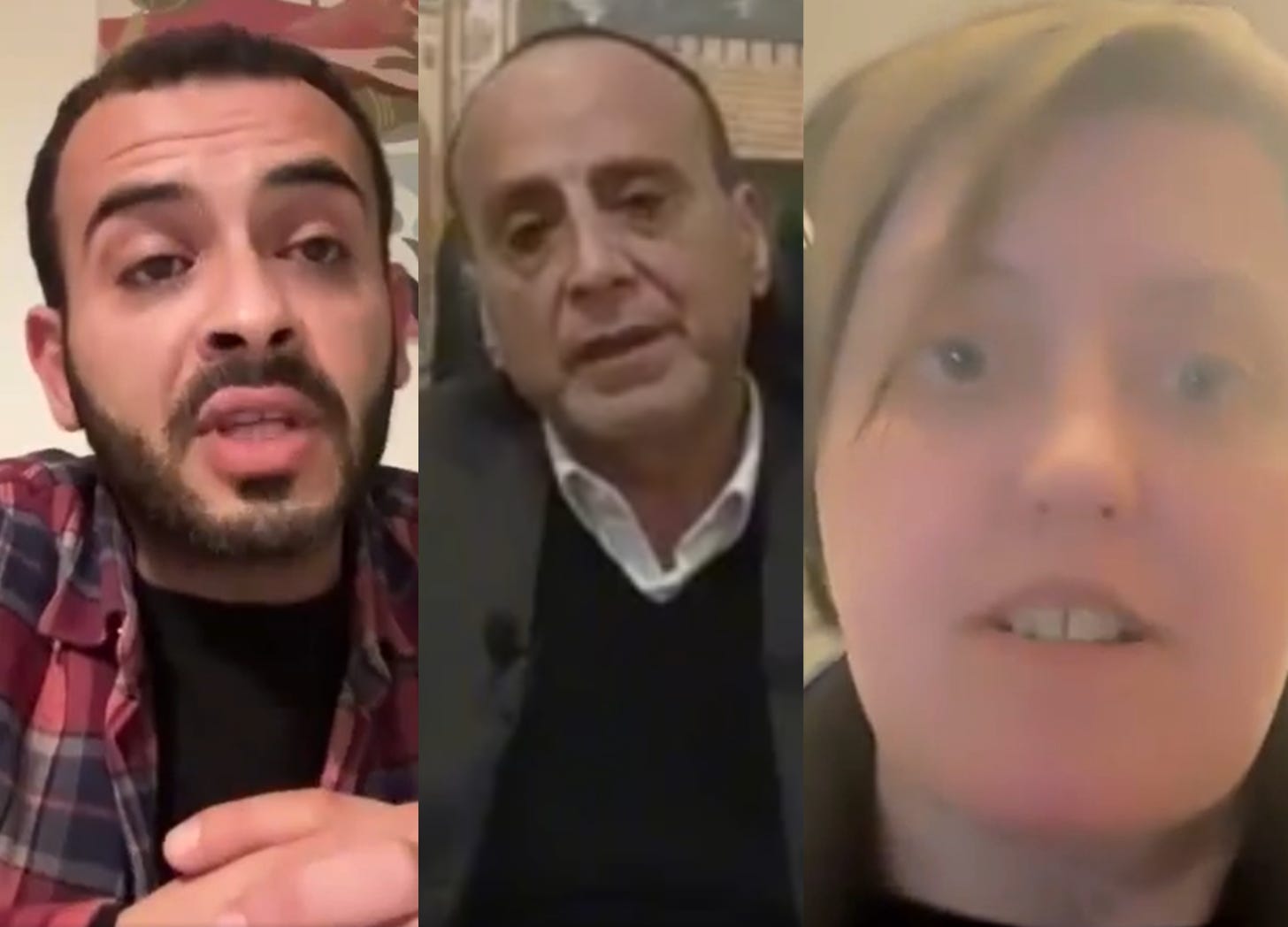
Masar Badil, a pro-Palestine organization with deep ties to the designated terrorist organization Samidoun, hosted an international online seminar featuring a senior Hezbollah official and representatives of the network implicated in supporting multiple U.S. and EU-designated terror groups.
The event brought together Charlotte Kates of Samidoun, Hezbollah’s head of Arab and International Relations Sayyed Ammar Moussawi, and Mohammed Khatib, the Belgium-based Europe coordinator of Samidoun—whose refugee status was revoked by Belgian authorities just months earlier over his documented support for designated terrorist organizations.
The seminar centered on discussions portraying what speakers characterized as “the resistance and Iran” as “the vanguard of forces defending the causes of liberation and independence throughout the region.”


The Featured Speakers and Their Records
Khatib is formally registered as a “hate preacher” with Belgium’s Coordination Unit for Threat Analysis (CUTA) due to his overt support for Hamas and the Popular Front for the Liberation of Palestine (PFLP), both EU-designated terrorist organizations.
Charlotte Kates, based in Canada, serves as Samidoun's international coordinator and is registered as the website owner and contact for Masar Badil. Kates has regularly co-hosted webinars where members of Hamas and other designated terrorist organizations have been interviewed and platformed.


Sayyed Ammar Moussawi represents Hezbollah's official diplomatic engagement efforts as the group's head of Arab and International Relations, positioning the seminar as a coordinated effort to present terrorist organizations as legitimate political actors on the world stage.
Growing Calls to Designate Masar Badil
Watchdog groups and European parliamentarians have long called for Masar Badil’s designation as a terror organization. The organization is closely associated with Samidoun and shares significant leadership overlap. Khaled Barakat, who leads both organizations, was personally sanctioned by the United States Office of Foreign Assets Control (OFAC) as a Specially Designated National in October 2024 for his role with the PFLP.
Though Masar Badil has not been formally designated as a terror entity in most jurisdictions, the organization has hosted multiple webinars featuring members of Hamas and the Houthis. These events have celebrated terrorist leadership and explicitly supported designated terror groups.
During a September 2024 Masar Badil webinar, Hamas spokesperson Sami Abu Zuhri referred to the group as "friends" and supporters. Host Mohammed Khatib reciprocated the sentiment, lauding Zuhri as a “brother and leader, while endorsing the October 7 attack. Khatib emphasized that participants view themselves as active participants in the “Palestinian resistance” rather than mere supporters.

Belgian Government Action
Belgium has taken a stronger stance to counter the threat posed by these networks. Belgian PM Bart De Wever announced plans to ban Samidoun in July 2025, introducing legislation that would permit the prohibition and dissolution of organizations posing threats to national security.
In his address to the Chamber, De Wever noted that “organizations like Samidoun glorify terrorist groups and their atrocities but are careful never to be caught explicitly inciting violence. They exploit our freedoms to spread toxic ideologies without committing criminal offenses that would lead to prosecution.”