



On Tuesday, March 3, 2026 on the Jewish festival of Purim, Israel's military continued its joint operation with the United States against the Islamic Republic of Iran, striking over 600 targets since the campaign began on February 28. Purim commemorates the Jewish people's survival from a genocide plotted in ancient Persia — the territory that today constitutes modern Iran. Across Israel, Purim celebrations moved into bomb shelters as Iranian retaliatory missiles continued to fall.
Meanwhile, Iranians in cities around the world poured into the streets to celebrate the elimination of Supreme Leader Ayatollah Ali Khamenei and call for the end of the Islamic Republic.
Khamenei's 37-year rule left a documented record of mass executions, the killing of political protesters, the suppression of women's rights, and the financing of terror groups responsible for a large number of American deaths — a legacy that helps explain why news of his death was met not with mourning by his own people, but with dancing in the streets.
The convergence of these events on a single day has drawn widespread attention to a thread of history stretching back more than two and a half millennia and the ancient, Biblical connection between the Jews and the Persians.
The Debt That Goes Back 2,500 Years
To understand why the timing of these events has resonated so deeply, the story starts in 539 BC. The Jewish people were in captivity in Babylon — their Temple destroyed by Nebuchadnezzar and their national existence in ruins — when the Persian King Cyrus the Great conquered Babylon and issued a decree freeing the Jewish exiles and authorizing the rebuilding of the Temple in Jerusalem.
Cyrus did not merely free the exiles. He returned the sacred Temple vessels Nebuchadnezzar had plundered and provided funding for the reconstruction. The Cyrus Cylinder — a clay inscription discovered in 1879 and now held in the British Museum — archaeologically corroborates the biblical account, confirming Cyrus’s policy of returning displaced peoples to their homelands. The prophet Isaiah had referenced Cyrus by name approximately 150 years before his birth — calling him God’s “anointed,” the only non-Jewish figure in Scripture to receive that designation.
Haman, Khamenei, and the Holiday Being Observed Today
The Book of Esther, read aloud in synagogues twice on Purim, tells the story of Haman — a senior official in the Persian court of King Xerxes — who plotted to exterminate the Jewish population of the Persian Empire. A Jewish woman named Esther, who had become queen, intervened at personal risk and the plot was thwarted. The holiday of Purim has marked that deliverance ever since.
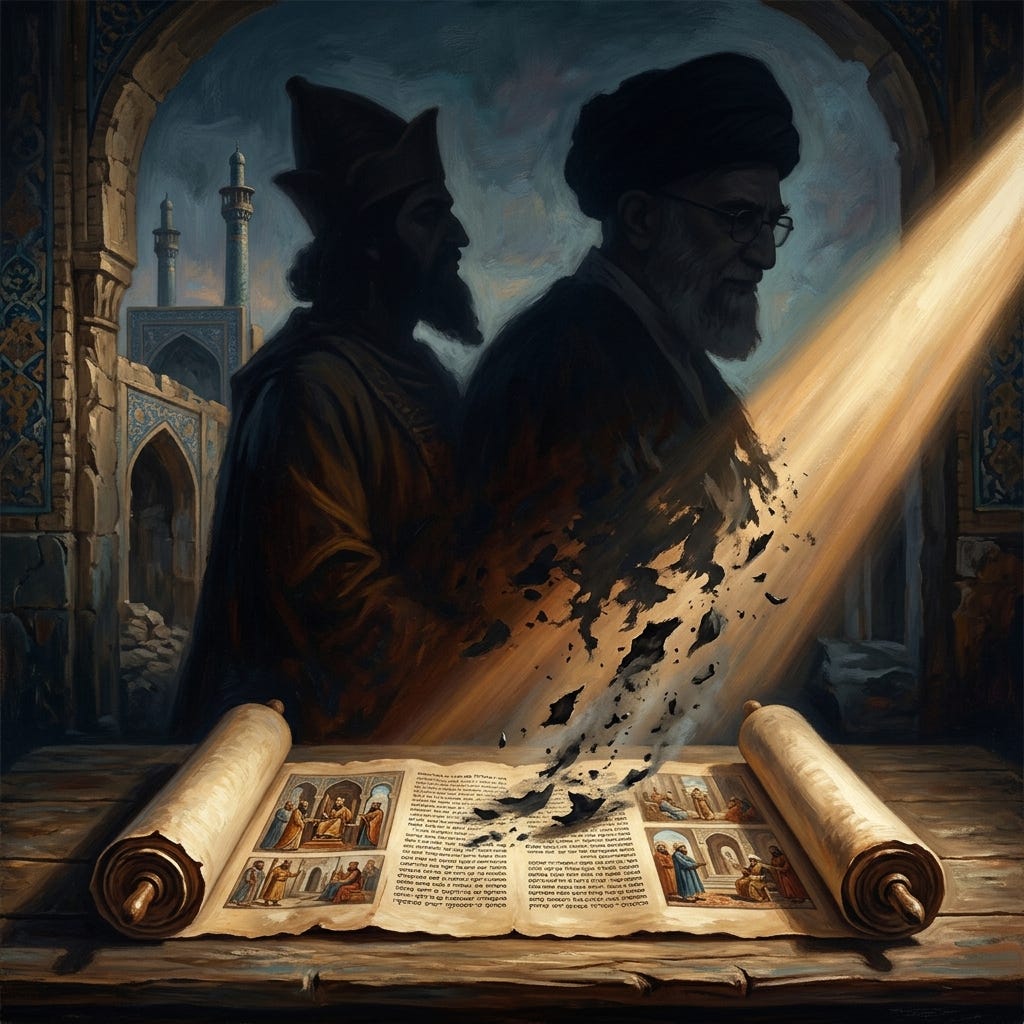
Iranian state media confirmed Khamenei’s death on February 28, following US-Israeli strikes on Tehran. A transitional council has been established to manage the succession. Commentators and observers across social media have drawn direct parallels between the Purim narrative and the current conflict.
Iranians and Jews Celebrate Together
The response from Iranian communities worldwide has been notable. In Golders Green, North London, Iranians and Jews gathered in the streets together following news of Khamenei’s death, with Iranians shouting “Long live Israel” and flying the US flag
In Westwood, Los Angeles — home to the largest Iranian diaspora community outside Iran — thousands rallied for a second consecutive day calling for regime change, with Iranian Americans describing hope for a secular democratic Iran. Inside Iran itself, large crowds took to the streets overnight following the announcement of Khamenei’s death, though PBS News Hour noted that celebrations inside the country were tempered by decades of fear and deep uncertainty about what comes next.

A Historical Reversal That Has Captured Global Attention
Before 1979, Israel and Iran maintained a close strategic partnership. El Al operated regular flights between Tel Aviv and Tehran. An estimated 100,000 Jews lived in Iran. The Brookings Institution has noted that the hostility between the two countries dates specifically to the 1979 Islamic Revolution — not to any deeper historical enmity between the two peoples.
The parallel between Cyrus’s liberation of the Jewish people and the current moment has been widely noted. The Jerusalem Post observed: “As Cyrus the Great once liberated Israel, Israel now liberates Iran.” The Jerusalem Post separately quoted Abraham Accords advocate Loay Alshareef, who argued that Cyrus’s ancient act toward the Jewish people created a historical debt now being repaid. One widely shared social media post on February 28 captured the sentiment: “538 BCE: Persia frees the Jews. 2026 CE: Jews free the Persians.”
On Purim 2026, the convergence of ancient text and current events is one that Jewish communities — and Iranian ones — are marking with a sense of history that is difficult to ignore.
How come the name "Cyrus" never managed to be accepted as a name of Jews?