


Jewish Onliner is an independent publication. If you find our work valuable, please consider becoming a paid subscriber. You can also subscribe to us on WhatsApp and Telegram. Follow us on Instagram, Discord, and X.
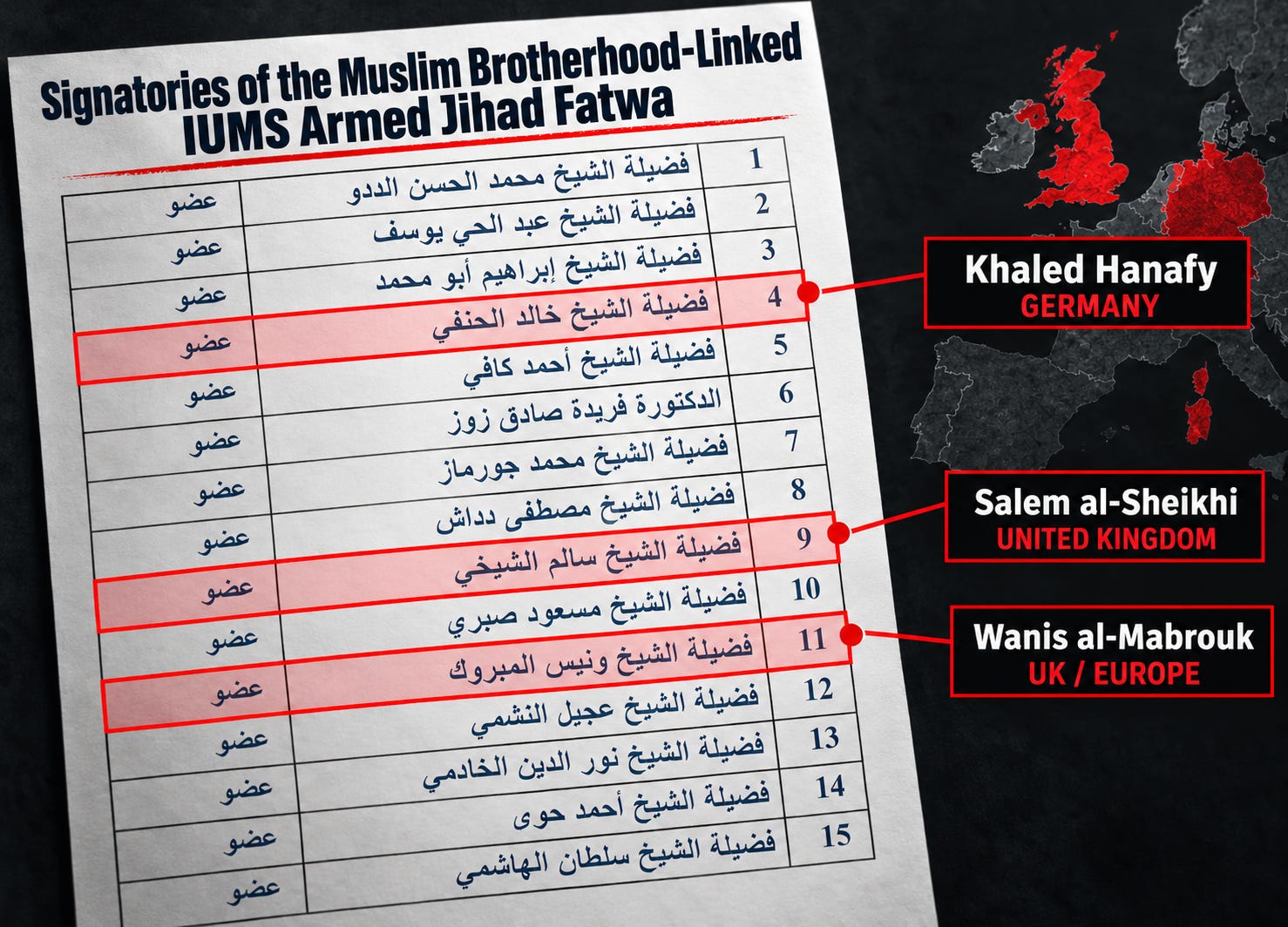
Three Islamic scholars with documented connections to Britain and Germany were named among 15 participants in a March 2025 fatwa issued by the Qatar-headquartered International Union of Muslim Scholars (IUMS), calling for armed jihad against Israel, military intervention by Muslim governments, and financial support to equip “fighters.” One participant, listed as a British national in UK corporate records, previously spent two years in a Libyan prison after being accused of belonging to the Muslim Brotherhood, according to his published biography.
The organization was described as the Muslim Brotherhood’s “transnational scholarly authority” by attorney Arielle F. Klepach of the National Jewish Advocacy Center in August 2026 testimony submitted to a U.S. Senate Judiciary subcommittee, as previously reported by Jewish Onliner.
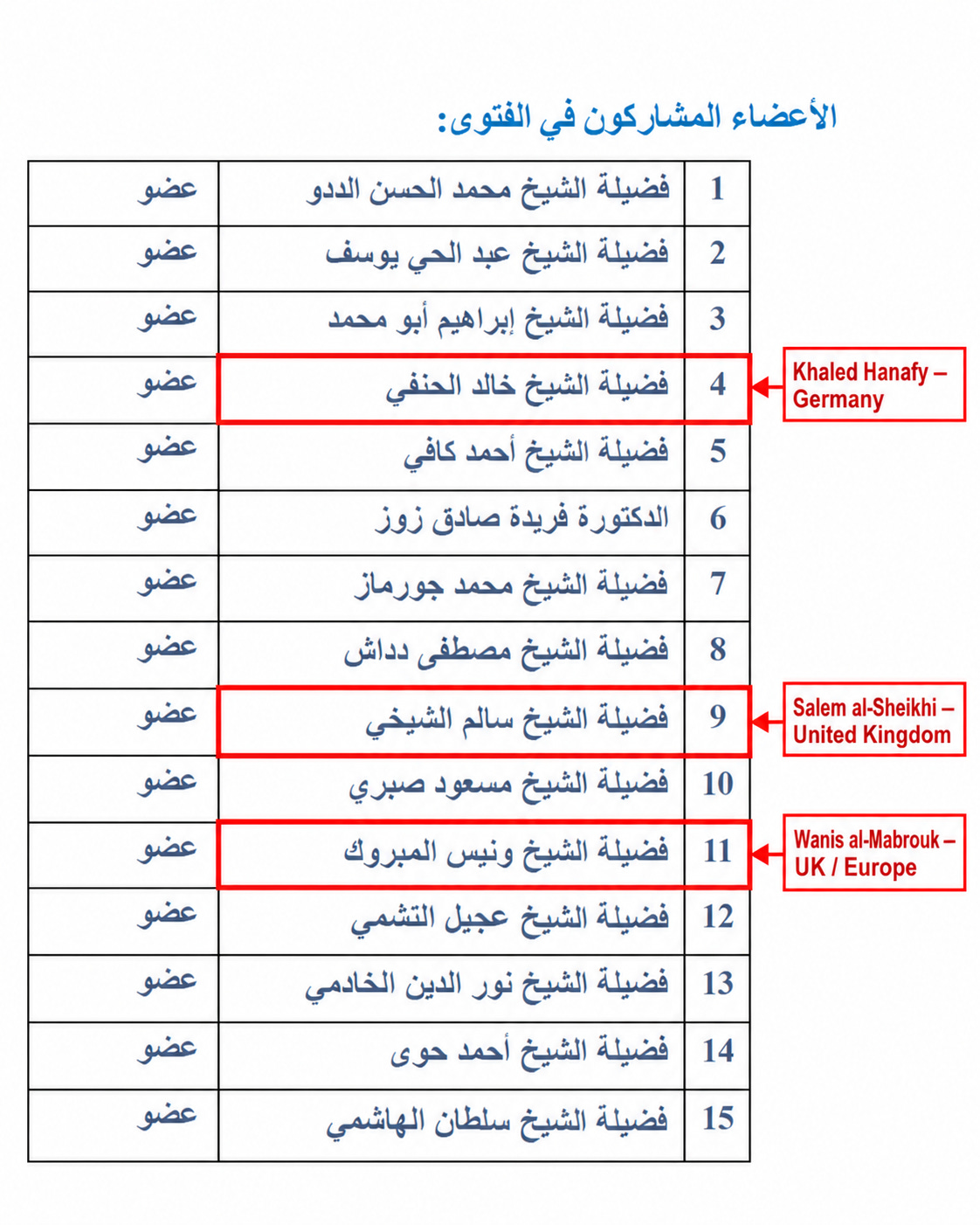
The participants included Salem al-Sheikhi, a British national with a history of religious adjudication in Manchester; Khaled Hanafy, a Germany-based Islamic jurist; and Wanis al-Mabrouk, a senior IUMS official with longstanding connections to British and European Islamic institutions.
The Arabic-language fatwa, dated March 28, 2025, and published April 1, listed the three among 15 scholars identified as participating in the ruling. The IUMS’s published English version declares jihad against what it calls the “Zionist entity” a religious obligation for capable Muslims, instructs Muslim governments to intervene militarily, and calls on wealthy Muslims to help finance “fighters.”
Fatwa Demands Military Intervention and Financing of “Fighters”
A fatwa is an Islamic religious legal opinion issued by a qualified scholar or religious authority. The IUMS ruling presented armed jihad against Israel as a religious obligation extending beyond Gaza to Muslims and Muslim-majority governments worldwide.
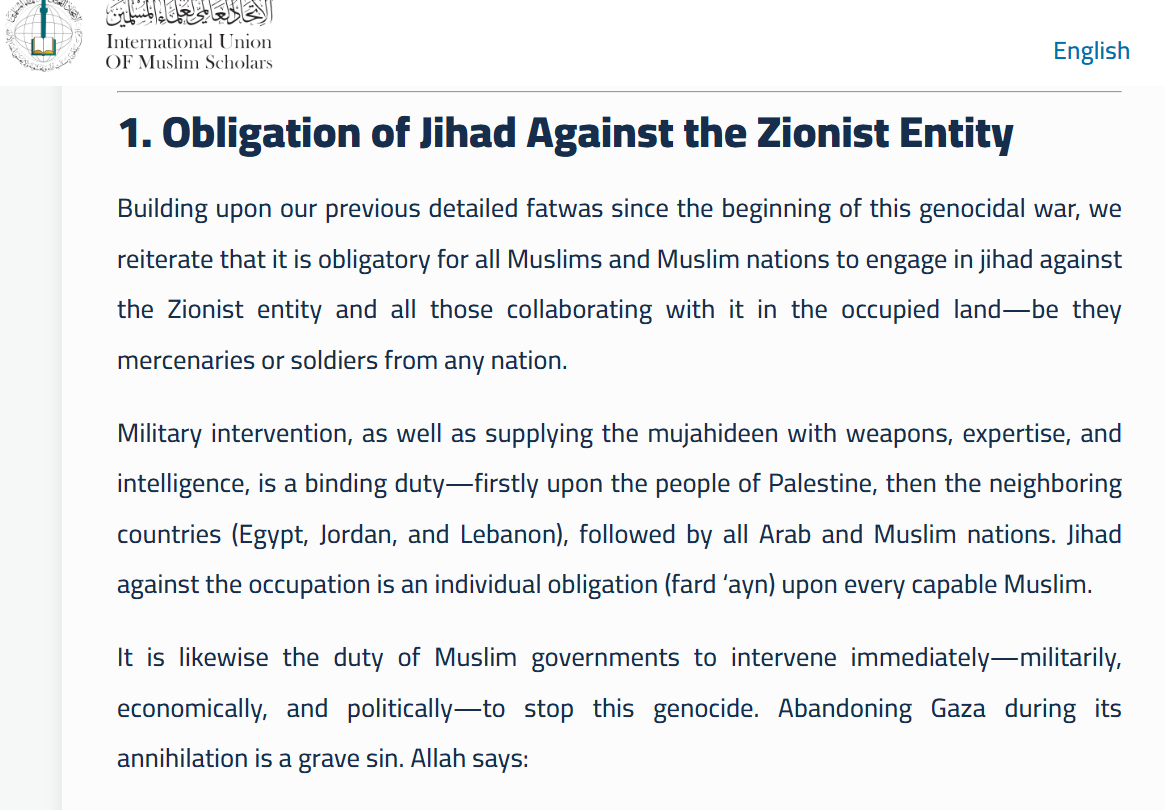
The ruling’s first provision states:
“Jihad against the occupation is an individual obligation (fard ‘ayn) upon every capable Muslim.”
It describes military intervention and the provision of weapons, expertise and intelligence to “fighters” as binding duties, beginning with Palestinians, followed by neighboring Egypt, Jordan and Lebanon, and subsequently other Arab and Muslim nations. It also instructs Muslim governments to intervene economically and politically, characterizing failure to act as a grave religious sin.
Another provision calls for Muslim and Arab states to establish a unified military alliance, citing a Quranic verse on preparing military strength to strike fear into enemies.
The ruling also declares financial jihad obligatory for capable Muslims. Wealthy Muslims are instructed to contribute their personal wealth beyond obligatory giving to equip “fighters,” while supporters are urged to ensure that financial assistance reaches the armed “resistance.”
The fatwa also demands a complete land, sea and air blockade of Israel and prohibits supplying resources that could support its war effort. It declares Muslims who supply such resources out of support for Israel and with the intention of weakening the armed “resistance” to be apostates from Islam, while characterizing profit-motivated supplies as a grave sin.
Additional provisions direct Islamic scholars to advocate jihad, pressure governments and military institutions to act, and demand that Muslim-majority states sever normalization agreements with Israel. The fatwa was issued under IUMS President Ali Mohieddin al-Qaradaghi and Fatwa Committee Secretary Fadl Abdullah Murad.
British National Salem al-Sheikhi Was Jailed in Libya Over Alleged Muslim Brotherhood Membership
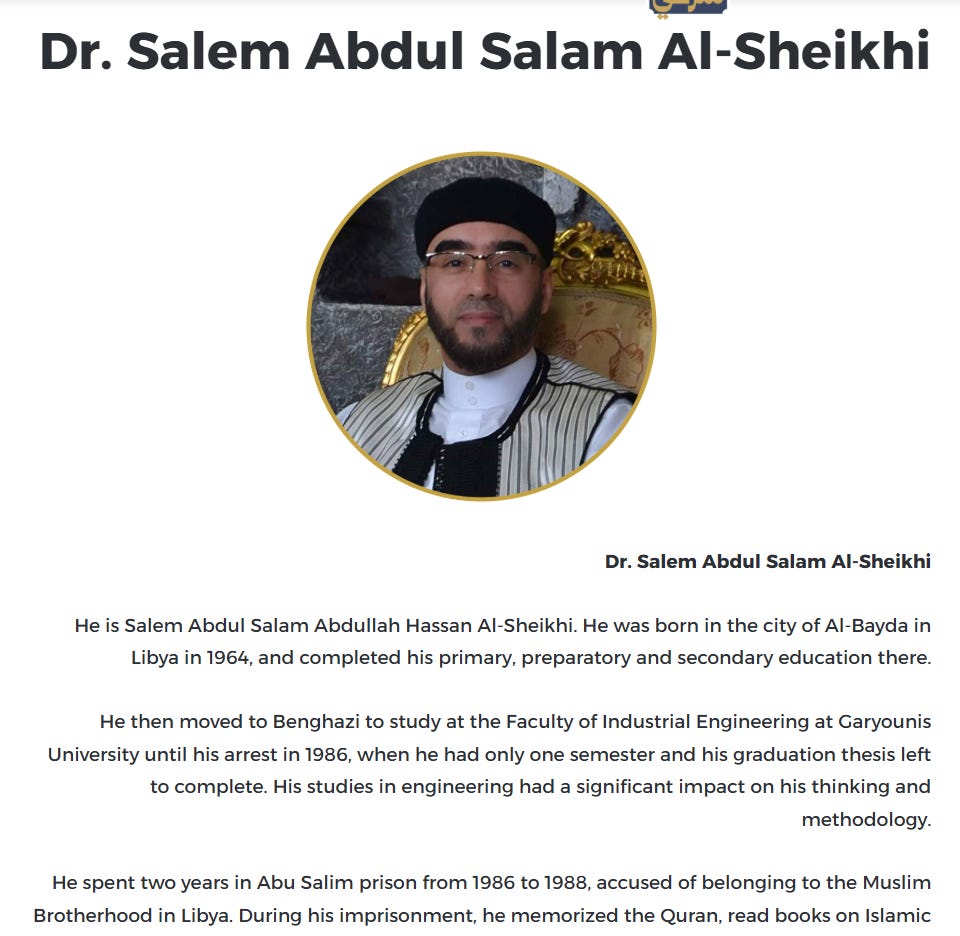
One participant, Salem al-Sheikhi, is a Libyan-born Islamic scholar with longstanding connections to religious institutions in Britain.
According to his published biography, al-Sheikhi spent two years in Libya’s Abu Salim Prison between 1986 and 1988 after being accused of belonging to the Muslim Brotherhood. He relocated to Britain in 1996 and became a preacher at Manchester’s Didsbury Mosque in 1999.
Following Libya’s 2011 revolution, al-Sheikhi was appointed minister of religious endowments by the National Transitional Council, according to the same biography.
The biography also identifies him as a Sharia judge in Manchester, a religious arbitrator in British Muslim affairs, a member of the European Council for Fatwa and Research, and an IUMS trustee.
His British connections extend beyond religious institutions.
Official Companies House records identify a Salem Sheikhi, born in October 1964, as a British national residing in England and director of AFAQ Consultancy and Training Ltd, an active company incorporated in January 2021.
The same director’s record lists historical appointments involving the Peace Centre for European Muslim Studies and other British organizations. Those institutional connections strongly indicate that the record concerns the scholar.
His Scholars Forum continued publishing articles attributed to him in 2026.
Germany-Based Islamic Jurist Khaled Hanafy
Another named participant, Khaled Hanafy, is an Egyptian-born Islamic scholar whose official biography identifies him as residing in Germany.
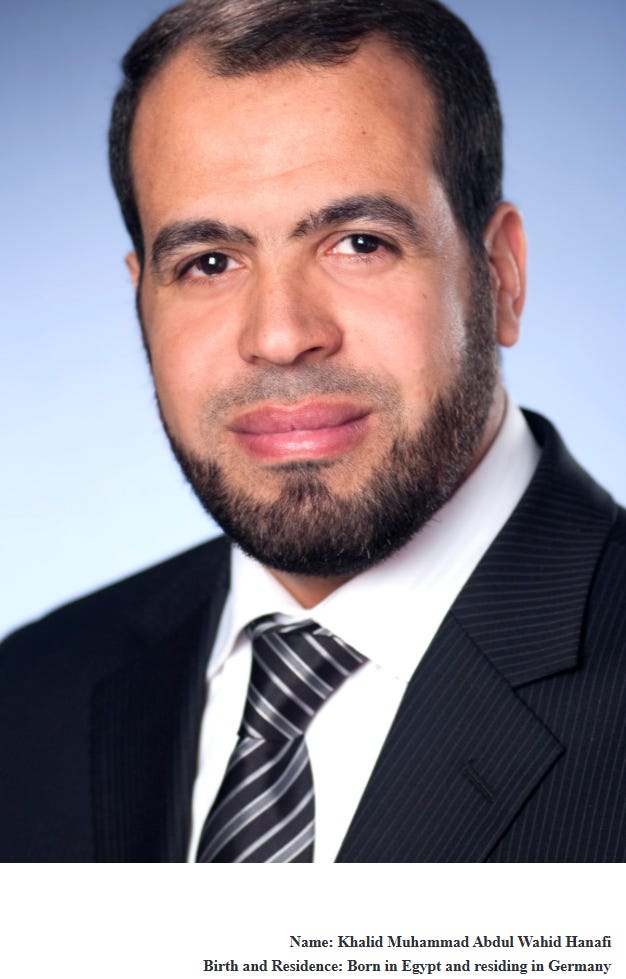
Hanafy has held senior positions within European Islamic institutions, including the European Council for Fatwa and Research and the European Council of Imams. Institutional biographies also identify him as dean of the European Institute of Human Sciences in Germany and chairman of the German fatwa committee.
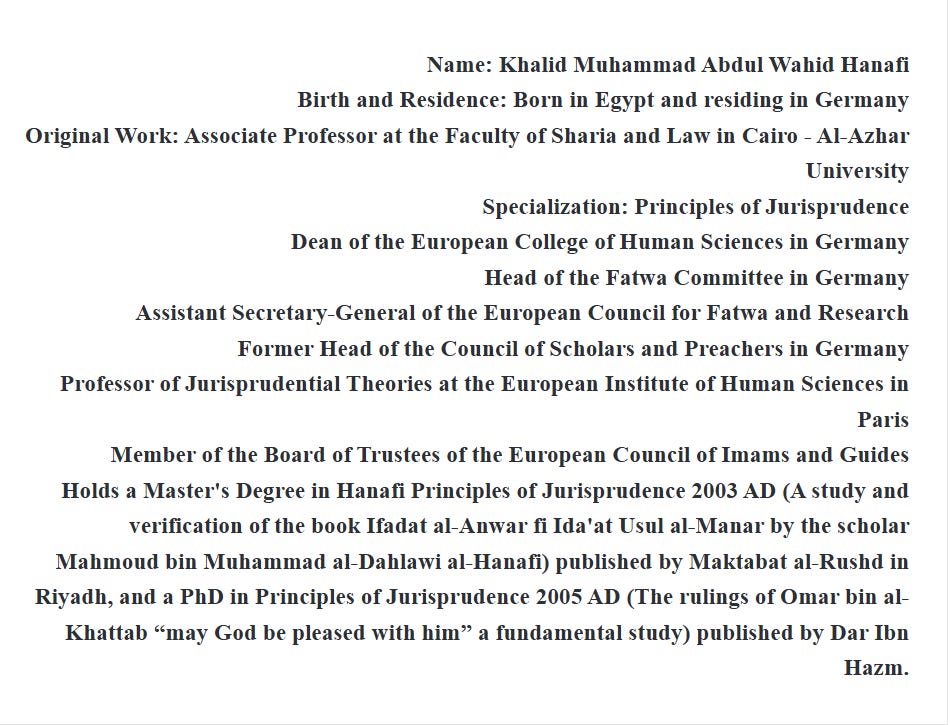
On February 4, 2026, the European Council of Imams published a Friday sermon attributed to Hanafy, identifying Bonn’s Al-Muhajireen Mosque as the venue for February 6. The organization published additional sermon texts attributed to him at the same mosque in June.

Wanis al-Mabrouk’s British and European Connections
Wanis al-Mabrouk, another named participant, serves as an assistant secretary-general of IUMS and is a member of the European Council of Imams.
The Libyan-born scholar has longstanding connections to Islamic institutions in Britain. A 2008 NEFA Foundation report identified him as a British citizen, while a contemporaneous Arabic interview listed previous positions at Islamic educational institutions in Wales and Birmingham, as well as an Islamic center in Sheffield. His current citizenship and residence could not be independently verified.

Al-Mabrouk was also listed among the endorsers of the Amman Message, where he was identified as a representative of the Union of Muslim Organisations of the United Kingdom and Ireland.
His senior IUMS position remained publicly documented in 2026, while the European Council of Imams continued publishing his writings on Islamic political jurisprudence and religious identity.
IUMS’s Wider European Network
The three fatwa participants are part of a larger European network associated with IUMS.
In Bosnia and Herzegovina, Safvet Halilović, a professor at the University of Zenica, serves on IUMS’s governing Council of Trustees, having been reelected for a four-year term in January 2024.
A March 2024 article titled “Glimpses of Islam in Norway”, published on the IUMS website and authored by Islamic scholar Ali Fatini, identifies him as a member of the organization. Fatini also contributes to the European Council of Imams.
In an August 2014 article, IUMS identified Mustafa Abdullah Qaraf as a member of the organization in Britain. An October 2014 report by Al-Araby Al-Jadeed also identified him as an imam at a mosque in Manchester.
The Muslim Brotherhood’s “Transnational Scholarly Authority”
The IUMS was founded in 2004 under Yusuf al-Qaradawi, an Egyptian-born cleric based in Qatar who was widely regarded as a spiritual leader of the Muslim Brotherhood until his death in 2022. Qaradawi publicly defended Palestinian suicide bombings targeting Israeli civilians. The U.S. State Department has repeatedly described IUMS as “widely viewed in the press and academia as being affiliated with the Muslim Brotherhood.”
Jewish Onliner previously identified North American IUMS members, documenting scholars and institutional leaders affiliated with the organization across the United States and Canada.
In a separate January 2026 investigation, Jewish Onliner identified Australia’s Grand Mufti, Ibrahim Abu Mohammed, among the participants named in the same March 2025 fatwa. The European findings add another dimension to the organization’s international reach.
The March 2025 fatwa identifies al-Sheikhi, Hanafy and al-Mabrouk among its participating scholars. Their documented connections to British and German Islamic institutions illustrate the international reach of IUMS and place figures active in European religious networks among those named in a ruling demanding military intervention against Israel and financial support for armed jihad.