


Jewish Onliner is an independent publication. If you find our work valuable, please consider becoming a paid subscriber.
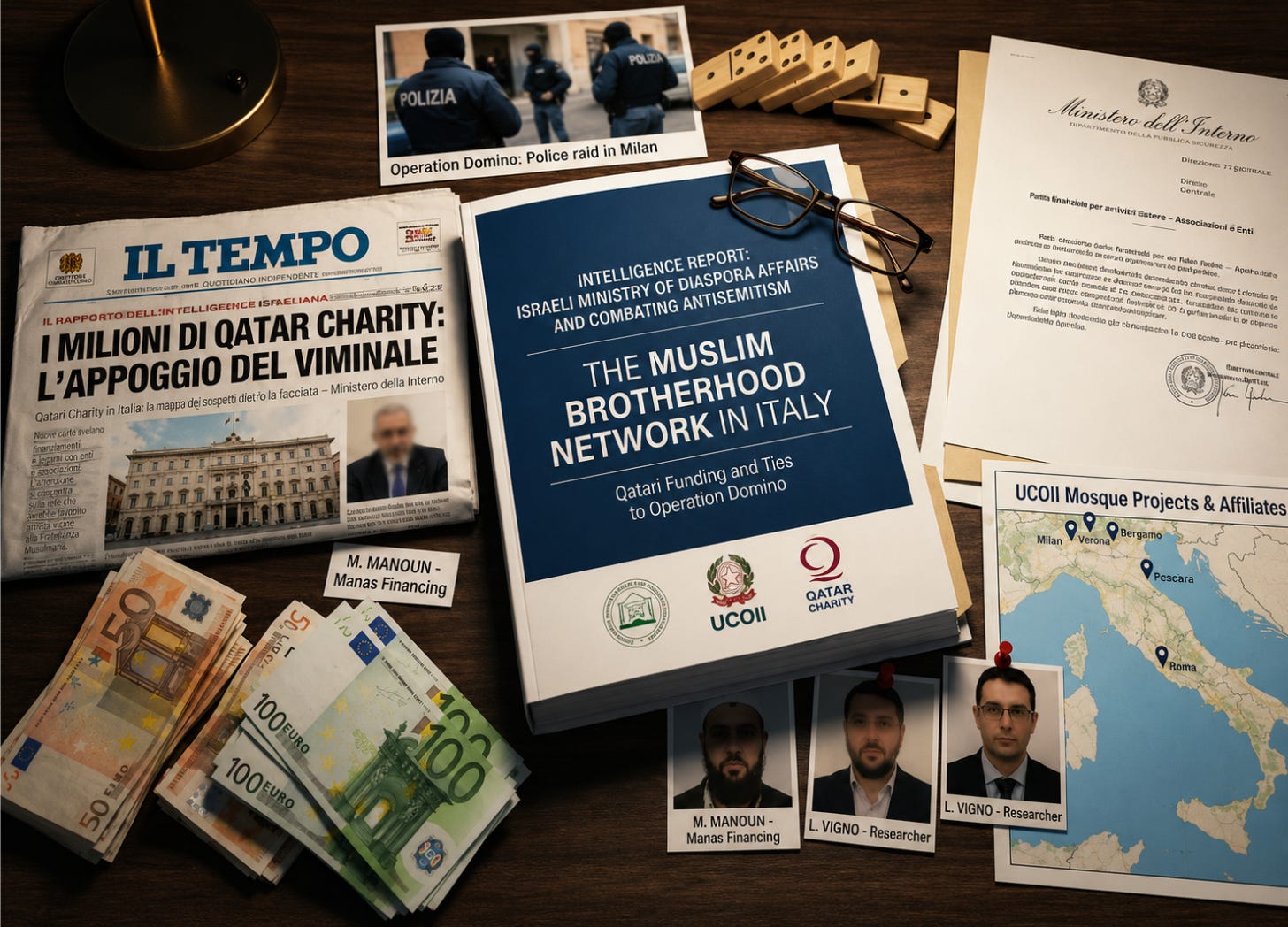
Israel’s Ministry of Diaspora Affairs and Combating Antisemitism has published a detailed report mapping what it describes as a Muslim Brotherhood-linked infrastructure embedded in Italian civil society, centered on religious, educational, and welfare organizations that the ministry says operate under legitimate public-facing structures while maintaining ties to the global Brotherhood network.
The report arrives just months after Operation Domino, Italy’s December 2025 anti-terrorism operation targeting an alleged Hamas-financing network. The report also points to a wider Brotherhood-linked milieu that it says benefited from €50 million in Qatar Charity and Nectar Trust funding, approved under Italy’s own Interior Ministry framework, while senior figures in that milieu have since defended suspects arrested in the Hamas-linked case.
The Network
The report maps five core organizations. The primary body is UCOII — the Union of Islamic Communities and Organisations in Italy — which controls 122 associations and approximately 80 mosques and serves as Italy’s FIOE representative, the pan-European Brotherhood umbrella. Its youth arm GMI held its 22nd national conference December 26–29, 2025 — the exact week Italian police launched Operation Domino.
The Bayan Institute, a religious training school near Verona, was cited in a 2025 European Parliament question for disseminating extremist ideology. The Islamic Alliance of Italy (AII) was placed on the UAE’s terrorist organization blacklist in 2015 and has been described by researcher Lorenzo Vidino as “the inner core of the Muslim Brotherhood milieu in Italy.” The fifth, the Association of Palestinians in Italy (API), is classified as Hamas-affiliated — its head, Mohammad Hannoun, was arrested in Operation Domino.


The Qatari Pipeline and the Italian Stamp
Qatar Charity funded 45 projects in Italy worth €50 million: more than in any other European country. The principal beneficiary was UCOII, which received at least €30 million of that total, according to the admission of former president Izzeddin Elzir. Qatar Charity financed 43 UCOII-affiliated mosques, including new builds in Bergamo and Ravenna and expansions in Rome and Piacenza.
This was formally approved by Italy’s Ministry of the Interior under Article 10 of the National Pact for an Italian Islam. As of February 2026, PayPal had blocked UCOII from receiving online donations, stating the organization was “currently not eligible.” The report also says Brotherhood-linked organizations use Italy’s 5x1000 tax-allocation mechanism to solicit public tax-directed contributions.
The Hamas Arm and Its Defenders
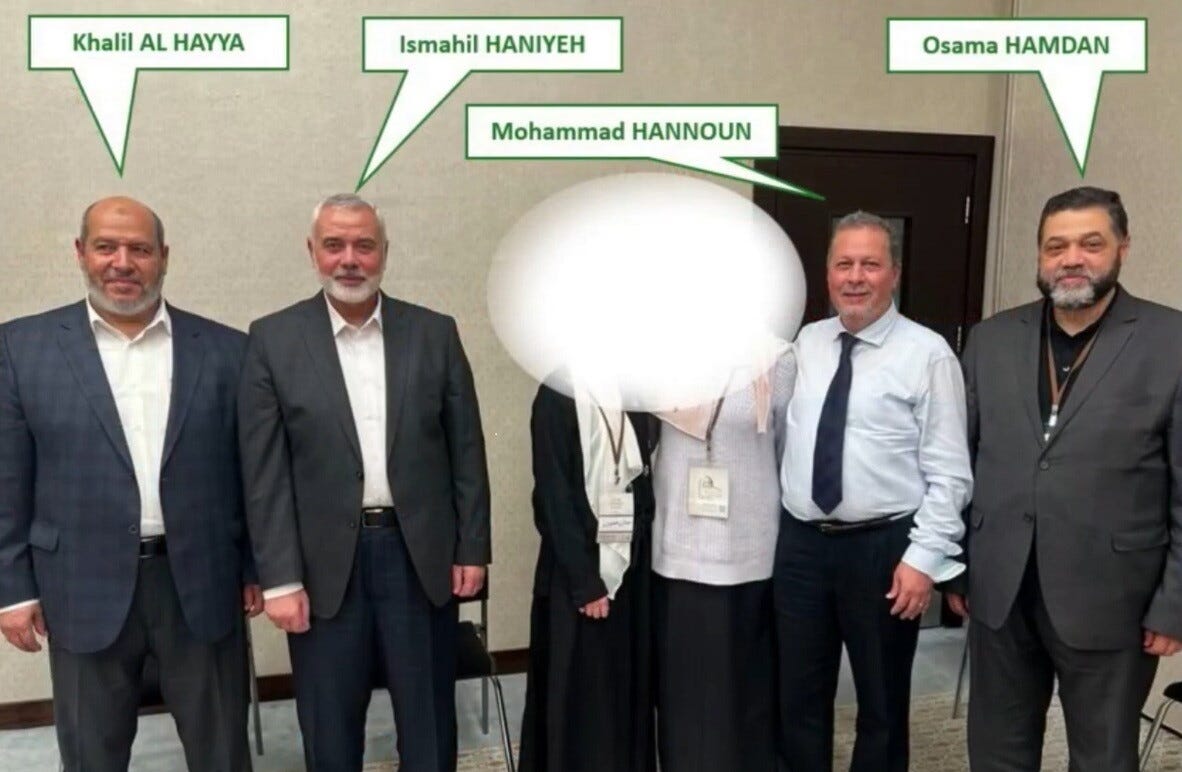
The report draws an explicit line between this institutional infrastructure and Operation Domino’s targets. Hannoun’s API is classified as Hamas-affiliated, with Hannoun documented as having met repeatedly with Hamas leaders including Ismail Haniyeh and Khaled Mashal.
The U.S. Treasury designated Hannoun in October 2024, saying he was an Italy-based Hamas member who had sent at least $4 million to Hamas over a decade. In June 2025, OFAC sanctioned La Cupola d’Oro, describing it as a Hannoun-established sham charity used to evade sanctions and raise funds for Hamas’s military wing.
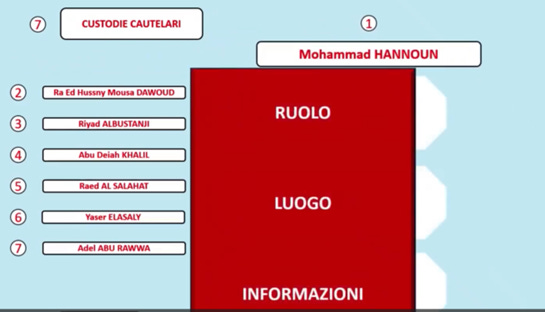
Euronews, citing Italian prosecutorial material, reported that more than 71 percent of donations collected by ABSPP-related associations were routed to entities controlled by or linked to Hamas. Hannoun’s arrest also drew public support from figures in the wider Brotherhood-linked milieu. According to the report, Davide Piccardo, head of the Islamic Alliance of Italy, defended Hannoun after his arrest. Piccardo’s publishing house has published an Italian translation of Yahya Sinwar’s book, while FIOE co-founder and UCOII figure Ali Abu Shwaima spoke at a January 2026 Milan rally calling for Hannoun’s release.
The Euro-Med Dimension
A concurrent investigation by Italian daily Il Tempo adds a parallel financial current: seized Operation Domino files contain a dedicated ledger labeled “Contabilita RA ABDOU,” tracking $1.17 million in deposits and $1.22 million in withdrawals through an Istanbul node attributed to Ramy Abdu — chairman of Geneva-based Euro-Med Monitor — across just eight months of 2024. Abdu’s brother Saleh Mohammed Ismail Abdu, identified in the files as “Abu Khaled,” is described by Il Tempo as an Istanbul-based figure in the alleged financial network.


Israeli records have linked Ramy Abdu to Hamas-associated European infrastructure since 2013, and in 2020 Israel issued a property-restriction order involving Abdu over IPALESTINE, an organization Israel says belongs to Hamas.
Euro-Med has since supplied documentation to South Africa’s ICJ legal team against Israel. It was also cited in the controversy surrounding a New York Times column by Nicholas Kristof that amplified unverified allegations of sexual abuse of Palestinian detainees, including the claim that Israeli forces used dogs to sexually assault prisoners.
Where the Case Stands
As of the most recent reports reviewed, Hannoun and several co-defendants remained in detention, while InfoPal, Hannoun’s news agency, continued to display an Italian bank-account donation banner.
The ministry report’s central charge is institutional. It argues that organizations it identifies as part of Italy’s Muslim Brotherhood-linked milieu, alongside a Hamas-affiliated Palestinian association, gained legitimacy inside Italian civil society while benefiting from major Qatar Charity and Nectar Trust funding approved through Italy’s own Interior Ministry framework.
I’m not surprised but explains why Meloni seems to have changed