


Jewish Onliner is an independent publication. In an age when grotesque libels about Jews and Israel spread with alarming speed, data-driven research matters more than ever. If you find our work valuable, please consider becoming a paid subscriber.

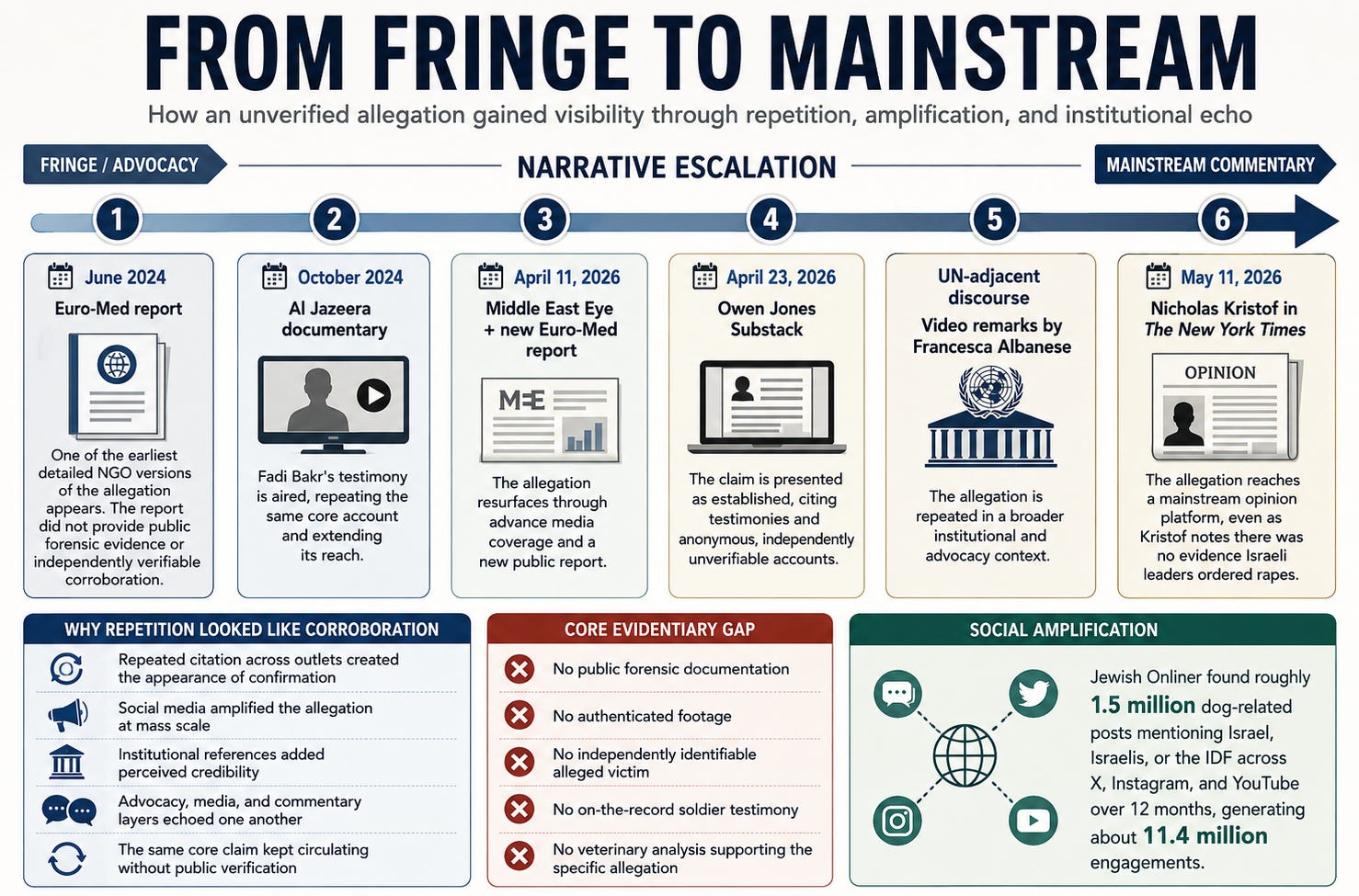
When Nicholas Kristof published “The Silence That Meets the Rape of Palestinians” in the New York Times on May 11, 2026, he cited one specific fringe allegation that had circulated for two years: that Israeli guards used specially trained dogs to sexually assault Palestinian detainees. Yet the dog-rape claim remains unsupported by corroborating evidence. No public sources provide forensic documentation, authenticated footage, an independently identifiable alleged victim, on-the-record soldier testimony, or veterinary analysis substantiating the allegation.
This article examines how an unverified allegation moved through fringe activist media, Qatar-linked sources, and advocacy networks with documented or alleged ties to Hamas-linked figures, with each layer giving the claim additional visibility and apparent credibility before it reached mainstream editorial platforms as part of a broader narrative of documented abuse.
Jewish Onliner’s social media analysis also found that the highest-reach amplification was largely driven from outside the United States. Of the 100 high-reach posts reviewed, 24% were classified as U.S.-based, while 76% were classified as outside the U.S. The classification was based on account location data and available platform-signup metadata, though such signals are imperfect and should be treated as indicators rather than definitive proof of user location.
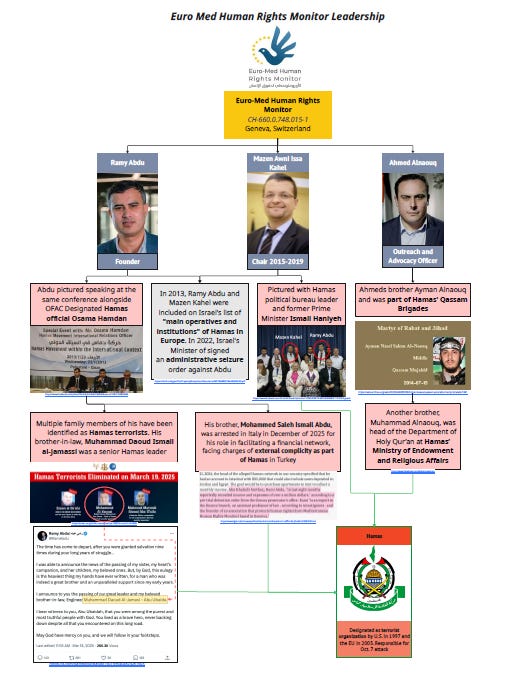
Euro-Med’s Claims and Alleged Hamas Ties
The allegation was first widely formalized in NGO reporting in June 2024, when Euro-Med Human Rights Monitor published a report alleging that Israeli forces used police dogs against Palestinian civilians and detainees, including “at least one reported rape.” Euro-Med did not publish forensic evidence, identifying details about the alleged victim, or independent corroboration sufficient for outside verification.
Israeli authorities have identified Ramy Abdu in Hamas-related counterterror financing materials. A 2013 Israeli Defense Ministry publication listed Abdu in connection with Hamas-linked European activity, and in 2020 Israel issued a seizure or restriction order involving Abdu related to alleged Hamas funds and property.
NGO Monitor published photographic evidence of Abdu and former Euro-Med chair Mazen Kahel posing alongside former Hamas political leader Ismail Haniyeh in 2011.
Separately, Abdu has faced criticism over a social media claim that he was a childhood friend of Assad Abu Sharia, identified as a former leader of the Mujahideen Brigades, a Hamas-aligned terrorist organization implicated in the October 7 attacks, including the kidnapping of the Bibas children. Moreover, Abdu’s brother-in-law was a senior Hamas official, as previously reported by Jewish Onliner.
Amplification Through Media Intermediaries
The next major media amplification came in October 2024, when the Qatari-owned Al Jazeera aired a documentary featuring Fadi Bakr’s testimony, the same account cited by Euro-Med in June 2024. Following the documentary, the allegation continued to simmer on the fringes of social media.
Then, on April 11, 2026, the allegation resurfaced again when the Qatari-linked Middle East Eye published an exclusive based on a Euro-Med report it said it had seen in advance, followed by Euro-Med’s public release of “Another Genocide Behind Walls,” which included new detainee testimonies alleging sexual violence in Israeli detention, including claims involving dogs.
On April 23, 2026, British anti-Israel commentator Owen Jones advanced the allegation on his personal Substack in an article titled “Israel Is Raping Palestinians With Dogs.” Jones presented the allegation as established, writing that there was “overwhelming evidence” and citing Palestinian testimonies as well as alleged Israeli soldier accounts relayed through Shaiel Ben-Ephraim. The soldier accounts, however, were anonymous and not independently verifiable from Jones’s article.
Ben-Ephraim’s credibility has also been contested. The Daily Bruin reported in 2020 that he left UCLA following multiple allegations of sexual harassment, while noting in a correction that he did not acknowledge the specific claims.
The claim also entered discourse around UN human rights officials. In video remarks circulated online, UN Special Rapporteur Francesca Albanese stated that Palestinian detainees had been “raped... including with trained dogs.”


Social Media Amplification & Analysis
Jewish Onliner also conducted a social media analysis of dog-related posts mentioning Israel, Israelis, or the IDF across X, Instagram, and YouTube over the past 12 months. The query generated roughly 1.4 million posts and 11.4 million engagements. In JO’s review, a large majority of posts related to allegations that Israeli forces used dogs to sexually assault Palestinians, though the dataset also captured some broader dog-related Israel content. The volume underscores how the allegation and related imagery circulated at mass scale across major platforms.
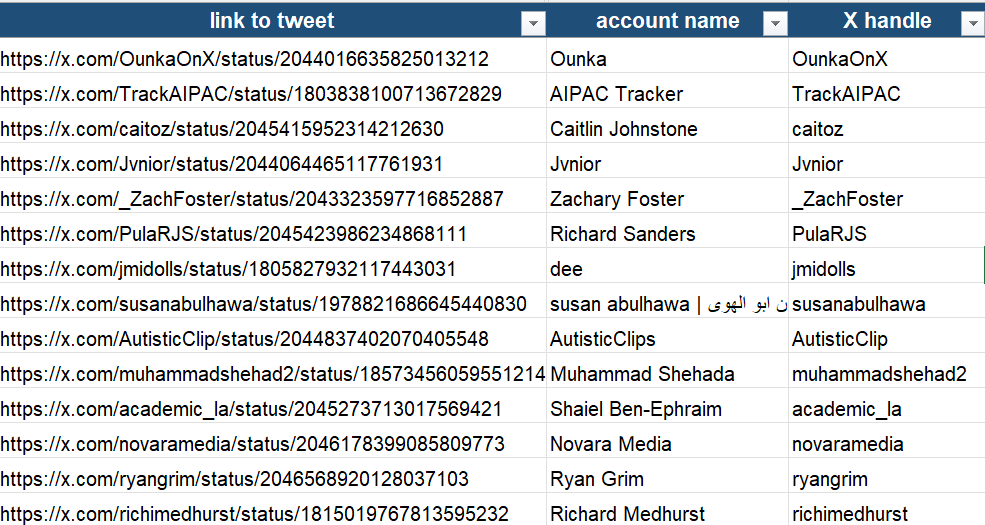
Among the most viral amplifiers of the narrative was Jvnior, a high-engagement X account that has drawn scrutiny from Community Notes users. Public posts citing a Community Notes leaderboard state that the account has received more than 80 notes for allegedly presenting false or outdated content as current news.


The findings suggest that the allegation did not spread through a single publication or witness account alone. Rather, it circulated through a broader attention ecosystem of advocacy figures, activist media outlets, and high-reach social media accounts, many of which amplified the claim without verifying its accuracy.
The Architecture of the Narrative
By the time Nicholas Kristof published his May 11, 2026 column, the allegation had already moved through multiple layers of citation and amplification: Euro-Med’s NGO report, an Al Jazeera documentary, Middle East Eye coverage, activist articles by Owen Jones, broader UN reporting on alleged detention abuse, and sustained social media circulation. Yet the central evidentiary gap remained unresolved.
None of the public sources provided forensic documentation, authenticated footage, an independently identifiable alleged victim, on-the-record soldier testimony, or veterinary analysis supporting the specific dog-rape allegation.
Instead, repetition across advocacy, media, and institutional channels appeared to create a sense of corroboration, allowing an unverified claim to enter mainstream commentary as part of a broader narrative of documented abuse.
Aside front the absolute absurdity, just ask yourself this: do you really believe there is a dog on this earth with such low standards?