


Jewish Onliner is an independent publication. If you find our work valuable, please consider becoming a paid subscriber.
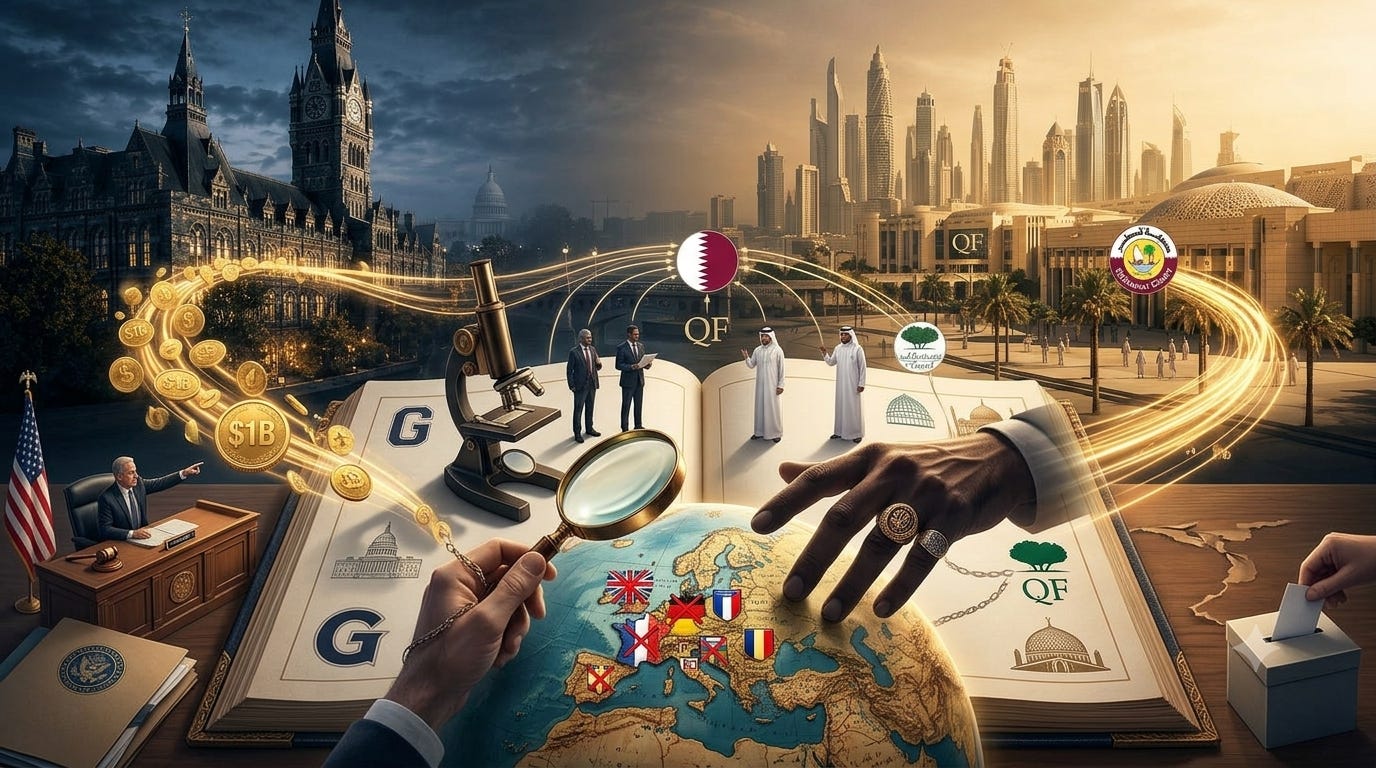
Earlier this week, Campus Reform reported that Georgetown University has launched a research grant program linking its Washington, D.C., and Qatar campuses—and one of the inaugural projects targets “far-right populism” in Europe. The DC-Doha Collaborative Research Grant Program, announced in June 2026, selected eight faculty teams for support through a program that offers research-project grants of up to $35,000 for one-year projects and $50,000 for two-year projects.
Among the approved grants: “Tackling Far-Right Populism: Effective Strategies in Europe,” led by professors including Gabor Scheiring, an assistant professor based at Georgetown’s Qatar campus. Critics say the research agenda reflects Qatari strategic priorities more than academic independence.


Qatar’s Billion-Dollar Investment in Georgetown
Georgetown’s relationship with Qatar runs deep. The university’s Doha campus operates within Education City, a complex funded by the Qatar Foundation, a state-controlled entity. According to Department of Education disclosures, Georgetown has accepted $1.46 billion in foreign funding since 1986, with Qatar contributing nearly $1.1 billion—making the Gulf monarchy Georgetown’s largest foreign donor by a considerable margin. A 2025 ISGAP report separately estimated that Georgetown received about $1.073 billion from Qatar since 2005 and argued that this funding has influenced the university’s academic environment, research priorities, faculty recruitment, and programming.
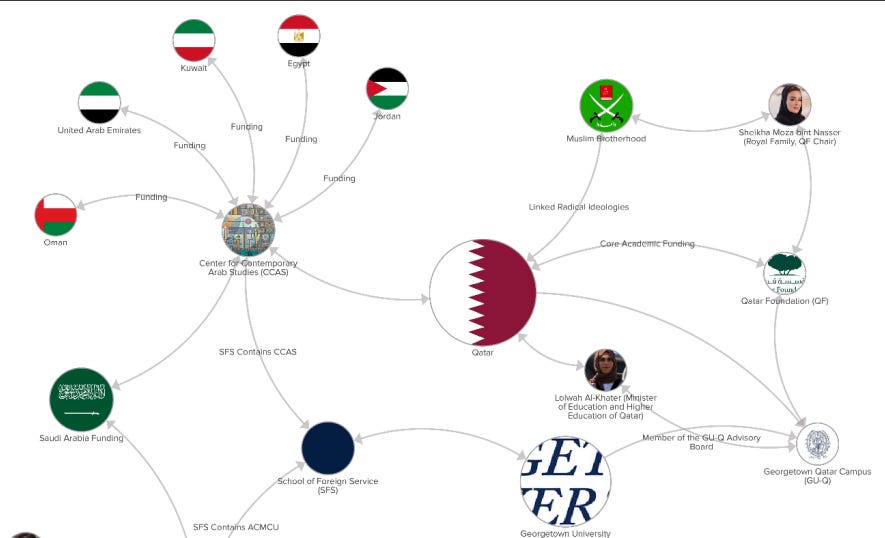
The Middle East Forum identified Georgetown as “the American university most thoroughly captured by Qatar,” noting that Qatari funding supports the Center for Contemporary Arab Studies and the Prince Alwaleed Bin Talal Center for Muslim-Christian Understanding, both of which have promoted anti-Israel activism and co-signed letters supporting campus encampments in 2024.
The Bridge Initiative and Islamophobia Research
Georgetown’s Bridge Initiative—a research project housed within the Alwaleed Center and directed by John Esposito—focuses on combating what it defines as “Islamophobia.” Esposito, a longtime Boycott, Divestment, and Sanctions supporter with alleged ties to Muslim Brotherhood figures, founded the project with Qatari financial support. In May 2026, the Brandeis Center called on the Justice Department to investigate whether Georgetown violated the Foreign Agents Registration Act through a $630,000 contract with a Qatari Foreign Ministry-linked organization. The contract requires Georgetown to consult with the Qatar-backed Islam and Muslims Initiative on speaker selection and event themes for conferences on “Islamophobia.”


Bridge Initiative research fellow Farid Hafez is also a longtime editor of the European Islamophobia Report. The 2024 edition, co-edited by Hafez and Enes Bayraklı, frames Islamophobia as a structural and political phenomenon across Europe and repeatedly links anti-Muslim sentiment to far-right politics, securitization, and restrictions on pro-Palestinian activism.
Why Qatar Fears European Populism
Qatar’s government has long targeted what it calls “extreme right-wing groups” through official statements and state-funded media. Al Jazeera, the Qatari government-funded outlet, regularly features academic pieces on the “far right,” “Islamophobia,” and “anti-Qatar campaigns.” Critics argue that the narrative serves a strategic purpose: populist and nationalist movements in Europe increasingly challenge open-border policies and Islamist influence in European institutions—positions that directly threaten Qatar’s soft-power strategy of using Islamist ideology and networks to expand influence in Western societies.
The newly funded Georgetown research project—”Tackling Far-Right Populism”—fits squarely within this framework. The project team includes Pauliina Patana from Georgetown’s School of Foreign Service and Gabor Scheiring, who is based at the Qatar campus. Scheiring’s research focuses on populism, political economy, and comparative politics—topics that align with Qatar’s interest in monitoring and countering European political movements that oppose Islamist influence.
Academic Freedom Under Foreign Influence
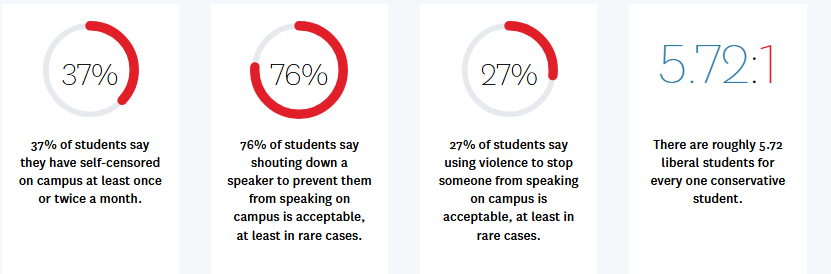
Critics argue that Georgetown’s dependence on Qatari funding has compromised freedom of expression. According to the Foundation for Individual Rights and Expression (FIRE), Georgetown’s Qatar campus earned a place on FIRE’s 2019 list of the “10 Worst Colleges for Free Speech” after canceling a scheduled debate over whether major religions should portray God as a woman. FIRE later argued that the episode reflected a broader problem with American branch campuses operating under local laws that restrict speech; a Georgetown Qatar spokesperson told The Hoya that faculty and student groups may host events on campus only when they are “in accordance with Qatari law.”
Congressional scrutiny has intensified. In July 2025, Georgetown’s interim president testified before the House Committee on Education and the Workforce at a hearing examining antisemitism, faculty ideology, and foreign funding, where lawmakers questioned the university’s relationship with Qatar. ISGAP has called for a federal investigation into Georgetown specifically, arguing that Qatar’s financial influence has fostered an environment hostile to Jewish students and faculty.
Shifting Priorities and Murky Interests
Georgetown’s new research initiative connecting its D.C. and Doha campuses may strengthen academic collaboration, but the “far-right populism” project raises fundamental questions about whose interests shape research priorities at America’s premier diplomatic training institution. With more than $1 billion in Qatari funding, contractual obligations to consult Qatari government-linked organizations on programming, and a research agenda that mirrors Qatar’s geopolitical concerns, Georgetown’s academic independence appears increasingly compromised.
For a university that trains future diplomats and foreign-policy professionals, the issue is not whether this single grant proves Qatari direction. It is whether Georgetown’s billion-dollar Qatar relationship, Qatar-linked programming contracts, and Doha-integrated research agenda create influence risks that deserve far more scrutiny.