


Jewish Onliner is an independent publication. If you find our work valuable, please consider becoming a paid subscriber.

An English court has ordered the International Centre of Justice for Palestinians (ICJP) to pay £82,130 toward the legal costs of a British-Israeli IDF reservist, after refusing the organization’s application to bring a private prosecution against him under the Foreign Enlistment Act 1870.
The outcome is a significant setback for ICJP’s legal strategy and raises questions about the organization’s institutional conduct, according to UK Lawyers for Israel (UKLFI), which supported the soldier’s defense.
Chief Magistrate Paul Goldspring ordered the £82,130 payment assessed on an indemnity basis — a heightened standard, above the ordinary rate, reflecting the court’s disapproval of ICJP’s conduct.

The Ruling
ICJP’s application sought to prosecute “Soldier A,” a British-Israeli dual national, arguing that his return to Israel in October 2023 to rejoin his IDF reserve unit after the Hamas-led attacks of October 7 amounted to unlawful enlistment in a foreign military. Chief Magistrate Goldspring rejected the application on multiple independent grounds. Central among them: the Foreign Enlistment Act 1870 does not reach dual nationals serving in the armed forces of their own second country of nationality — Soldier A was already an IDF reservist fulfilling a pre-existing obligation under Israeli law, not enlisting anew, which the judge found is not “foreign enlistment” in any meaningful sense.
The court also found no evidence that the UK Executive recognized the legal “state of war” the Act requires: the hostilities ICJP pointed to involved Hamas and Hezbollah, which are proscribed terrorist organizations, not foreign states, for the Act’s purposes.


Tayab Ali’s Prior Role With Alleged Hamas-Linked Group
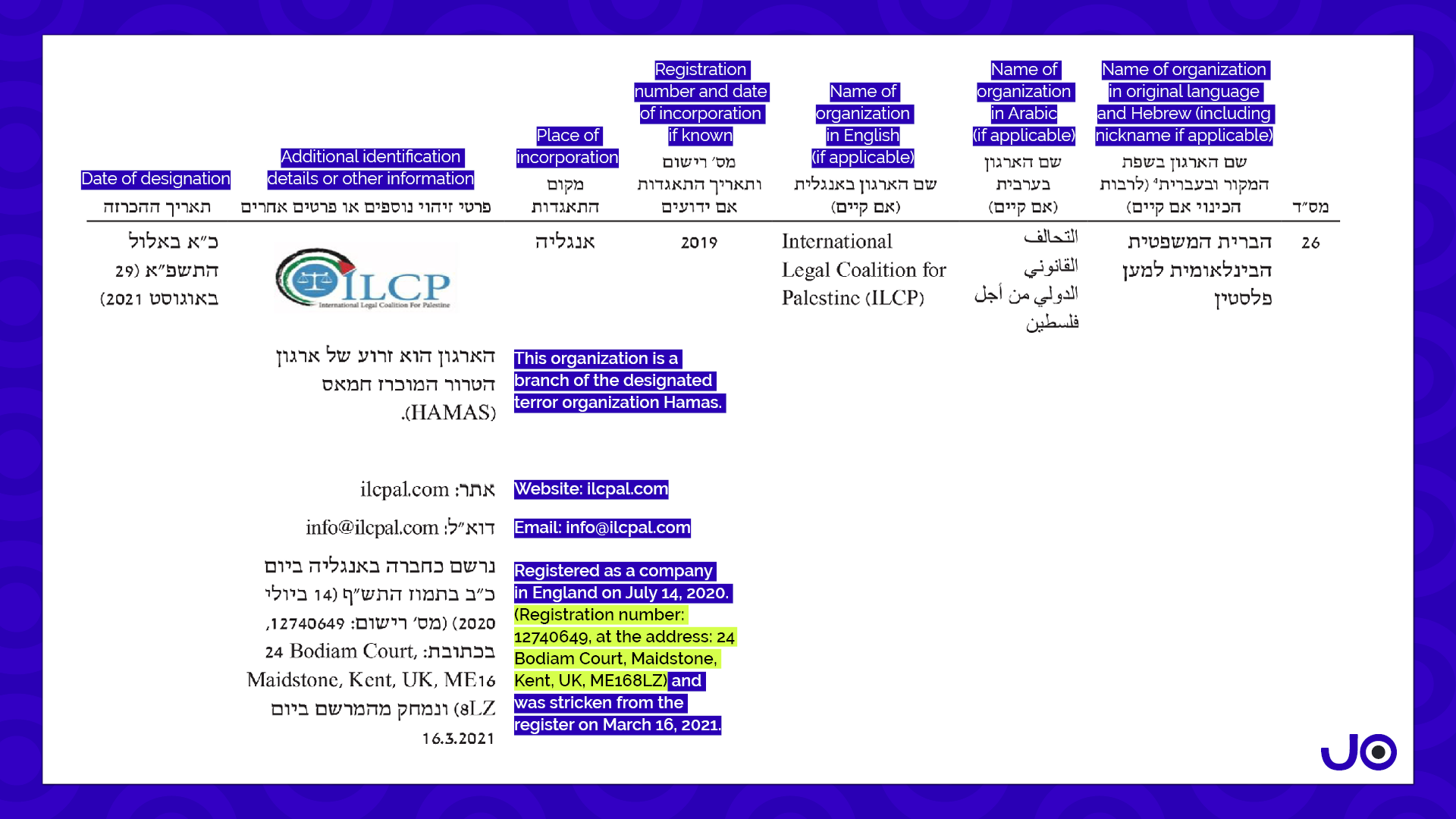
Jewish Onliner previously reported that Companies House records show that ICJP director Mohammad Tayab Ali also previously served as a director of the now-dissolved International Legal Coalition for Palestine (ILCP), incorporated in July 2020 and legally dissolved in March 2021. ICJP and ILCP are separate legal entities: ICJP is registered under company number 13054048 at an address in Harrow; the ILCP was registered under company number 12740649 at a different address in Maidstone, Kent.
In August 2021 (several months after its legal dissolution), Israel’s Defense Ministry designated ILCP a terrorist organization, describing it as an institution established by Hamas and, in practice, “a proxy body for Hamas” intended to expand Hamas’s support and influence internationally.
Breaches of Prosecutorial Duty
Perhaps most damaging to ICJP’s credibility, Chief Magistrate Goldspring found “profound and serious breaches” of the duty of candour that private prosecutors owe to the court. ICJP had failed to disclose the government statements described above, related CPS prosecution guidance, and its own 2022 referral of related allegations to Metropolitan Police counterterrorism officers — a referral whose outcome ICJP did not explain to the court. Despite being aware of the government’s long-standing position, Goldspring found, ICJP never raised it in its application, case summary, or skeleton argument — an omission he called “serious and inexcusable.”
The court also flagged an undisclosed institutional tie between ICJP and its own solicitors: ICJP director Mohammad Tayab Ali is a deputy managing partner at Bindmans LLP, the firm instructed as ICJP’s counsel.
Separately, the judge criticized ICJP’s expert witness, Dr. Mandy Turner, who was found to have participated in an ICJP WhatsApp group despite being presented to the court as independent. Goldspring concluded she was properly considered “a campaigner and activist, not an independent expert,” finding that her report presented unverified material as fact and used language — including the term “IOF” for Israel’s military — that displayed bias. Parts of her evidence, he wrote, were “more akin to propaganda than independent analysis.”
Abuse of Process and Political Motive
Chief Magistrate Goldspring concluded that ICJP’s “dominant motive” was not the pursuit of justice for a specific criminal act but “the advancement of a political and ideological agenda”, using the criminal courts, in his words, as “a platform for political posturing” against UK government policy. He warned that the courts “must not be used as a vehicle for political debate,” adding: “I fear that is close to being the case here.”
The judge found that allowing the proposed prosecution to proceed would have been “truly oppressive,” and separately described the application itself as “vexatious,” noting that ICJP had sought anonymity for itself while simultaneously briefing the press and publishing details of its own application on its website before any judicial determination — a pattern the judge said may have been calculated to allow ICJP to control the narrative and enhance its public profile.
Significance and Pattern of Targeting
In a comment to Jewish Onliner, Daniel Berke, the solicitor acting for Soldier A at 3D Solicitors and director of UKLFI, highlighted the broader implications of the ruling:
“UKLFI were fully prepared for attempts by anti-Israel groups to target IDF soldiers. We had a team ready, with expert knowledge of criminal law, international law and the law of armed conflict, and with expertise in the relevant history and facts. The team was able to swiftly respond to draw the attention of the Court to false and misleading contents of the application by ICJP.”
Berke cautioned that further attempts may follow, emphasizing the ruling’s deterrent effect:
“There may be further attempts to prosecute IDF soldiers, but the ruling will have come as a harsh lesson for those groups who seek to misuse the courts and the criminal justice process for improper purposes. It has exposed the efforts that organisations committed to targeting Israel will go to. This includes presenting false information including in a discredited ‘expert’ report, withholding disclosure and misleading the Court, in order to control the narrative.”
He concluded with a stark assessment of ICJP’s conduct: “The conduct of the ICJP was unscrupulous and it is right that they were ordered to pay the full costs of Soldier A.
UKLFI Calls Ruling a Complete Vindication
UK Lawyers for Israel (UKLFI), which supported Soldier A’s defense, praised his legal team: solicitor Daniel Berke of 3D Solicitors, also a UKLFI director, and barristers Natasha Hausdorff, Legal Director of UKLFI’s charitable trust, and Peter Wright KC. A UKLFI spokesperson called the ruling “a complete vindication” of the position that British-Israeli dual nationals may serve in the IDF without committing any offence, adding that the court “rejected ICJP’s case on every point.”
💪💪💪💪💪