


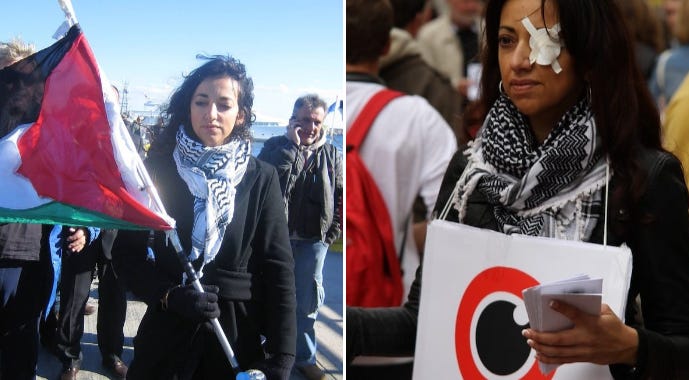
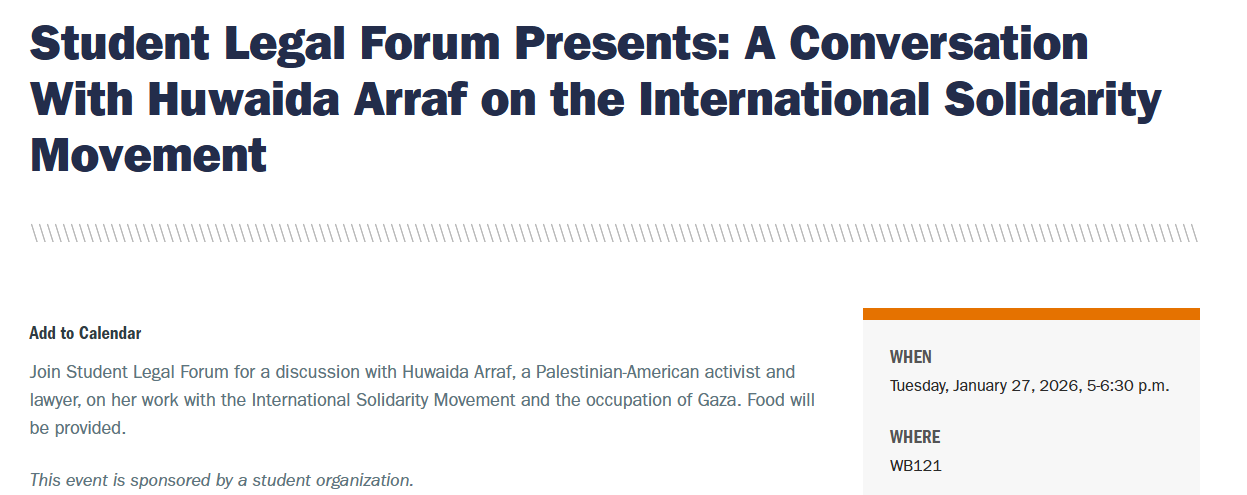
The University of Virginia School of Law will host Huwaida Arraf, co-founder of the International Solidarity Movement (ISM), on Tuesday, January 27, 2026, for what organizers describe as “a conversation” on her work with the organization and “the occupation of Gaza.”
The event, sponsored by the Student Legal Forum—a group that seeks to introduce "notable persons" to the academic community—raises questions about the type of voices being elevated at one of America's premier legal institutions. Arraf's alleged associations with designated terror organizations, her published endorsement of violence, and her legal representation of individuals convicted in deadly terror attacks have made her a controversial figure.
The 90-minute discussion aims to stimulate “education, debate, and participation in important issues,” according to the Student Legal Forum’s mission statement. The organization, contactable through a University of Virginia email address, lists its purpose as introducing speakers on “legal, political, economic, and foreign affairs matters” to the law school community.
Who Is Huwaida Arraf?
Arraf, a Palestinian-American lawyer and activist, has spent more than two decades at the center of the Israeli-Palestinian conflict. Arraf helped found ISM in the early 2000s and later married fellow ISM activist Adam Shapiro. This established what would become one of the most controversial Western activist organizations operating in the Palestinian territories.
In May 2002, Arraf claimed that she and other ISM activists entered Bethlehem's Church of the Nativity to deliver food and support to armed Palestinian terrorists inside, which included members of the Al-Aqsa Martyrs' Brigades—a U.S.-designated terrorist organization. They described their actions as providing "international protection.”


Even more revealing are Arraf’s own published statements about violence. In a 2002 article co-authored with her husband, she wrote that “the Palestinian resistance must take on a variety of characteristics, both nonviolent and violent,” explicitly stating that Palestinians have “a right to resist with arms.” These comments represent not merely criticism of Israeli policy, but an endorsement of violent tactics during a period when suicide bombings were devastating Israeli civilian populations.
Arraf has publicly acknowledged that ISM activists cooperate with Hamas, Palestinian Islamic Jihad, and the Popular Front for the Liberation of Palestine (PFLP)—all organizations designated as Foreign Terrorist Organizations by the U.S. State Department. Her transparency about these connections stands in stark contrast to the ISM’s public presentation as a “non-violent” movement.
The International Solidarity Movement: Behind the “Non-Violent” Facade
The organization Arraf co-founded presents itself as committed to non-violent resistance and human rights. However, a comprehensive study by the Meir Amit Intelligence and Terrorism Information Center reveals a more complex reality.
Founded in 2001 by “extreme leftist Americans” and Palestinian activists, the ISM recruited Western volunteers to engage in what it termed “direct action” in the Palestinian territories. While the organization’s public messaging emphasized non-violence, internal training manuals and documented activities painted a different picture.
According to the Israeli intelligence assessment, ISM volunteers specialized in “hindering IDF operational activities” and served as “human shields for terrorist operatives wanted by the Israeli security forces.” The organization’s activities included obstructing counter-terrorism operations, preventing the demolition of terrorists’ homes, and providing terrorists with “financial, logistic and moral support.”
Perhaps most damningly, the ISM’s own internal documents, obtained by journalists and researchers, show that activists received security briefings on how to deceive Israeli authorities. According to training manuals from workshops in California, London, and East Jerusalem, volunteers were instructed to pretend to be tourists, change personal details on passports, and deny connections to the ISM when questioned by Israeli security.

The organization’s connection to terrorist violence extends beyond ideology. ISM activists have been documented sheltering wanted terrorists, and the group’s infrastructure was allegedly used by operatives from Palestinian Islamic Jihad. In the 2003 Mike’s Place attack in Tel Aviv, the perpetrators were British nationals, who allegedly forged links with foreign left-wing activists including ISM.
The Anti-Defamation League notes that in 2016, Arraf joined the legal defense team of Rasmea Odeh, a convicted terrorist affiliated with the PFLP who was convicted for a 1969 supermarket bombing in Jerusalem that killed two Hebrew University students. This represented not just ideological alignment, but active legal advocacy for someone convicted of deadly terrorism.


Arraf’s recent activities suggest her views have not moderated over time. At the People’s Conference for Palestine, she shared the stage with individuals who face international travel restrictions, maintain documented ties to terrorism, and have openly advocated for “violent resistance” methods.