


Jewish Onliner is an independent publication. If you find our work valuable, please consider becoming a paid subscriber.
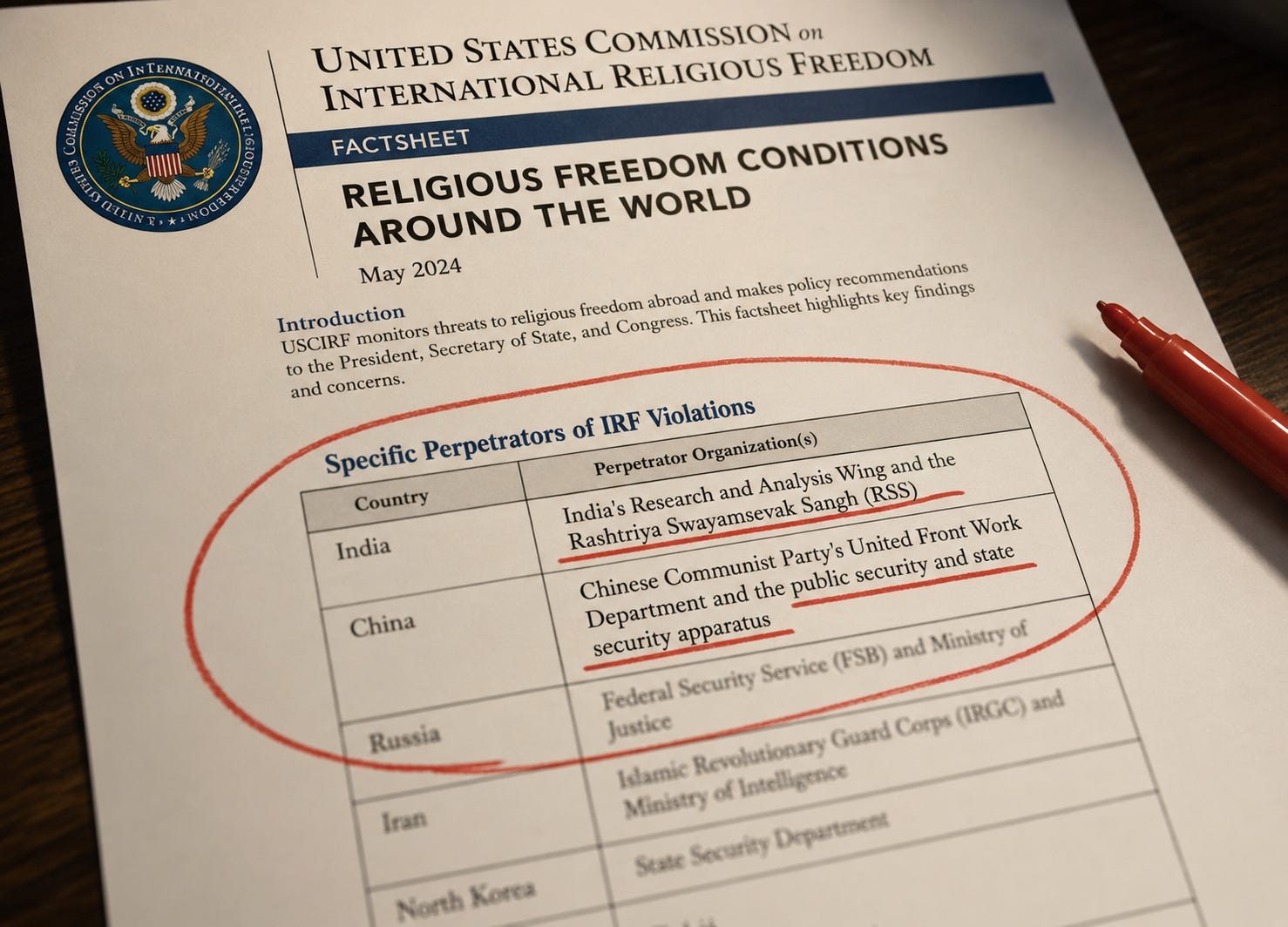
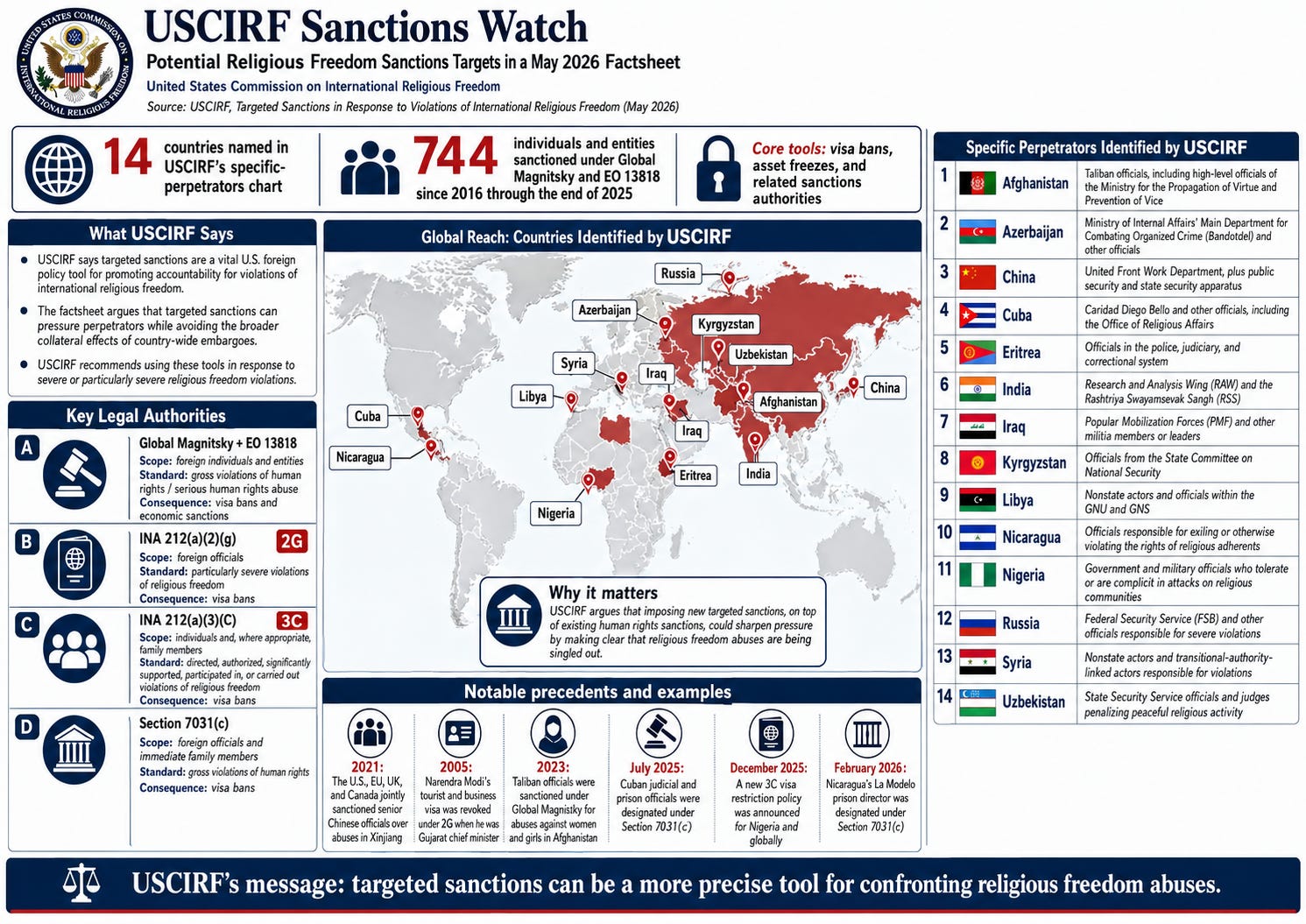
The U.S. Commission on International Religious Freedom released a detailed factsheet in May 2026 identifying specific government agencies, militia groups, and officials across 14 countries as potential targets for U.S. sanctions over severe religious freedom violations. The document, titled “Targeted Sanctions in Response to Violations of International Religious Freedom,” draws from the commission’s 2026 Annual Report to name entities ranging from China’s Communist Party United Front Work Department to India’s Rashtriya Swayamsevak Sangh as perpetrators warranting visa bans and asset freezes under existing U.S. legal authorities.
The factsheet identifies “Chinese government agencies, entities, and officials, including the Chinese Communist Party’s United Front Work Department and the public security and state security apparatus” as sanctions targets. The designation points to the United Front Work Department’s role in implementing policies against Uyghurs and other Muslim groups in Xinjiang, as well as restrictions on Christian churches and Tibetan Buddhist communities. In 2021, the United States, European Union, United Kingdom, and Canada jointly imposed targeted sanctions against senior Chinese officials responsible for abuses against Uyghurs and other minorities in Xinjiang, marking the first coordinated human rights sanctions by these partners since the 1989 Tiananmen Square crackdown.
For India, the commission named “individuals and entities, such as India’s Research and Analysis Wing and the Rashtriya Swayamsevak Sangh (RSS)” as potential targets. The RSS is the Hindu nationalist parent organization of Prime Minister Narendra Modi’s ruling BJP party. The factsheet notes that the only officially acknowledged use of religious freedom visa sanctions involved Modi himself—his tourist and business visa was revoked in 2005 when he served as chief minister of Gujarat, following “sustained pressure from civil society and members of Congress to hold him accountable for his alleged role in inciting religiously motivated violence.”
Russia’s Federal Security Service (FSB) appears on the list as the commission identifies “Russian government agencies, including the Federal Security Service (FSB), and officials responsible for severe violations of religious freedom” as targets. The designation comes amid Russian crackdowns on religious minorities and independent congregations.
Cuba’s Caridad Diego Bello, head of the Office of Religious Affairs (ORA), is specifically named in the factsheet. In July 2025, the State Department designated Cuban judicial and prison officials under Section 7031(c) for their involvement in the detention and torture of July 2021 protestors, “which included a number of FoRB victims.”
Afghanistan’s “Taliban officials, including high-level officials of the Ministry for the Propagation of Virtue and Prevention of Vice (MPVPV)” are identified as targets. The factsheet notes that in 2023, the U.S. government issued Global Magnitsky sanctions against Taliban officials for “religious-inspired human rights abuses committed against women and girls in Afghanistan.”
Azerbaijan’s targets include “government agencies, such as the Ministry of Internal Affairs’ Main Department for Combating Organized Crime (also known as Bandotdel), and officials.” For Eritrea, the commission names “government officials, including those in the police, judiciary, and correctional system.”
Iraq’s “Popular Mobilization Forces (PMF) and other militia members or leaders” are identified as perpetrators. In Libya, targets include “nonstate actors and officials within both the Government of National Unity (GNU) and the Government of National Stability (GNS).” Syria’s entry specifies “Syrian actors—whether nonstate or affiliated with the transitional authorities—responsible for religious freedom violations.”
Kyrgyzstan’s “Kyrgyz officials, such as those from the State Committee on National Security” and Uzbekistan’s “State Security Service officials and judges who repeatedly arrest individuals or issue administrative or criminal penalties for peaceful religious activities” round out Central Asian targets.
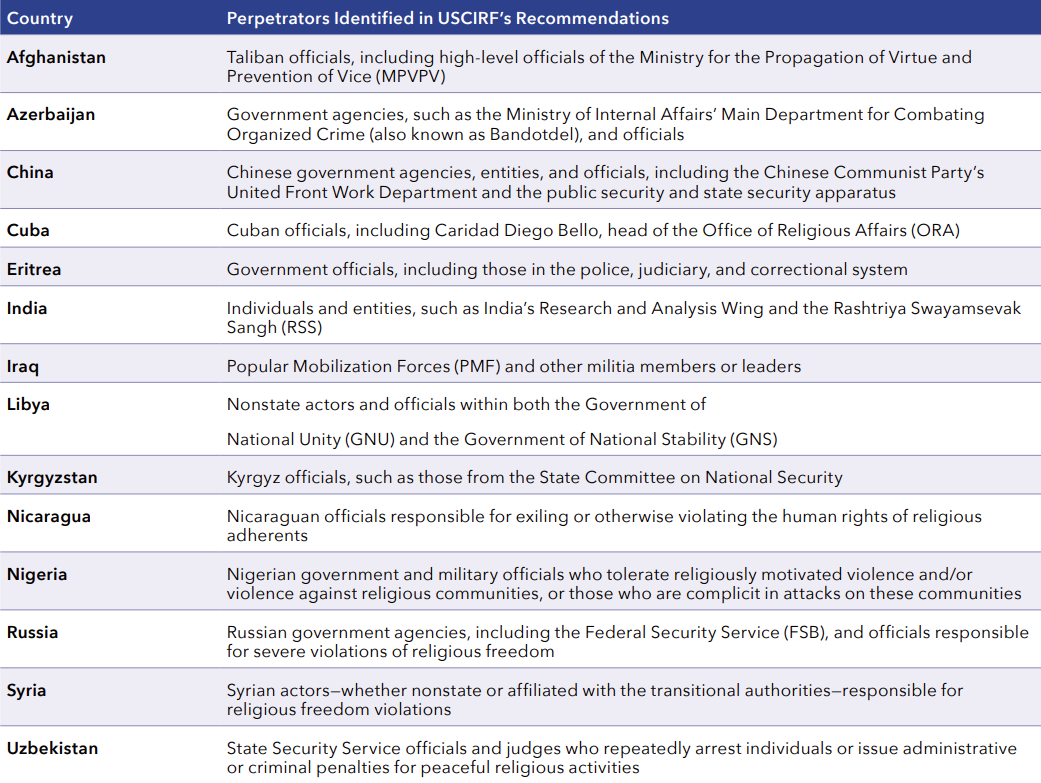
Nicaragua’s entry identifies “Nicaraguan officials responsible for exiling or otherwise violating the human rights of religious adherents.” In February 2026, the State Department designated the director of Nicaragua’s La Modelo prison under Section 7031(c) for involvement in gross violations of human rights—the prison has held numerous religious freedom victims.
For Nigeria, the commission recommends targeting “Nigerian government and military officials who tolerate religiously motivated violence and/or violence against religious communities, or those who are complicit in attacks on these communities.” In December 2025, the State Department announced a new visa restriction policy focused on individuals who have “directed, authorized, significantly supported, participated in, or carried out violations of religious freedom” in Nigeria and globally.
The factsheet outlines multiple legal authorities available for imposing these sanctions. The Global Magnitsky Human Rights Accountability Act, permanently reauthorized in 2022, has been used to sanction 744 individuals and entities for human rights abuses or corruption since 2016. Additional authorities include Section 212(a)(2)(g) of the Immigration and Nationality Act—which makes foreign officials responsible for particularly severe religious freedom violations ineligible for U.S. visas—and Section 7031(c) of the State Department’s appropriations law, which authorizes visa restrictions on foreign officials involved in gross human rights violations.
The commission emphasized that “imposing new targeted sanctions, on top of existing human rights sanctions, in direct response to a CPC designation could serve as a distinct tool to address IRF violations and increase pressure on foreign governments by making clear that religious freedom abuses are being singled out.” The factsheet notes that in countries like Burma, China, Iran, and North Korea, the U.S. has used “double-hatted sanctions”—repurposing existing sanctions as the official response to religious freedom violations rather than imposing new measures.
To be honest, the fact the US is looking at the parent organization of the BJP - Rashtriya Swayamsevak Sangh - doesn't surprise me. Many people don't realize how much persecution against minorities happens in India. According to Open Doors, they are higher than China for persecution. Finally someone is paying attention to this. Much of the persecution is ignored and the courts are so corrupt they don't care.