


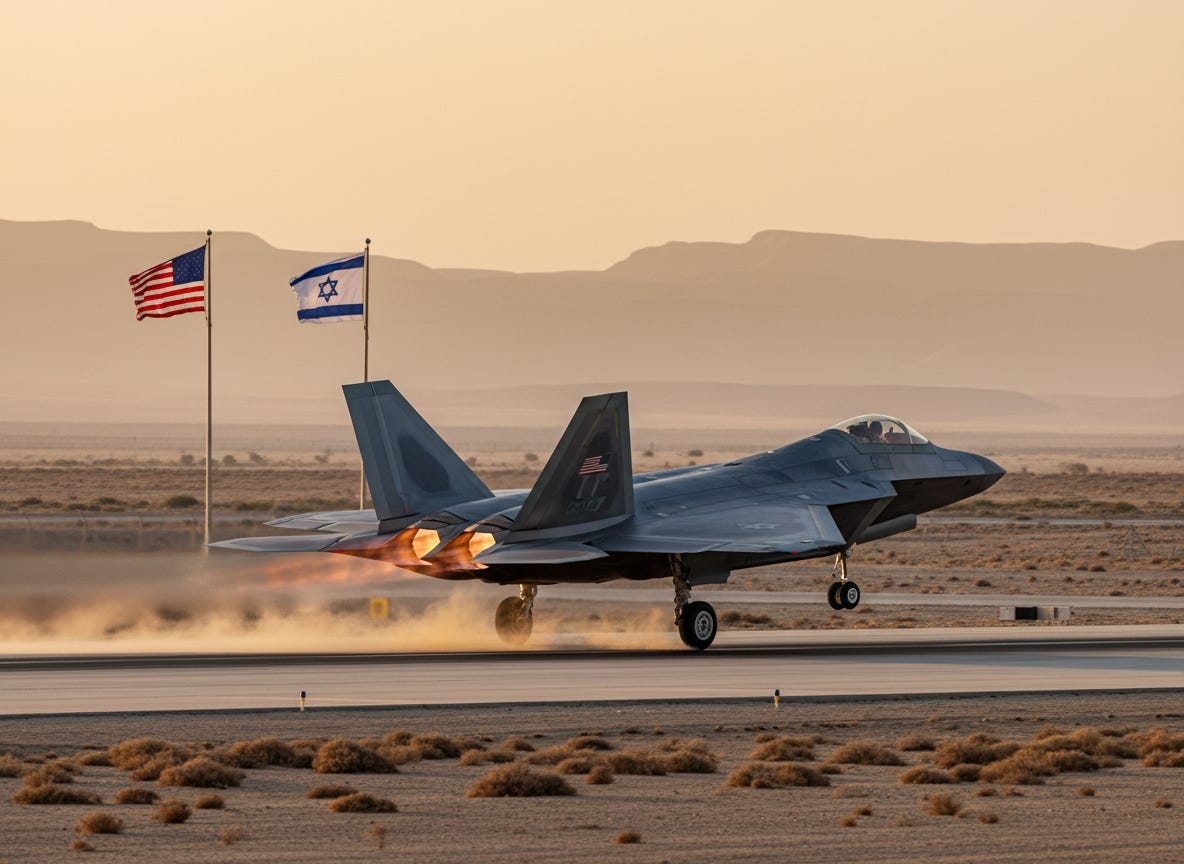
A new analysis from the Jewish Institute for National Security of America (JINSA) recommends the United States significantly expand its military presence at Israeli bases and relocate key assets from vulnerable facilities across the Middle East.
The proposal is set to come as Iranian missile and drone strikes during Operation Epic Fury have killed more than a dozen American servicemembers at bases in Arab countries, wounded hundreds more, and destroyed or damaged at least a dozen U.S. aircraft including aerial refueling and early warning platforms.
Meanwhile, U.S. air operations from Israeli bases have continued uninterrupted with zero American casualties, according to the report authored by Jonathan Ruhe, JINSA Fellow for American Strategy.
Historic Deployment Already Underway
The shift is already beginning. Days before Operation Epic Fury commenced, the United States deployed eleven F-22 stealth fighters to Ovda Airbase in southern Israel alongside KC-46 and KC-135 aerial refueling tankers at Ben Gurion Airport. This marked the first-ever operational deployment of U.S. combat aircraft to Israeli territory, implementing a recommendation JINSA made in November 2025 following a site visit with former CENTCOM leaders.

The deployment reflects growing recognition that Israel offers what Ruhe describes as “reliable access, favorable geography, and operational support unlike anywhere else in the Middle East.” Unlike Arab host nations that have prohibited U.S. overflights and operations against Iran even after suffering Iranian attacks themselves, Israel has encouraged the United States to rotate assets through its bases without restrictions since before last summer’s 12-Day War.
Vulnerability Gap Exposed
The security differential has proven stark during the current conflict. Iranian strikes have not only inflicted significant American casualties at Gulf bases but also taken critical communications and logistics facilities offline. U.S. Central Command has been forced to disperse thousands of servicemembers away from these bases to hotels and office buildings across the region for safety, sacrificing readiness and effectiveness in the process.

By contrast, Israeli bases benefit from what the report characterizes as a “world-class, multi-layered air defense network” and offer greater warning time than facilities farther east to counter Iranian missile and drone threats. The infrastructure at Israeli facilities already meets U.S. Air Force standards, having been built to American specifications or maintained to support Israel’s own U.S.-made aircraft fleet.
Strategic Geography and Infrastructure
Ovda Airbase, where the F-22s are now stationed, was constructed to American specifications in the early 1980s to implement the Camp David Accords. The facility features runways, hardened shelters, fuel bunkers, ammunition storage, and a dedicated terminal for U.S. use. Situated in southern Israel’s desert, it offers extensive undeveloped acreage for potential expansion.

The report emphasizes Israel’s geostrategic location at the crossroads of Europe, Asia, and Africa enables it to support rapid global mobility operations. Shipping lanes accounting for one-sixth of global trade and one-third of container traffic worldwide fall within the operational radius of U.S. fighter aircraft based in Israel, providing coverage of more than $1 trillion in annual commerce.
Broader Strategic Implications
JINSA’s recommendations extend beyond immediate wartime needs. The report suggests regular rotational deployments through Ovda, prepositioning of critical munitions, and using the base as a regional CENTCOM hub for combined exercises and planning. It also proposes that Israeli facilities could host U.S. Army and Marine Corps units for live-fire exercises in Ovda’s wide-open terrain.
The analysis frames expanded Israeli basing as both a security upgrade and a strategic signal. Ruhe argues it would serve “as an important corrective to Arab countries, like Qatar, who believe that providing basing gives them permission to pursue policies counter to U.S. interests.” The move would also reinforce to partners like Saudi Arabia that maintaining good relations with Washington requires maintaining good relations with Israel.
As American planners had already begun moving certain regional logistics facilities westward away from the Gulf before the current conflict, the report suggests the operational experience of Operation Epic Fury has validated the strategic logic of a westward shift toward Israeli territory.
This is so disgusting, it makes me vomit. In the history of the Jewish state it was always its patron who eventually turned into a treasonous enemy. Israel must never allow the United States any military basis there…. ever!
Smart move👌happy Passover❤️💫
🇺🇸🤝🇮🇱💫