


Jewish Onliner is an independent publication. If you find our work valuable, please consider becoming a paid subscriber. You can also subscribe to us on WhatsApp and Telegram. Follow us on YouTube, TikTok, Instagram, Discord, and X.
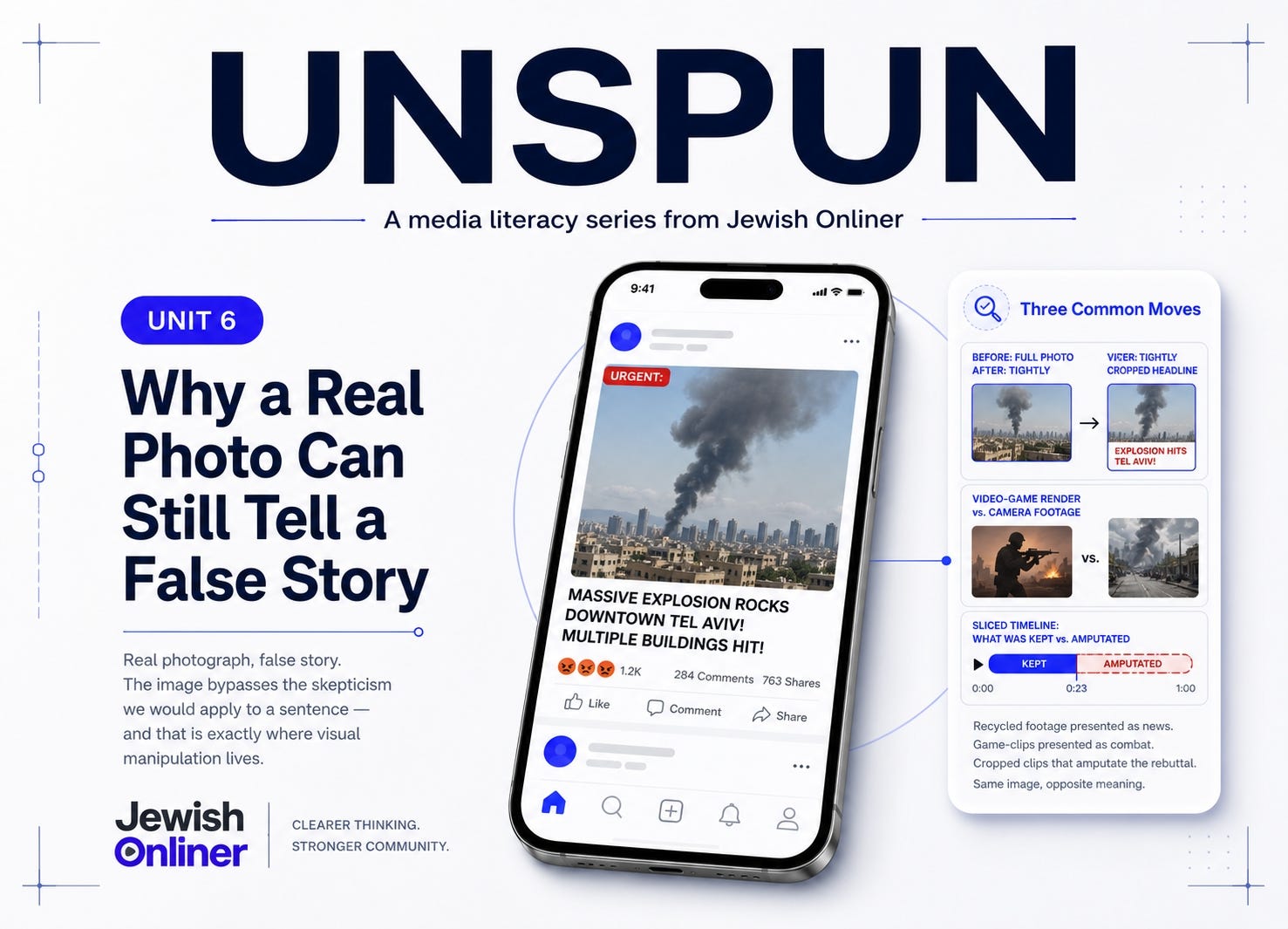
Text gets read. Images get absorbed.
When you read a sentence, part of your brain is still evaluating — checking whether the writer sounds credible, whether the argument holds together, whether you have reason to doubt. When you see an image, that evaluation mostly does not happen. The image doesn’t argue. It shows. And “shows” feels like proof in a way that “says” never quite does.
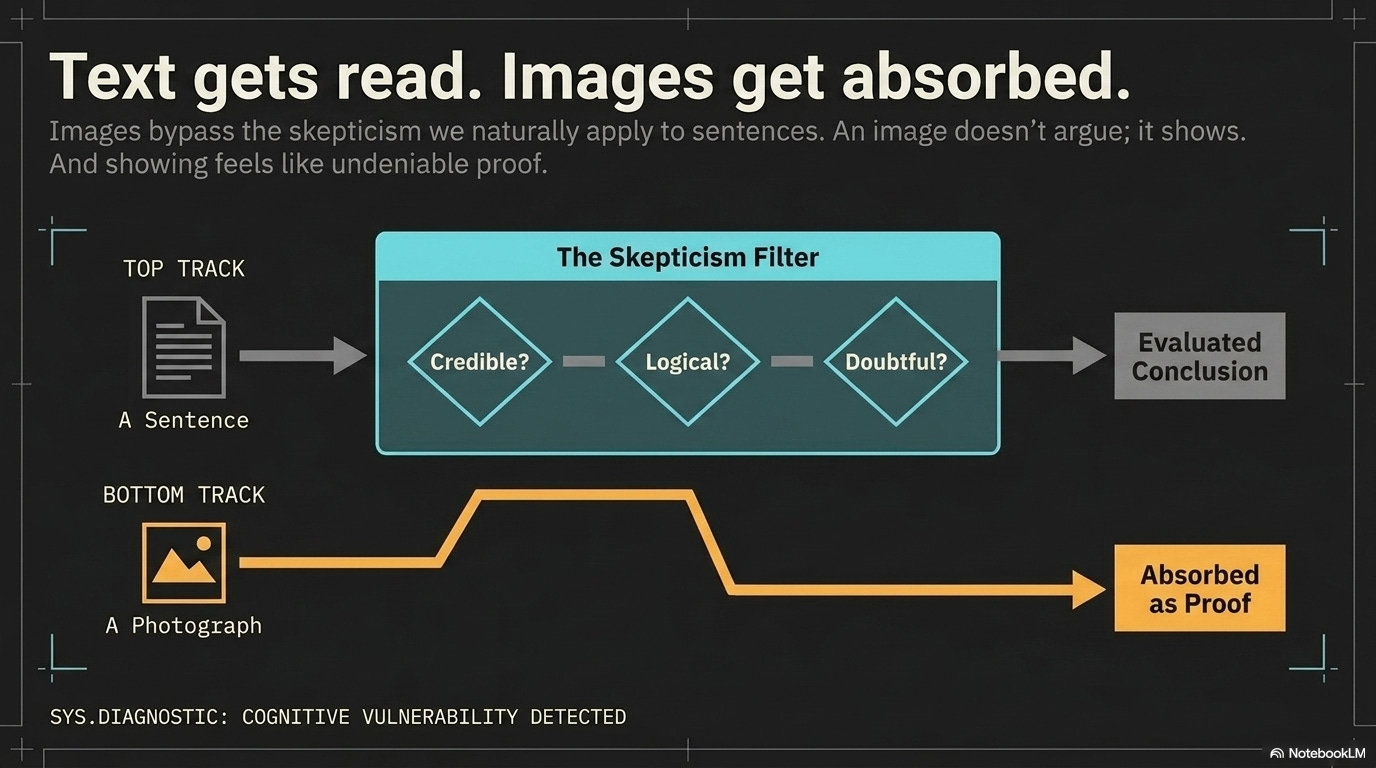
That instinct made sense when photographs were expensive, cameras were rare, and images were mostly used as documentation. It doesn’t make sense anymore. In an environment where millions of images circulate every day, most of them stripped from their original context, “real photo” and “true story” have come apart. And the gap between them is exactly where visual manipulation lives.
There is a stubborn assumption underneath most people’s visual instincts: if a photo is real, the story it tells must be true. That is no longer how it works. Images lie constantly — not by fabrication, but by framing, captioning, cropping, and the removal of context. And because images feel like evidence, they bypass the skepticism we would apply to a sentence.
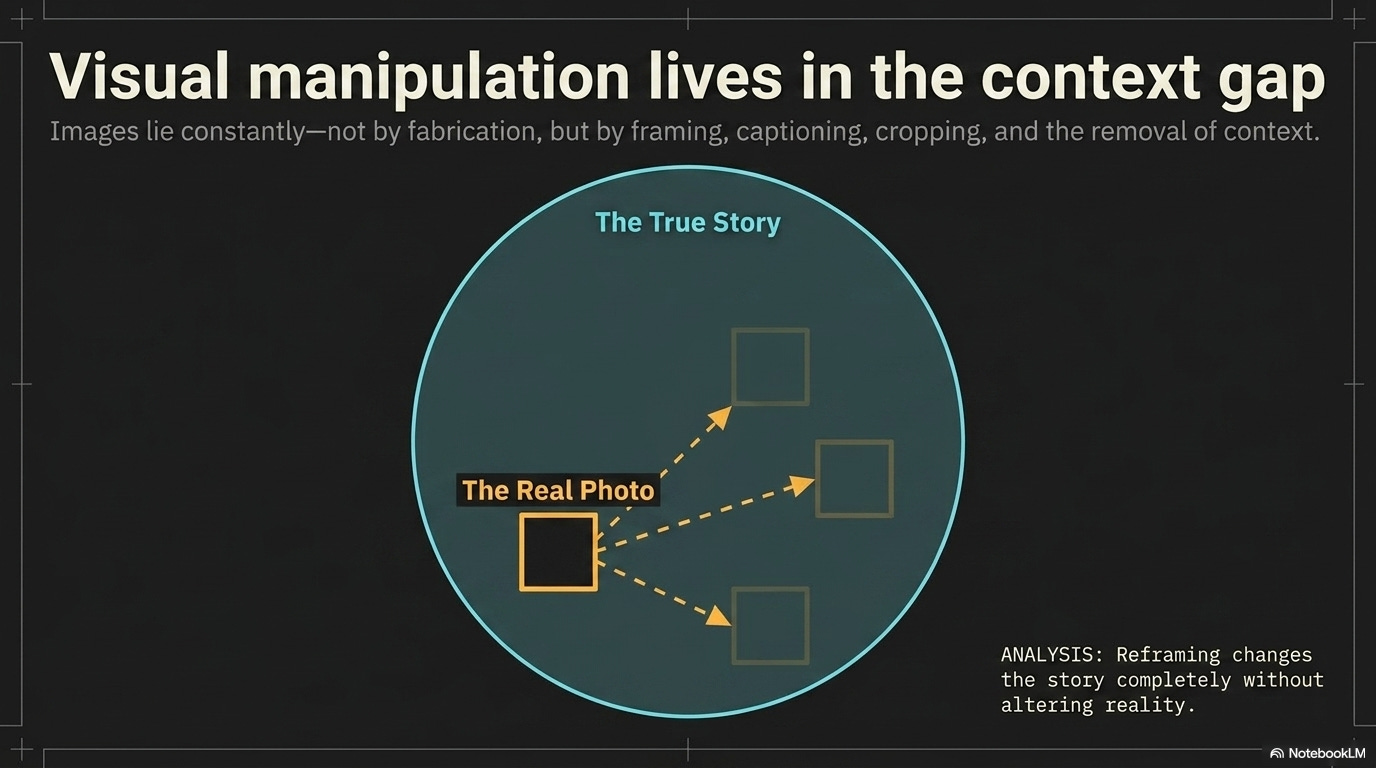
The most effective visual manipulation almost never requires editing a single pixel. It requires a real image and a false claim about what it shows.
Three of The Most Common Moves
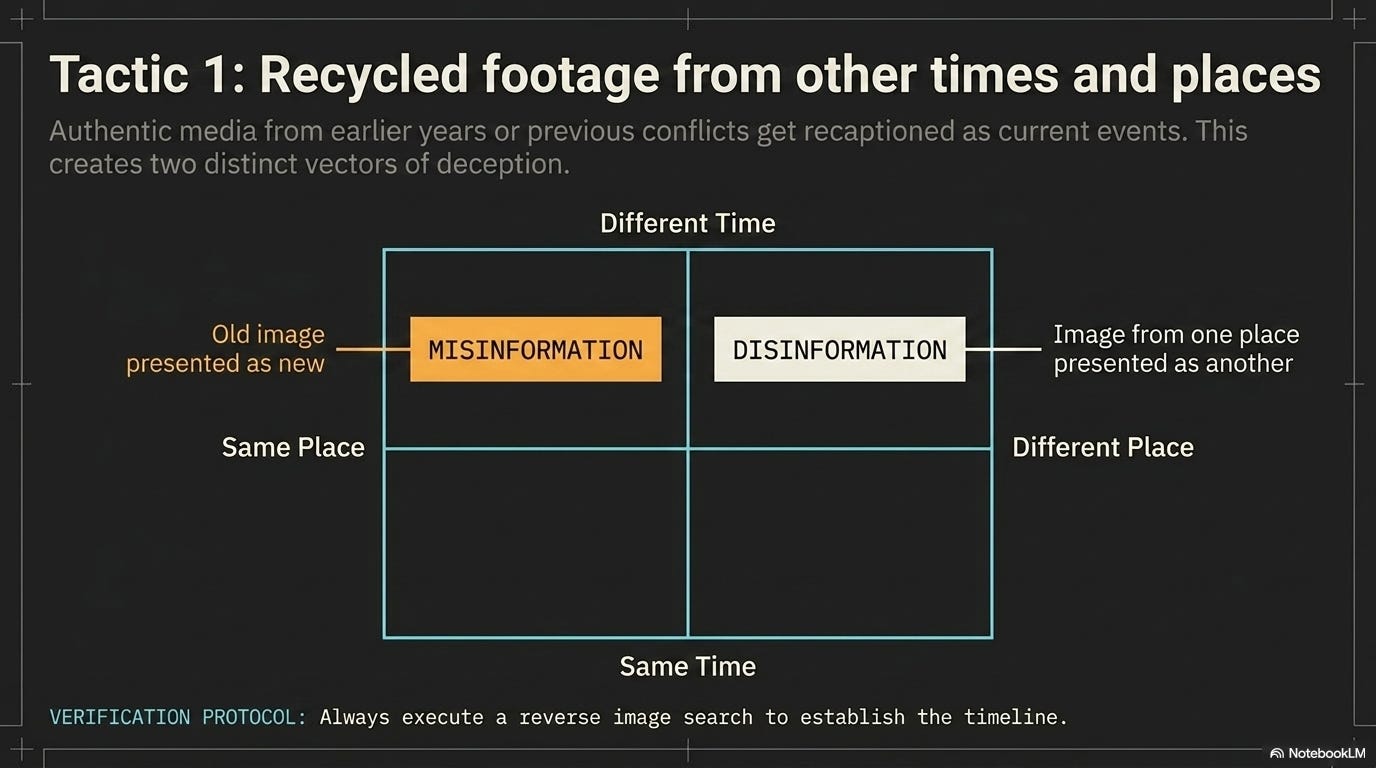
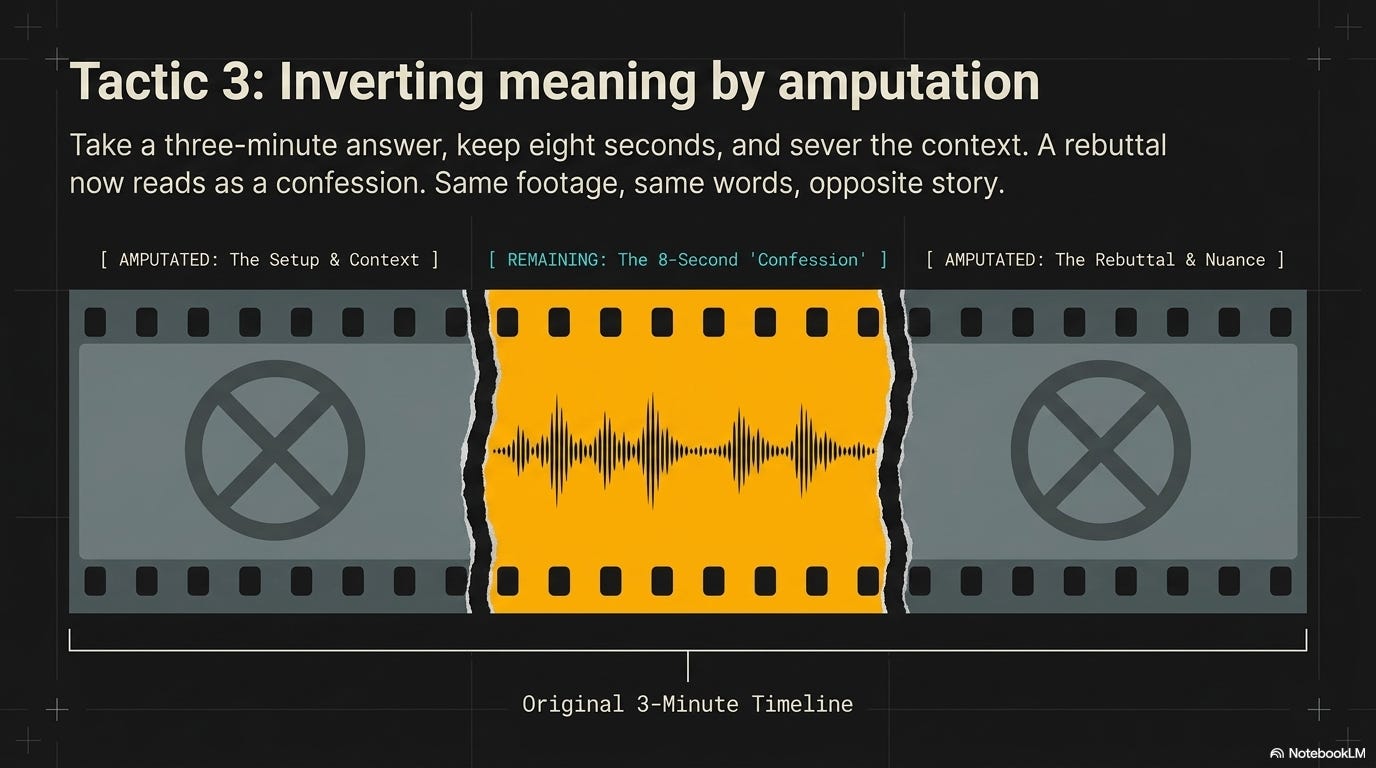
Recycled footage. Authentic video and photos from other conflicts and earlier years get recaptioned as current events. Throughout the Gaza war, the pattern was so common that verification desks built dedicated workflows just to catch it. An old image presented as new is misinformation; an image from one place presented as another is disinformation. Neither required editing a single frame.
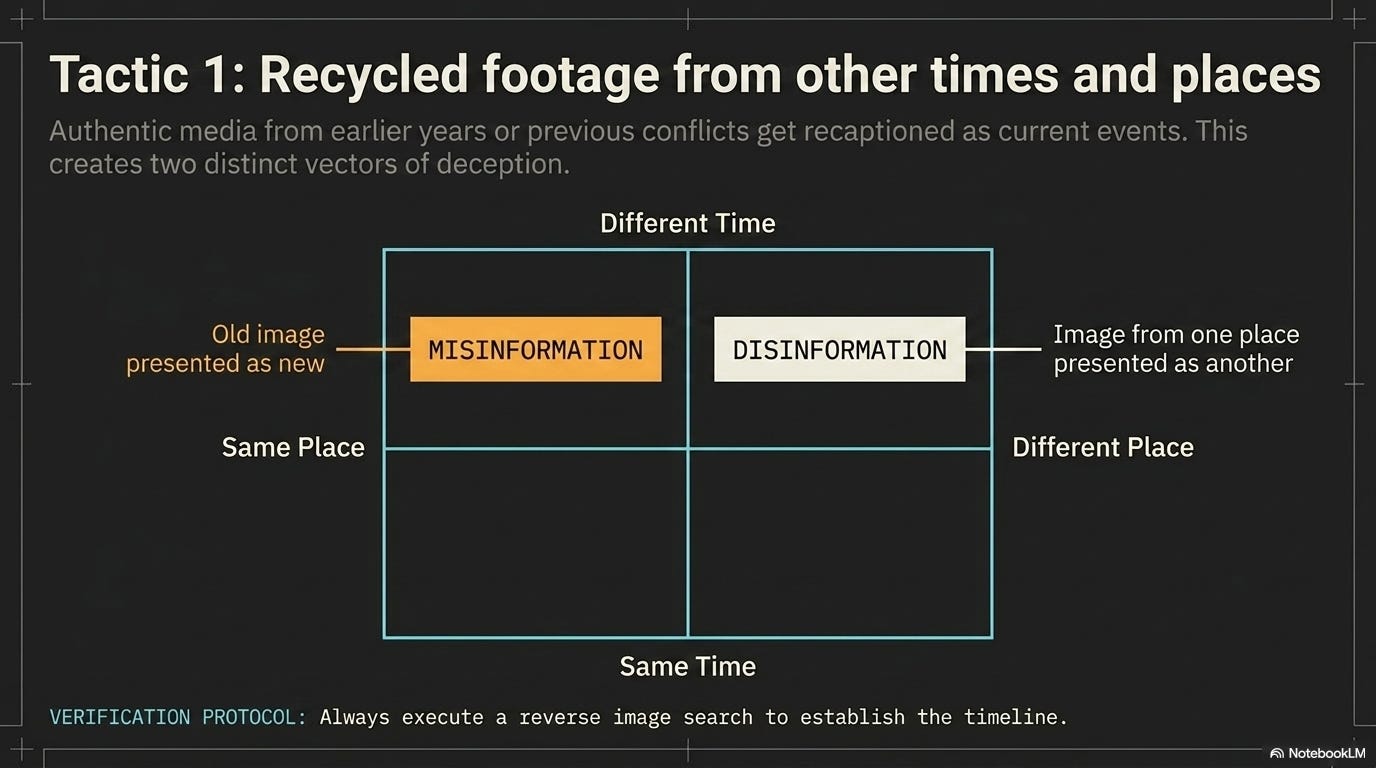
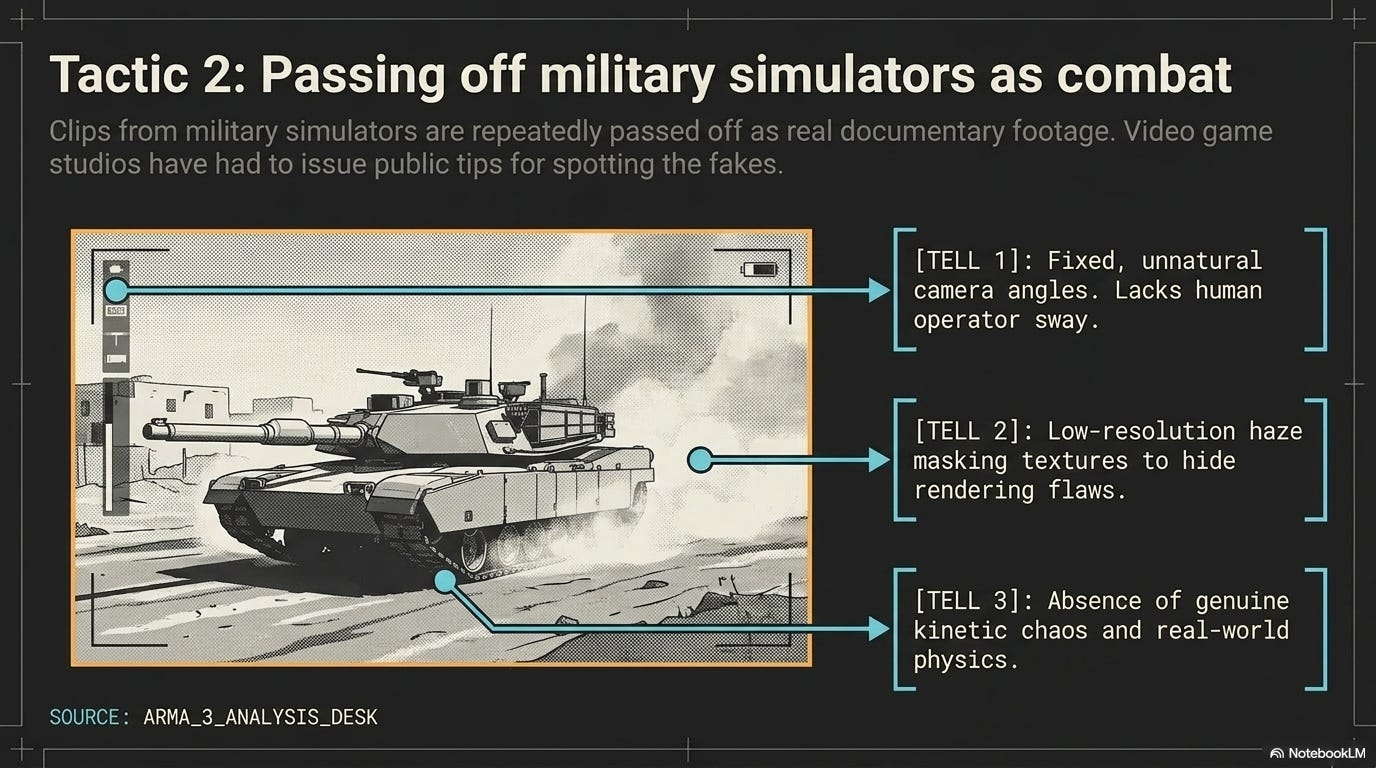
Video-game footage. A stranger cousin of the same trick. Clips from the military simulator Arma 3 have repeatedly been passed off as real combat in both the Ukraine and Gaza wars — the problem widespread enough that the game’s studio has publicly urged people to stop, and offered tips for spotting it: fixed camera angles, low-resolution haze hiding the tells, an absence of the chaos real footage carries.
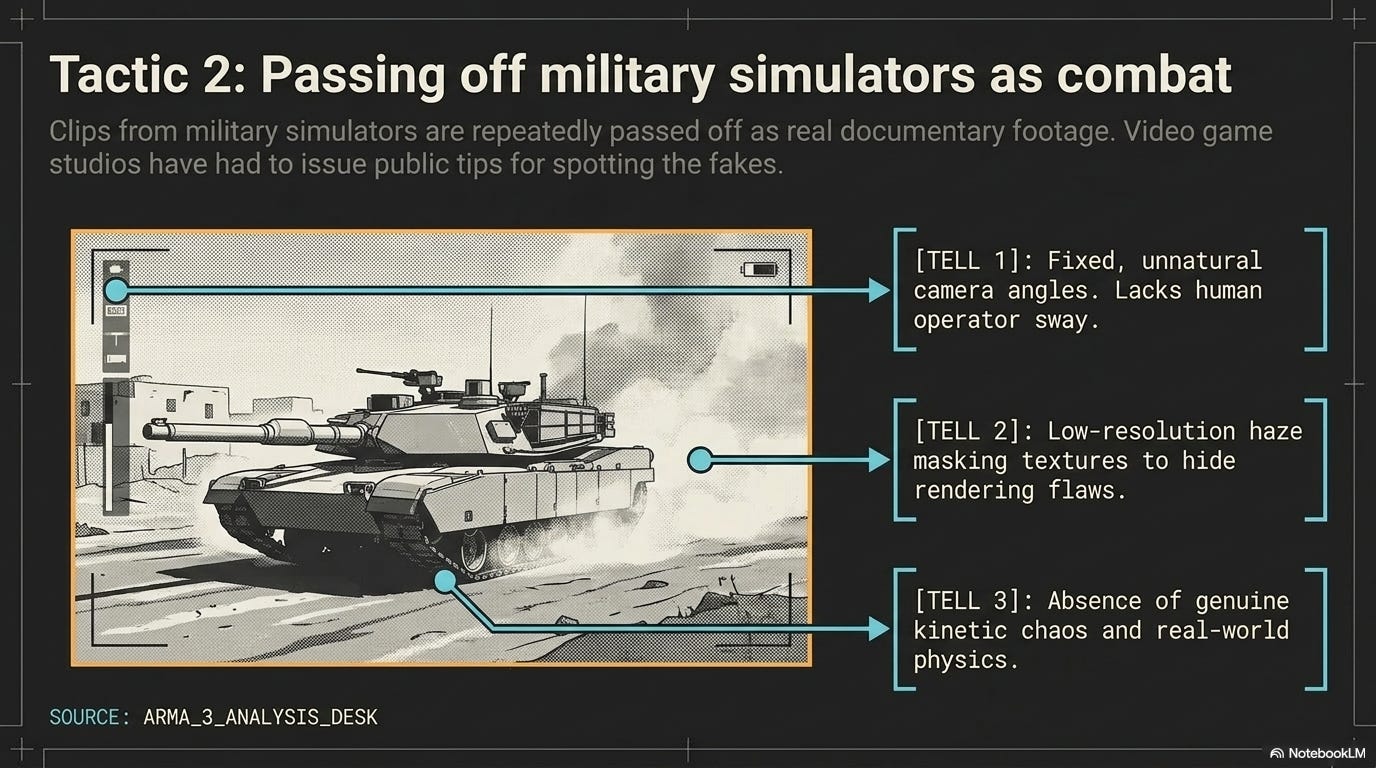
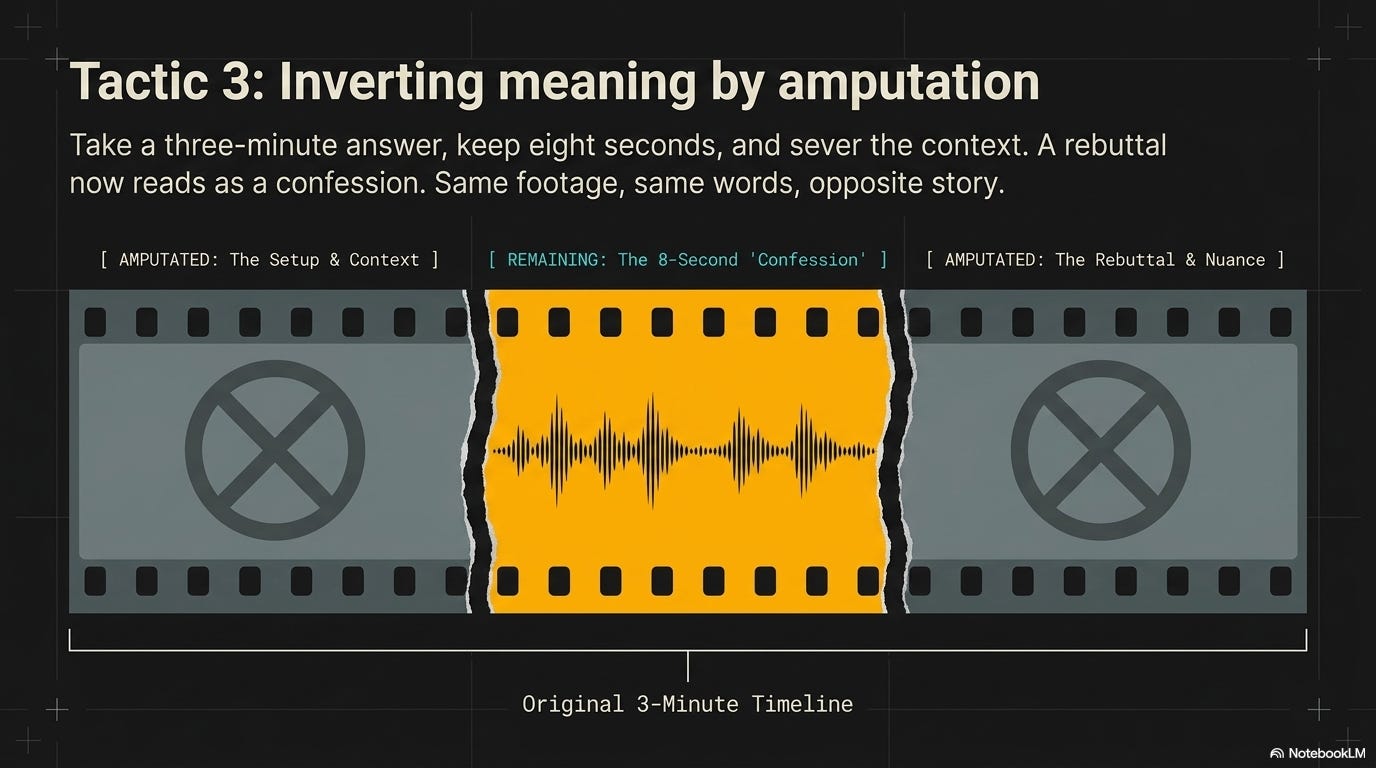
The cropped clip. Inverts meaning by amputation. The technique is simple: take a three-minute answer, keep eight seconds, and cut the “some people claim that …” off the front and the “… but that’s wrong” off the back. What was a rebuttal now reads as a confession. By the time the full clip surfaces, the short version is already embedded in articles and memes, and the full one gets dismissed as “damage control.” Same footage, same words, opposite story.
The Screenshot Trap
Screenshots are the most efficient tool for laundering a weak claim. Someone posts something provocative — maybe satire, maybe a parody account, maybe stripped of its thread. Someone else screenshots it, crops the context, and reposts it as “they actually said this.”
The screenshot removes your ability to verify: you cannot click through, cannot read the replies that would correct it, and cannot check whether the account is even real. Worse, screenshots can be edited — text changed, timestamps altered, usernames faked — and most people never notice, because an image reads as authentic. If a screenshot is making a shocking claim, find the original post before you believe it.
What To Do
Before you believe, share, or react to an image: reverse-image-search it to find the earliest version and check whether it is being recycled. Find the original source rather than trusting a screenshot.
Read the caption critically — it is telling you how to see the image, and a different caption would tell a different story. Check the date. And ask what is outside the frame: what happened just before or after, and what context was cropped away. Seeing is no longer enough. You have to see and verify.