


Jewish Onliner is an independent publication. If you find our work valuable, please consider becoming a paid subscriber. You can also subscribe to us on WhatsApp and Telegram. Follow us on YouTube, TikTok, Instagram, Discord, and X.

A misleading claim lands in your feed. Maybe it’s a screenshot with no source. Maybe it’s a clip cut to imply the opposite of what was said. Maybe it’s a breaking-news headline that will be corrected in six hours but has already been shared a million times.
You have about two seconds. Long enough to feel something. Not long enough to think. And in that window, you become one of two things: someone who slows the manipulation chain down, or someone who speeds it up.
The manipulation machine doesn’t run on bad actors alone. It runs on ordinary people forwarding, screenshotting, quote-posting, and reacting faster than they verify. Every one of those actions is a vote for what deserves more reach. Most people never think of themselves as part of the infrastructure. They are.
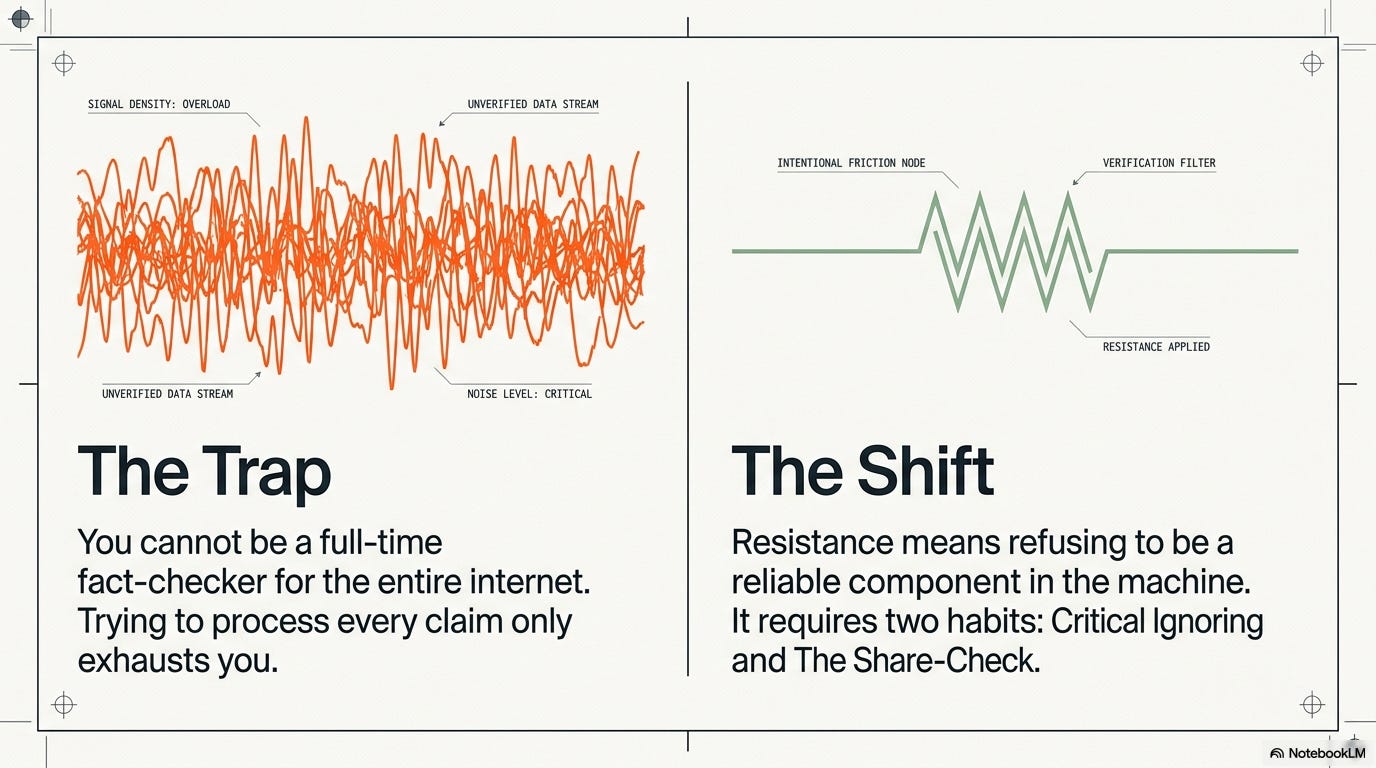
Resistance does not mean becoming a full-time fact-checker for the entire internet. It means refusing to be a reliable component in the machine that carries unverified claims at scale. Two habits do most of the work: critical ignoring, and the share-check.
Critical Ignoring: The Skill Nobody Teaches
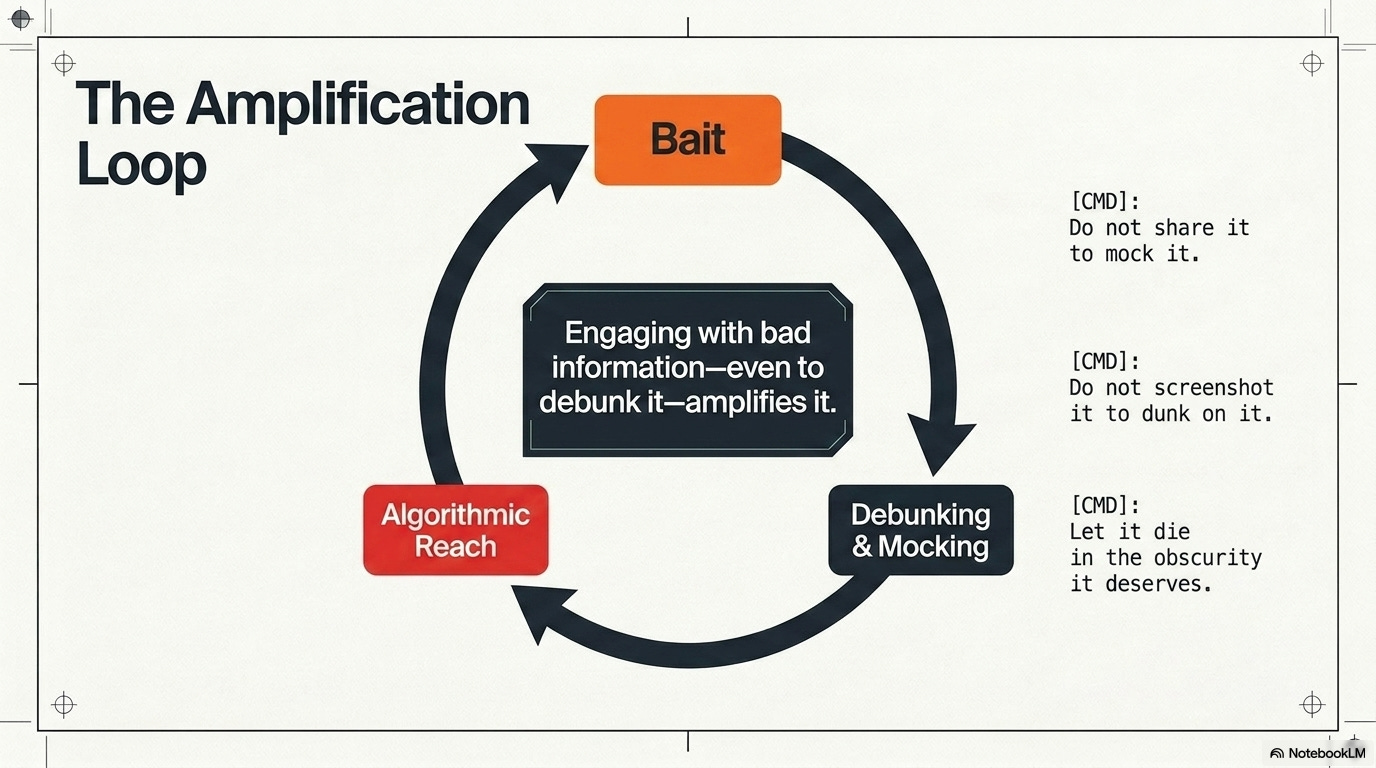
Not every controversy, claim, or outrage-post deserves your attention. Most do not. Critical ignoring is the deliberate choice not to engage with low-quality information — not out of fear of being wrong, but because engaging with bad information, even to debunk it, amplifies it.
When you see something engineered to provoke you, the honest question is whether it is worth your attention or whether it is simply bait. If it is bait, the strongest response is usually no response. Do not share it to mock it. Do not screenshot it to dunk on it. Let it die in the obscurity it deserves. Your attention is finite; spend it on purpose.
The Share-Check: Pause Before You Amplify
Every share, screenshot, quote-post, and forward is an editorial decision. You are deciding what deserves more reach — and treating that decision as automatic is how weak claims travel further than the corrections that follow them. Before you pass something on, run three questions: Can I verify it? If not, I’m not sharing it, I’m laundering it. Am I preserving context?
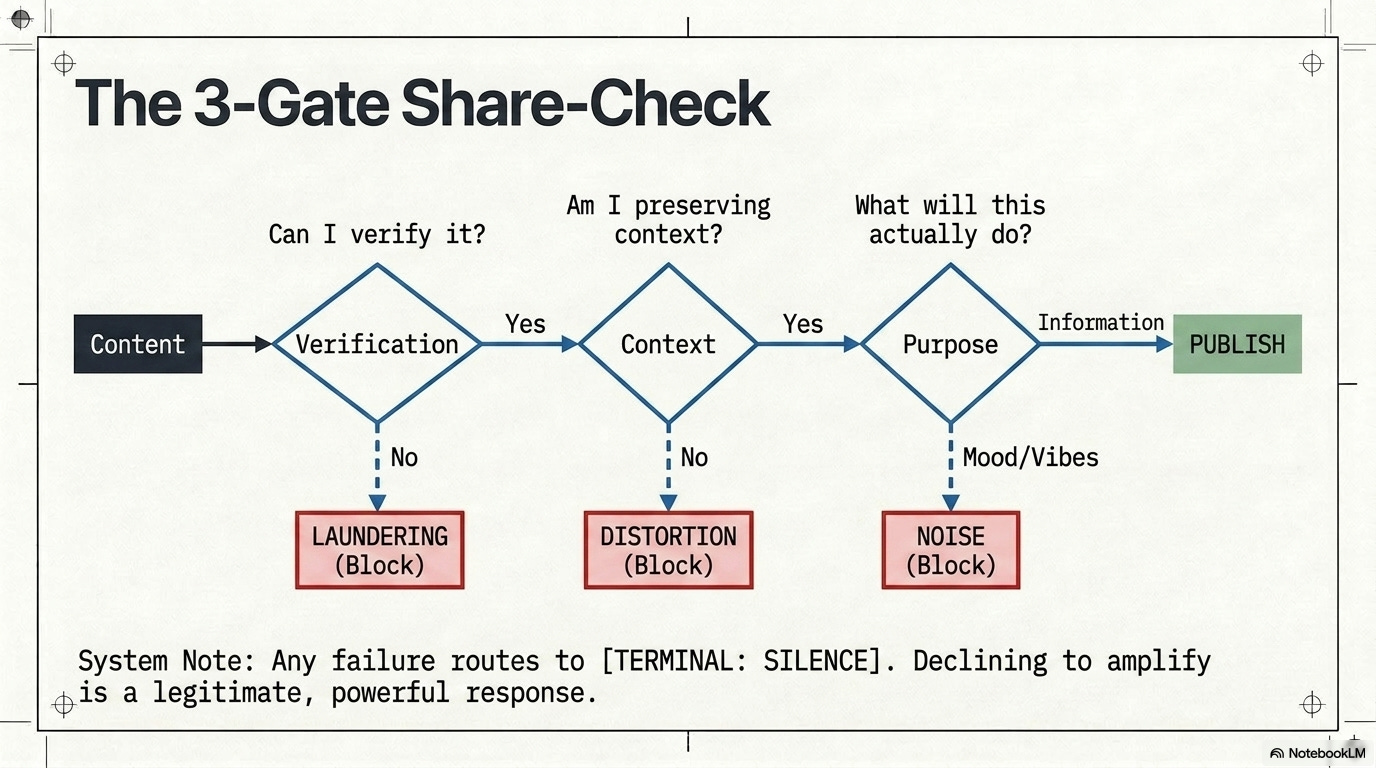
Screenshots strip attribution. Clips remove the sentences that reverse the meaning. Summaries introduce interpretation the original did not carry. And: what will this actually do? If the honest answer is “make people feel what I already feel,” that is not sharing information. That is amplifying a mood.
Silence is not a failure.
Declining to amplify a claim you cannot check is a legitimate — often the strongest — response.
Breaking News Is Where Both Habits Get Tested
Breaking news is where manipulation moves fastest: information is incomplete, sources are unclear, emotions are high, and everyone is racing to be first. In April 2026, after the Daily Wire laid off roughly 50 employees, Candace Owens told millions of followers it was “over fifty percent” of the workforce — then sixty percent, then an “absolute bloodbath.” None of it was accurate. Boreing’s own summary of the moment doubles as the rule for all breaking news: in 2026, “lies are fast and the truth gets there last.”
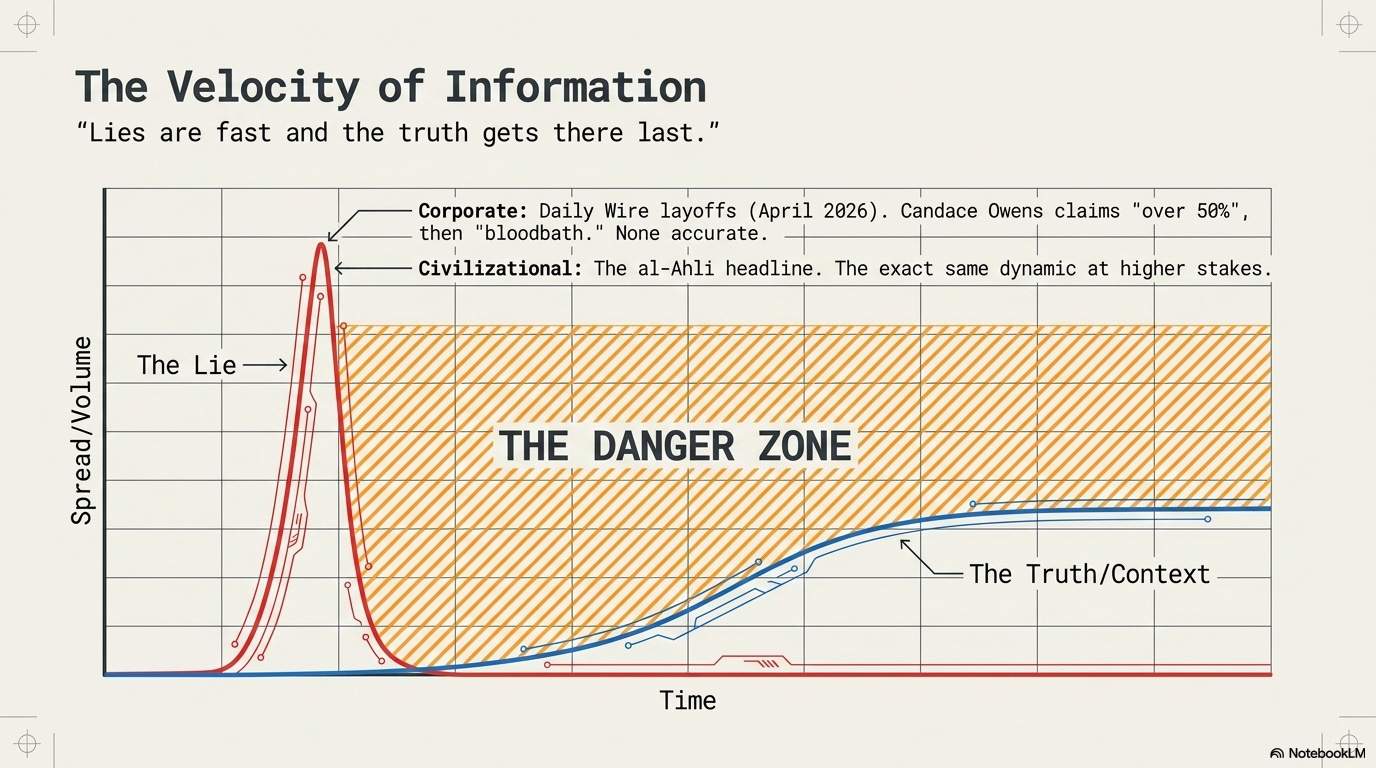
The al-Ahli headline is the same dynamic at civilizational stakes rather than corporate ones. The protocol is identical in both cases:
Wait — initial reports are routinely wrong or incomplete. Let the story develop before you form a conclusion.
Verify before you share — run the source through Unit 3. If you cannot verify it, do not pass it on.
Preserve context — if you do share, link the original. Do not crop quotes, clip video, or screenshot a headline stripped of its source.
Acknowledge uncertainty — “Unconfirmed reports suggest …” is more honest, and ages far better, than “Breaking: this just happened.”
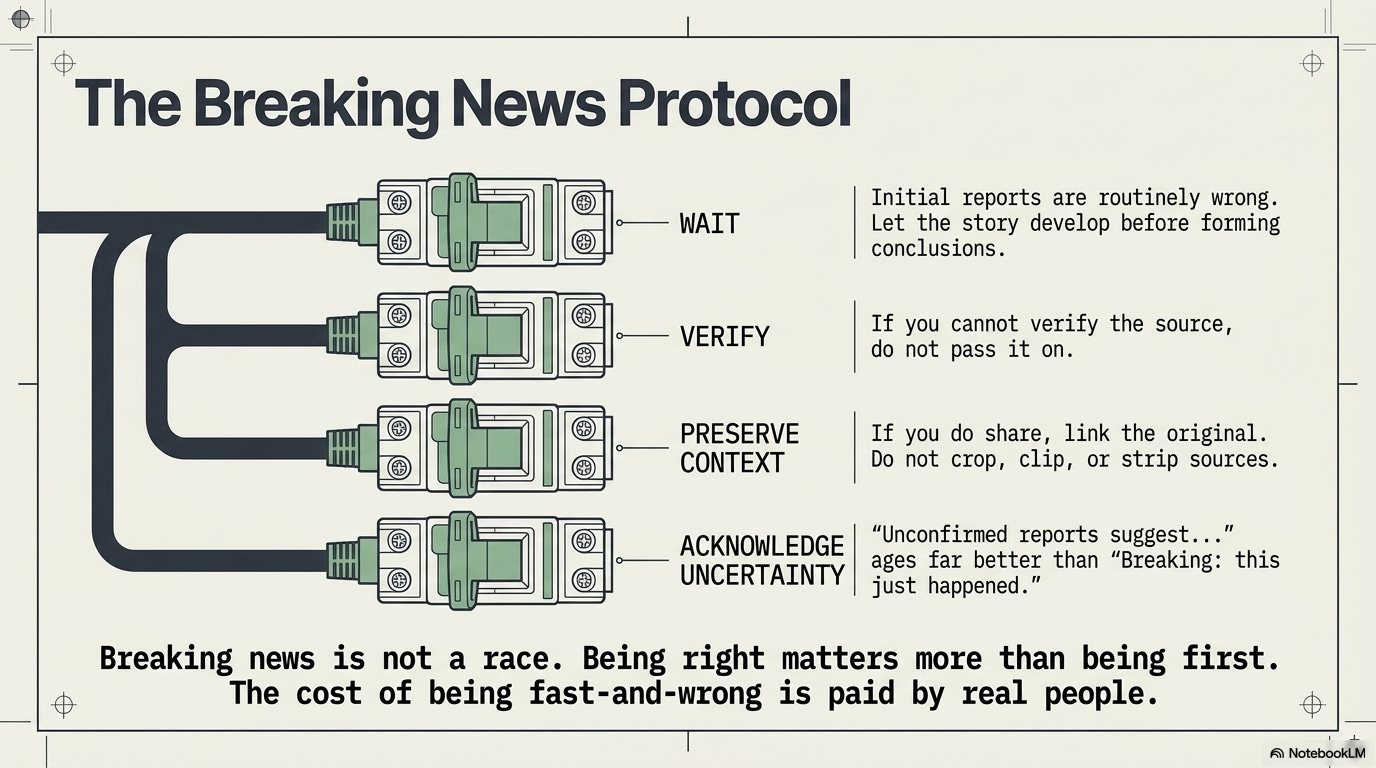
Breaking news is not a race. Being right matters more than being first, and the cost of being fast-and-wrong is paid by real people.