


Jewish Onliner is an independent publication. If you find our work valuable, please consider becoming a paid subscriber. You can also subscribe to us on WhatsApp and Telegram. Follow us on Facebook, YouTube, TikTok, Instagram, Discord, and X.

Once you understand what manipulation is, the next question is: how does it actually work? What are the specific moves that shape perception before you’ve had time to evaluate evidence? The patterns are surprisingly consistent. And once you learn to recognize them, you start seeing them everywhere.
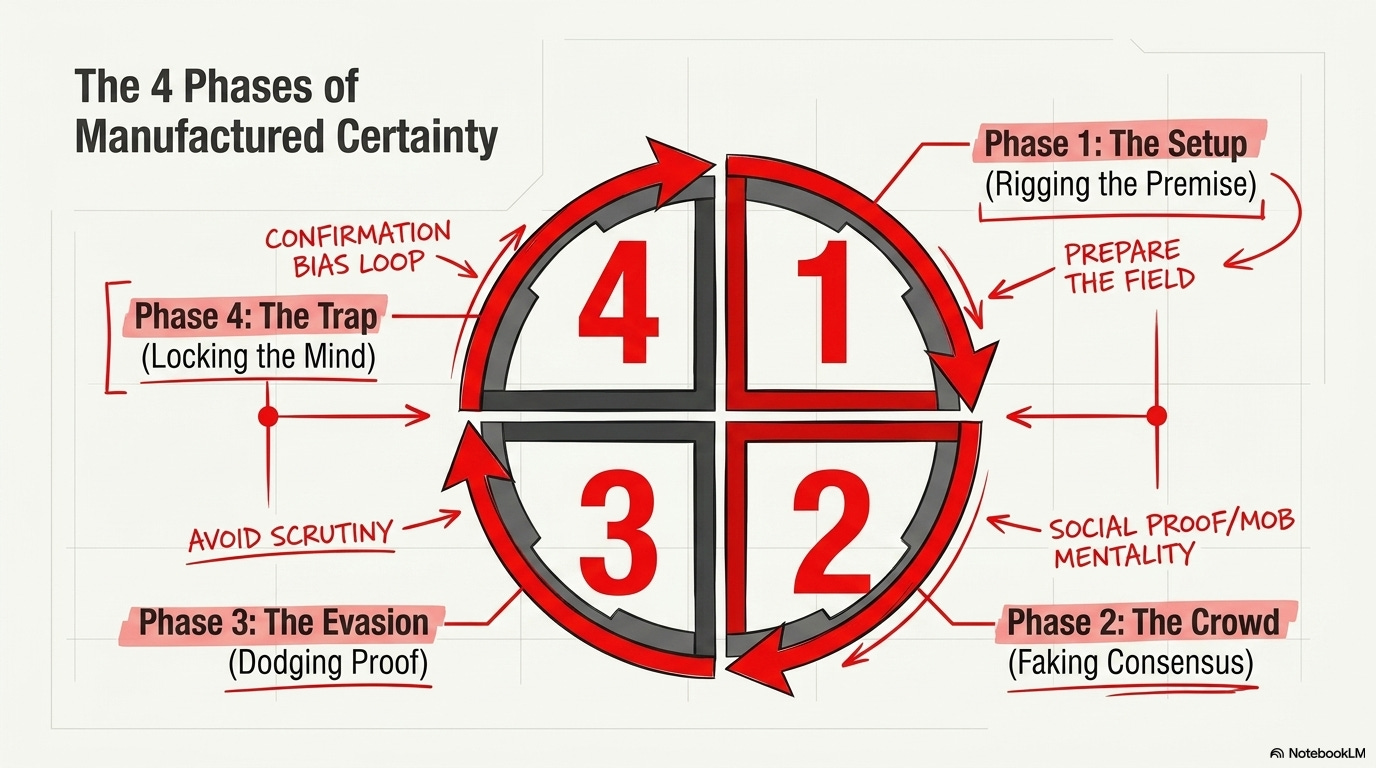
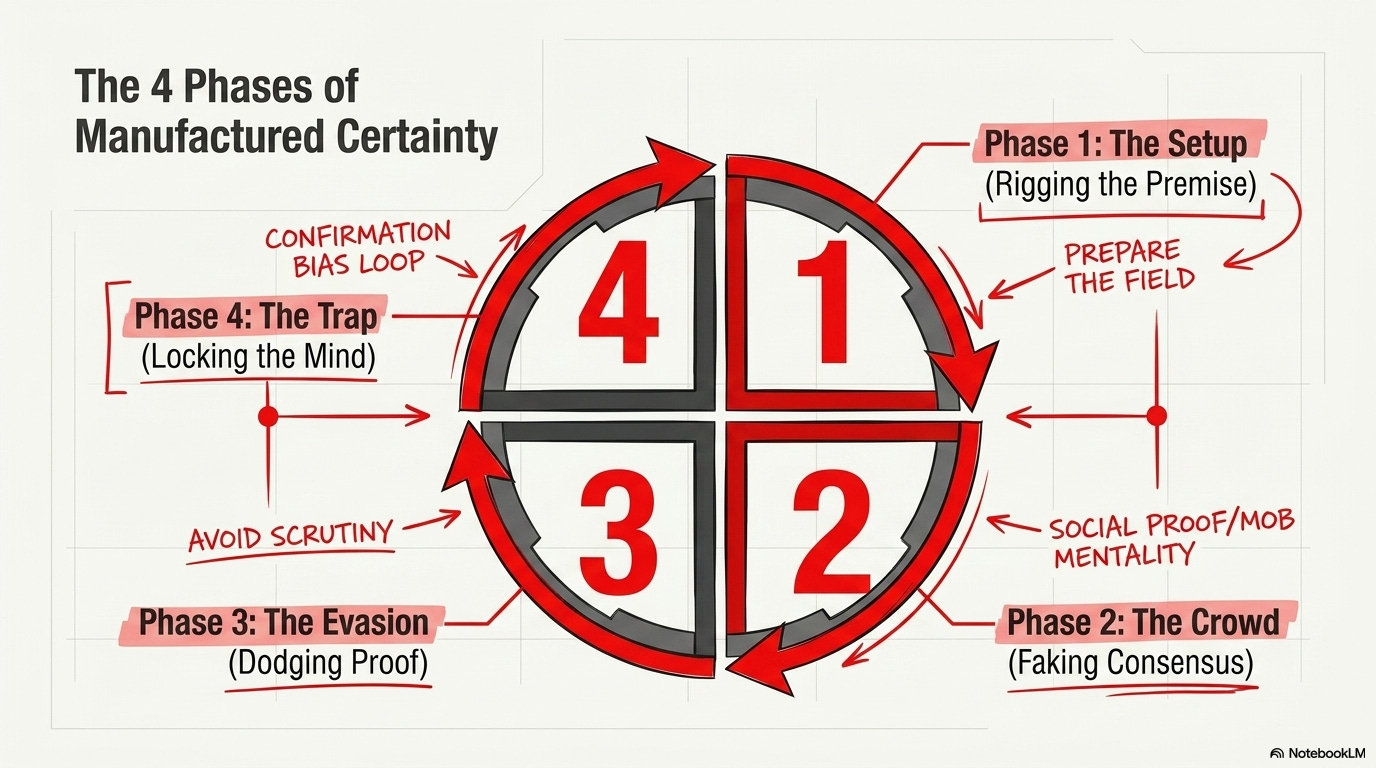
Manipulation runs on a small, recognizable set of moves. Below are eighteen techniques Daily Wire co-founder and former CEO Jeremy Boreing dissected in a 2026 episode analyzing how commentators like Tucker Carlson and Candace Owens build conviction without evidence.

The 18 Tactics
Pre-suasion — telling you what something means before you see it, so you recognize it instead of evaluating it. Loose Change plays conspiratorial audio over real 9/11 footage and you then “see” a demolition. It is also why Tucker Carlson runs a monologue before interviews that don’t go his way — and not before the ones that do.
The Illusion of insight — the exhilarating “scales falling from your eyes” rush. It is the feeling of conviction, not of truth, and it can be manufactured.
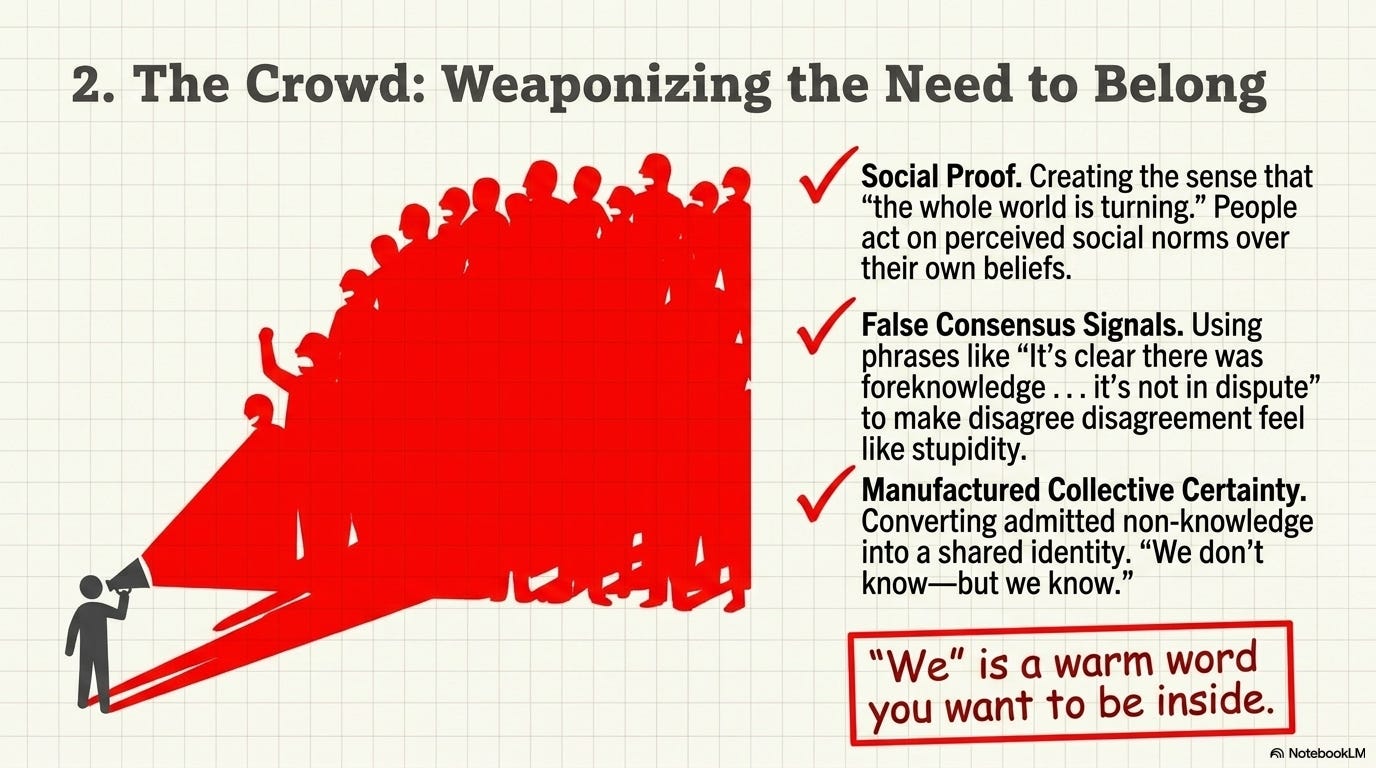
Social Proof — the sense that everyone already agrees — “the whole world is turning.” People act on perceived social norms even over their own beliefs, which is why candidates speak with a crowd arrayed behind them.
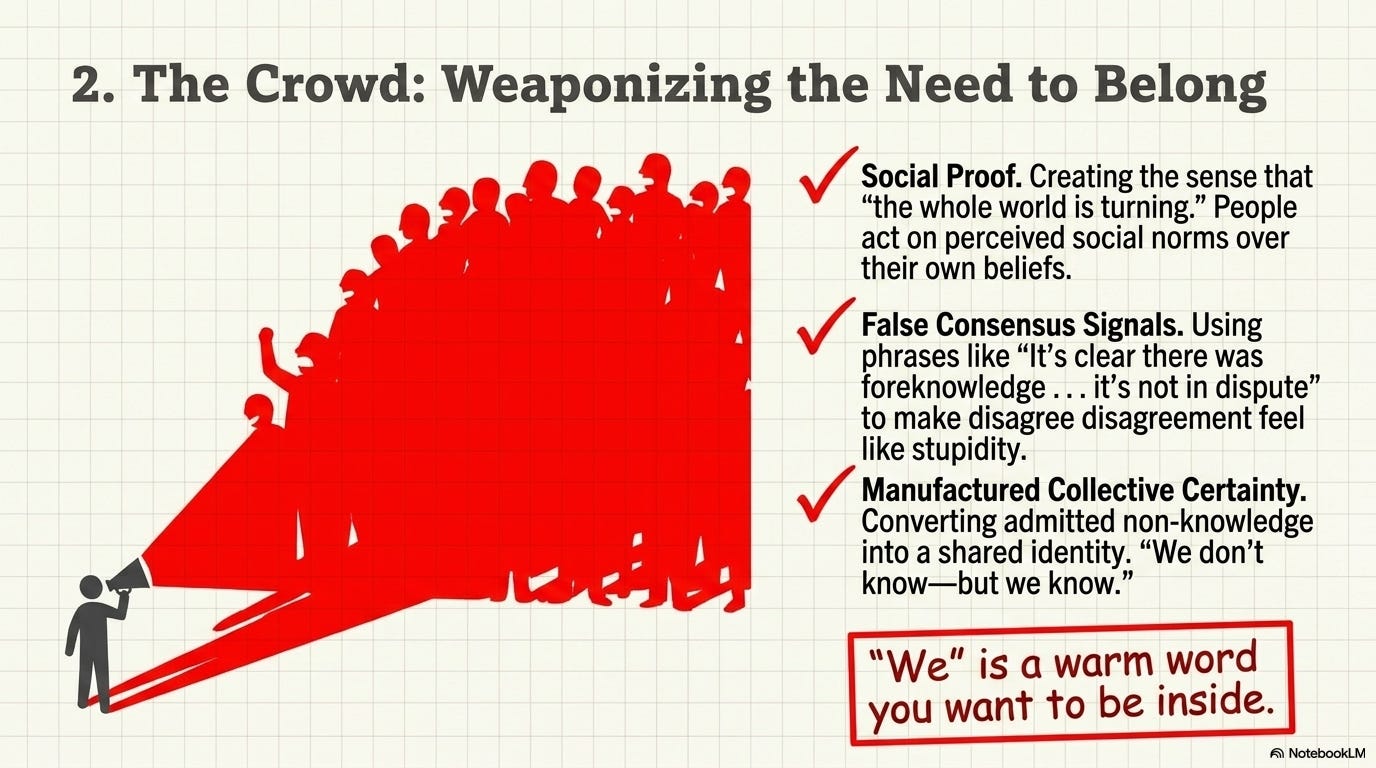
False Consensus Signals — “it’s clear,” “everyone knows,” so disagreement feels like stupidity. Tucker on Pearl Harbor: “It’s clear there was foreknowledge … it’s not in dispute.”
Presupposition — stating a contested claim inside a clause as already-settled fact — what salesmen call the assumptive close. Tucker: “When Roosevelt allowed Pearl Harbor to happen — which he did …”
The plausible-deniability hedge — full certainty up front, a tiny hedge at the back, so the speaker can retreat after the certainty has landed. Tucker: “That’s been proved. I think.”
Epistemic closure — language signaling the question is settled, so asking for evidence makes you the one out of bounds. Tucker: “It’s universally recognized at this point …”
Thought-terminating clichés — “obviously,” “of course” bolted onto a wild claim as if noting the sky is blue. Tucker on the CIA and Ukrainian drone strikes: “Yes, obviously. Tell me how you didn’t.”
The illusory truth effect — repetition plus confidence makes a claim feel true regardless of evidence. Boreing’s team found hundreds of these markers across 23 episodes of one show.
Burden shifting — treat the claim as self-evident so the skeptic has to disprove it. “Tell me how you didn’t” makes your doubt the thing that needs explaining.
Assertion stacking — pile certainty signals so fast the brain stops checking for evidence. Tucker on Ukraine: “Maybe … of course it did. Obviously … it’s the truth.” Three certainty moves, two sentences, nothing underneath.
Motivated reasoning — start from the conclusion you want, admit the evidence isn’t there, and invite the audience to jump anyway. Candace Owens’s whole brand: “We don’t know — but we know.”
Manufactured collective certainty — convert admitted non-knowledge into “we all know,” because “we” is a warm word you want to be inside. Not “I suspect,” but “we know.”
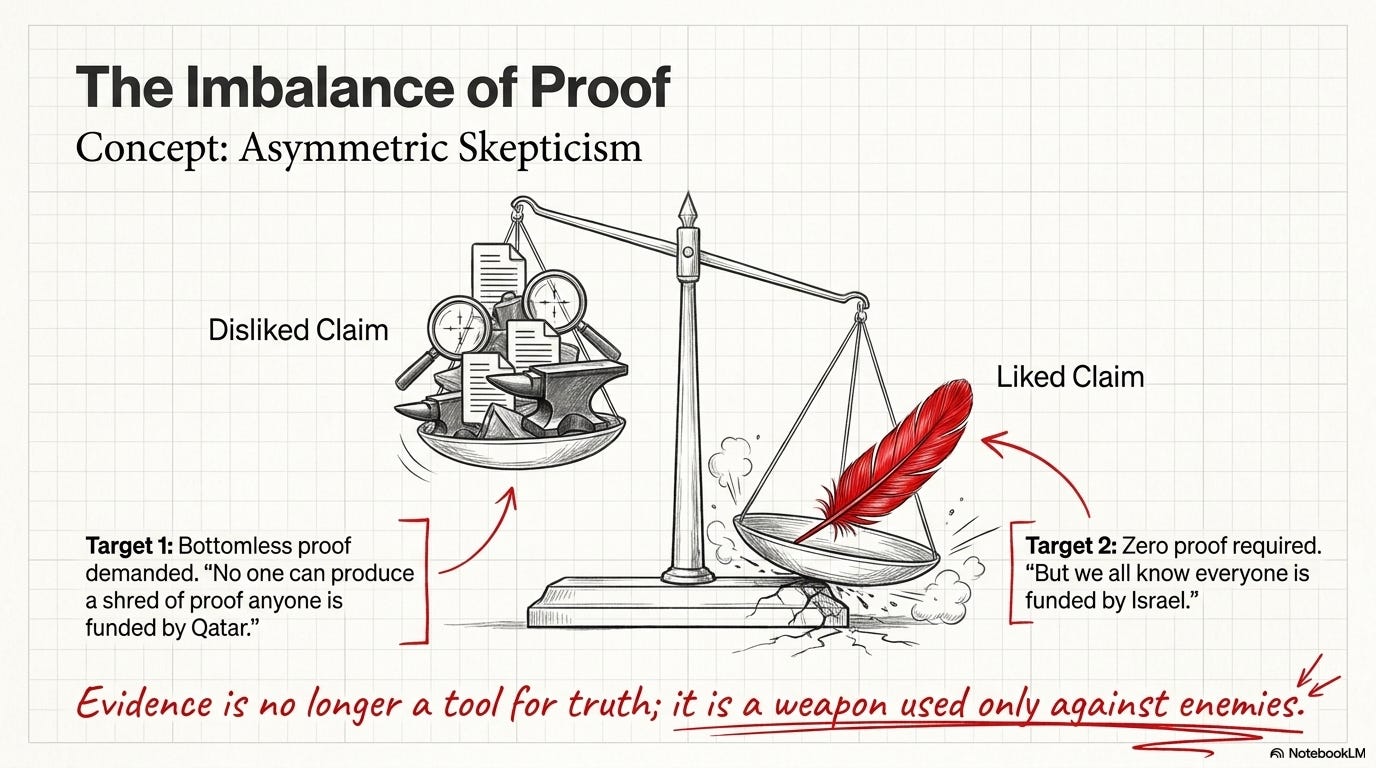
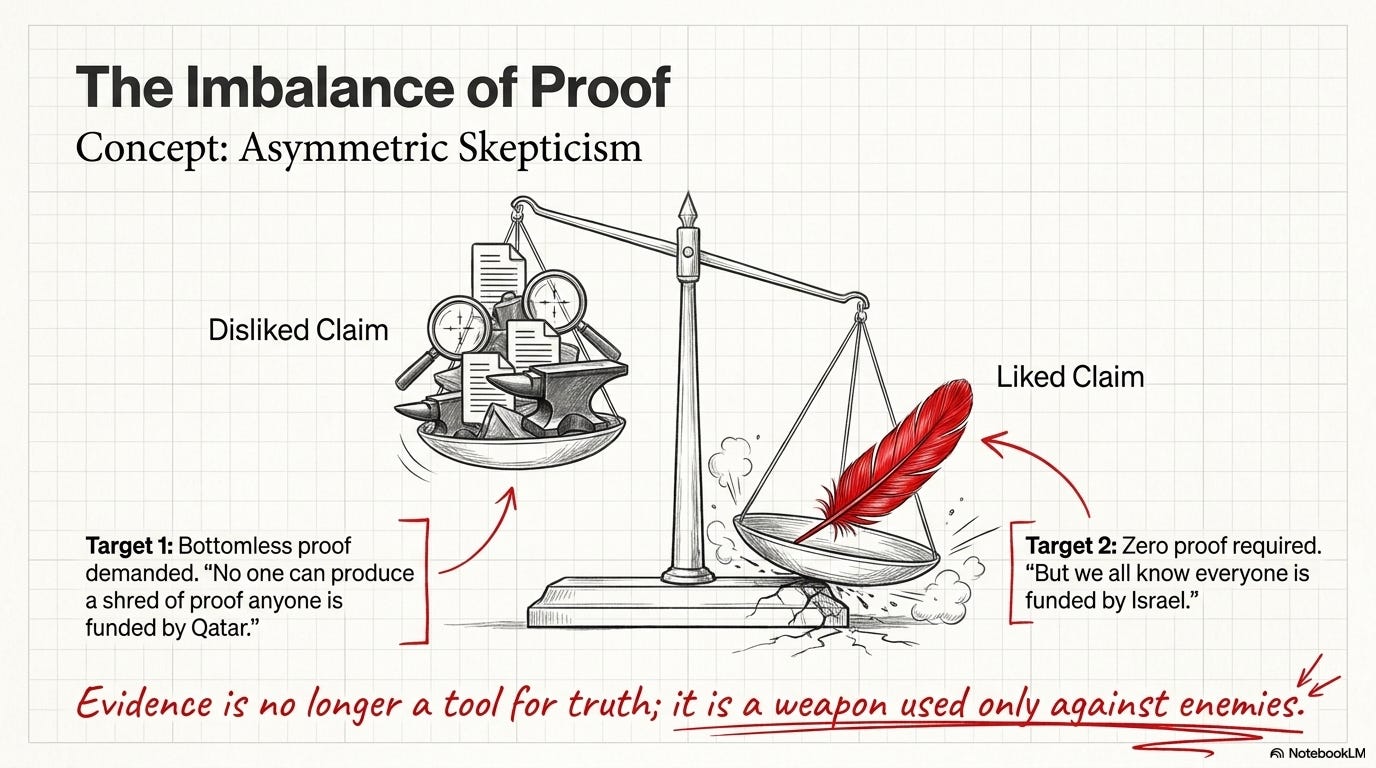
Asymmetric skepticism — bottomless proof demanded of the disliked claim, none of the liked one. Candace: no one can produce “a shred of proof” anyone is funded by Qatar, but “we all know” everyone is funded by Israel.
Authority transfer — one forbidden or compelling truth becomes a credential, and that trust is then spent on a dozen claims you never checked — a foot in the door. Once you trust the narrator, you stop auditing when Tucker says Roosevelt let Pearl Harbor happen, or when Candace says Jews commit child sacrifice.
Shifting the default — move the unspoken baseline from “America can” to “America lies, its institutions are corrupt,” so conclusions flow from the mood, not the evidence. The moon landing is his proof: identical photos, rock samples, and retroreflectors, yet roughly half of Gen Z now doubt it. The evidence didn’t change. The default did.
The unfalsifiable frame — a theory that explains everything, where contradicting evidence only proves you’re “over the target” and questioning it proves you’re one of the compromised. That, Boreing says, is when rational skepticism has curdled into religious conviction.
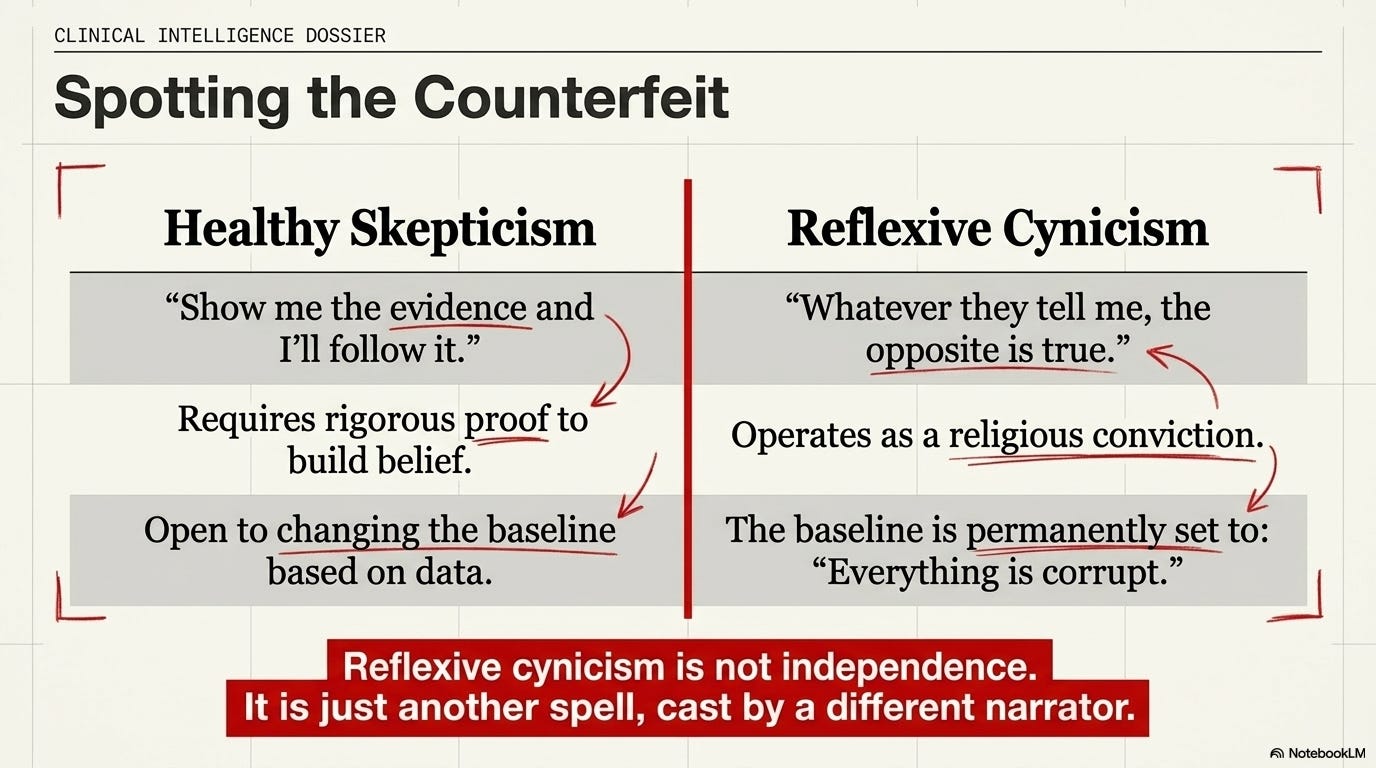
Reflexive cynicism — the counterfeit of skepticism: “whatever they tell me, the opposite is true.” Healthy skepticism says “show me the evidence and I’ll follow it”; reflexive cynicism is just another spell, cast by a different narrator.
Three More From The Standard Toolkit
These three carried the al-Ahli case covered in Unit 1:
Emotional priming — a strong feeling delivered before the evidence, so the evidence lands as confirmation. “This will enrage you,” and then the claim.
Loaded language — charged words that pre-decide interpretation. “Misfired rocket” versus “airstrike”; “protesters” versus “rioters.”
Cherry-picked / stripped context — real material, only the convenient part — a figure of “500 total victims” clipped down to “500 killed.”
You do not need to catch all twenty-one every time. Catching one is usually enough to make you slow down and slowing down is most of the battle.
These tactics work because they bypass your critical thinking before you realize you need it. They create the feeling of certainty, consensus, and moral clarity without requiring evidence. Once you learn to recognize them, you’ll see them everywhere — not just in obvious propaganda, but in commentary, activism, and even casual conversation. The goal isn’t to become paranoid. It’s to notice when someone is doing the persuasion work that evidence should be doing.
Manipulators need to manipulate because they have no substance. Tucker Carlson also uses a lot of acting, like all those exaggerated facial expressions, the sarcastic tone of voice, like "if you don't agree with it you're stupid".