


Jewish Onliner is an independent publication. If you find our work valuable, please consider becoming a paid subscriber. You can also subscribe to us on WhatsApp and Telegram. Follow us on Instagram, Discord, and X.
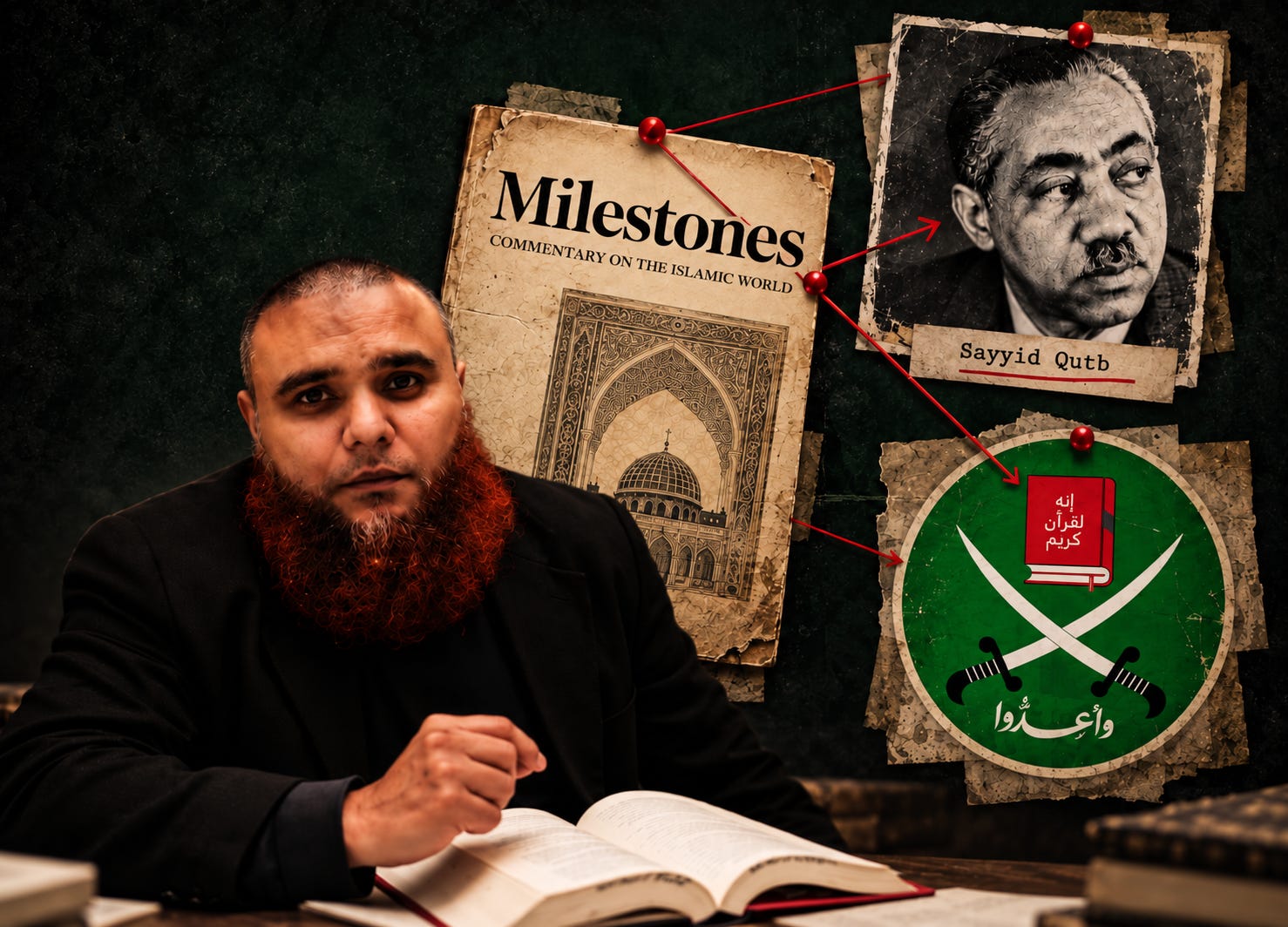
A visiting professor at the University of Pittsburgh has publicly defended Hamas rocket attacks against Israel, challenged the characterization of Hamas fighters as terrorists, and argued that lasting peace cannot be achieved until the “full dismantling of Israel.” He also founded an Islamic political publication that draws intellectual inspiration from Sayyid Qutb, a leading Muslim Brotherhood ideologue whose writings influenced al-Qaeda and other jihadist movements. Courses he has taught at the university include Anthropology of Islam and Anthropology of the Middle East.
Dr. Tanzeen Rashed Doha, a visiting assistant professor in Pittsburgh’s Department of Anthropology, founded and serves as general editor of Milestones: Commentary on the Islamic World, an independent journal established by 2017. His writings discuss Hamas, the Taliban, Islamic militancy, and the relationship between Islamist movements and secular political systems.
Doha also participated in an August 2024 colloquium organized by the Ummatics Institute, a research organization advocating greater political unity across the Muslim world. Its leadership includes a former Hizb ut-Tahrir spokesman, while its broader directory includes individuals with reported or alleged ties to Hamas and the Muslim Brotherhood.
Defending Hamas Rocket Attacks and Calling for Israel’s Dismantling
In a June 2021 essay titled The Rockets that Explode History, Doha defended Hamas rocket attacks against Israel, describing the response from Gaza as “principled resistance.” He wrote that the May 2021 ceasefire was regarded as a relative victory for Hamas across much of the Islamic world, particularly in Gaza, and argued that no lasting peace could be achieved until the “full dismantling of Israel.”
Doha also challenged the condemnation of Hamas militants as terrorists for attacking Israelis with bombs and rockets. He portrayed criticism of rocket attacks from Gaza as a reversal of responsibility for the violence, accusing Israel of being the original aggressor.

“What if the rockets from Gaza were a consequence of a well thought-out, strategically principled and tactically sound political-military analysis?” he asked.
Discussing the permissible use of militant tactics within Islamic ethical and legal traditions, Doha cited Islamic scholars who had justified “martyrdom operations,” a term commonly used to describe suicide bombings, in the context of the conflict with Israel.
Elsewhere in the essay, Doha described Hamas’s military wing as leading the fighting and wrote that the rockets from Gaza had opened a religious framework of jihad around which different factions united. He also praised Islamists for playing what he described as the most advanced role in challenging Western dominance and emphasized their willingness to embrace martyrdom.
At the beginning of the essay, Doha also included a quotation attributed to Sayyid Qutb about words acquiring power through the deaths of those who proclaim them.
A Publication Whose Founder Explicitly Invoked Sayyid Qutb
Doha's publication, Milestones: Commentary on the Islamic World, shares its principal title with the influential 1964 book by Sayyid Qutb, a leading Muslim Brotherhood ideologue whose writings influenced jihadist movements, including al-Qaeda. Doha's own writings explicitly acknowledge Qutb's intellectual influence.
Qutb, who was executed by the Egyptian government in 1966, advocated replacing secular political systems with governance grounded in Islamic law.
The connection between the two publications extends beyond their shared name.
In a May 2017 essay titled Deadly Milestone, Doha explicitly invoked Qutb’s book while discussing the concept of milestones as guiding markers for Islamic revival.
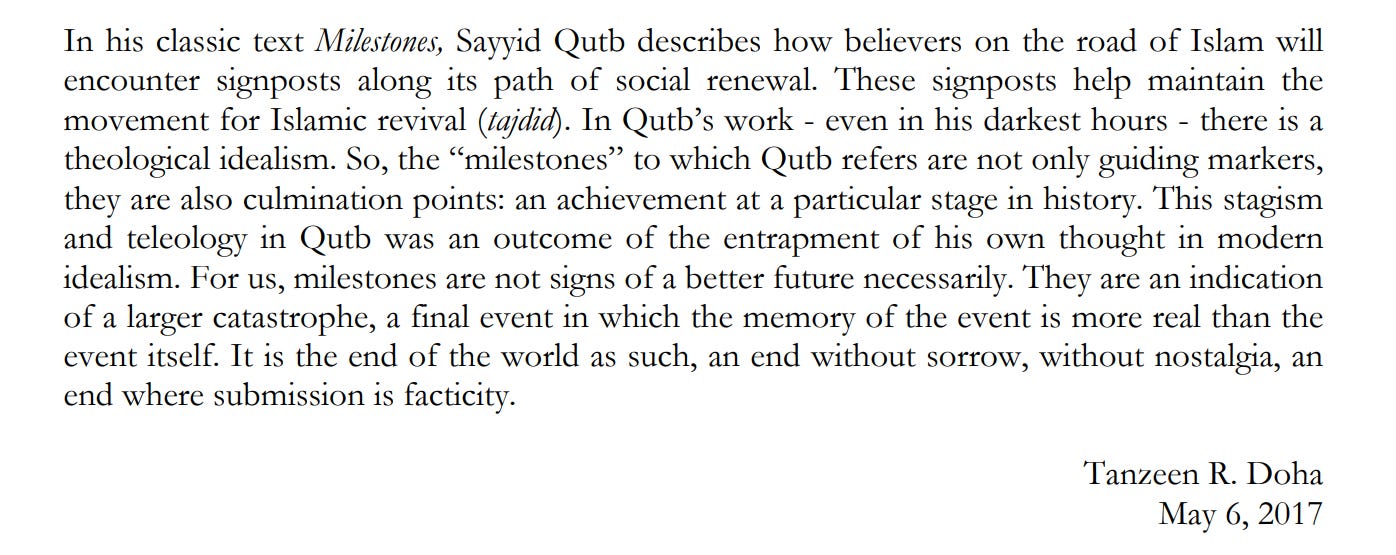
Later in the same essay, coauthored with Iftekhar Jamil, the authors acknowledged the Brotherhood ideologue’s intellectual influence, writing that:
“Sayyid Qutb’s influence on our essay should be easy to identify.”
The nine-page essay also examined poetry associated with the Afghan Taliban, criticizing interpretations that separated the movement’s literary expressions from its Islamist ideology and political struggle.
In another passage, the authors reproduced a poem by a Bangladeshi Islamic seminary student depicting a bombing in which civilians are killed. They interpreted the poem as challenging secular representations of Islamist violence rather than as a literal endorsement of an attack.
The publication’s website lists an academic editorial board featuring scholars from several prominent universities, including Ovamir Anjum of the University of Toledo, who is also the founder and chief research officer of the Ummatics Institute, and the late Abdulaziz Sachedina, who previously held George Mason University’s IIIT Chair in Islamic Studies. The International Institute of Islamic Thought was among the organizations identified in the Muslim Brotherhood’s 1991 explanatory memorandum concerning its North American activities.
Connections to Islamist Institute With Former Hizb ut-Tahrir Spokesman
Doha is also listed on the website of the Ummatics Institute, an organization promoting political integration across the Muslim world and renewed institutions modeled on the historical caliphate.
The institute’s research operations manager and editor-in-chief, Uthman Badar, previously served as a spokesman for Hizb ut-Tahrir in Australia. The organization, which advocates establishing a caliphate, was proscribed as a terrorist organization by the United Kingdom in January 2024 and designated a prohibited hate group by Australia in March 2026.
Other figures appearing in Ummatics’ directory include Azzam Tamimi, who has been described as a Hamas “special envoy” and as a “leading member of the Muslim Brotherhood in Britain,” and Wadah Khanfar, the former director-general of Al Jazeera. In a 2015 article, former Al Jazeera bureau chief Mohamed Fahmy reported that a Muslim Brotherhood website had identified Khanfar in 2007 as one of the leading figures in Hamas’s Sudan office.

Teaching Islam and Middle Eastern Studies at Pittsburgh
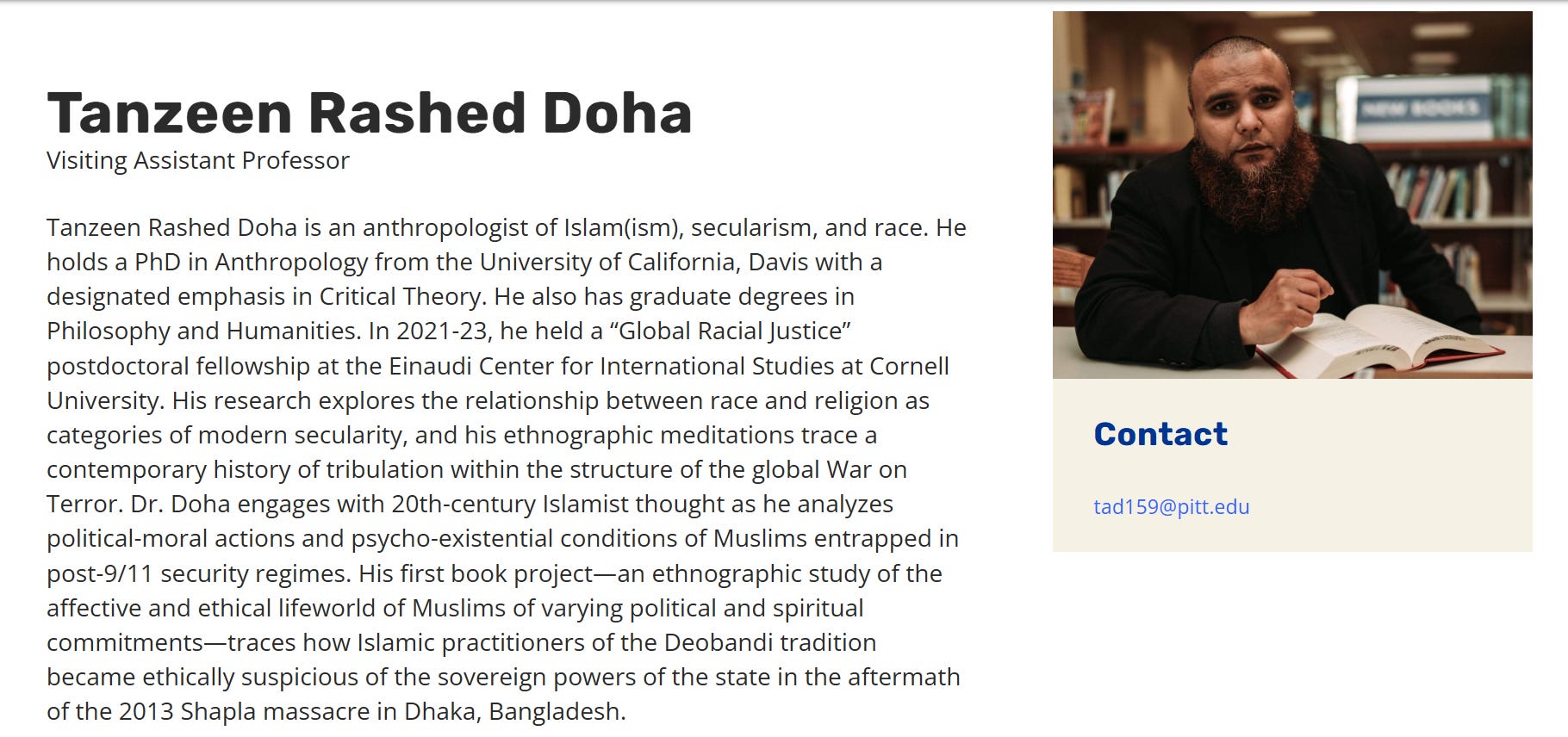
According to his official university biography, Doha earned his doctorate in anthropology from the University of California, Davis, and previously held a Global Racial Justice postdoctoral fellowship at Cornell University’s Einaudi Center for International Studies from 2021 to 2023. His academic research focuses on Islamism, secularism, race, and the experiences of Muslim communities during the War on Terror.
University of Pittsburgh course records show that Doha taught Anthropology of Islam in Spring 2025. A separate Fall 2025 course listing identifies him as the instructor of Anthropology of the Middle East.

His university biography also describes courses examining Islamic political thought, the Deobandi tradition, Islamist movements, global jihad, and political debates surrounding the abolition of the caliphate. Doha also founded the podcast Everything is Fire, whose first season, according to his Pittsburgh biography, was sponsored by Cornell University’s Einaudi Center.
Muslim Brotherhood Faces Growing U.S. Counterterrorism Scrutiny
Doha’s writings and institutional connections come amid increased U.S. scrutiny of the Muslim Brotherhood and its relationships with terrorist organizations, particularly Hamas, which emerged from the Brotherhood’s Palestinian branch.
On January 13, 2026, the United States designated three Muslim Brotherhood branches, including the movement’s Egyptian branch, as terrorist entities. The Egyptian and Jordanian branches were designated Specially Designated Global Terrorists for providing material support to Hamas, while the Lebanese branch, al-Jamaa al-Islamiyah, was additionally designated a Foreign Terrorist Organization.
The Treasury Department alleged that members of the Egyptian Brotherhood had helped facilitate the movement of prospective Hamas fighters into Gaza and that the organization had coordinated with Hamas on potential attacks against Israeli interests.
In July, Treasury announced additional sanctions targeting an Egyptian Brotherhood official and entities accused of channeling funds to Hamas, including through purported charitable organizations.
The designations underscore the continuing significance of the movement founded in Egypt in 1928, whose ideological development was heavily influenced by Sayyid Qutb. Doha’s explicit engagement with Qutb, his published arguments defending Hamas, and his participation in Islamist intellectual networks illustrate how debates shaped by Brotherhood ideology continue within contemporary academic and political discourse.