


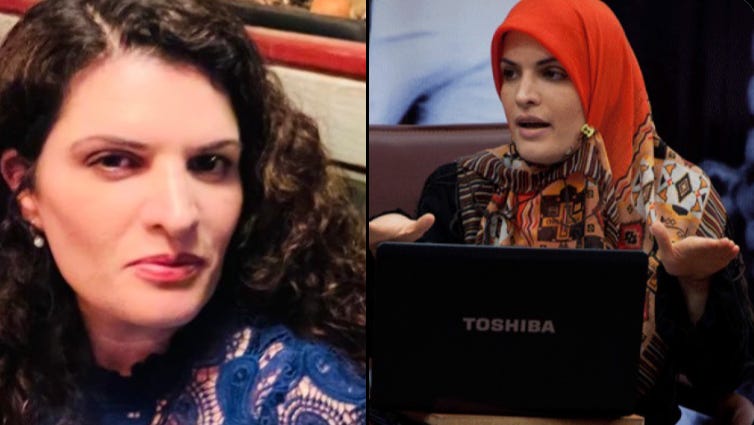
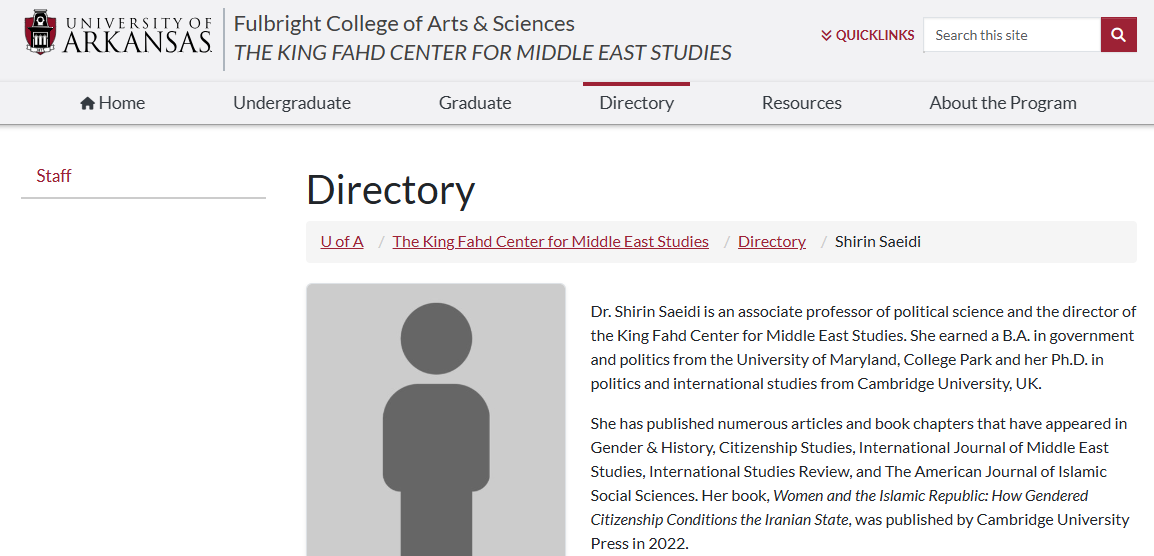
Dr. Shirin Saeidi, an associate professor of political science and director of the King Fahd Center for Middle East Studies at the University of Arkansas, has come under intense scrutiny following a series of social media posts in late November 2025 allegedly expressing support for Iranian Supreme Leader Ali Khamenei and opposing the U.S. designation of Iran’s Islamic Revolutionary Guard Corps (IRGC) as a terrorist organization.
The controversy escalated when Iranian-Americans and activists began circulating Saeidi’s statements on social media, prompting calls for her dismissal and investigations into potential violations of university policy. According to Benjamin Weinthal, a journalist who covers Iran for Fox News Digital, the University of Arkansas told him that Saeidi improperly used university letterhead in connection with support for Hamid Nouri, a convicted Iranian regime war criminal.
Controversial Social Media Activity
In posts shared on X (formerly Twitter) in late November, Saeidi defended the IRGC, praised Iran’s Supreme Leader Ali Khamenei, and offered prayers for his protection. In a November 27 post, Saeidi wrote: “The leader who kept Iran intact during the Israeli attack, May god protect you.”
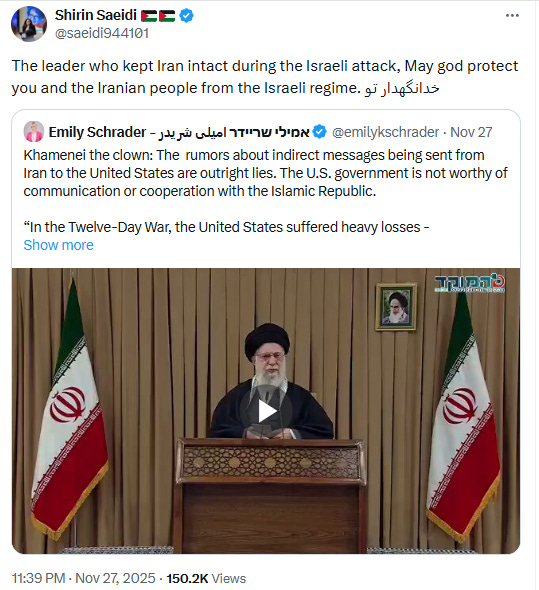
In another post the same day, she defended the IRGC and criticized its designation as a terrorist entity, writing: “We should have spoken up sooner—when the IRGC was placed on a terrorist list, when Hamid Nouri was kidnapped based on lies in memoirs.”
Kasra Aarabi, Director of IRGC Research at United Against Nuclear Iran (UANI), commented: “Nothing unusual here—just a lecturer at a U.S. university “speaking up” for the most antisemitic armed Islamist group in the world, which also happens to be a U.S.-designated terrorist org. No wonder Western universities have become engines of indoctrination and extremism.”
University Letterhead Controversy
Adding to the scandal, Reporter Benjamin Wienthal of Fox News Digital stated that the University of Arkansas had confirmed to him that Saeidi improperly utilized university credentials and official letterhead to provide support for Hamid Nouri during his criminal trial in Sweden. Nouri was convicted in July 2022 and sentenced to life imprisonment for his participation in the systematic execution of thousands of political prisoners in Iran’s notorious 1988 massacre, one of the worst human rights atrocities in modern Iranian history.
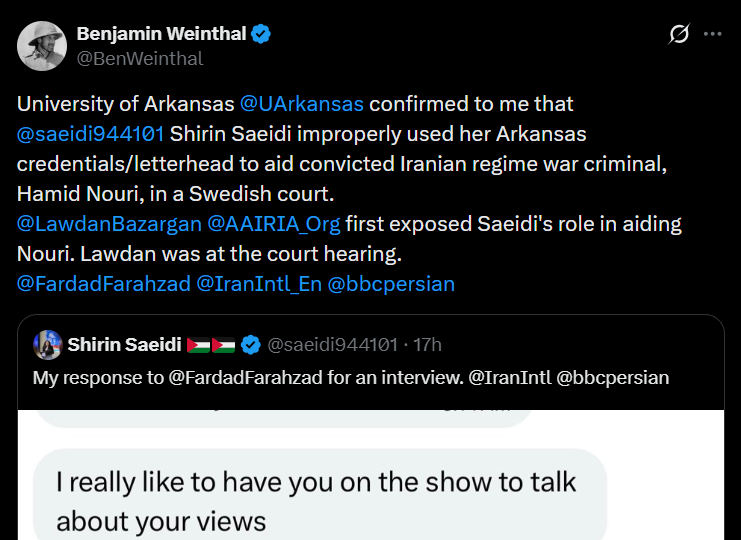
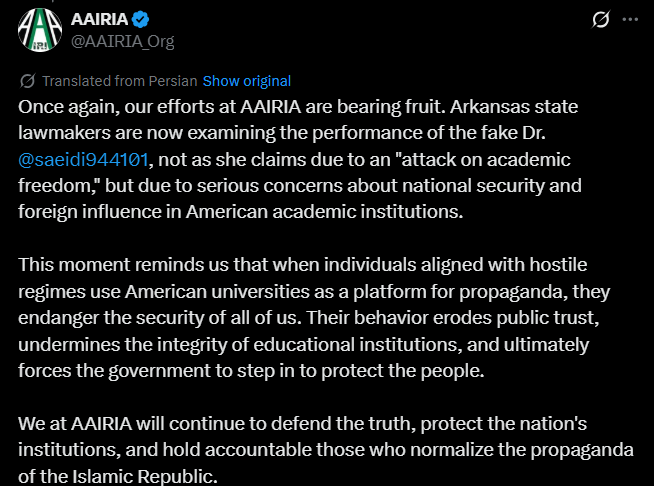
Iranian-American activists, including the Association of Iranian-Americans for Justice (AAIRIA) led by Lawdan Bazargan, have been at the forefront of efforts to hold Saeidi accountable. AAIRIA has called on the university to investigate what they characterize as violations of academic ethics and potential misuse of the institution’s resources to advance the agenda of a foreign authoritarian regime.
Victims’ Families Speak Out
Gazelle Sharmahd, whose German-Iranian father Jamshid Sharmahd was executed by the Iranian regime on October 28, 2024, after a widely condemned show trial, has been particularly vocal in condemning Saeidi’s statements. In posts shared across social media, Sharmahd criticized the professor for what she characterized as amplifying the regime’s propaganda and praising a government responsible for killing, “over 600 American troops ands thousands or Iranians.”
The families of victims of the 1988 massacre have also expressed outrage at Saeidi’s defense of Nouri and her characterization of his conviction as based on false testimony. For many in the Iranian diaspora, the 1988 executions—in which an estimated 5,000 political prisoners were killed—represent an ongoing wound, with thousands of families still seeking justice for their murdered relatives.
Academic Freedom or Iranian Regime Advocacy?
While Saeidi has previously invoked academic freedom in response to criticism, activists and experts argue that her statements cross the line from scholarly analysis into advocacy for a regime designated by the U.S. government as a state sponsor of terrorism.
The IRGC, which Saeidi appears to have defended in her posts, has been linked to numerous terrorist attacks. Iran-backed forces were responsible for the 1983 Beirut barracks bombing that killed 241 American service members, and U.S. courts have ordered Iran to pay damages to victims and their families for its role in the attack.
Arkansas state lawmakers have reportedly also begun scrutinizing Saeidi’s activities, examining concerns about national security and foreign influence in state-funded academic institutions.
Limited University Response
As of November 29, 2025, the University of Arkansas has not announced any disciplinary action against Saeidi beyond what journalists report the university privately confirmed regarding the improper use of university letterhead. The institution’s limited public response has frustrated activists who argue that Saeidi’s conduct warrants immediate investigation and potential termination.
The case has reignited broader debates about the limits of academic freedom when faculty members appear to advocate for foreign regimes with documented records of human rights abuses, terrorism sponsorship, and threats against U.S. allies.
Iranian-American organizations continue to pressure the university for accountability, with AAIRIA organizing a sustained campaign highlighting what they describe as Saeidi’s pattern of supporting the Islamic Republic. The controversy shows no signs of abating, with more activists and public figures joining calls for investigation and action.