


Jewish Onliner is an independent publication. If you find our work valuable, please consider becoming a paid subscriber.
The UN Human Rights Council’s Commission of Inquiry released a June 9, 2026 report examining violence by “non-State actors” in the West Bank and Gaza—placing Israeli civilians and Palestinian armed groups in the same analytical framework. A detailed legal rebuttal by UN Watch Legal Advisor Dina Rovner argues that the Commission’s central claims rest on inflated data, selective sourcing, and double standards. The Commission concluded that “settler violence functions as a means of implementing Israeli State policy,” but UN Watch contends this lacks evidentiary support and conflates a small extremist minority with state policy.


The Numbers Problem
The Commission’s findings rely heavily on UN Office for the Coordination of Humanitarian Affairs (OCHA) statistics tracking West Bank incidents. But according to UN Watch, a comprehensive April 2025 study by Israeli NGO Regavim examined OCHA’s listing of 6,285 incidents classified as Israeli violence against Palestinians between January 2016 and April 2023 and identified systematic methodological problems.
According to Regavim’s analysis, approximately 20 percent of incidents OCHA classified as “settler violence” occurred in Jerusalem—not the West Bank—often involving Temple Mount visits or clashes between Muslim worshippers and Israeli police. Another 19 percent involved complaints of “trespassing” by Israeli tourists or hikers without assault or property damage allegations. The study also found OCHA’s database included traffic accidents, infrastructure work, and archaeological visits in its “violence” tallies.
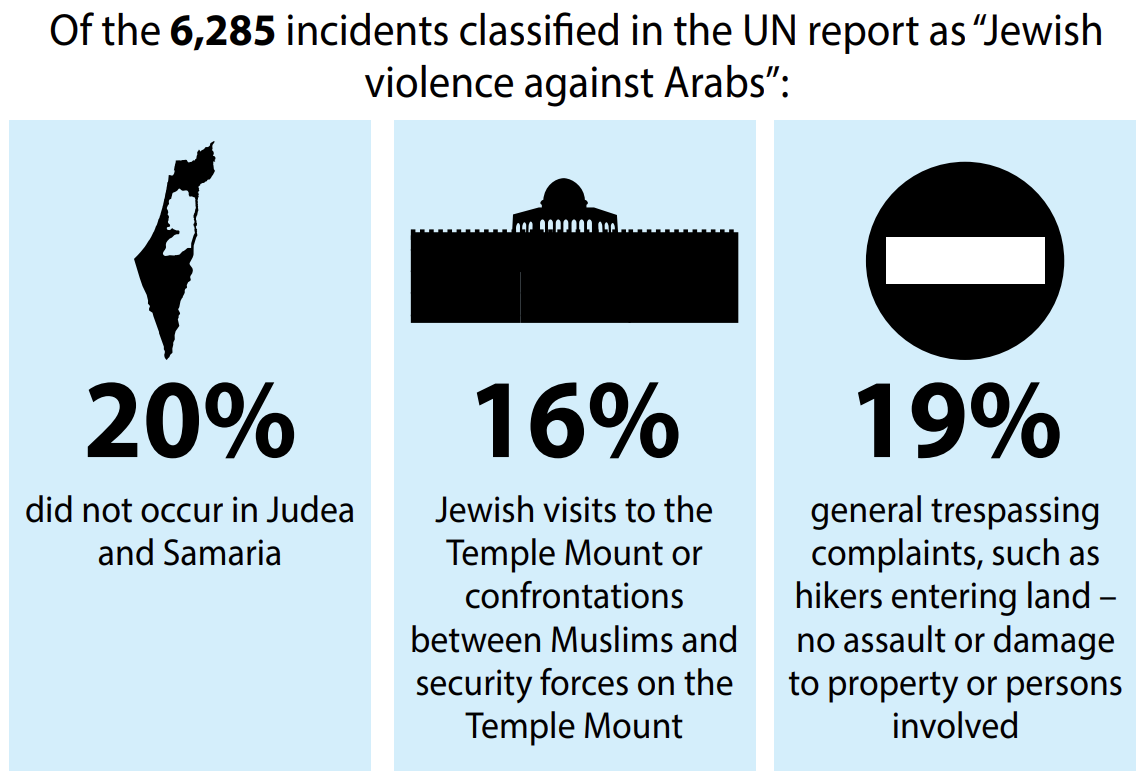
After filtering incidents lacking physical violence initiated by Israeli civilians against Palestinians or property, Regavim identified 833 relevant incidents over the 7.5-year period—roughly 9.4 allegations per month. The Wall Street Journal editorial board endorsed key findings in June 2025, and a 2026 analysis by the Jerusalem Institute for Strategy and Security, authored by reserve IDF officers Brig. Gen. Erez Winner and Col. Gabi Siboni, reached similar conclusions.
How Victims Are Labeled
UN Watch’s critique highlights asymmetry in how the Commission labels victims. In paragraph 68, the Commission notes that 42 Israelis were killed in West Bank terrorist attacks between 2023 and 2025, emphasizing that 36 were “settlers.”
When discussing Palestinian fatalities, the Commission does not consistently distinguish between uninvolved civilians, armed group members, or individuals killed while carrying out attacks. Instead, Palestinian victims are categorized by age and sex. UN Watch argues this asymmetric labeling creates an impression that attacks on Israeli civilians are more explicable—a framing the report would never apply by describing Hamas terrorism as “Gazan violence.”
From Fringe to Policy
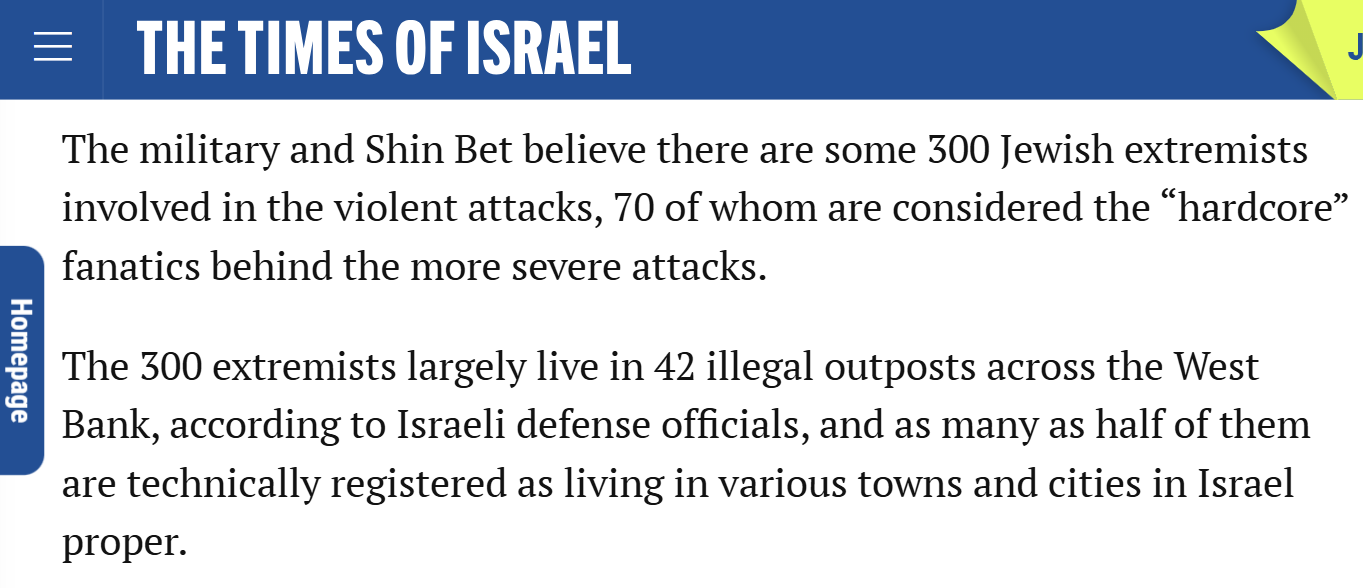
The Commission’s claim that settler violence functions “as a means of implementing” Israeli state policy is unsupported, UN Watch contends. Israeli defense officials estimate the violent extremist fringe at roughly 300 individuals, many of whom are not West Bank residents but at-risk youth from Israel proper.
Israeli leaders have publicly condemned extremist violence. In a May 24, 2026 speech, President Isaac Herzog denounced such acts as carried out by an “anarchist mob,” saying they “defile and violate every basic moral, legal, and Jewish norm.” Israeli police have investigated cases, arrested suspects, and used administrative detention and removal orders against violent offenders. The Commission acknowledges these measures but dismisses them as “symbolic.”
Critics of the UN report argue this creates an unfalsifiable framework: condemnations are discounted, arrests treated as insufficient, and absence of immediate judicial outcomes presented as evidence of impunity—even when legal processes are still ongoing.
Hamas: Context vs. Accountability
While the Commission documented 249 cases of executions and severe physical violence in Gaza in 2024-2025, resulting in at least 108 deaths and 384 injuries, Hamas-affiliated forces were found involved in at least 60 of these incidents. Critics note the report repeatedly shifts explanatory focus to Israel. Hamas abuses are described as occurring in a “vacuum created by relentless Israeli attacks and widespread destruction of Gaza,” a framing that risks minimizing Hamas governance failures and longstanding repression patterns.
The Standard Applied
UN Watch’s analysis acknowledges that violent attacks by Jewish extremists against Palestinians occur and should be prosecuted. But it argues the Commission fails to apply consistent standards: Israeli civilians are stigmatized collectively based on a small minority’s actions, while comparable scrutiny is not applied to Palestinian armed groups or Palestinian Authority structures.
A credible human rights report, UN Watch contends, should distinguish civilians from combatants, separate verified attacks from disputed claims, identify when fatalities involved perpetrators, and apply uniform descriptive standards. The Commission’s June 2026 report, according to this analysis, does the opposite—filtering a real but limited problem through politicized categories to produce narrative rather than fact-finding.
Who could imagine that any arm of the UN is anti-semitic and anti-zionist? I still believe that the best solution is to move the UN from NYC to Gaza. Their hatred would then be closer to their intended audience.