


Jewish Onliner is an independent publication. If you find our work valuable, please consider becoming a paid subscriber. You can also subscribe to us on WhatsApp and Telegram. Follow us on Instagram, Discord, and X.
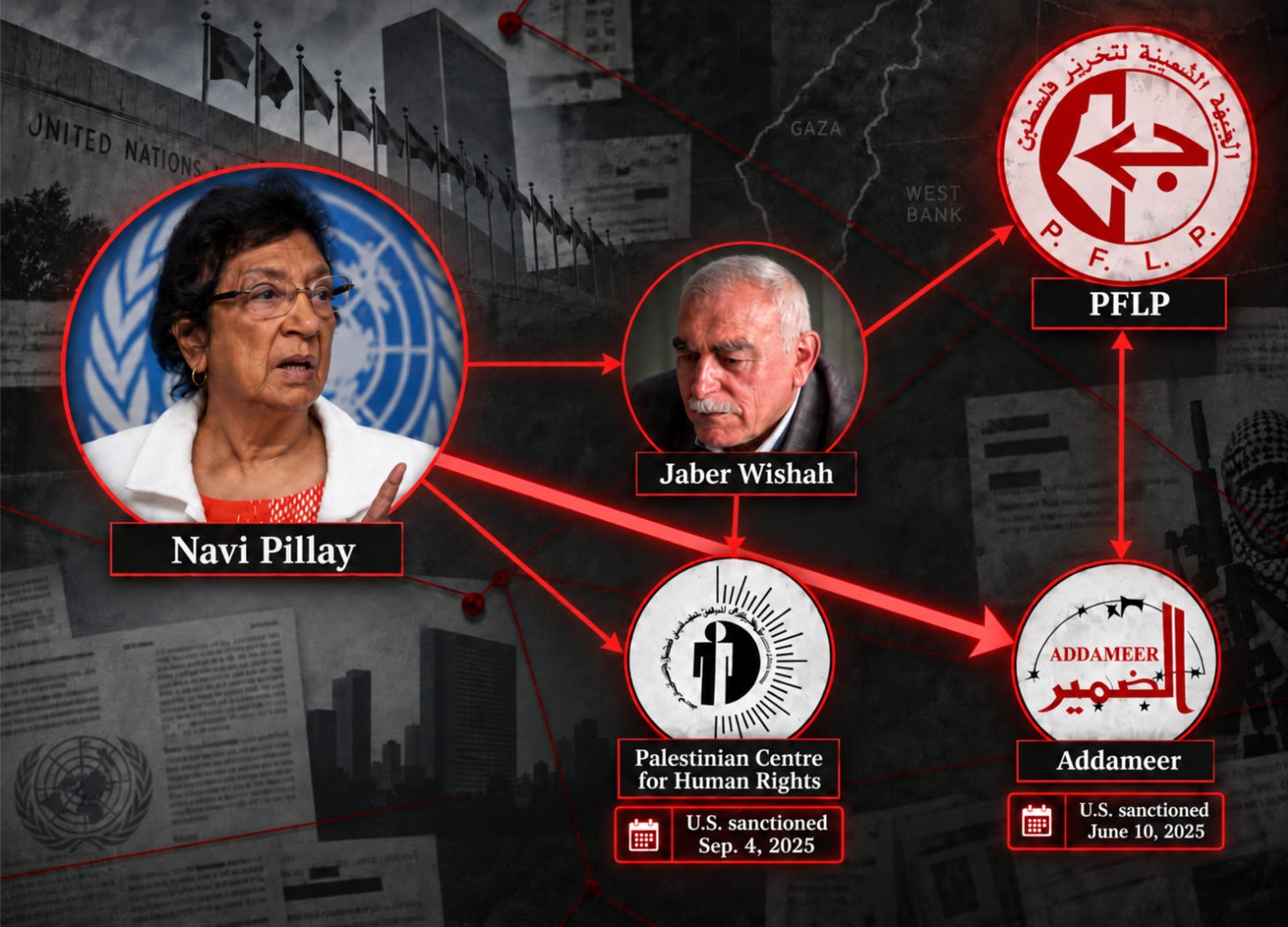
South African jurist Navanethem “Navi” Pillay was awarded the 2026 Nobel Peace Prize on October 9, renewing attention to her record as United Nations High Commissioner for Human Rights and her subsequent leadership of a UN commission investigating Israel. Among her previous statements was an October 2023 interview, conducted just three weeks after Hamas’s massacre in Israel, in which she described Palestinians as being “forced to resort to armed struggle.”

UN Watch and other critics have highlighted Pillay’s controversial statements concerning Israel, her defense of a UN commissioner accused of making antisemitic remarks, and allegations that her former office provided Chinese authorities with information about human rights activists.


Contacts With PFLP-Linked Figures and Organizations Later Sanctioned by Washington
Pillay’s earlier interactions with pro-Palestinian organizations have attracted attention following subsequent U.S. sanctions. In February 2013, the Palestinian Centre for Human Rights (PCHR) announced that Jaber Wishah, its deputy director for branch affairs, was scheduled to meet Pillay and the UN Special Rapporteur on Torture. Wishah had previously held a senior position in the Popular Front for the Liberation of Palestine (PFLP), a U.S.-designated foreign terrorist organization.

A December 1985 report in the Israeli newspaper Maariv, documented by NGO Monitor, identified Wishah as the head of the PFLP’s military wing in Gaza. According to that reporting, he was convicted by an Israeli court of offenses including attempted murder of an Israeli soldier, bomb-related offenses, weapons possession, conspiracy to commit murder, and holding a leadership position in a terrorist organization. A September 1999 interview in the Arabic-language newspaper Al Bayan likewise described Wishah as having been responsible for the PFLP’s military apparatus. He subsequently held senior positions at PCHR.

In September 2013, PCHR and the Office of the UN High Commissioner for Human Rights (OHCHR), then headed by Pillay, co-organized a seminar in Khan Yunis. According to PCHR, Wishah opened the event alongside Saber al-Nairab, an OHCHR human rights officer. The event brought together 34 participants representing 15 local organizations, alongside political activists and independent figures.
In September 2025, the U.S. State Department sanctioned PCHR alongside Al-Haq and Al Mezan Center for Human Rights over their involvement in International Criminal Court proceedings targeting Israeli nationals without Israel’s consent. The sanctions were imposed under an executive order concerning the ICC.
A separate encounter involved Addameer, a pro-Palestinian prisoner advocacy organization. According to Addameer’s own 2011 report, its representatives participated in a meeting with Pillay during her visit to Ramallah in February 2011. In June 2025, the U.S. Treasury Department sanctioned Addameer, stating that it had long supported and was affiliated with the PFLP. Treasury designated the organization for acting on behalf of the terrorist group.

Whistleblower Allegations Involving China
Another controversy concerns allegations from former UN human rights officer Emma Reilly that Pillay’s office provided Chinese authorities with advance information about individuals intending to raise human rights concerns at UN meetings. Reilly first reported the practice internally in 2013, during Pillay’s tenure. In a 2017 account, the Government Accountability Project described how Reilly had learned that UN officials were providing Chinese authorities with the names of dissidents expected to participate in Human Rights Council proceedings.


A subsequent investigation by Devex reported that names were provided to Chinese officials despite Reilly’s objections. The UN maintained that the individuals had already publicly disclosed plans to attend and that precautions had been taken to protect them. Reilly continued to challenge the practice and alleged that her efforts to expose it resulted in retaliation. Following Pillay’s Nobel announcement, Reilly renewed her allegations, publishing what she described as internal correspondence documenting disclosures made during Pillay’s leadership. She accused the UN human rights office of endangering dissidents and their families.
Pillay also faced criticism in 2010 for not attending the Nobel Peace Prize ceremony honoring imprisoned Chinese democracy advocate Liu Xiaobo. Her absence attracted attention as Beijing pressured governments and international representatives to boycott the ceremony.
Defense of a UN Commissioner’s Remarks About a “Jewish Lobby”
In 2022, Pillay defended fellow UN commissioner Miloon Kothari following remarks concerning a supposed Jewish lobby and Israel’s membership in the United Nations. Kothari had referred to a “Jewish lobby” allegedly controlling social media and questioned why Israel was permitted to remain a UN member.

The controversy surrounding Pillay and the commission also reached Germany, where a planned event honoring her at Berlin City Hall was cancelled in September 2022 after then-Mayor Franziska Giffey withdrew her support following objections from Israeli officials.
Criticism of Silence on Authoritarian Abuses and Contacts With Iranian Officials
Pillay’s handling of human rights abuses under authoritarian regimes has also been the subject of criticism. A 2011 study by UN Watch examined her statements published on the UN website between September 2008 and June 2010 and found that she had issued no statements addressing the human rights situations in 146 countries, including 34 classified as “Not Free” by Freedom House. Among those countries were Cuba, North Korea, Eritrea, Saudi Arabia, Sudan and Belarus. The organization also found that nine of Pillay’s 21 country-specific statements concerning the Middle East and North Africa during that period focused on Israel.
The study further criticized Pillay’s response to Iran’s violent crackdown following the disputed June 2009 presidential election. According to UN Watch’s review, Pillay issued no dedicated public statement addressing the repression despite reports of arrests, beatings and killings of demonstrators. Her first public remarks on the crackdown came approximately three months later, during a broader address to the UN Human Rights Council.
In September 2013, Pillay met Iranian Foreign Minister Mohammad Javad Zarif in New York. According to Iranian media reporting cited by Radio Farda, the discussions included possible human rights training workshops in Iran and an invitation for Pillay to visit the country. Zarif was subsequently sanctioned by the United States in 2019 for acting on behalf of Iran’s Supreme Leader.
At the April 2009 Durban Review Conference in Geneva, Pillay remained at the proceedings while European delegates walked out during Iranian President Mahmoud Ahmadinejad’s speech attacking Israel.

Controversial Statements Regarding Charlie Hebdo
In September 2012, Pillay sharply criticized the French satirical magazine Charlie Hebdo for publishing cartoons depicting the Prophet Muhammad. Her spokesperson, Rupert Colville, described the magazine’s decision as “doubly irresponsible” and characterized the cartoons as “malicious and deliberately provocative.” A UN briefing also relayed Pillay’s position that she “fully understands why people wish to protest strongly” against the cartoons, while specifying that protests should remain peaceful.


Pillay’s criticism came despite Charlie Hebdo having already suffered a firebomb attack against its offices in November 2011 following the publication of cartoons depicting Muhammad. Less than two and a half years after her remarks, on January 7, 2015, Islamist terrorists stormed the magazine’s Paris headquarters and murdered 12 people, including editor Stéphane Charbonnier and several prominent cartoonists. Following the massacre, UN Watch revisited Pillay’s earlier statements, criticizing UN officials for directing condemnation toward the magazine’s cartoons despite the threats and violence its journalists had faced.
She’s a dyed-in-wool Jew hater.
But that’s not all. HOW could she give names to China about dissidents?!?! HOW could she keep silent when religious fanatics killed Charlie Hebdo members in France and bombed Danes for their freedom of expression? Aren’t these freedoms also ‘human rights?’ There have been poor Nobel Peace choices in the past, and this leads the pack. Like having Iran and China on UN Human Rights councils?!?! What a bad joke the UN has become, and the Nobel provides the laughs.
Disgusting.
Nothing good will come of this.