


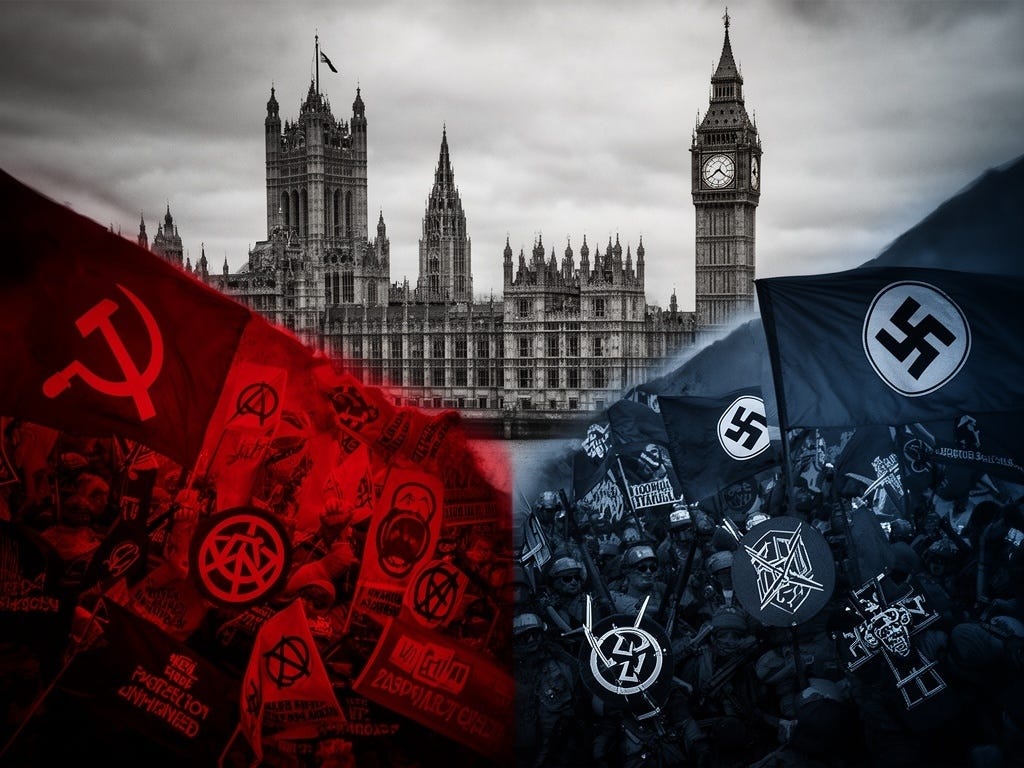
Antisemitism functions as a cross-cutting gateway to extremism in the United Kingdom, operating across the entire political spectrum and underpinning the majority of extremist narratives through conspiracy theories rooted in anti-Jewish hatred, according to a new UK Parliament report published April 1.
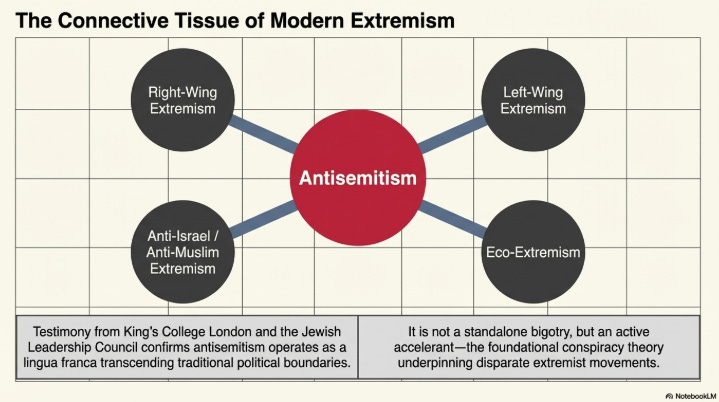
The Home Affairs Committee’s investigation, “Combatting new forms of extremism,” found that antisemitic discourse acts as a “lingua franca” that transcends traditional political boundaries, appearing in both British left-wing and right-wing extremist movements. The report comes as the UK experiences rising incidents of anti-Jewish violence, including a terrorist attack at Heaton Park Hebrew Congregation synagogue on October 2, 2025, cited in the report as “a tragic example of the risks posed by antisemitism in the UK.”
The 62-page report identifies antisemitism as both a standalone threat and a radicalizing force that “intersects with other drivers of extremism, reinforcing grievances, legitimizing hostility, and creating unique radicalisation pathways for individuals.” This marks one of the most explicit acknowledgments by UK authorities of antisemitism’s central role in the evolving extremism landscape.
How the Investigation Came About
The inquiry was triggered by disturbing revelations about the 2024 Southport attack, in which three children were murdered. While the Home Affairs Committee initially focused on the police response to subsequent summer disorder, investigators discovered that the perpetrator had been referred to Prevent, the UK’s counter-terrorism program- three times prior to the attack. Each case was closed because he did not meet the threshold for terrorism risk, with the final referral specifically concerning his online activity.


This failure prompted the Committee to launch a broader investigation in May 2025 into “emerging trends in extremism” and individuals who “fall below the threshold for radicalisation” but still pose risks. Over seven months, the Committee collected 55 pieces of written evidence and held four oral evidence sessions with experts, law enforcement, and community organizations.
Antisemitism’s Role as “Gateway Ideology”
The Committee heard testimony from Dr. Daniel Allington, Reader in Social Analytics at King’s College London, who characterized antisemitic discourse as operating “as a lingua franca” across ideological boundaries. The Jewish Leadership Council, an umbrella organization representing UK Jewish groups, told the Committee that “most forms of extremism are underpinned by conspiracy theories, many of which are rooted in antisemitism.”
Both Dr. Allington and the Jewish Leadership Council urged lawmakers to view antisemitism as “a risk factor of radicalisation to extremism,” not merely a form of bigotry but an active accelerant toward violent extremism.
The report identifies the Israel-Hamas conflict as a primary driver of recent spikes in antisemitic activity. Following Hamas’s October 7, 2023 attacks on Israel, public referrals to the UK’s Counter Terrorism Internet Referral Unit (CTIRU) surged by 48 percent. Overall, CTIRU has seen a 150 percent increase in public referrals since 2021.
Online Platforms Fuel Antisemitic Radicalization
The report documents how social media platforms, gaming environments, and encrypted forums serve as breeding grounds for antisemitic content that evades regulatory oversight. Virulent extremist material, including antisemitism, is “frequently hosted on smaller, encrypted platforms that escape high-level regulatory scrutiny,” the report states.
Witnesses emphasized that online algorithms actively promote extremist narratives by pushing “a steady stream of harmful content” to users, particularly young people. The Committee found that children aged 11-15 represent the highest numbers of those discussed at Prevent intervention panels, with 4,715 children aged 17 and under accounting for more than half of all 8,778 Prevent referrals in the year ending March 2025- the highest number ever recorded.
The report characterizes the online environment as central to “new forms of extremism,” defined by the Committee as the combination of young ages of those involved, fluid belief systems that don’t fit traditional ideological categories, and the dominant role of digital platforms in radicalization.
“Mainstreaming” of Anti-Jewish Rhetoric
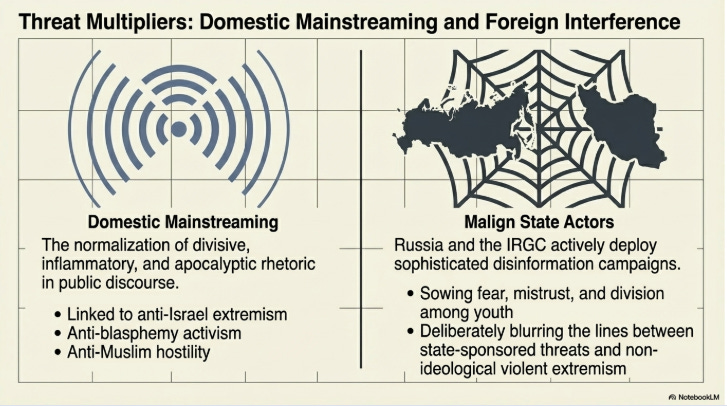
Beyond online spaces, the Committee identified the “mainstreaming of antisemitic and anti-Muslim rhetoric” in public discourse as a key driver of extremism. The report notes rising incidents linked to “anti-Israel extremism” alongside anti-blasphemy activism, anti-Muslim hostility, and eco-extremism—all characterized by “divisive, inflammatory and apocalyptic rhetoric.”
The Committee warns that malign state actors, specifically naming Russia and Iran’s Islamic Revolutionary Guard Corps (IRGC), are actively using disinformation to “sow fear, mistrust and division, targeting young people in particular and blurring the lines between state threats, terrorism and non-ideologically motivated violent extremism.”
System Failures and Recommendations
The investigation reveals that the UK’s current counter-extremism approach “has not kept pace” with evolving threats. The Prevent programme, designed to stop people from becoming terrorists, is “overly reliant on counter-terrorism systems” and “poorly adapted to identify individuals being drawn into extremism online.”
The Committee’s principal recommendation calls for embedding Prevent within a broader “triage structure” that functions as a “big front door” to assess concerns before directing individuals to appropriate support services—whether counter-terrorism intervention, mental health services, or community-based programs.
Additional recommendations include establishing a “coherent, long-term research and evidence-gathering programme on new forms of extremism” and strengthening digital literacy education to help young people “recognise manipulative content, understand algorithms, and identify AI-generated or deceptive content.”
The report comes as the UK government implements its new social cohesion strategy, “Protecting What Matters,” published in March 2026, which acknowledges that social cohesion has come under strain from “a rising tide of extremism and malign foreign actors.”
The Committee’s findings underscore a troubling reality: antisemitism is not merely one form of hatred among many, but a ideological connective tissue linking disparate extremist movements and current systems are failing to address it effectively.
https://behindthenarrative7.substack.com/p/why-the-world-hates-jews-a-kabbalistic?utm_source=share&utm_medium=android&r=bpnge