


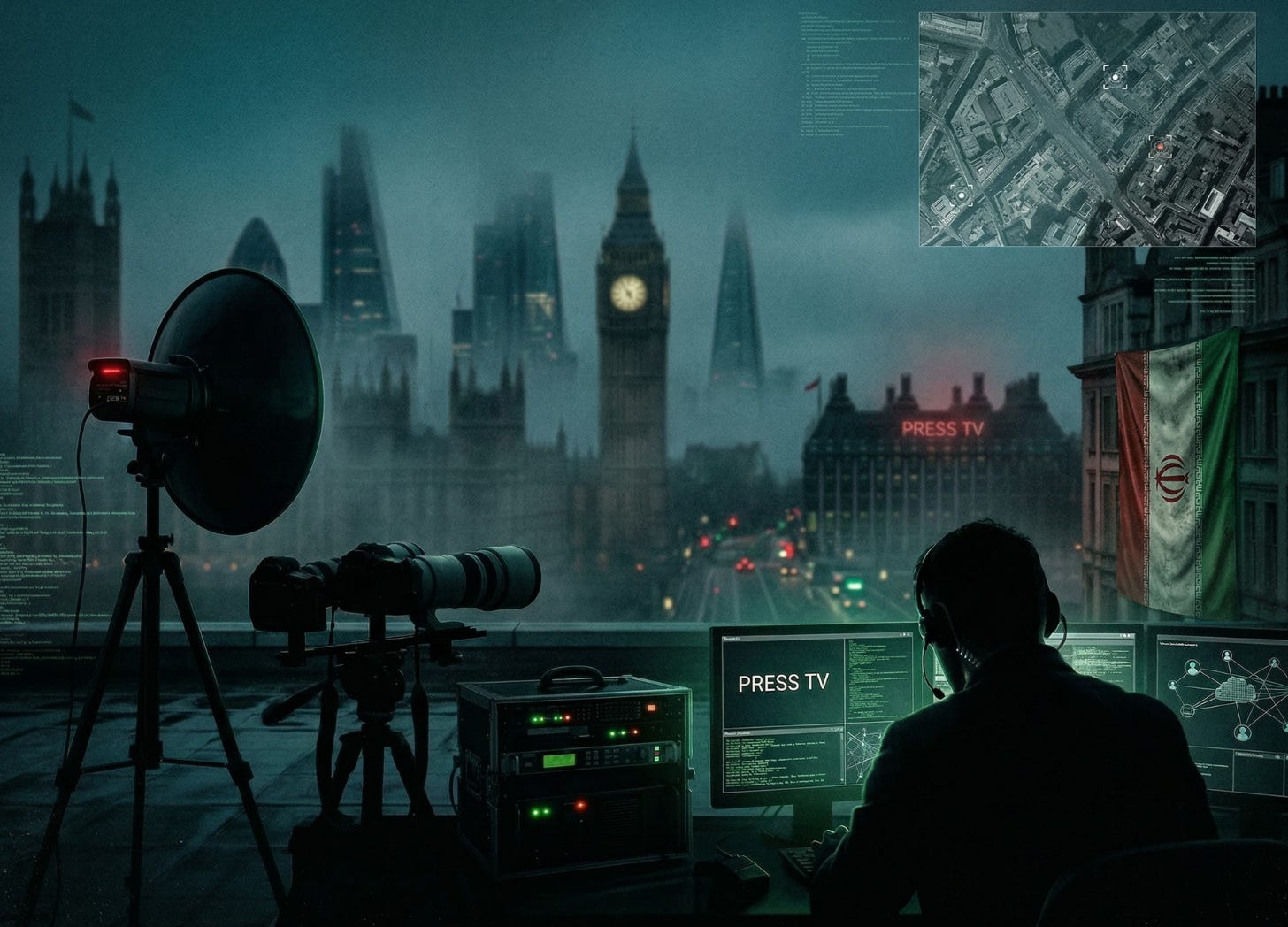
Recent reporting in The Telegraph, citing British government warnings and terrorism experts, says Iran has exploited London’s “permissive environment” for recruitment and influence activity, with Press TV — the regime’s English-language state broadcaster — alleged to play a central role.
The allegations fit a broader pattern documented by Western governments and researchers, who have described Iranian state media and affiliated networks as instruments of propaganda, influence operations, and, in some cases, recruitment activity.
British officials and terrorism experts say Tehran has used London’s openness to support recruitment and operational activity, with Press TV alleged to function as more than a conventional media outlet. Those concerns have been sharpened by recent cases involving Jewish targets in Britain.
Two men were arrested after a firebomb attack on ambulances owned by a Jewish charity in north London. Separately, two Iranian men were charged this month with conducting hostile surveillance of the Israeli embassy, Bevis Marks Synagogue, and other Jewish targets.
Jonathan W. Hackett, a former U.S. Marine Corps interrogator and special operations capabilities specialist with roughly two decades of intelligence-related experience, told The Telegraph that, in his assessment, Press TV personnel have been used to spot and assess potential recruits before those contacts are passed to more experienced Iranian handlers in Tehran.
The Monica Witt Recruitment Pipeline
Press TV’s alleged role in recruitment extends beyond potential local assets. Hackett explained that Marzieh Hashemi, a Press TV presenter, may have played an early-stage role in the recruitment of Monica Witt, one of the Iranian regime’s most significant U.S. intelligence defections. Public U.S. charging documents in the case do not name Hashemi, and she was not charged.


Witt, a former U.S. Air Force counterintelligence specialist with access to classified national defense information, defected to Iran in 2013. According to Hackett’s account, Hashemi may have served as an initial contact in Witt’s recruitment before Witt was allegedly passed to Iranian intelligence personnel in Tehran. “The Monica Witt case was like a bombshell on the intelligence community,” Hackett said. “This was the biggest win the Iranian regime ever had.”

The U.S. Treasury’s Office of Foreign Assets Control designated Press TV in September 2023, citing not only the broadcaster’s airing of forced confessions from journalists and activists, but also stating that the outlet had been used by Iranian intelligence services to recruit sensitive assets, including U.S. persons. The designation gave official U.S. backing to longstanding concerns that Press TV has served not only as a propaganda outlet, but also as a channel used by Iranian intelligence services for coercive and recruitment-related activity.
Creating “Target Lists” for Extremists
Beyond the recruitment allegations, critics quoted by The Telegraph, including representatives of the Community Security Trust, say Press TV programming has publicized and vilified Jewish institutions in ways that raise serious security concerns.
A CST spokesman told The Telegraph that Press TV’s flagship program Palestine Declassified was “the most anti-Semitic media currently produced in this country,” and CST has separately raised concerns about material targeting Jewish institutions and individuals in Britain.
The program is presented by two prominent British left-wing figures: Chris Williamson, a former Labour MP suspended from the party after dismissing antisemitism concerns as “smears,” and David Miller, an academic dismissed from the University of Bristol after comments about Jewish students and Israel drew sustained controversy.
As a CST spokesman told The Telegraph, each episode follows a similar pattern: the presenters “pick a topic and highlight large numbers of ordinary Jewish organisations, charities, schools and individuals. They paint them all as genocidal, Zionist extremists who are infiltrating Britain.” Because the material is broadcast by Iranian state media, the spokesman said, it raises concerns about the safety of the people and institutions singled out and requires additional security and monitoring work to mitigate possible threats.


A Broader Apparatus of Influence Operations
Press TV’s London presence appears to sit within a much broader Iranian media and influence infrastructure designed to shape Western opinion and advance Tehran’s strategic interests. Research published by the Jerusalem Institute for Strategy and Security, together with reporting on the Iran Experts Initiative, has described a multi-layered Iranian influence apparatus that includes cyber campaigns, disinformation networks, impersonation operations, cultivation of sympathetic outside voices, and more traditional recruitment efforts.
Iran’s Ministry of Intelligence and the Islamic Revolutionary Guard Corps Intelligence Organization have both been linked by Western officials and researchers to influence and disinformation campaigns targeting foreign audiences.
Reporting on the Iran Experts Initiative described Iranian diplomatic efforts to cultivate outside analysts and policy specialists who could help advance Tehran’s positions in Western policy and media circles, particularly on issues such as nuclear diplomacy. During the 2024 U.S. election cycle, U.S. officials and private-sector researchers also documented Iranian cyber-enabled influence efforts, including hack-and-leak operations and disinformation targeting U.S. political figures.
The reach extends beyond traditional broadcast media. Microsoft reported that traffic to Iranian state and state-affiliated news outlets rose about 42 percent in the first week after October 7, especially in English-speaking countries aligned with the United States, and remained significantly above prewar levels a month later. Much of that material circulated through Iranian state and state-affiliated media ecosystems across social media and alternative video platforms, where Press TV has retained a substantial audience despite having had its UK broadcast licence revoked by Ofcom in 2012.
Sanctions and the Grey Zone
In March, a group of MPs wrote to Security Minister Dan Jarvis urging Press TV's designation under the UK financial sanctions regime. The Telegraph reported that officials had discussed possible sanctions, with one government source stating: “They are essentially providing a target list for terrorists. Shutting Press TV down would send a strong message—and it would protect the Jewish community from immediate, documented threats.”