


Jewish Onliner is an independent publication. If you find our work valuable, please consider becoming a paid subscriber. You can also subscribe to us on WhatsApp and Telegram. Follow us on Instagram, Discord, and X.

The British government has funded an AI initiative involving Qatar Charity, an international aid organization designated by Israel in 2008 over allegations of financing Hamas. The British Embassy-backed program brought Qatar Charity together with Qatar’s foreign ministry, state development fund, and charity regulator for a four-day fellowship in London and Cambridge.
The charity is also represented in British-funded academic research and named as a contributor to a broader humanitarian AI project. The partnerships raise questions about British due diligence involving an organization that has faced terrorism-financing allegations, international restrictions, and scrutiny over its financial activities.
British-Funded Fellowship and Research
Qatar University announced on November 3 that the British Embassy in Doha funded the inaugural Qatar–UK Fellowship on AI in Humanitarian Action. Participants represented Qatar Charity, the Ministry of Foreign Affairs, Qatar Fund for Development, the Regulatory Authority for Charitable Activities (RACA), Qatar Red Crescent Society, Education Above All Foundation, and universities.
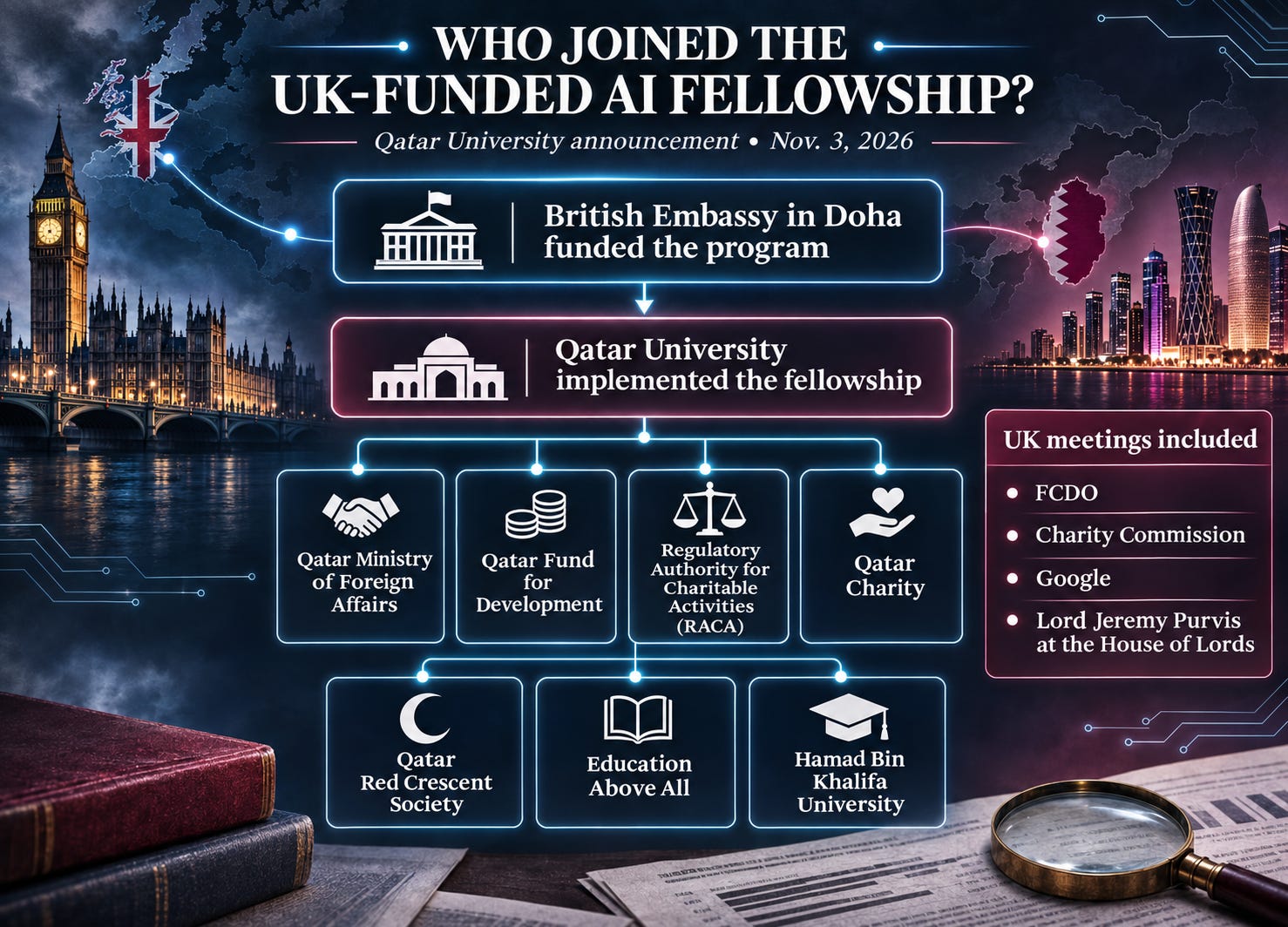
The program included discussions with Britain’s Foreign, Commonwealth and Development Office (FCDO), the Charity Commission, and UK Health Security Agency, alongside visits involving Google and the House of Lords. Discussions covered AI regulation, institutional risk management, and humanitarian applications. Qatar University did not identify Qatar Charity’s individual delegate.
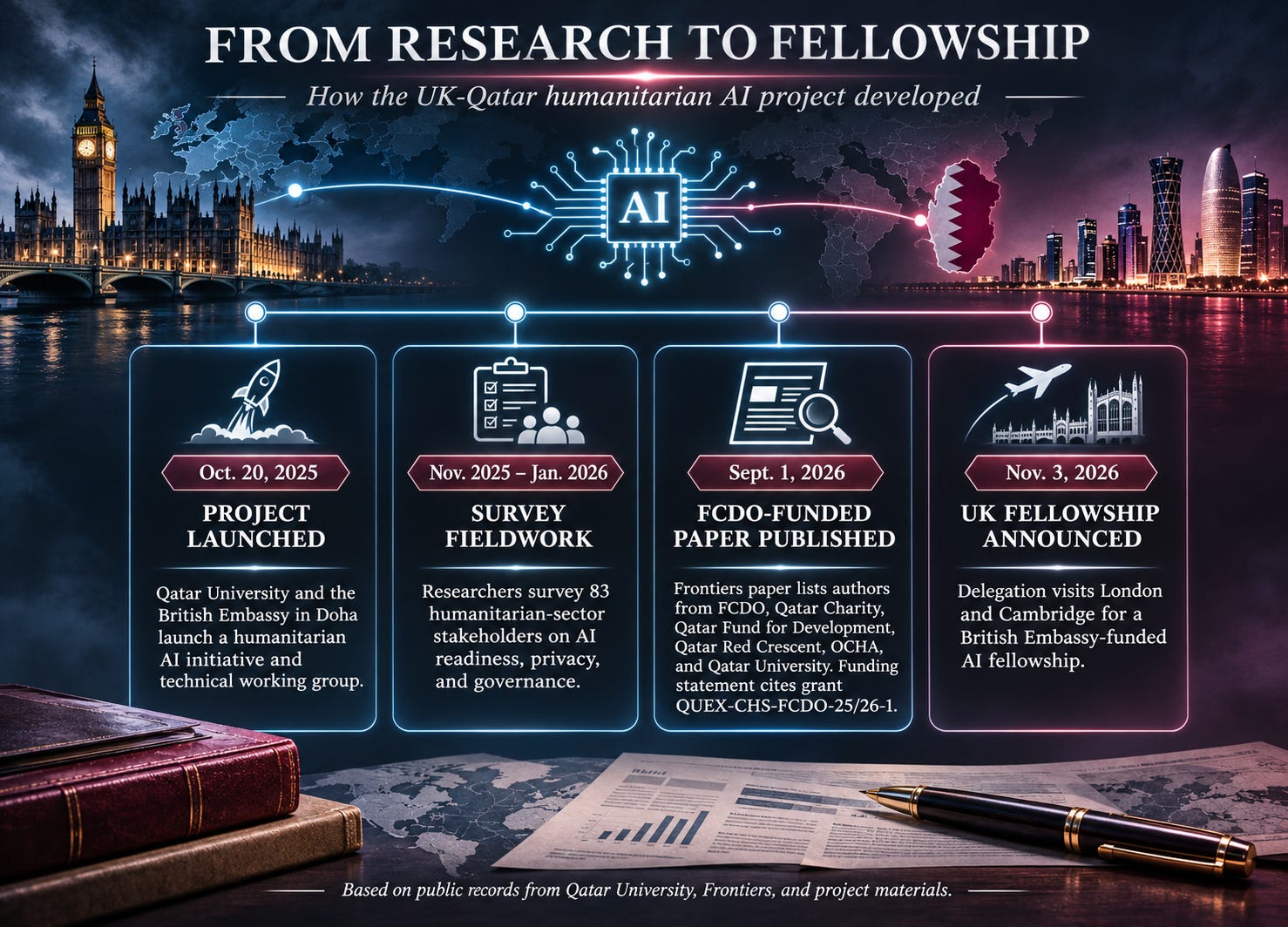
A September study in Frontiers in Public Health establishes another connection. Qatar Charity researcher Abdelaziz Khatir Jadeed and FCDO-affiliated official Kwalombota Kwalombota were among its nine authors. The paper acknowledges British government funding and credits Kwalombota with contributing to the investigation and manuscript review.
A Broader AI Partnership
The fellowship follows an October 2025 agreement between Qatar University and the British Embassy to develop humanitarian AI coordination, data sharing, early-warning systems, and ethical guidelines intended to inform international standards.
The resulting Humanitarian AI Observatory explicitly names Qatar Charity among its contributors. It describes a technical working group led by Qatar’s foreign ministry, co-led by Qatar Fund for Development, and operating in partnership with the FCDO. The group helps shape the project’s technical direction, validate outputs, and guide responsible AI governance.
Qatar Charity has independently disclosed substantial existing AI capabilities. At an August 2026 forum hosted by RACA, a charity executive described using AI for country-risk assessments, partner due diligence, supplier screening, and project monitoring. The forum specifically addressed money laundering and terrorist-financing risks within Qatar’s nonprofit sector.
The British partnership therefore involves a charity already applying AI to sensitive financial and operational functions, as the wider initiative moves toward developing practical humanitarian technology.
Qatar Charity’s Terrorism-Financing Allegations
Israel listed Qatar Charity as an unlawful association in 2008 over allegations of financing Hamas. Israeli authorities subsequently imposed financial restrictions involving the organization, including a 2011 measure prohibiting local organizations from receiving its funds.
In June 2017, Saudi Arabia, the United Arab Emirates, Bahrain, and Egypt included Qatar Charity on a terrorism blacklist during their diplomatic confrontation with Doha.
Qatar Charity also faced American civil litigation alleging financial support for Hamas and Palestinian Islamic Jihad. In Force v. Qatar Charity, plaintiffs alleged that the organization helped channel funds through Qatari banks to support terrorist operations.
Separate scrutiny has focused on Qatar Charity’s European financing network. A 2019 investigation by French journalists Christian Chesnot and Georges Malbrunot, based on reportedly leaked internal documents, identified approximately €71 million in Qatar Charity funding for 140 mosque and Islamic-center projects across Europe. The journalists associated parts of that financing network with organizations close to the Muslim Brotherhood.


Qatar’s Terrorist-Financing Oversight Under Scrutiny
Concerns extend to Qatar’s broader regulatory environment. In its 2023 evaluation, the Financial Action Task Force credited improvements in the country’s safeguards but identified significant shortcomings in terrorist-financing investigations and prosecutions.
FATF specifically found that Qatari authorities had insufficiently advanced investigations and prosecutions involving the potential abuse of licensed nonprofit organizations. It also identified weaknesses in converting financial intelligence into effective enforcement action.
Those findings make the participation of RACA, Qatar’s charity regulator, alongside Qatar Charity in the British-backed initiative particularly relevant to questions about financial compliance, institutional capacity, and oversight.
Western Technology Partnerships Face Scrutiny
Western technology cooperation with Qatari institutions has drawn criticism elsewhere. In The Cipher Brief, Foundation for Defense of Democracies senior adviser Toby Dershowitz and Asher Boiskin examined Google Cloud’s AI partnership with Qatar-funded Al Jazeera, warning about the potential amplification of state-directed narratives through advanced AI systems. They called for stronger risk assessments and transparency surrounding such partnerships.
Their analysis concerned Al Jazeera rather than Qatar Charity, but raised related questions about how Western governments and technology companies assess Qatari institutional partners before providing advanced technological capabilities.
British Funding Raises Oversight Questions
Britain’s involvement now encompasses funded research, institutional exchanges, and an expanding partnership to develop humanitarian AI capabilities and governance frameworks. Qatar Charity’s inclusion connects that effort to an organization with a documented history of terrorism-financing allegations and international financial restrictions.
Qatar University’s November 3 announcement indicates that the next phase will involve developing and testing practical AI applications, deepening cooperation between British institutions and Qatar’s humanitarian sector.
The central accountability question is what due diligence British authorities conducted before including Qatar Charity in the initiative, and what safeguards will govern its participation as the partnership develops.
With British funding supporting the effort, Qatar Charity’s controversial history and existing use of AI for financial and operational oversight make those questions a matter of public accountability.