


Jewish Onliner is an independent publication. If you find our work valuable, please consider becoming a paid subscriber. You can also subscribe to us on WhatsApp and Telegram. Follow us on Instagram, Discord, and X.

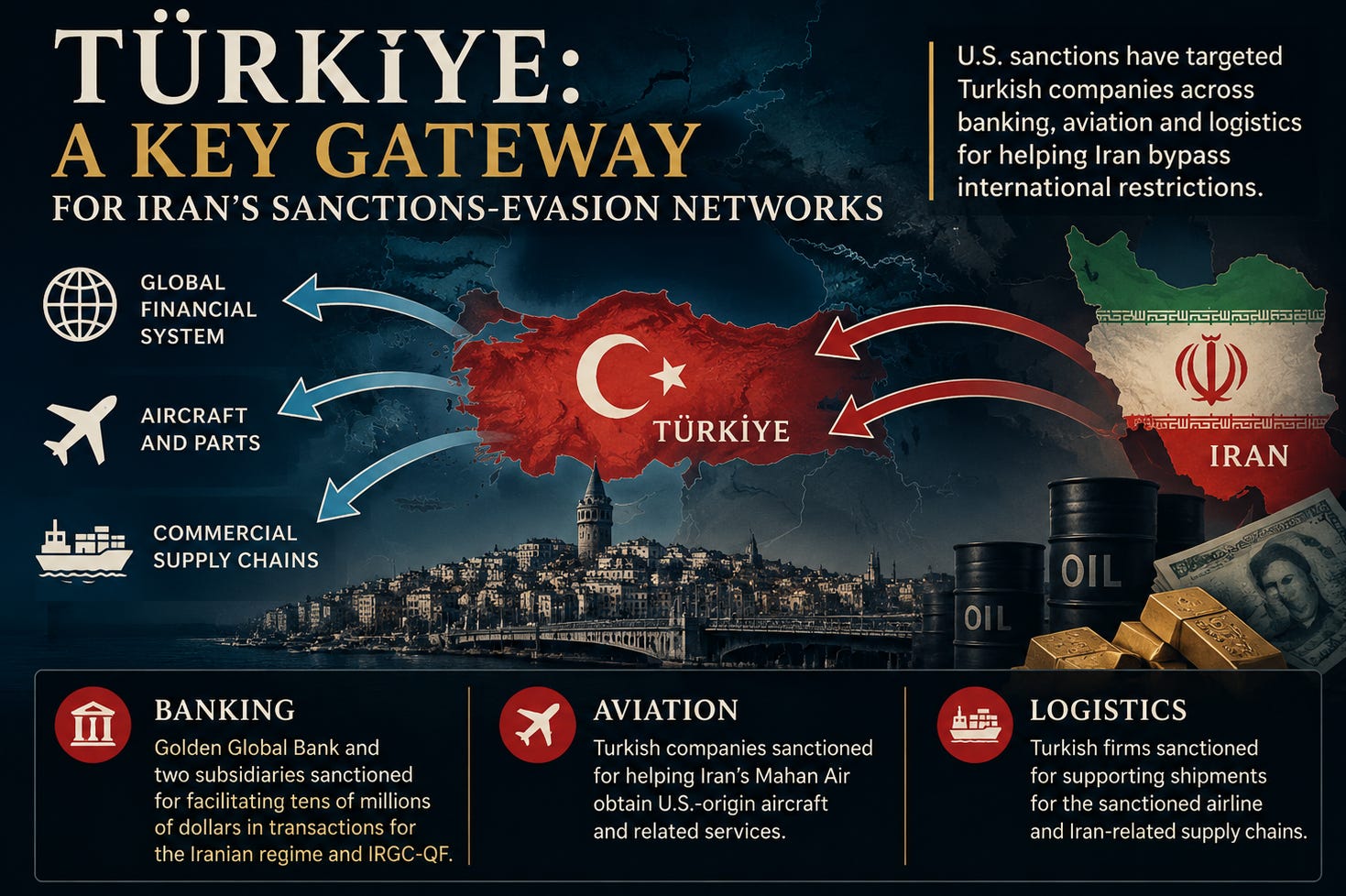
A series of recent U.S. sanctions actions has placed Turkish companies across banking, aviation and logistics at the center of Washington’s campaign against the Iranian regime’s efforts to bypass international restrictions.
In separate actions over the past several weeks, the Treasury Department has targeted a Turkish investment bank accused of facilitating transactions connected to Iran’s Islamic Revolutionary Guard Corps-Quds Force (IRGC-QF), aviation companies accused of helping Iran’s Mahan Air obtain U.S.-origin aircraft, and logistics firms accused of supporting shipments for the sanctioned airline.
Taken together, the sanctions reveal how Turkish-based companies have appeared across multiple sectors that U.S. authorities identify as critical to the Islamic Republic of Iran’s ability to maintain access to international finance, aircraft and commercial supply chains.
A Turkish Bank Accused of Financing the Iranian Regime
On September 4, the Office of Foreign Assets Control designated Golden Global Bank and two subsidiaries, Golden Global Portföy Yönetimi and Golden Global Varlık Kiralama, accusing the institutions of providing financial infrastructure for the Iranian regime’s sanctions-evasion efforts.
The Treasury Department alleged that Golden Global facilitated tens of millions of dollars in transactions connected to the IRGC-QF and provided the Iranian regime with correspondent banking access that allowed funds to move internationally. Treasury further alleged that the bank was established to help transfer Iranian oil revenues from China into Türkiye, where proceeds could then be converted into cash and gold through money exchangers.


Treasury’s action targeted a licensed Turkish financial institution rather than only offshore entities or informal intermediaries. According to Reuters, Golden Global was a small Turkish investment bank based in Istanbul.
Golden Global was also a relatively new entrant into Türkiye’s financial sector. Turkish regulatory records show that the bank was established in 2019 and received authorization to begin operations in 2020. The bank describes itself as Türkiye’s first investment bank operating under interest-free banking principles and says it was established to provide “banking services and alternative financing methods” to foreign trade companies. The timeline is notable because a financial institution created only several years earlier became the target of a major U.S. sanctions action over alleged activity benefiting the Iranian regime.
A Wider Golden Global Corporate Structure
Beyond the sanctioned bank itself, corporate records reveal a broader Golden Global business structure. Golden Global Emtia, a commodity-trading company operating under the same brand, was not separately designated by OFAC. However, Turkish corporate records show overlap between Golden Global entities and their senior leadership.
Recep Kaba, chairman of Golden Global Bank’s board, also serves as chairman of Golden Global Emtia, while Yavuz Yeter serves as Golden Global Bank’s general manager and board member, as well as vice chairman of Golden Global Emtia and chairman of Golden Global Portföy Yönetimi.
The overlap is notable because the Treasury Department alleged that Golden Global provided financial services connected to Iranian oil revenue flows through Türkiye, including mechanisms that allowed proceeds to be converted into cash and gold.
The shared leadership structure highlights the broader corporate network surrounding Golden Global and raises questions about the relationship between the sanctioned bank and its affiliated entities. The issue is also significant because OFAC’s 50 Percent Rule can apply sanctions restrictions to entities owned 50 percent or more by blocked persons, even when those entities are not individually listed.
From Banking to Aircraft Procurement
Days after targeting Golden Global, Treasury expanded its Iran sanctions campaign into aviation, targeting Turkish companies accused of supporting Mahan Air.
On September 8, the Treasury Department sanctioned Sky Phoenix, a Türkiye-based aviation company accused of serving as an intermediary in the transfer of U.S.-origin Boeing 777 aircraft to Mahan Air.
According to Treasury, Mahan Air received at least three Boeing 777 aircraft after the planes moved through third-country intermediaries before reaching the Iranian airline. Treasury said the transfers resembled previous sanctions-evasion methods used to support Mahan Air.


Mahan Air has been sanctioned by Washington since 2011 for providing material support to the IRGC-QF. Treasury has repeatedly accused the airline of supporting the Iranian regime’s military and regional operations.
The recent sanctions also come amid broader concerns over the use of Turkish aviation routes by Iranian-linked networks. A 2025 assessment by the Alma Research and Education Center examined Mahan Air flights between Iran and Lebanon that transited Turkish airspace, warning that Tehran may have been seeking alternative aviation routes for moving funds and supplies to Hezbollah following disruptions to previous land corridors through Syria.
Turkish Logistics Firms and Iran’s Aviation Supply Chain
The same September 8 action targeted two Turkish logistics companies, S Sistem and MES Cargo.
Treasury alleged that S Sistem coordinated shipments on behalf of Mahan Air, including unmanned aerial vehicle components and industrial equipment destined for Iran, while MES Cargo served as a general sales agent for Mahan Air and coordinated shipments for the airline.
The designations highlight that the Iranian regime’s aviation sanctions-evasion efforts rely not only on airlines themselves, but also on outside companies involved in aircraft transfers, cargo handling and commercial services.
The Remaining Questions
The recent sanctions actions provide a detailed picture of the types of intermediaries Washington says the Iranian regime relies upon: financial institutions that provide access to global banking, aviation firms that facilitate aircraft transfers and logistics providers that move goods through international supply chains.
Important questions remain unanswered, including the specific transactions underlying Treasury’s allegations against Golden Global, whether Turkish regulators identified concerns before the U.S. designation, and whether additional companies connected to the sanctioned entities could face scrutiny.
As Washington continues targeting the Islamic Republic of Iran’s international networks, Turkish companies operating in sensitive sectors are likely to face increased attention from U.S. sanctions authorities and global compliance officials.
Didn’t President Trump call Erdogan a friend of the US a while back. This is what a friend does?? Erdogan is an Islamist through and through. He will practice taqiyah in order to further their agenda.
Turkey is not the West’s friend