


Jewish Onliner is an independent publication. If you find our work valuable, please consider becoming a paid subscriber. You can also subscribe to us on WhatsApp and Telegram. Follow us on Instagram, Discord, and X.
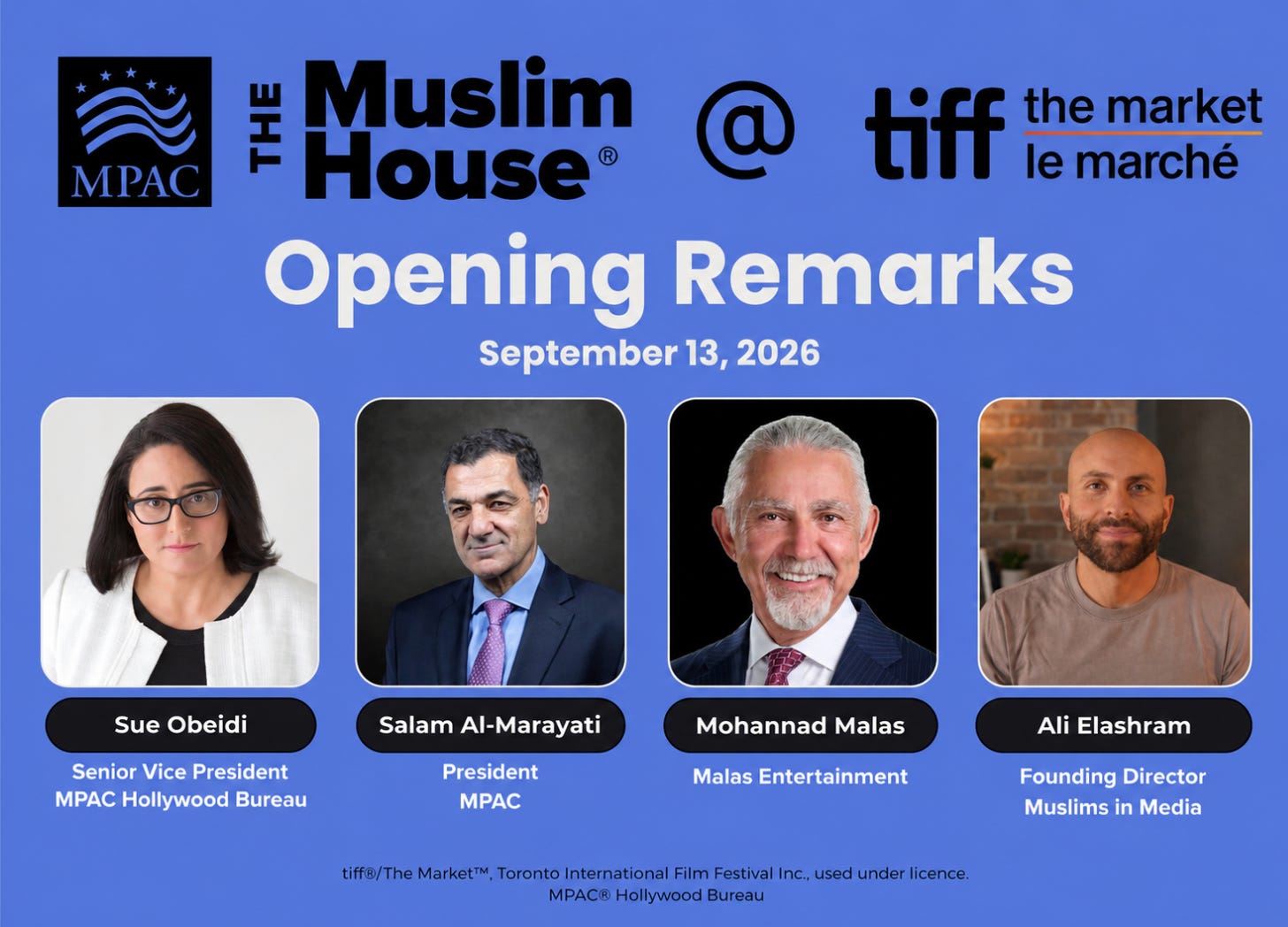
The Muslim Public Affairs Council’s Hollywood Bureau is bringing its Muslim House cultural hub to the Toronto International Film Festival for the first time on September 13 and 15, with MPAC President Salam Al-Marayati scheduled to interview filmmaker Bassam Tariq inside TIFF Lightbox.
Al-Marayati’s appearance comes 25 years after he suggested, during a Los Angeles radio interview on September 11, 2001, that Israel should be investigated over that day’s terrorist attacks. “I think we should put the state of Israel on the suspect list,” he said on KCRW’s Which Way, L.A.? The Los Angeles Times later reported the remarks.
The episode was not his first national controversy involving terrorism. Two years earlier, his appointment to a federal commission examining terrorism was withdrawn amid objections over his previous statements concerning Hamas, Hezbollah and attacks against Israel.
The Hollywood Bureau and Muslim House operate under the Muslim Public Affairs Council Foundation, a federally recognized 501(c)(3) nonprofit whose charitable contributions are generally tax deductible. Muslim House does not appear to be a separate nonprofit entity. MPAC describes it as a program produced by the Hollywood Bureau.
“Legitimate Resistance” and the Marine Barracks Bombing
In November 1999, Al-Marayati described Hezbollah attacks against Israeli soldiers in Lebanon as “legitimate resistance” during an appearance on PBS.
That year, an MPAC counterterrorism position paper addressed the 1983 bombing of the U.S. Marine barracks in Beirut, which killed 241 American servicemen. The paper said the bombing was “not in a strict sense, a terrorist operation,” instead characterizing it as a military attack against a noncivilian target. The language was later quoted in witness testimony before the 9/11 Commission.
Then-House Minority Leader Richard Gephardt had appointed Al-Marayati in June 1999 to the National Commission on Terrorism, a 10-member body tasked with reviewing U.S. counterterrorism policy.
Jewish organizations and members of Congress objected to the appointment, with critics accusing Al-Marayati of failing to unequivocally condemn Hamas and Hezbollah. Gephardt withdrew the appointment the following month amid the controversy.


MPAC’s Response to October 7
MPAC’s framing of the Hamas-led October 7, 2023 attack also drew criticism.
In a statement issued as the attack unfolded, MPAC identified Israeli “occupation” as “the source of the problem.” It said Israeli policies had created a political vacuum that allowed Hamas and other groups to gain support and “justify their violent attacks.”
MPAC has since described Israel’s military campaign in Gaza as genocide. Its archived Palestine page states, “It is a genocide.”
MPAC’s Muslim Brotherhood History
MPAC’s founding leadership also included figures with documented histories involving the Muslim Brotherhood.
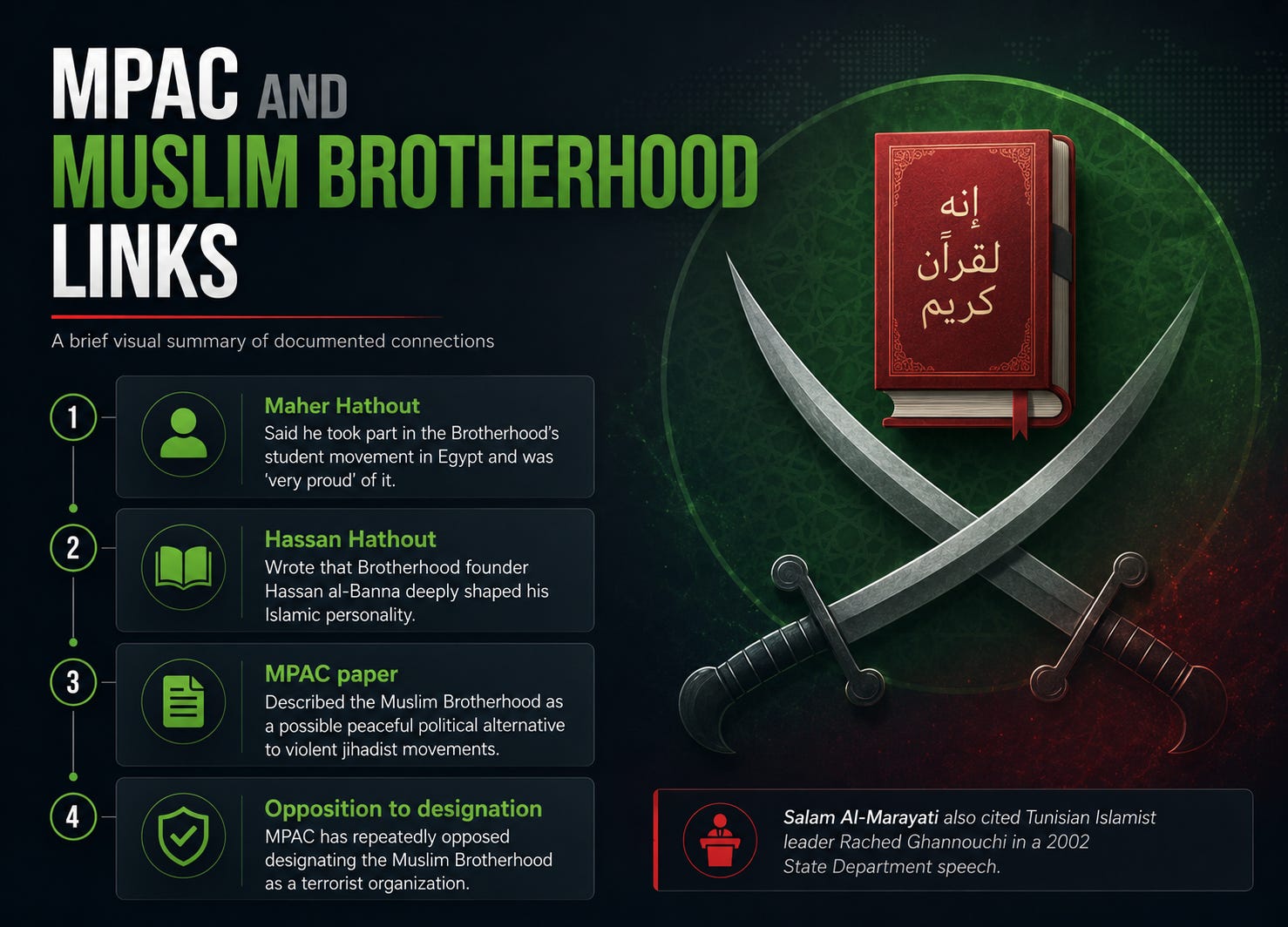
Maher Hathout, an MPAC founder and longtime senior adviser, was reported in 2012 as acknowledging that he had participated in the Muslim Brotherhood’s student movement in Egypt before immigrating to the United States. Hathout said he was “very proud” of that involvement.
His brother Hassan Hathout, who also served as an MPAC president, described Muslim Brotherhood founder Hassan al-Banna as the person who most influenced his life. In his writings, Hassan Hathout called al-Banna his teacher and said he had shaped his “Islamic personality.”
MPAC later portrayed organizations such as the Brotherhood as potential competitors to violent jihadist movements. Its Building Bridges to Strengthen America counterterrorism paper, quoted in a U.S. Senate hearing record, said “conservative groups like the Muslim Brotherhood” could present a long-term strategic challenge to violent extremists by drawing Muslims toward peaceful political activism.
Al-Marayati also cited Tunisian Islamist leader Rached Ghannouchi in a 2002 speech at the U.S. State Department as an example of someone promoting “dialogue between civilizations, not confrontation.”
MPAC has repeatedly opposed efforts to designate the Muslim Brotherhood as a terrorist organization. Most recently, it denounced an August 2026 Senate Judiciary hearing examining Muslim Brotherhood networks in the United States as promoting “long-discredited conspiracy theories.”
The Muslim House Comes to Toronto
The Canada Pavilion program lists the September 15 events as presented by Muslim House and MPAC Hollywood Bureau alongside Muslims in Media, M Film Lab, the Inspirit Foundation and the Canadian Race Relations Foundation.
Several participants also have documented records of activism targeting Israel. Fawzia Mirza withdrew from the Tel Aviv International LGBT Film Festival in 2017 in support of the cultural boycott of Israel, while Mirza, Aisha Jamal and Amber Fares have since signed the Film Workers for Palestine pledge. Bassam Tariq signed an earlier statement accusing Israel of genocide and apartheid, and Jamal used the phrase “continuing genocide” in a 2026 Hot Docs program description. Shireen Ahmed has also participated directly in BDS programming, chairing a 2022 webinar organized by the Palestinian BDS National Committee.