


Jewish Onliner is an independent publication. If you find our work valuable, please consider becoming a paid subscriber.
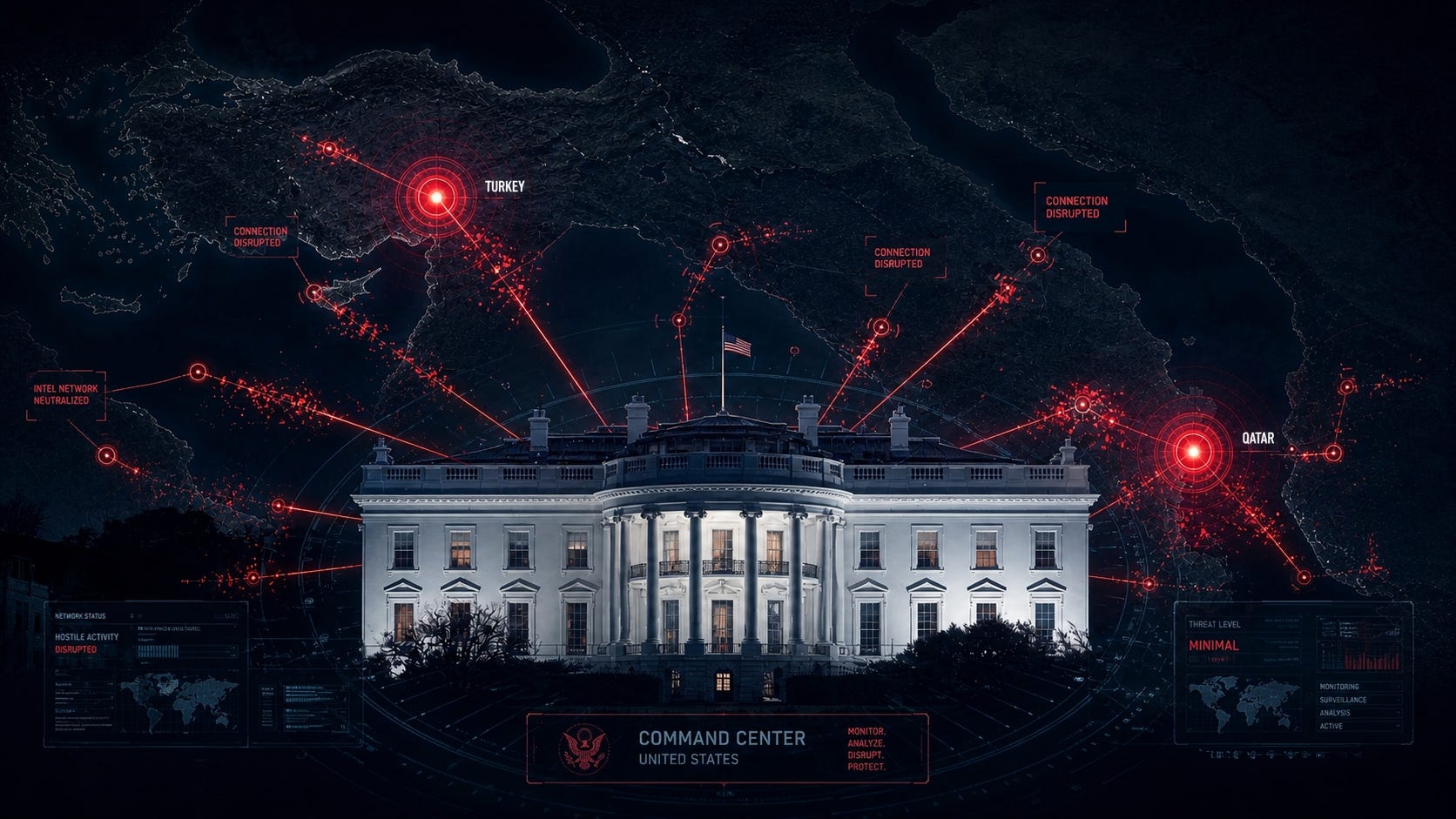
The White House released its 2026 U.S. Counterterrorism Strategy this week, marking the first comprehensive CT doctrine of President Trump’s second term. The document outlines the Muslim Brotherhood as “the root of all modern Islamist terrorism” and vows to pursue FTO (Foreign Terrorist Organization) designations against Brotherhood branches from the Middle East and other regions, aiming to dismantle the movement’s operations worldwide.


The document frames the Brotherhood designation campaign as a key counterterrorism priority alongside dismantling cartel networks and neutralizing Iranian-backed proxies, elevating the nearly century-old Islamist movement to the top tier of U.S. national security threats.
Earlier this year, the U.S. designated four Muslim Brotherhood branches under counterterrorism authorities the Lebanese, Egyptian, Jordanian, and Sudanese branches.
As previously documented by Jewish Onliner, the Foundation for the Defense of Democracies (FDD), and others, there are various other branches of the movement harboring terror ties. Below is a list of Brotherhood-linked entities that could be next in line for designation.
Yemen’s Al-Islah
The Yemeni Brotherhood affiliate was co-founded by Abdul Majid al-Zindani, who the U.S. designated as a Specially Designated Global Terrorist in 2004 for serving as a “spiritual leader” to Osama bin Laden. A federal lawsuit identifies Zindani as coordinating the 2000 USS Cole attack that killed 17 United States Navy sailors. In 2013, Treasury noted Zindani issued “religious guidance in support of AQAP operations.”


Libya’s Hizb al-Watan
Libya’s Hizb al-Watan is another Islamist party cited as a possible target for scrutiny because of its Brotherhood-linked leadership networks. The party has been led by Abdelhakim Belhaj, a former commander of the Libyan Islamic Fighting Group, which the U.S. and U.N. designated for al-Qaeda links, and by cleric Ali al-Sallabi. Belhaj and Sallabi were also placed on terrorism-linked lists by Saudi Arabia, the UAE, Egypt, and Bahrain in 2017.


Malaysia’s PAS (Parti Islam SeMalaysia)
Malaysia's oldest and largest Islamist opposition party advocates transforming Malaysia into an Islamic state. "PAS is held up by the Muslim Brotherhood as a model of a successful Islamic party that can win elections and rule," chief executive officer of the Institute of Democracy and Economic Affairs (IDEAS) told Al Jazeera.
In January 2025, PAS President Abdul Hadi Awang publicly declared what he called an "early victory for Hamas," praising the group's "tactical wisdom" and describing Palestinian militants as "mujahidin."


Today, PAS holds 43 seats in Malaysia’s 222-member Parliament and is the country’s largest single parliamentary party, giving it significant influence inside the opposition Perikatan Nasional bloc. PAS also governs or helps govern the conservative northern states of Kelantan, Terengganu, Kedah, and Perlis, making it one of Southeast Asia’s most politically successful Islamist movements.
Syria’s Muslim Brotherhood
Syria’s Muslim Brotherhood became one of the Assad regime’s central Islamist rivals after the Baath Party consolidated power. In the late 1970s and early 1980s, the Brotherhood endorsed armed struggle against Hafez al-Assad’s government and aligned with the Fighting Vanguard, an Islamist militant offshoot linked to assassinations, bombings, and attacks on state and Baath Party targets. The confrontation culminated in the 1982 Hama uprising and the regime’s brutal assault on the city, which killed or disappeared thousands and forced much of the Brotherhood into exile.
After 2011, the exiled Syrian Brotherhood sought to regain influence through opposition bodies, humanitarian networks, and anti-Assad organizing. Congressional testimony in 2018 alleged that Syrian Brotherhood-linked advocacy networks in the United States, including figures associated with the Syrian American Council, helped normalize U.S. support for radical Islamist factions in Syria, including Jabhat al-Nusra and Ahrar al-Sham. The testimony alleged influence and ideological sympathy, but does not by itself prove direct terrorist financing by the Syrian Brotherhood or SAC.
Turkey and Qatar—The State Sponsors
The 2026 Counterterrorism Strategy explicitly names Iran as the “world’s number one state sponsor of terror.” Beyond individual Brotherhood chapters, various observers and experts, characterize Qatar and Turkey as state-level sponsors of the global network. FDD identifies both as state sponsors of the Muslim Brotherhood. Turkey provides asylum to Brotherhood members and hosts Hamas operatives. Qatar funds the Brotherhood through “bottomless energy wealth” and its Al Jazeera network.
The January actions enable the U.S. to sanction "people, businesses, nonprofits, and networks" supporting designated chapters, a framework that could expand rapidly as more branches are targeted.