


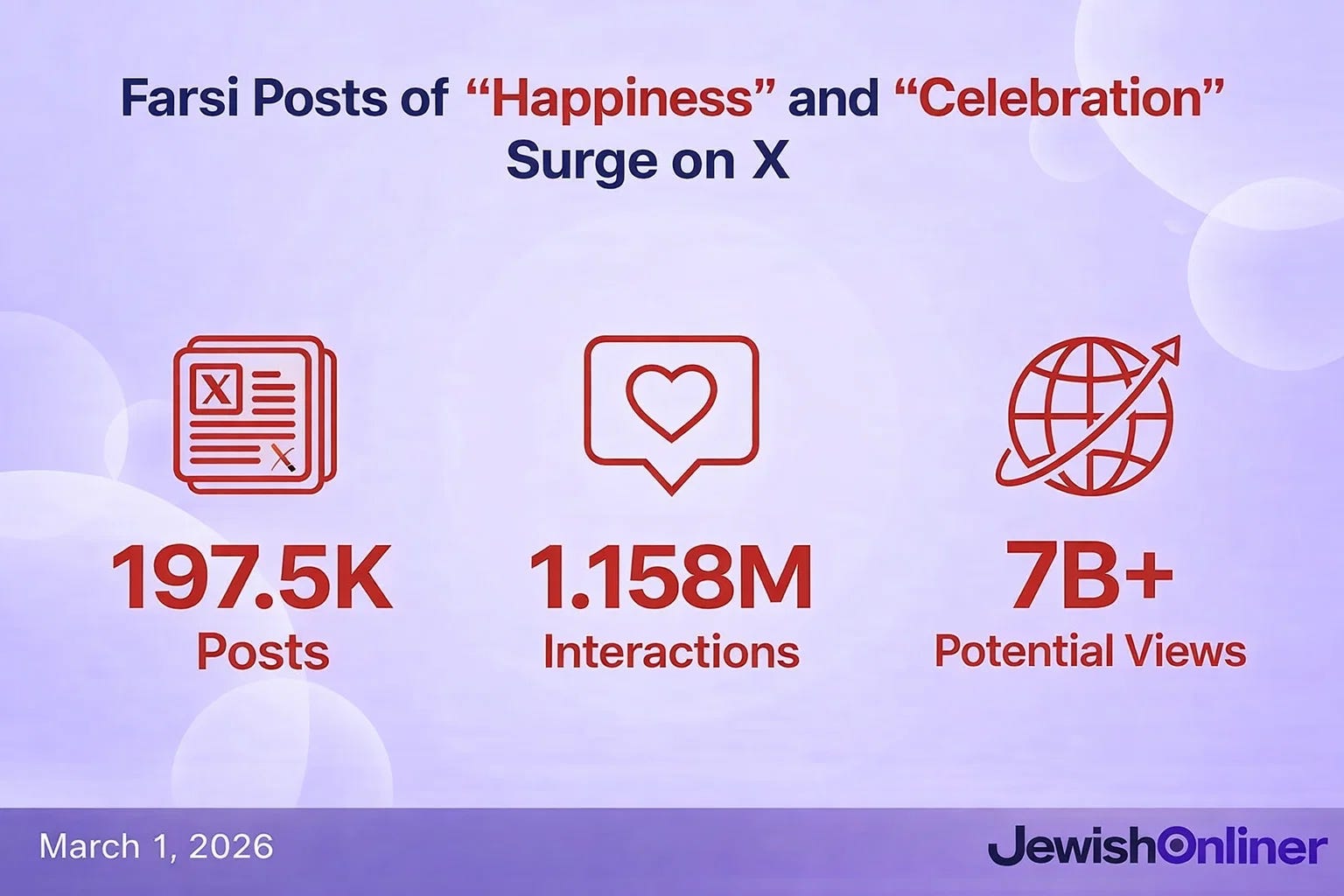
A data-driven analysis conducted by Jewish Onliner from the first 24 hours after the joint U.S.-Israeli operation from February 28-March 1, saw activity on X surge to extraordinary levels, marking the highest traffic in the platform’s history. The joint strikes, known as “Operation Roaring Lion” in Israel and “Operation Epic Fury” in the United States, in which Iran’s Supreme Leader Ayatollah Ali Khamenei and other senior leadership officials were eliminated, reveals a striking response: rather than grief, Persian-language users expressed widespread celebration.
Jewish Onliner’s analysis found that the word “Iran” in Farsi was posted roughly 2 million times on X, generating approximately 10.2 million engagements and an estimated 4.9 billion potential views, with the heaviest activity originating from inside Iran itself. The operation marks a fatal blow against a regime long associated with executions, mass arrests, and violent crackdowns on its own people.
Massive Volume, Celebratory Tone
The volume was matched by unmistakably positive sentiment. The Farsi word for “happiness” appeared about 103,000 times, generating roughly 616,000 engagements. The Farsi word for “celebration” was posted approximately 94,500 times, drawing another 542,000 engagements.
The data points to a burst of visible joy among Persian-speaking users in the immediate aftermath of the strikes, with the vocabulary of the online discourse dominated by expressions of relief, excitement, and hope rather than grief or outrage.
In some cases, the reaction extended beyond social media. Reports note that in the southern city of Gal-e-Dar, celebratory crowds were seen tearing down a statue of Ruhollah Khomeini, architect of the Islamic Revolution.
Geographic Distribution: Inside Iran and Across the Diaspora
The heaviest volume of Persian-language posting came from Iran itself, followed by significant activity from Pakistan, the United States, the United Kingdom, India, the Netherlands, and Canada.
The geographic spread is notable. While Iran accounted for the largest share of activity, the concentration of posting in diaspora hubs such as the United States, United Kingdom, Canada, and the Netherlands indicates that the reaction resonated across a transnational Persian-speaking audience, amplifying a shared sense that a historic turning point has arrived.
A Political Rupture, Not a National Trauma
The volume and language patterns indicate that for many users, the moment was experienced less as a national trauma than as a political rupture, one that, at least online, prompted open expressions of relief and excitement.
So far, the data offers an early indication of something deeper: that a significant portion of Iran’s population, long subjected to the regime’s repression, viewed the elimination of its leadership not as an attack on the nation, but as a potential liberation from it.