


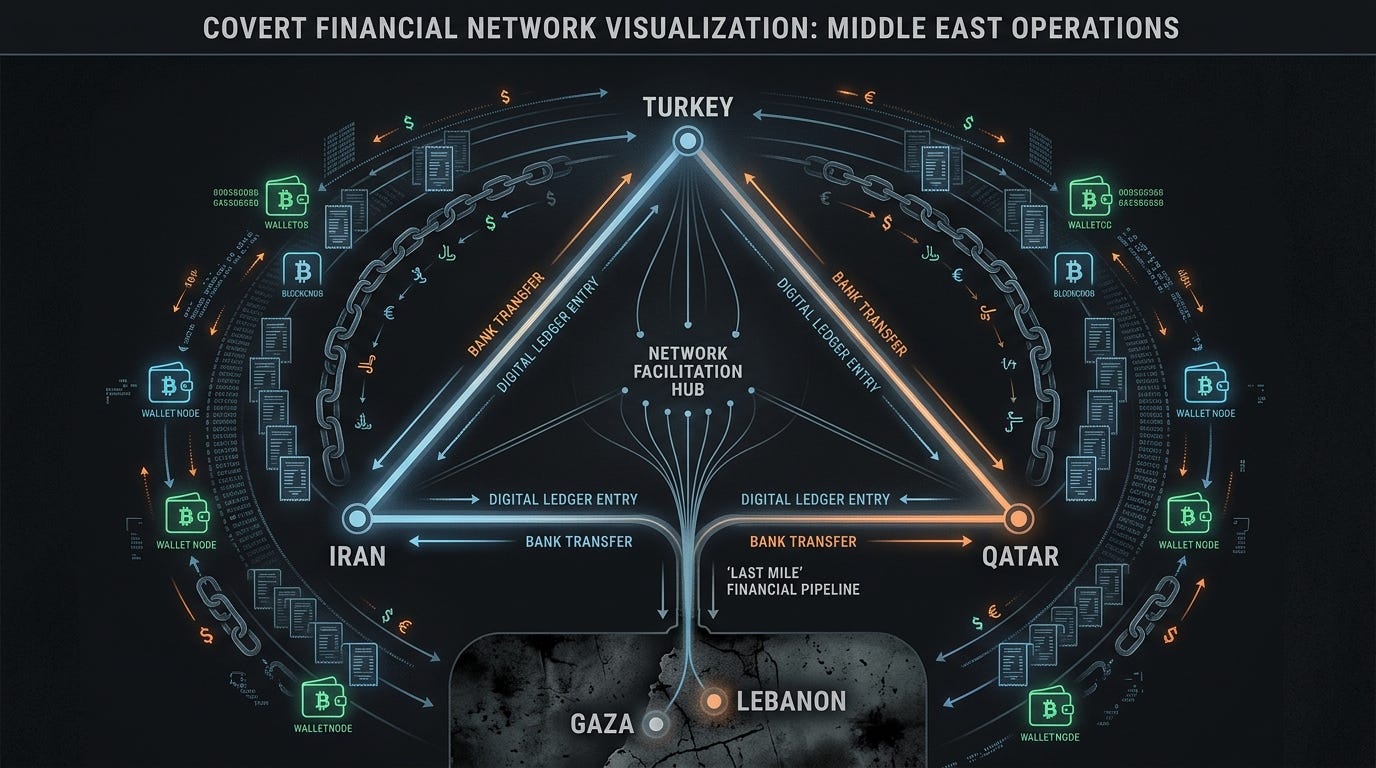
A March 11 report published by the Jewish Institute for National Security of America (JINSA), authored by Meriem Mokhtari, warns that even as U.S.-Israeli strikes degrade Iranian command-and-control and financial infrastructure, the campaign to sever proxy financing remains “unfinished.” The report claims Hamas in Gaza and Hezbollah in Lebanon are now pivoting to the Muslim Brotherhood’s global financial apparatus as an alternative funding backbone, with the “last-mile” node increasingly anchored in Doha and Ankara/Istanbul.
The central allegation is that “humanitarian” fundraising, shadow banking, exchange-house transfers, and crypto rails can be stitched into a single operational pipeline—one that survives leadership relocations and outpaces enforcement.
Iran’s State Channels Were Hit—So The Network Migrated
The report states that within the first 72 hours of conflict, the Central Bank of Iran’s digital infrastructure was incapacitated, and Iranian internet connectivity fell 99% from prewar levels.
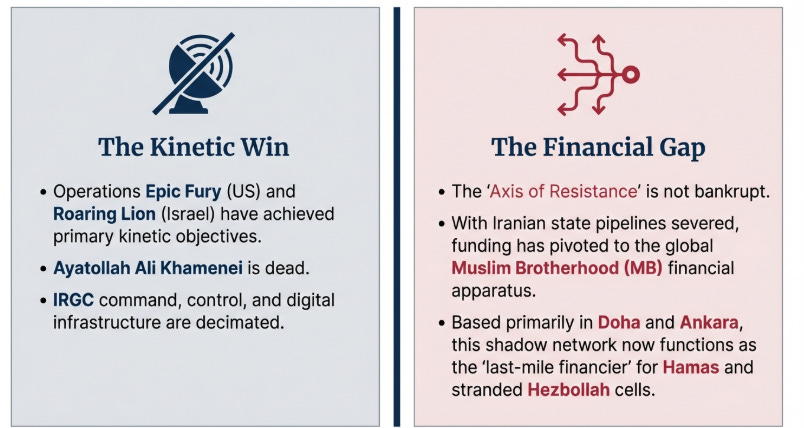
It describes Iran’s prewar proxy-funding model as dependent on state-linked sources like the CBI and National Development Fund, supplemented by IRGC “dark fleet” oil tactics that masked crude as “Malaysian blend” sold predominantly to China. The disruption inside Iran, JINSA argues, triggered an immediate cash‑flow crunch—pushing the financing burden outward to a more dispersed set of non‑state facilitators abroad, including networks with Muslim Brotherhood‑linked reach.
The report anchors its argument in a wartime disruption scenario—asserting that Iran’s conventional command-and-control and financial transfer capacity was degraded, accelerating a pivot to non-state intermediaries.
Funding Routes
According to the JINSA report, the cash pipeline doesn’t flow through one clean channel—it splits into four parallel routes that ultimately converge on a tight network of Gaza-based money changers who convert inbound transfers into physical cash for Hamas commanders.
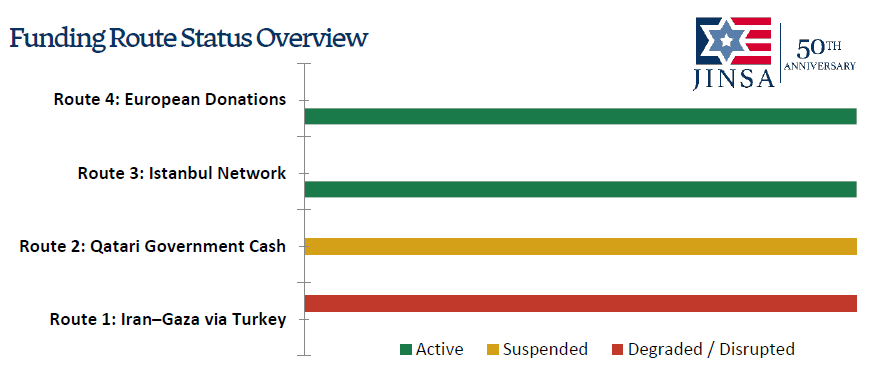
Route 1 — Iran-to-Gaza (Degraded)
JINSA describes a prewar route in which Iranian funds moved through Lebanon, then passed through Turkish money changers, and finally entered Gaza. Israeli and U.S. intelligence reportedly confirmed that the network transferred hundreds of millions of dollars to Hamas leadership before the current conflict crippled parts of the pipeline.
The Insight also claims that since January 2025, Iran sent more than $1 billion to Hezbollah through the same exchange-house mechanism—evidence, in JINSA’s framing, of the route’s scale even as the Iranian terminal has been degraded.
Route 2 — Direct Qatari Government Cash (Suspended for Now)
Beginning in 2018, JINSA states Qatar channeled $30 million per month into Gaza as physical cash—an arrangement that the Insight argues functioned less like relief and more like operational oxygen. A joint U.S.-Israeli intelligence assessment reportedly found that much of that money supported Hamas’s military infrastructure, and the Insight adds that internal Hamas documents seized by Israel indicate direct Qatari government funding of Hamas military activity.
This route has been suspended since October 2023, JINSA notes, because physical cash delivery into Gaza became impossible—and the Insight assesses that current operations foreclose any near-term resumption. Source
Route 3 — The Istanbul Network (Active Now — Main Route)
JINSA identifies the Istanbul network as the primary active channel: Qatar-based charities raise donations under humanitarian cover, then transfer funds to Istanbul, where Hamas’s finance apparatus allegedly stores value in a reported $500 million portfolio of Turkish real estate and shares. The Insight names Zaher Jabarin—described as Hamas’s director of finance and previously sanctioned by Treasury—as the figure tied to this asset base, which JINSA argues remains operational regardless of where Hamas’s political leadership relocates.
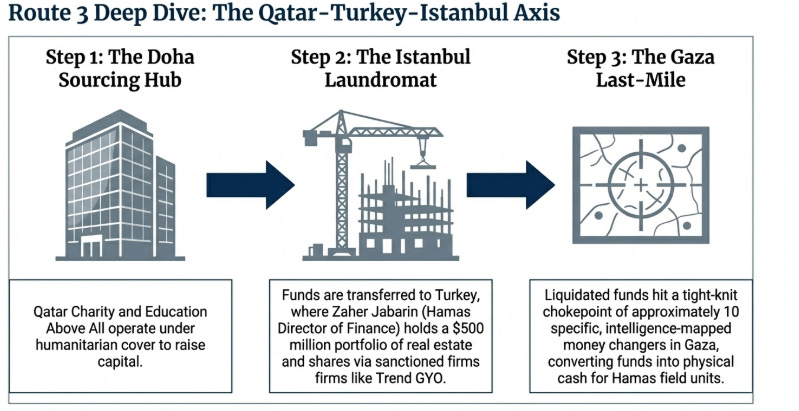
From there, funds move through currency exchange businesses into Gaza, and JINSA cites Treasury records indicating one exchange house alone sent more than $21 million to Hamas and its military wing between 2017 and 2019. In the final link, roughly ten Gaza money changers—known to Israeli intelligence, the report says—turn those transfers into cash for field units.
Route 4 — European Donations (Active Now)
JINSA argues that Hamas-linked fundraising in Western Europe generates millions in “humanitarian” donations that are then laundered through Turkish exchange houses and delivered to operational commanders. JINSA reports that MB-linked umbrella groups in Europe function as backbone infrastructure for this pipeline and contends that regulatory enforcement has lagged—creating exploitable arbitrage. Most notably for U.S. enforcement, the Insight states that some transfers pass through American banking systems, which JINSA frames as both an exposure point and an opportunity for disruption under U.S. law.
The Convergence Layer: Shadow Banking + Crypto
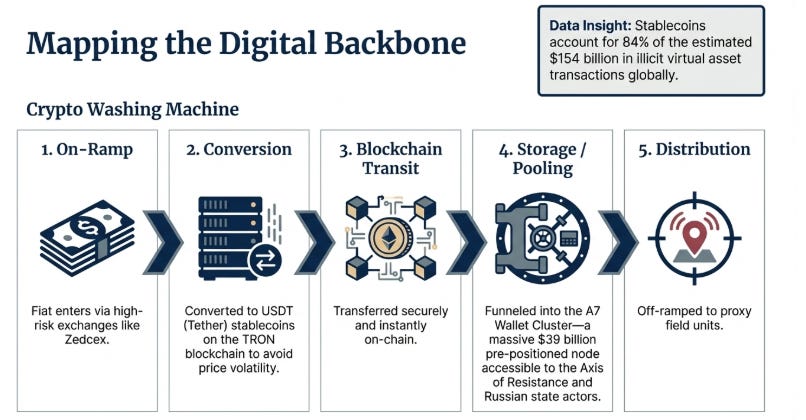
The Insight details a “hybrid-finance” architecture that merges (1) Hamas as an interoperability bridge to both the IRGC and Brotherhood-linked networks, (2) a FinCEN-examined $9 billion shadow-banking system that uses UAE/Turkey front companies and U.S. correspondent accounts, and (3) a digital backbone where TRM Labs allegedly confirmed shared TRON-based wallet clusters and high-risk exchanges. The report also highlights a “A7 wallet cluster” it describes as a $39 billion node connecting Russia and Iran.
The Policy Playbook
JINSA’s bottom line is that Treasury already has an off‑the‑shelf toolkit for turning financial pressure into operational disruption: it urges using Section 311 to flag the Brotherhood’s International Organization as a “Primary Money Laundering Concern,” while Treasury’s own guidance describes Section 311 as a flexible way to shield the U.S. financial system from targeted money‑laundering and terror‑finance threats.
From there, the report’s logic is straightforward: FinCEN’s special measures are the plumbing that operationalizes restrictions inside the banking system, and OFAC’s virtual-currency guidance makes clear the same compliance expectations apply when value moves via wallets and stablecoins—not just wires and cash.
I wonder how the two fanatical Islamic sects,
1. the Muslim Brotherhood(lums)
2. the Shiite “12th Imam” community
get along with each other? What unites them is their neo-Nazism, hatred of Jews, and lack of moral.