


A new strategic assessment published by Israel’s Begin-Sadat Center for Strategic Studies maps out alternative futures for Iran following the joint U.S.-Israeli Operation Epic Fury, identifying scenarios ranging from optimal regime change to the necessity of another war.
The analysis, published March 18, by Col. (res.) Shay Shabtai, a senior researcher at the BESA Center specializing in national security and strategic planning, evaluates how several unresolved variables could shape Iran’s trajectory moving forward.

Operation’s Impact and Outstanding Questions
According to the assessment, Operation Epic Fury has dramatically altered Iran’s strategic position. While a significant portion of the regime’s immediate arsenal has been destroyed, its long-term capacity for rehabilitation has been even more severely degraded. The Iranian leadership has taken heavy damage and is only partially functioning, while a regional defense coalition has greatly reduced Iran’s ability to inflict damage on targets including Israel and threaten maritime energy traffic through the Strait of Hormuz.
Building on these military gains, Shabtai identifies six fundamental variables that will determine whether this tactical dominance translates into a lasting strategic transformation: whether the Iranian public will reach a tipping point to actively overthrow the regime, who the real decision-makers in Iran are today and their actual positions beyond public defiance, whether the U.S. and allies can minimize disruptions in the Strait of Hormuz, finding a solution for Iran’s enriched uranium stockpiles protected deep in mountain sites, the possibility of Iranian extreme actions such as chemical or radioactive weapons use or major terrorist attacks, and how long President Trump will view the war as succeeding in reaching his goals.
Seven Scenarios From Optimal to Negative
The BESA Center assessment outlines seven distinct scenarios based on an “alternative futures” methodology:
Optimal: Popular uprising successfully topples the regime while hostilities conclude.
Good: The conflict ends first, followed by regime collapse as Iranians, emboldened by witnessing their government’s weakness, mobilize for change.
Affirmative: Tehran’s leadership accepts a far-reaching agreement constraining its chemical weapons program, nuclear ambitions, ballistic missile development, proxy warfare networks, human rights abuses, and naval aggression, culminating in what Shabtai defines as a “CNOHMP Deal” — a comprehensive framework addressing Chemical, Nuclear, Other (ballistic), Human Rights, Maritime, and Proxy threats.
Tolerable: The regime becomes hardened but weakened, no longer capable of threatening neighbors while undergoing extended internal decline.
Enforcement: The regime attempts rebuilding its military infrastructure, necessitating periodic strikes by Washington and/or Jerusalem to degrade reconstruction efforts.
Another War: Tehran successfully reconstitutes capabilities, compelling another major military campaign (dubbed Roaring Lion 3) to again set back the regime and create fresh opportunities for internal change.
Negative: The regime remilitarizes while international actors, including Jerusalem, prove unable or unwilling to intervene effectively.
Shabtai’s analysis suggests the middle scenarios, involving either regime fragmentation or the need for military intervention, represent the most probable trajectories absent major shifts toward either popular revolution or diplomatic breakthrough.
Four Models for Continued Regime Control
If the existing regime maintains control, the assessment identifies four possible configurations based on external and internal behavior:
‘Venezuela’ Model: Tehran’s elite could prioritize their own survival by making significant external concessions, either publicly or through covert arrangements, while maintaining iron-fisted domestic rule. Shabtai notes this transformation would require time to coalesce within regime circles.
‘North Korea’ Model: The Islamic Revolutionary Guard Corps could consolidate power into a military dictatorship characterized by both external belligerence and domestic repression. While this path appears plausible, Shabtai views it as inherently unstable over time.
‘Gorbachev’ Model: A figure within the establishment could emerge to liberalize both foreign relations and domestic governance, stabilizing the regime through moderation rather than force. However, no potential candidates for such leadership have been identified.
‘Rafsanjani’ Model: The regime could attempt returning to earlier patterns where aggressive regional behavior generated nationalist support at home while allowing some domestic breathing room. Shabtai considers current conditions incompatible with this approach.
The assessment concludes that IRGC military rule represents the likeliest continuation scenario, with minimal prospects for either external or internal moderation.
Alternative Leadership Models for New Regime
For scenarios involving a new regime, the analysis cross-references stability and openness to identify four alternatives:
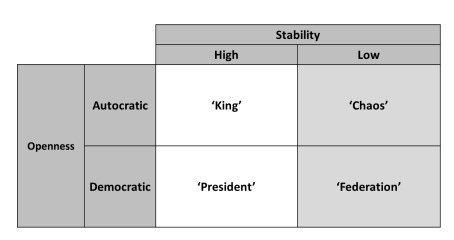
‘King’ Scenario: A strongman ruler could establish autocratic stability, the historical norm for Iran, though whether Iranians would accept such governance after decades of authoritarian rule remains uncertain.
‘Chaos’ Scenario: Weak authoritarian leadership could struggle to maintain cohesion across Iran’s diverse population, potentially sparking conflicts between political factions (pro-monarchy versus Islamist elements) and ethnic groups. This contradicts deep-rooted Iranian national identity.
‘President’ Scenario: Iran could transition toward electoral democracy and representative government, without historical precedent, raising questions about long-term viability.
‘Federation’ Scenario: Democratic regionalization could see Iran reorganize along ethnic or factional lines through negotiated settlements and popular votes, though major metropolitan areas like Tehran and Isfahan would complicate such divisions.
Shabtai assesses higher probability for scenarios maintaining Iranian state integration, reflecting broad public consensus, though whether an autocratic or democratic ruler would emerge remains difficult to predict.
Four-Point Strategic Recommendation
The BESA Center assessment concludes with four main recommendations:
Prepare for additional rounds: With neither regime collapse nor comprehensive diplomatic agreement appearing imminent, the U.S. and Israel should begin preparing now for post-conflict enforcement strikes and establishing conditions favorable for future operations as needed.
Pressure for comprehensive deal: Beyond pursuing regime change, and given Iran’s attacks on regional neighbors plus Strait of Hormuz disruptions, Western powers should build maximum international consensus demanding Tehran accept sweeping constraints across all threat categories—nuclear, chemical, ballistic, proxy, maritime, and human rights.
Locate alternative leadership: Intensified efforts should seek individuals capable of redirecting Iranian governance, either a reformer within the current system or a potential authoritarian replacement, possibly the same person evolving from internal change agent to new leader. Actively supporting such figures could fracture hardline consensus within the IRGC. Resources should not be concentrated on unlikely scenarios like territorial fragmentation or democratic transition.
Maintain cohesive international coalition: The existing coalition, American-led nations joined by targeted Middle Eastern states plus European and Asian partners, presents Tehran with limited diplomatic maneuverability, with Russia and India effectively acquiescing through non-interference.
The assessment provides a framework for understanding how the conclusion of Operation Epic Fury could unfold across multiple dimensions, with significant implications for U.S. and Israeli strategic planning in the months and potentially years ahead.