


Jewish Onliner is an independent publication. If you find our work valuable, please consider becoming a paid subscriber.
Editor's note: This is the inaugural article in a series examining alleged Muslim Brotherhood front groups in the United States—the 29 organizations listed in the infamous 1991 Muslim Brotherhood Explanatory Memorandum outlining a "Civilization-Jihadist Process" to destroy Western civilization from within. With renewed U.S. government focus on Brotherhood networks and recent congressional scrutiny, this series investigates the documented connections between these groups and their historical advancement of Brotherhood strategic objectives in America.
Tarbiyah, the Islamic Circle of North America’s program for spiritual growth, learning, and service, operates within ICNA, which appears as entry 26 in an appendix to a 1991 Muslim Brotherhood memorandum titled “A List of Our Organizations and the Organizations of Our Friends.”
Founded in 1968 as Halqa-e-Ahbab-e-Islami and renamed the Islamic Circle of North America in 1977, ICNA emerged from a South Asian Muslim network that researchers have linked to Pakistan’s Jamaat-e-Islami movement. ICNA says it now holds weekly or monthly events via its 300 NeighborNets across the United States and Canada.
A 2010 ICNA Sisters Wing members’ handbook describes a five-stage model of Islamic movement work that culminates in “the establishment of a Khilafah [Caliphate].” The document presents Tarbiyah as a long-term process of religious education, personal development, and collective organizing in pursuit of what ICNA’s charter calls Iqamat-ud-Deen, or the establishment of an Islamic system of life across individual, social, economic, and political spheres. The 2010 handbook also included works by Muslim Brotherhood founder Hassan al-Banna, ideologue Sayyid Qutb, and Yusuf al-Qaradawi.
The Tarbiyah Machine
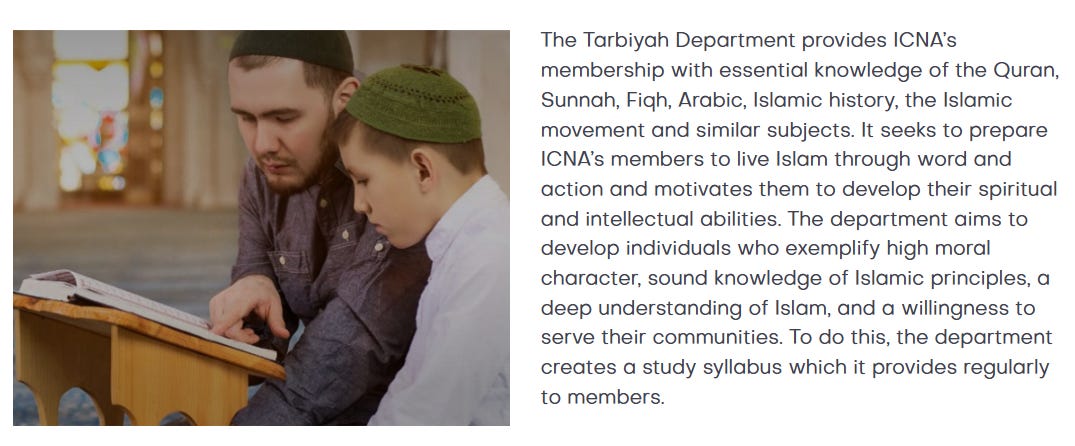
The Tarbiyah Department provides members with what it calls “essential knowledge of the Quran, Sunnah, Fiqh, Arabic, Islamic history, the Islamic movement and similar subjects.” That last phrase — “the Islamic movement” — appears throughout ICNA’s internal documents as shorthand for the global Islamist project to replace secular governments with Islamic states governed by Sharia law.
In its review of a 2010 ICNA Sisters Wing members’ manual, the Investigative Project on Terrorism described a structured process through which prospective members advance through reading assignments, peer follow-up, personal evaluation forms, and an oath for Members of the General Assembly.
IPT characterized portions of the reading material as extremist and argued that the system was designed to reinforce commitment to ICNA’s stated goals and methodology.
Stage One: The Extremist Reading List
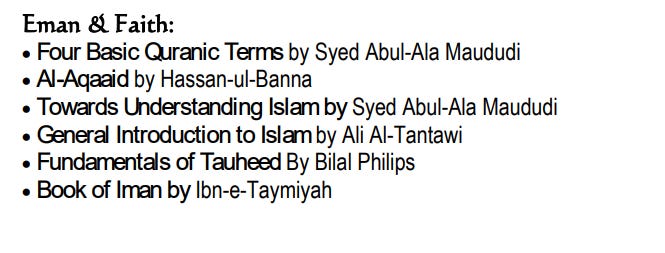
Entry-level ICNA members face a striking curriculum. The organization’s required reading list for basic members includes texts by figures whose works have inspired violent extremism worldwide:
Sayyid Abul A’la Maududi, the founder of Jamaat-e-Islami, was among the authors included in the 2010 ICNA Sisters Wing manual’s reading lists. The manual listed his Towards Understanding Islam under “Eman & Faith.” In its discussion of jihad, the book states that if no Muslims undertake it, “everybody is guilty,” adding that this obligation applies collectively except when an Islamic state is attacked by a non-Muslim power.
In 2010, Bangladesh’s government ordered mosques and libraries to remove Maududi’s works, with officials citing concerns that the books encouraged militancy and extremism.
Hassan al-Banna, founder of the Muslim Brotherhood, whose movement the 1991 Explanatory Memorandum identified ICNA as part of. ICNA’s 2003 Leadership Development Seminar featured a session titled “Gone but Not Forgotten: Imam Hassan al-Banna and Mawlana Mawdudi,” praising them as “two gigantic Islamic figures of this century that revived Islam and attracted millions of youth across the globe.”
Shamim Siddiqi, ICNA’s former Director of Dawah and Publications, whose book The Commitment — mandatory for all members — declares: “Islam denies all authorities other than Allah.”
Siddiqi’s text argues that Muslims living in America have only three valid options: establish Islam personally and socially, join a group struggling for “Iqamatuddin” (establishment of Islamic rule), or specifically join ICNA. “It would be a crime,” he writes, “to remain indolent for Islam and be the integral part of the BATIL [falsehood] society.”
Members also study Fathi Yakan’s To Be A Muslim, which the Investigative Project on Terrorism notes “declares that ‘true commitment requires every Muslim to dedicate his or her life in a jihad to establish and maintain a system of Islamic governance.’”
Stage Two: The Oath and Advanced Texts
Those who advance to become Members of the General Assembly (MGAs) — ICNA’s inner circle — must take a formal oath that include: “I affirm that the establishment of Allah’s Deen in this world is the goal of my life. I am joining ICNA for the achievement of this very purpose. I have no other objective in mind except the attainment of Allah’s pleasure and the success in the Hereafter.”
For prospective Members of the General Assembly, the 2010 manual directs participants to read at least two works from each category on an expanded reading list. Among the titles listed are Sayyid Qutb’s In the Shade of the Qur’an and Yusuf al-Qaradawi’s Priorities of the Islamic Movement in the Coming Phase. Qutb was a Muslim Brotherhood writer whose ideas later influenced jihadist figures including Osama bin Laden and Ayman al-Zawahiri.
The Investigative Project on Terrorism reported that a 2003 Tarbiyah guide, then hosted on ICNA’s website, reproduced passages from Qaradawi’s book, including a section describing “the Work of Struggle (Jihad)” as aimed at “liberating Muslim land” and fighting forces opposed to “the Islamic Call and the Muslim Nation.”
A System of Peer Accountability
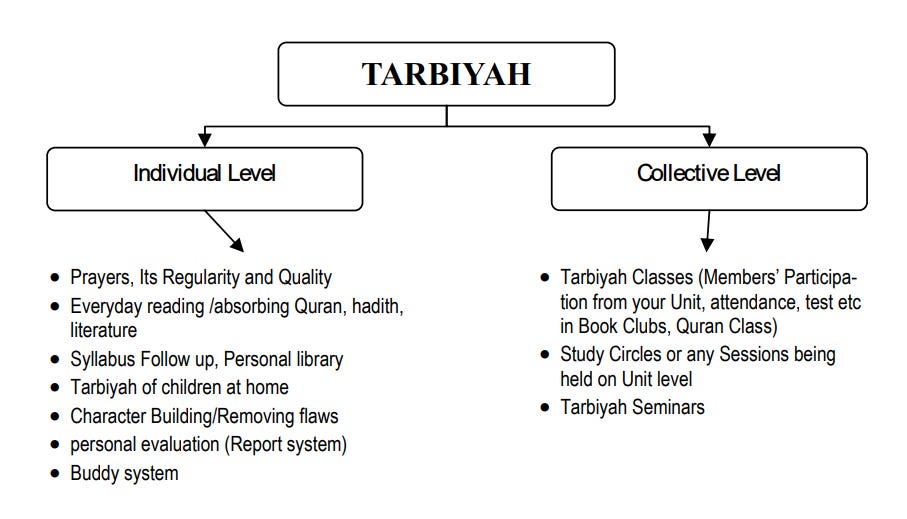
The 2010 ICNA Sisters Wing manual describes a buddy system and personal-evaluation process through which participants tracked aspects of their religious practice, received follow-up from peers, and submitted reports for guidance from unit leaders.
The Buddy System (Muwakha): Members are paired as a “single unit” to “monitor and help each other.” The 2010 manual instructs buddies to conduct weekly follow-ups, “detect shortcomings,” and provide “nasiha” (advice) to encourage “repentance or behavioral correction.” Experienced members mentor newcomers, creating a hierarchical monitoring network throughout the organization.
Individual Report Forms: The 2010 manual instructs members to complete monthly personal-evaluation forms tracking religious practice and movement participation, including daily prayers, Quran recitation, study, memorization, Dawah activity, and engagement in collective programs. The forms were shared with a Unit Coordinator for advice and comments and included a category for “Native Sisters,” which the manual defines as American, non-immigrant women and says should receive particular attention in efforts to incorporate them into the Islamic movement.
Taken together, the forms provide unit leaders with a record of participants’ religious practice, study, Dawah activity, and engagement in the organization’s collective programs. They also illustrate how the 2010 manual linked individual religious development to broader participation in ICNA’s stated movement objectives.
The Five-Stage Plan
The 2010 ICNA Sisters Wing manual lays out what it calls “Levels of work by the Islamic Movement” — a five-stage plan to achieve a global caliphate:
Stage 1 — Individual Level: Members undergo the “Tarbiyah Process,” studying the extremist texts outlined above. The manual explains this stage involves “radical literature promoting Islam in place of Western systems.”
Stage 2 — Family Level: Members work to establish Islamic rule within their households, described as “the second level of Iqamat-ad-Deen.”
Stage 3 — Societal Level: At the societal level, the manual describes ICNA’s work as combining public outreach, social services, and Dawah directed toward non-Muslims. It identifies WhyIslam as a subdivision of the Dawah Department that “works to promote Islam among non-Muslims,” while also instructing members to describe the initiative’s public purpose as building “a bridge of understanding” with non-Muslims.
Stage 4 — State Level: When “a good part of the society’s thinking individuals join the movement,” the manual states, “Then it may move to establish an Islamic society, obedient to Allah’s commands.”
Stage 5 — Global Level: “Wherever the Islamic movement succeeds to establish true Islamic society,” the handbook declares, “they will form coalitions and alliances. This will lead to the unity of the Ummah and towards the establishment of a Khilafah [Caliphate].”
ICNA describes itself as part of a global phenomenon: “Islamic movements are active in various parts of the world to achieve the same objectives. It is our obligation as Muslims to engage in the same noble cause here in North America.”
The Elite Training Ground
For members who progress through Tarbiyah’s basic stages, ICNA operates advanced leadership programs. ICNA Chicago’s Murabbi Development Program describes itself as a three-year course in Islamic literacy and activism, with about five hours of weekly study. Separately, ICNA’s education page says its Chicago Islamic Studies program was based on the curriculum of Al-Azhar’s Secondary College, located in Cairo.

The program explicitly trains for “activism,” not just religious education. Its goal is to develop “Islamic literate activists” who can “lead community efforts” and engage in “activist work to benefit the community, spread the message of Islam, and combat anti-Islamic efforts.”
Students spend five hours per week studying Hadith, Islamic jurisprudence, theology, and — tellingly — “Islamic Personality Development,” a subject focused on cultivating the character traits ICNA deems necessary for its movement work. The program has been taught by scholars including Imam Suhaib Webb and trains what ICNA describes as “a new caliber of Muslim leaders.”
ICNA’s Islamic Learning Foundation, which oversees these programs nationally, has reached more than 75,000 people across the United States through seminars, workshops, and intensive classes.
The Organizational Framework Behind Tarbiyah
ICNA’s Tarbiyah materials portray a structured framework of study, personal evaluation, peer accountability, and leadership formation in service of Iqamat-ud-Deen. Placed alongside ICNA’s listing as entry 26 in the appendix to the 1991 Muslim Brotherhood memorandum, those materials show how the organization’s approach to member formation draws on concepts long associated with Muslim Brotherhood-oriented Islamist organizing in North America.