


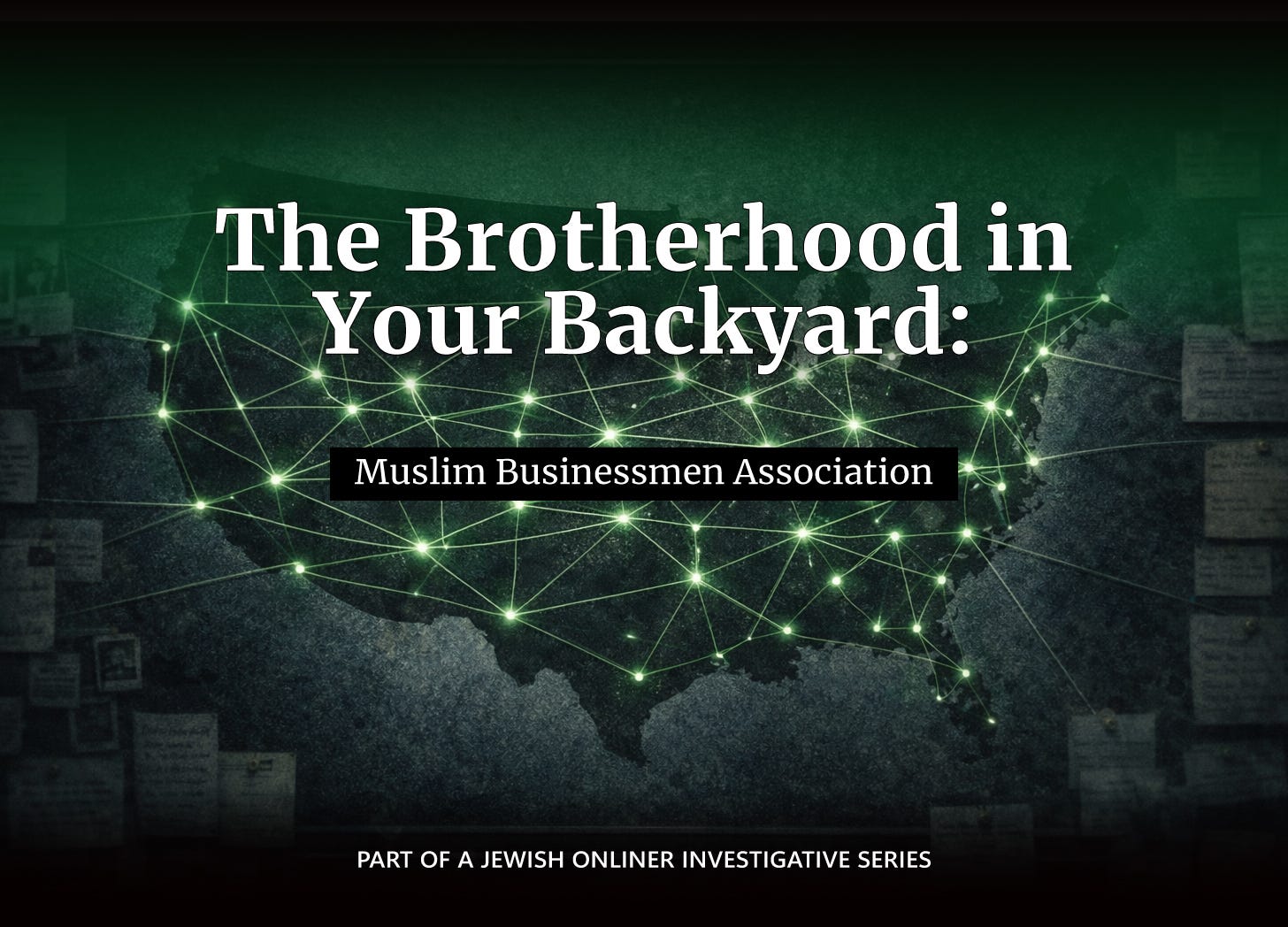
Editor’s note: This is the inaugural article in a series examining alleged Muslim Brotherhood front groups in the United States—the 29 organizations listed in the infamous 1991 Muslim Brotherhood Explanatory Memorandum outlining a “Civilization-Jihadist Process” to destroy Western civilization from within. With renewed U.S. government focus on Brotherhood networks and recent congressional scrutiny, this series investigates the documented connections between these groups and their historical advancement of Brotherhood strategic objectives in America.
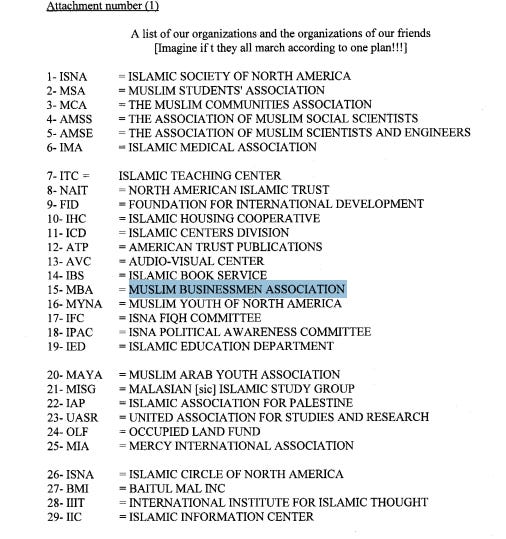
The Muslim Brotherhood’s own internal strategy document, recovered in an FBI search and later listed as a government exhibit in the Holy Land Foundation case, places the “Muslim Businessmen Association” at number 15 on a list of 29 organizations advancing what the memo calls a “Civilization-Jihadist Process” to destroy Western civilization from within.
The 1991 Explanatory Memorandum, authored by Brotherhood operative Mohamed Akram on May 22, 1991, identifies the “MBA” among “organizations of our friends” working toward what the document calls the “settlement” of Islam in America — embedding Islamic organizations into American civic life as part of a long-term Brotherhood strategy.
According to Discover the Networks, the “MBA” referenced in the memorandum corresponds to MÜSİAD (Müstakil Sanayici ve İşadamları Derneği), also known as the Independent Industrialists and Businessmen’s Association, a transnational Turkish business network founded in 1990. One Arabic-language report in TurkPress says rival Turkish business associations referred to MÜSİAD as the ‘Muslim Businessmen Association,’ citing its overtly Islamic orientation and legal restrictions at the time on religious names
Whether or not MÜSİAD is definitively the organization referenced in the 1991 memo, what investigators have documented is that this Turkish Islamist business network maintains an active American chapter that openly participates in events hosted by other organizations that do appear on the 1991 Brotherhood list — including ISNA and ICNA.
Below is what court records, Turkish-language media, and public documentation reveal about MÜSİAD’s founding-era leadership, its ideological roots, and its documented presence in the American Muslim organizational ecosystem today.
Ties to Organizations on the 1991 Brotherhood Memorandum
MÜSİAD USA’s documented organizational relationships are a matter of public record. The organization’s official announcement states it participated in an ISNA (Islamic Society of North America) conference in 2023, where MÜSİAD USA President Yavuz Orta addressed the hall as a speaker and presented MÜSİAD’s projects and organizational structure.
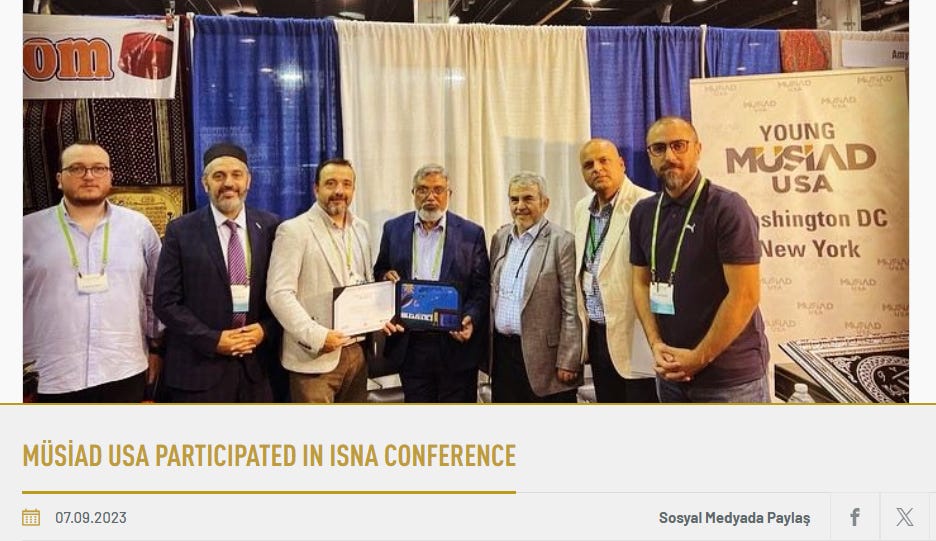
ISNA appears at number 1 on the 1991 Brotherhood memorandum list. Federal prosecutors named ISNA an unindicted co-conspirator in the Holy Land Foundation trial — the largest terrorism-financing prosecution in U.S. history.
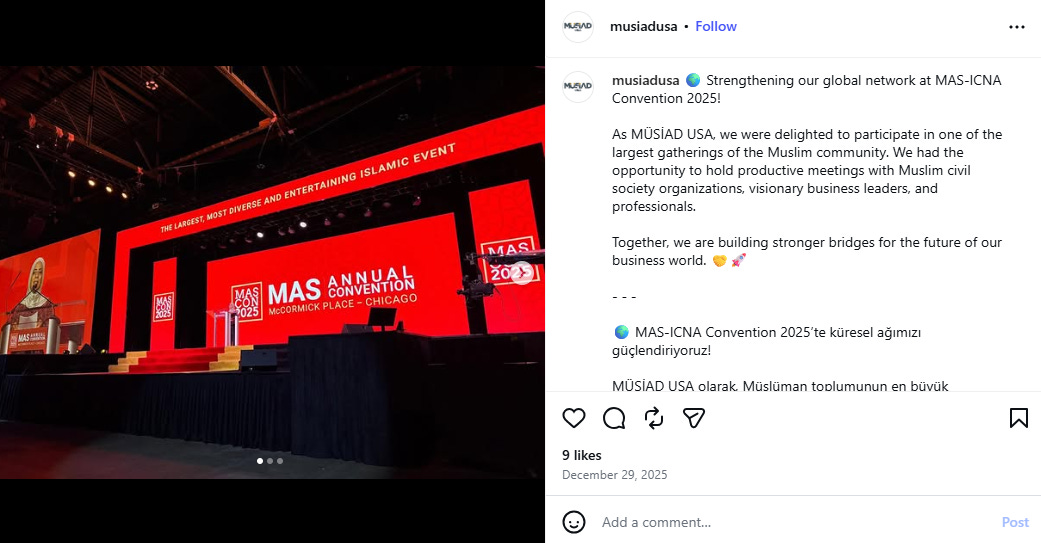
MÜSİAD USA also documented its participation in the MAS-ICNA Convention 2025 in Chicago, describing it as “one of the largest gatherings of the Muslim community.” The organization stated it held “productive meetings with Muslim civil society organizations, visionary business leaders, and professionals.”
ICNA (Islamic Circle of North America) appears at number 26 on the 1991 Brotherhood list. Young MÜSİAD USA separately posted that its delegation was “honored that the US Council of Muslim Organizations (USCMO) received our delegation” at the same convention.
USCMO’s founding members include MAS, ICNA, and CAIR. The convention where MÜSİAD participated featured Siraj Wahhaj — identified by federal prosecutors as an “unindicted co-conspirator” in the 1993 World Trade Center bombing.
Turkish Roots
Arabic-language Turkish coverage explicitly traces MÜSİAD’s origins to the conservative-Islamic business milieu of the Necmettin Erbakan era. The report states that businessman Erol Yarar presented the idea to Erbakan, and that rivals referred to MÜSİAD as the “Muslim Businessmen Association” because of its strict Islamic orientation - noting that Turkish law at the time did not allow overtly religious names.
MÜSİAD’s founding-era prominence also drew state scrutiny. Scholarly and contemporary reporting state that in 1998 a prosecutor sought MÜSİAD’s closure and that chairman Erol Yarar was charged with “inciting hatred.”
Erbakan founded the Milli Görüş (National Vision) movement, widely recognized as the ideological vehicle for Turkish Islamist politics. Scholars have described MÜSİAD as part of Turkey’s Islamically oriented business milieu associated with the Erbakan / Milli Görüş tradition.
Institutional Contact with IHH
MÜSİAD has an official relationship with IHH (İnsani Yardım Vakfı, or Humanitarian Relief Foundation). The IHH website documented that on January 24, 2018, IHH president Bülent Yıldırım and secretary-general Yavuz Dede visited the newly elected MÜSİAD president Abdurrahman Kaan in a congratulatory visit. According to the IHH announcement, "Views were exchanged on current issues and information was shared about the work being done."
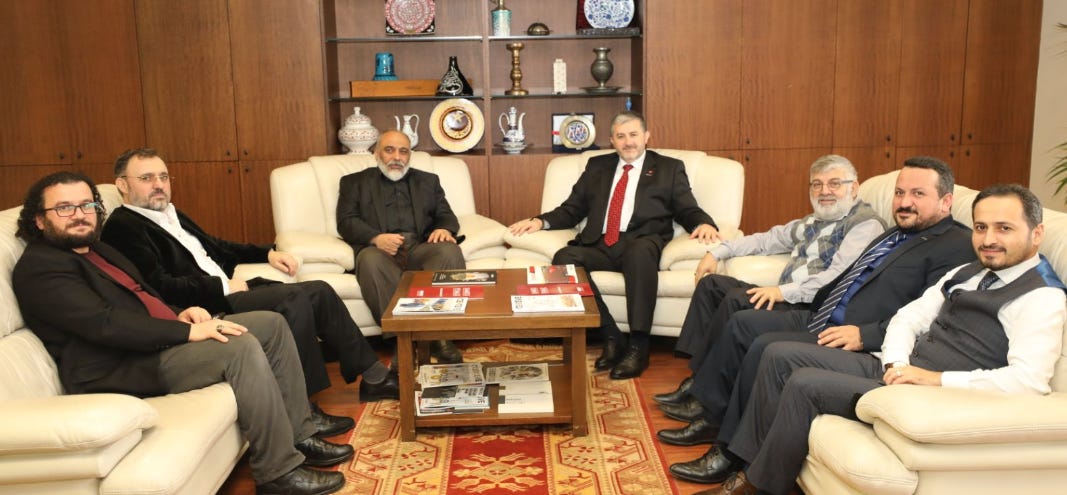
IHH has been accused of alleged ties to terrorism. The Christian Science Monitor reported that Israel accused IHH of funneling support to militant organizations and that analysts had linked it to jihadist fundraising in the 1990s. Reuters reported in 2014 that Turkish anti-terror police raided IHH offices in an operation targeting suspects with alleged links to al Qaeda.
MÜSİAD’s documented contact with IHH does not prove the business association shared those alleged activities, but it places MÜSİAD in a relationship footprint with a Turkish NGO surrounded by terrorism-related scrutiny.
An Islamist Business Network with Alleged Brotherhood Ties
Even if MÜSİAD cannot be definitively identified as the “MBA” in the 1991 memorandum, it remains relevant in the Brotherhood context because it arose from Turkey’s Islamist business milieu, its founding-period chairman was convicted of incitement, it faced closure proceedings in the 1990s, and its U.S. branch today has public ties to ISNA and ICNA—both named in the 1991 Muslim Brotherhood Explanatory Memorandum.