


Jewish Onliner is an independent publication. If you find our work valuable, please consider becoming a paid subscriber.
Editor’s note: This is the latest article in a series examining alleged Muslim Brotherhood front groups in the United States—the 29 organizations listed in the infamous 1991 Muslim Brotherhood Explanatory Memorandum outlining a “Civilization-Jihadist Process” to destroy Western civilization from within. With renewed U.S. government focus on Brotherhood networks and recent congressional scrutiny, this series investigates the documented connections between these groups and their historical advancement of Brotherhood strategic objectives in America.
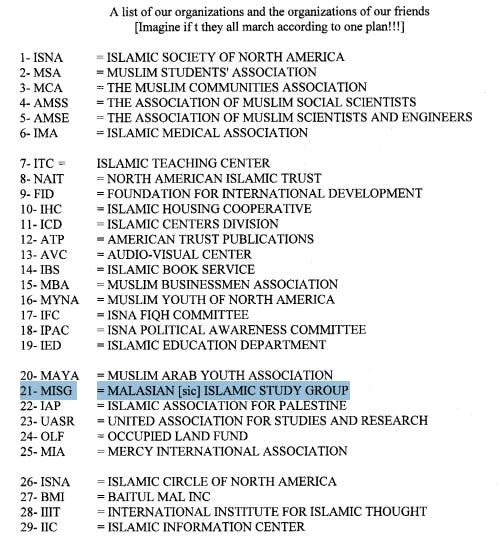
When the Muslim Brotherhood outlined its North American strategy in the 1991 “Explanatory Memorandum,” it included an attachmenet that listed 29 organizations it described as part of the movement’s “comprehensive settlement” infrastructure.
Number 21 on that list appears as “MISC = MALASIAN [sic] ISLAMIC STUDY CROUP,” an apparent misspelling or transcription error referring to the Malaysian Islamic Study Group, commonly known as MISG. The same list includes ISNA, MSA, NAIT, the Muslim Arab Youth Association, the Islamic Association for Palestine, the United Association for Studies and Research, the Occupied Land Fund, ICNA, and IIIT.
MISG is not as publicly familiar as ISNA, MSA, CAIR, or ICNA. But historical records place it inside the same early North American Islamist student ecosystem. A recent George Washington University Program on Extremism report states that MSA developed professional and ethnic-origin subgroups, including the Islamic Medical Association, the Islamic Association of Scientists and Engineers, the Muslim Arab Youth Association, and the Malaysian Islamic Study Group.
MISG Today
MISG Pro’s own website describes it as “a forum for Malaysian Muslim individuals and families in the USA to stay connected,” and says it is registered in Texas as a nonprofit with 501(c)(3) status granted in December 2019.
ProPublica’s Nonprofit Explorer lists MISG Pro Corporation as a Spring, Texas-based 501(c)(3), EIN 84-3529825, tax-exempt since December 2019. Its 2024 filing summary shows $47,522 in revenue, $49,332 in expenses, and $67,409 in net assets. Listed officers include Zabidi Yusof as president, Abdul Saleh as vice president, Usamah Zaki as secretary, and Mohdzamri Amin as treasurer, all with zero reported compensation.
From MSA to MISG
MISG’s own current convention materials trace the group’s founding to Illinois in 1976. The IMSA-MISG Muktamar website says MISG was founded “to unite Malaysian students who were active in campus-based Islamic study,” and that Indonesian Muslim students later became involved in MISG activities beginning in 1990. According to the same page, the Indonesian Muslim Student Association, later the Indonesian Muslim Society in America, was established in 1998 in Missouri at a MISG annual convention.
That history aligns with Islamic Horizons, ISNA’s official magazine, which says MSA helped create both the Muslim Arab Youth Association and MISG in response to the number of Gulf and Malaysian students studying in the United States during the 1970s. The same article says MSA sponsored the first MISG camp in Peoria, Illinois, in 1976.
Islamic Horizons also places Anwar Ibrahim, now Malaysia’s prime minister, at that founding-era MISG camp. According to the article, Anwar was invited to the first MISG camp in Peoria so he could connect with attendees. During the same period, the article says, he was appointed regional representative of the Riyadh-based World Assembly of Muslim Youth, or WAMY.
That detail places MISG’s early history not only inside the MSA orbit, but also near the broader transnational Islamist youth infrastructure of the period. The Washington Institute’s Matthew Levitt later described WAMY as closely linked to the Saudi government and alleged that it had “documented links to international terrorism,” citing concerns involving Hamas leader Khaled Mishal, militant funding allegations from Indian and Philippine officials, and extremist literature allegations.
This does not mean MISG itself is accused of WAMY’s alleged conduct. But it does show that MISG’s founding-era milieu overlapped with the same global Islamic youth networks that later drew terrorism-finance and extremism scrutiny.
An “Ikhwan-Modeled” Malaysian Student Network
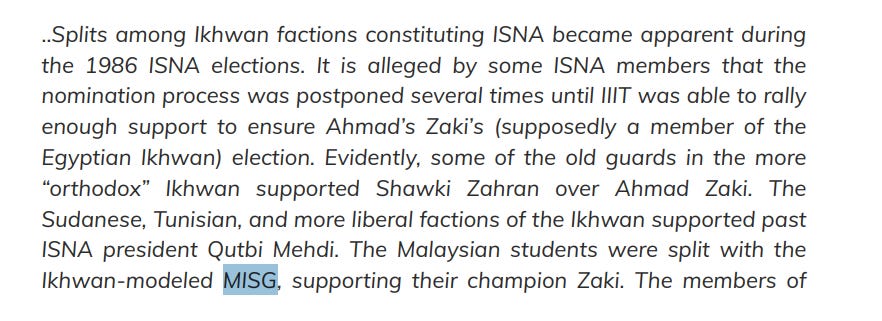
The GW Program on Extremism report adds another important historical detail. In a section discussing the continuity of alleged Brotherhood-linked organizations in the United States, the report cites a former Islamic Horizons editor’s description of internal ISNA factional politics in 1986. That account says Malaysian students were split between members of ABIM, the Muslim Youth Movement of Malaysia, and what it called the “Ikhwan-modeled MISG.”
The report frames MSA, ISNA, ICNA, IIIT, MAS, and related organizations as a cluster of entities whose alleged Brotherhood connections are sometimes contested, but whose founders and early leaders often came from Brotherhood-linked circles. It also notes that, over time, many American organizations tracing their origins to the Brotherhood evolved independently, sharing the movement’s general philosophy while becoming less operationally connected to the Middle East.
That caveat is important. The available evidence does not show that MISG Pro Corporation is sanctioned, charged, or accused by U.S. authorities of illegal activity. The significance of MISG is historical and network-based: it appears in the 1991 Brotherhood memorandum, it emerged from the MSA ecosystem, and it was described in a cited account as “Ikhwan-modeled.”
Current Mission Language
MISG’s present-day public language still emphasizes da’wah, Islamic centers, campus work, and society-building goals. The IMSA-MISG Muktamar website says MISG’s primary goal is to develop individuals who have “Islamic personalities,” integrate “common knowledge with Islamic knowledge,” and possess “a vision of establishing an Islamic society in Malaysia and Indonesia.”
The same page says MISG focuses on “the development of intellectual and Islamic morality through da’wah centered in the Islamic Center and the university campuses,” and says it works to build relationships with “halaqah” organizations throughout North America.
That language is not evidence of illegality or current Brotherhood control. It is relevant, however, because it reflects the same broad categories emphasized in the 1991 memorandum: Islamic centers, campus networks, religious education, and long-term institution building.
Annual Convention Infrastructure
MISG’s most visible current activity appears to be the IMSA-MISG Muktamar, an annual convention organized with the Indonesian Muslim Society in America. The 2025 Muktamar website describes the gathering as a multi-day program for adults, youth, young adults, students, children, and women, with sessions on Islamic identity, family life, da’wah, zakat, suicide awareness, seerah, and community impact.
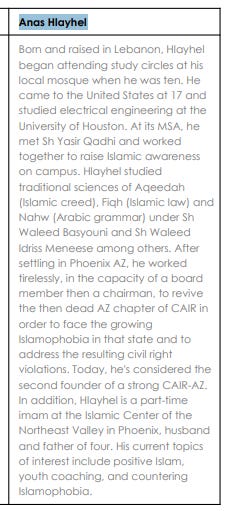
The convention also provides a window into MISG’s contemporary speaker and organizational ecosystem. The 2024 IMSA-MISG Muktamar sponsorship proposal listed Anas Hlayhel as a speaker and described his former CAIR-AZ leadership role.
CAIR is one of the most controversial U.S. Muslim advocacy organizations in the broader Brotherhood-network debate. In the Holy Land Foundation case, federal prosecutors listed CAIR among individuals and entities described as members of the U.S. Muslim Brotherhood’s Palestine Committee and/or its organizations. The list was part of the government’s unindicted co-conspirator and joint venturer filing.
A speaker tie to a former CAIR-AZ chairman does not establish control by CAIR or misconduct by MISG. But it does show that the IMSA-MISG convention platform intersects with other major organizations and personalities in the U.S. Muslim advocacy ecosystem.
A Small Group with a Larger Historical Meaning
MISG is not a household-name organization. Its current financial footprint is modest, and its public programming appears centered on Malaysian Muslim families, students, professionals, religious education, and community events.
But in the context of the 1991 Brotherhood memorandum, MISG’s importance lies in its placement inside a broader infrastructure. It was listed as number 21 among the memorandum’s “comprehensive settlement organizations.” It was born from the MSA ecosystem. It was linked in historical accounts to Anwar Ibrahim, ABIM, WAMY, ISNA, and IIIT. And today, it remains active through MISG Pro and the IMSA-MISG Muktamar convention.