


Jewish Onliner is an independent publication. If you find our work valuable, please consider becoming a paid subscriber.
Editor's note: This is an article in a series examining alleged Muslim Brotherhood front groups in the United States—the 29 organizations listed in the infamous 1991 Muslim Brotherhood Explanatory Memorandum outlining a "Civilization-Jihadist Process" to destroy Western civilization from within. With renewed U.S. government focus on Brotherhood networks and recent congressional scrutiny, this series investigates the documented connections between these groups and their historical advancement of Brotherhood strategic objectives in America.
ICNA Relief USA operates seven humanitarian programs across the United States, from food pantries to refugee services, reporting $60.5 million in total expenses, including $56.8 million in program-service expenses. The organization holds a coveted 4-star Charity Navigator rating and participates in the Combined Federal Campaign—allowing federal employees to designate voluntary payroll-deduction donations to the group. It is a member of the National Voluntary Organizations Active in Disaster (NVOAD), which coordinates with FEMA and other federal agencies during disasters.
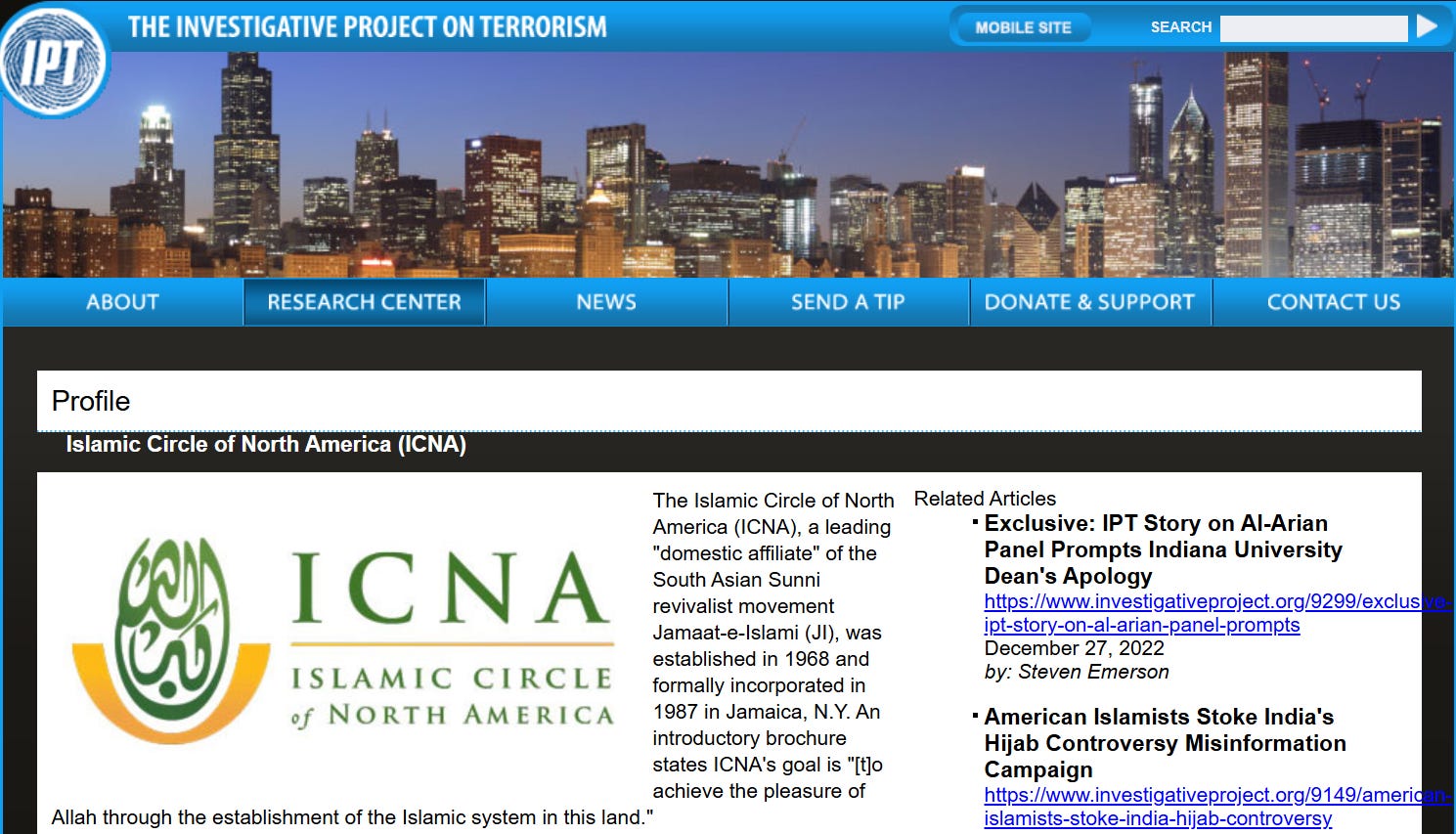
But ICNA Relief is the humanitarian arm of the Islamic Circle of North America (ICNA)—organization number 26 on the Brotherhood’s list—which the Investigative Project on Terrorism describes as “a leading domestic affiliate” of Jamaat-e-Islami (JI), a South Asian Islamist movement. In 2019, Rep. Jim Banks introduced H.Res.160, which was referred to committee but not enacted; it called on USAID, the State Department, the Department of Homeland Security, and other agencies to halt partnerships and funding arrangements with Jamaat-e-Islami-affiliated groups, including ICNA and ICNA Relief.
“A Step in the Right Direction”
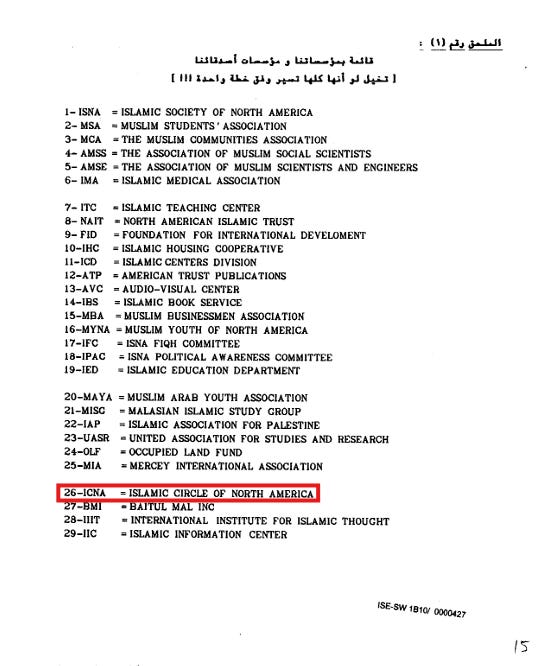
In May 1991, Muslim Brotherhood operative Mohamed Akram wrote an internal memorandum titled “An Explanatory Memorandum On the General Strategic Goal for the Group In North America.” The document, seized by federal investigators and introduced as evidence in the 2008 Holy Land Foundation terrorism financing trial, outlined a “Civilization-Jihadist Process” in which Brotherhood members would work to “eliminate and destroy the Western civilization from within and ‘sabotage’ its miserable house by their hands and the hands of the believers.”
The memorandum listed 29 organizations as part of the Brotherhood’s network in North America. Number 26 on that list: ICNA—the Islamic Circle of North America. But the document went further than simply naming ICNA. In discussing the strategy of “absorbing Muslims and winning them” for the settlement project, Akram wrote: “Here, two points must be noted; the first one: we need to comprehend and understand the balance of the Islamic powers in the U.S. arena. The second point: what we reached with the brothers in ‘ICNA’ is considered a step in the right direction, the beginning of good and the first drop that requires growing and guidance.”
The language is revealing. The memorandum distinguished between “our organizations”—those directly under Muslim Brotherhood control—and “the organizations of our friends”—allied groups with shared ideological goals. ICNA appears in the memo not as a group founded by the Egyptian Muslim Brotherhood, but as an allied organization the memo’s author viewed as useful to the Brotherhood’s broader “settlement” strategy in North America.
The Jamaat-e-Islami Connection
The Islamic Circle of North America was established in 1968 with a stated goal: “to achieve the pleasure of Allah through the establishment of the Islamic system in this land.” The organization’s ideological roots trace directly to Jamaat-e-Islami founder Maulana Syed Abdul A’la Maududi, who preached that Muslims must “strive to change the wrong basis of government, and seize all powers to rule and make laws from those who do not fear God.”
An early ICNA leader, Ashrafuzzaman Khan, served as a commander in a JI militia group during Bangladesh’s 1971 war of independence. In 2013, a Bangladeshi war crimes tribunal found Khan guilty of murdering 18 Bangladeshi intellectuals and sentenced him to death in absentia.
Congressional testimony from 2018 identified ICNA as part of a network of “legacy groups” in America whose agendas are “consistent with this global support and theocratic, theo-political activist process and network of the Muslim Brotherhood.” The testimony noted that “While the MB hatched groups like ISNA and NAIT, Mawdudi’s Jamaat-e-Islami hatched similar groups like the Islamic Circle of North America (ICNA). There has always been major overlap between leadership and organizational ideologies.”
The Humanitarian Arm
ICNA Relief USA operates as a legally separate 501(c)(3) organization from its parent ICNA, but the connection is explicit. The organization’s own website describes it as operating “under the Islamic Circle of North America” and working to “assist and empower underprivileged Americans through sustainable social services.” According to the organization’s 2024 Form 990 tax filing, ICNA Relief USA reported total revenue of $58 million, with $57.9 million coming from contributions and grants. The organization reported $60.5 million in total expenses—including $56.8 million in program-service expenses—resulting in a deficit of $2.5 million for the year.
The organization’s largest program expense is hunger prevention, which consumed $28.2 million in 2024. Refugee services accounted for $11.2 million, while health services cost $5.7 million. The filing shows ICNA Relief reported 404 employees and approximately 1,941 volunteers nationwide. CEO Abdul Rauf Khan received $110,264 in compensation, while a second officer, Maqsood Ahmad, received $129,641.
Notably, the 2024 Form 990 indicates that ICNA Relief received $28 million in non-cash contributions—likely food and supplies distributed through its hunger prevention programs. ICNA Relief states that it operates only within the United States, and its public Form 990 reports no foreign grants, no international operations, and no payments to foreign individuals or organizations. The organization states explicitly on its website: “ICNA Relief, is a nonprofit 501(c)(3) organization that only operates and provides services within the United States of America and its territories.”
Government Access and Mainstream Legitimacy
ICNA Relief’s integration into mainstream disaster response and federal charitable giving systems raises questions about due diligence in vetting charitable partners. The organization is a member of NVOAD, which coordinates with FEMA and other government agencies during disasters. ICNA Relief’s disaster relief team has participated in FEMA’s Voluntary Organization Partnership meetings. The organization is also approved for the Combined Federal Campaign, meaning federal employees can designate ICNA Relief to receive portions of their charitable contributions through payroll deduction.
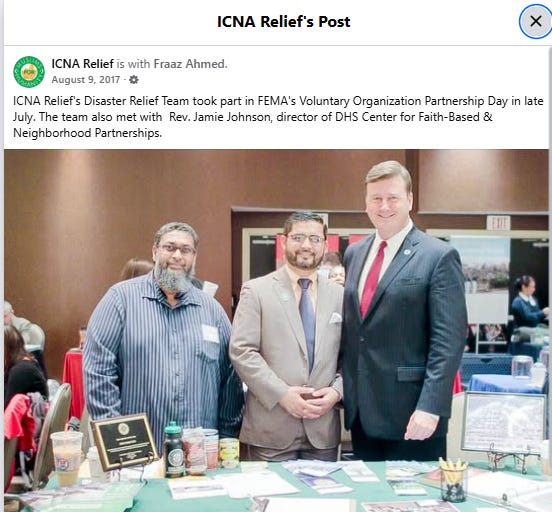
CEO Abdul Rauf Khan’s biography notes that his efforts “helped ICNA Relief gain the status of the largest Muslim-run non-profit, working exclusively within the USA” and that his “contributions have earned personal recognition and prestigious awards for ICNA Relief, including the White House Community Service Award during the Obama Presidency.” Khan holds a Master’s degree in Business Management and previously earned a Bachelor’s degree from the University of Karachi in Pakistan.
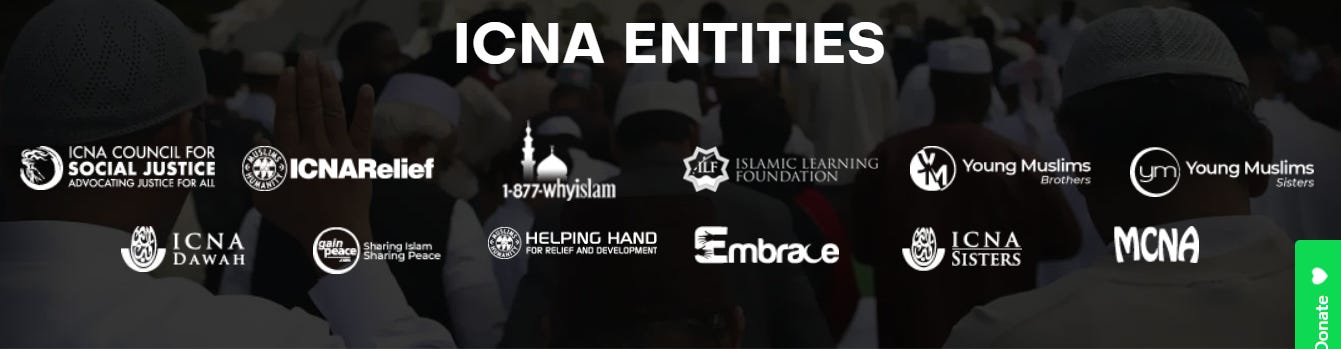
The organization’s leadership structure reveals deep ties to the broader ICNA network. Khan serves on boards for “various national and local Islamic organizations” and holds “leadership positions in the Islamic Center of Boca Raton, Young Muslims, Garden of Sahaba Academy, Youth Coalition of South Florida, ICNA South East Region, and is a National Shura member of ICNA.” Young Muslims is ICNA’s youth division, established to cultivate the next generation of Islamic activists.
The Ideological Ecosystem
The parent organization, ICNA, has repeatedly drawn criticism from researchers and watchdog groups over extremist content at its conferences and its affiliations with radical figures. In 2010, the Anti-Defamation League released a statement denouncing ICNA for hosting speakers who attacked Jews from the stage at its 2009 conference. At ICNA’s 2019 conference, the organization featured a representative of Turkey’s Islamist authoritarian government. In September 2021, ICNA joined other American Islamist organizations in hosting a memorial ceremony for Pakistani Islamist Syed Ali Shah Geelani, a sympathizer of Osama bin Laden.
In 2000, ICNA leader Mohammad Yunus wrote that one of ICNA’s goals was to establish an Islamic state in the U.S., which would “pave the way for the reestablishment of the Caliphate.” As recently as 2019, then-ICNA president Zahid Bukhari called on Muslims to establish Islam as a way of life in the United States.
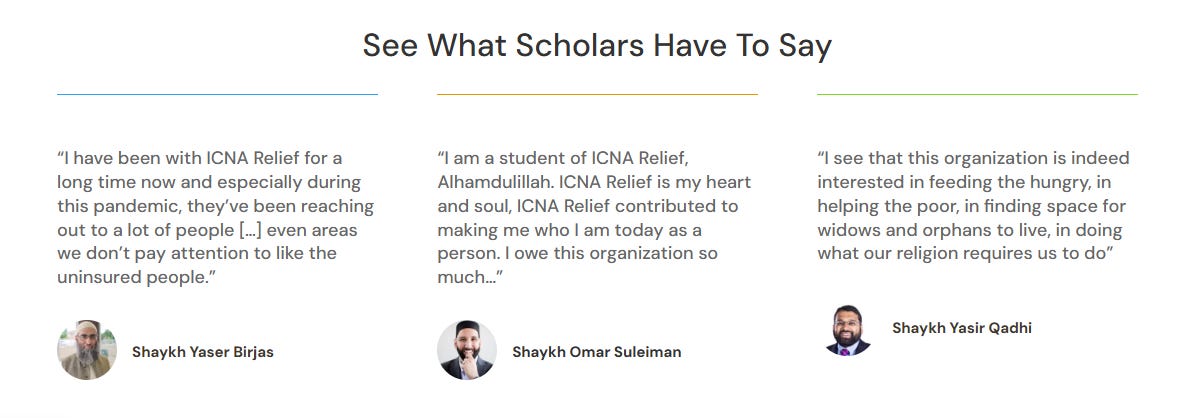
The interconnected nature of the Brotherhood network becomes apparent in ICNA Relief’s choice of public endorsers. The organization prominently features Dr. Yasir Qadhi on its website under “See What Scholars Have To Say,” where he states: “I see that this organization is indeed interested in feeding the hungry, in helping the poor, in finding space for widows and orphans to live, in doing what our religion requires us to do.” What ICNA Relief doesn’t mention is that Qadhi serves as chairman of the Fiqh Council of North America—another organization listed in the 1991 Muslim Brotherhood Explanatory Memorandum as number 17 under its previous name, “ISNA Fiqh Committee.” The Fiqh Council describes itself as a body of Islamic scholars. Its predecessor name, “ISNA Fiqh Committee,” appears as number 17 in the same 1991 memorandum, making Qadhi’s endorsement another point of overlap with entities named in the document.
ICNA is a founding member of the U.S. Council of Muslim Organizations (USCMO), which also includes the Muslim Ummah of North America. The USCMO brings together a range of American Muslim organizations under a coordinating umbrella to amplify their political influence.
The Pattern Continues
ICNA Relief’s model mirrors that of other Islamist-linked charitable organizations: provide genuine humanitarian services to vulnerable populations while operating under the ideological umbrella of organizations that have historically advocated the establishment of an Islamic system of governance. This dual-track approach—legitimate social services combined with a contested ideological history—creates a challenging dynamic for policymakers and the public.
ICNA Relief’s public Form 990 reports no foreign grants or international operations, and the organization states that it works only inside the United States. Yet its structural and ideological ties to ICNA, and through ICNA to both Jamaat-e-Islami and the broader Muslim Brotherhood network, raise fundamental questions about whether U.S. government agencies and federal employees should be directing resources—and legitimacy—to organizations linked to Islamist networks that the Brotherhood itself identified as allies in the project to “eliminate and destroy Western civilization from within.”
https://here4good.short.gy/CWdng1