


Jewish Onliner is an independent publication. If you find our work valuable, please consider becoming a paid subscriber.
Editor’s note: This article is part of an ongoing series examining the 29 organizations listed in the infamous 1991 Muslim Brotherhood “Explanatory Memorandum” outlining a “Civilization-Jihadist Process” to destroy Western civilization from within. With renewed scrutiny of Brotherhood networks in America, this investigation traces the documented connections between these groups and their role in advancing Brotherhood strategic objectives on U.S. soil.
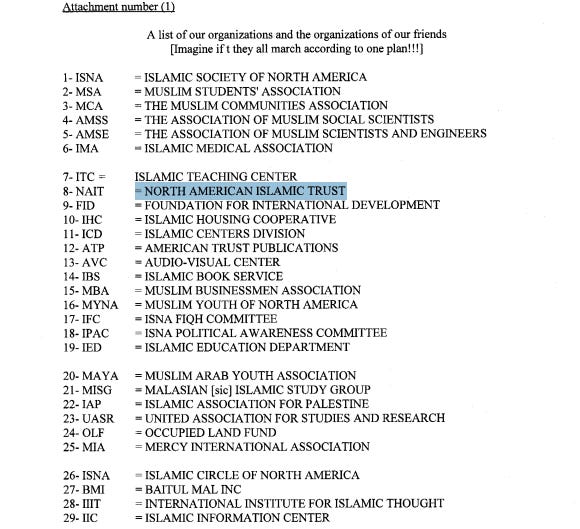
In 1979, the North American Islamic Trust (NAIT), later listed as entity eight in the Muslim Brotherhood’s 1991 Explanatory Memorandum, established the Islamic Centers Cooperative Fund (ICCF).
NAIT says ICCF pools the reserve funds of more than 400 Islamic centers, invests them through NAIT, and extends limited interest-free loans to Islamic centers, mosques, and schools. NAIT-linked materials reported that ICCF held close to $50 million in net assets as of year-end 2021.
NAIT receives funding from donations and grants and, according to InfluenceWatch, does not file IRS tax returns as a religious organization. ICCF is presented as a NAIT program overseen by NAIT’s board, including chairman Dr. Gaddoor Saidi. He appears to correspond to “Gaddor Ibrahim Saidi,” listed as an unindicted co-conspirator in the government’s Holy Land Foundation filing.
The Brotherhood’s 1991 strategic memo called for a “civilization-jihadist process” of “settling” Islam in North America. ICCF appears to function as a financial mechanism within that institutional strategy. NAIT says the fund pools mosque reserves, invests them through NAIT, and extends interest-free loans to Islamic centers, mosques, and schools. That model closely resembles the durable institutional infrastructure Hudson Institute analysts traced to the Brotherhood’s 1991 “Settlement” strategy.
The Fund and Its Origins
ICCF describes itself as a cooperative pool that lets mosques avoid “Riba-laden banks,” grow their reserves through sharia-compliant investments, and access interest-free loans for new construction. Mosques deposit excess funds either as “Qard al-Hasan” (trust) or for halal investments, which NAIT then invests in “halal stocks, real estate, properties, leases and other opportunities.”
NAIT board member Muzammil Siddiqi stated that 12–15% of ICCF’s holdings circulate as short-term interest-free loans to entrusted institutions. A “Yield Equalization Reserve” absorbs market losses so that participating mosques never lose principal.
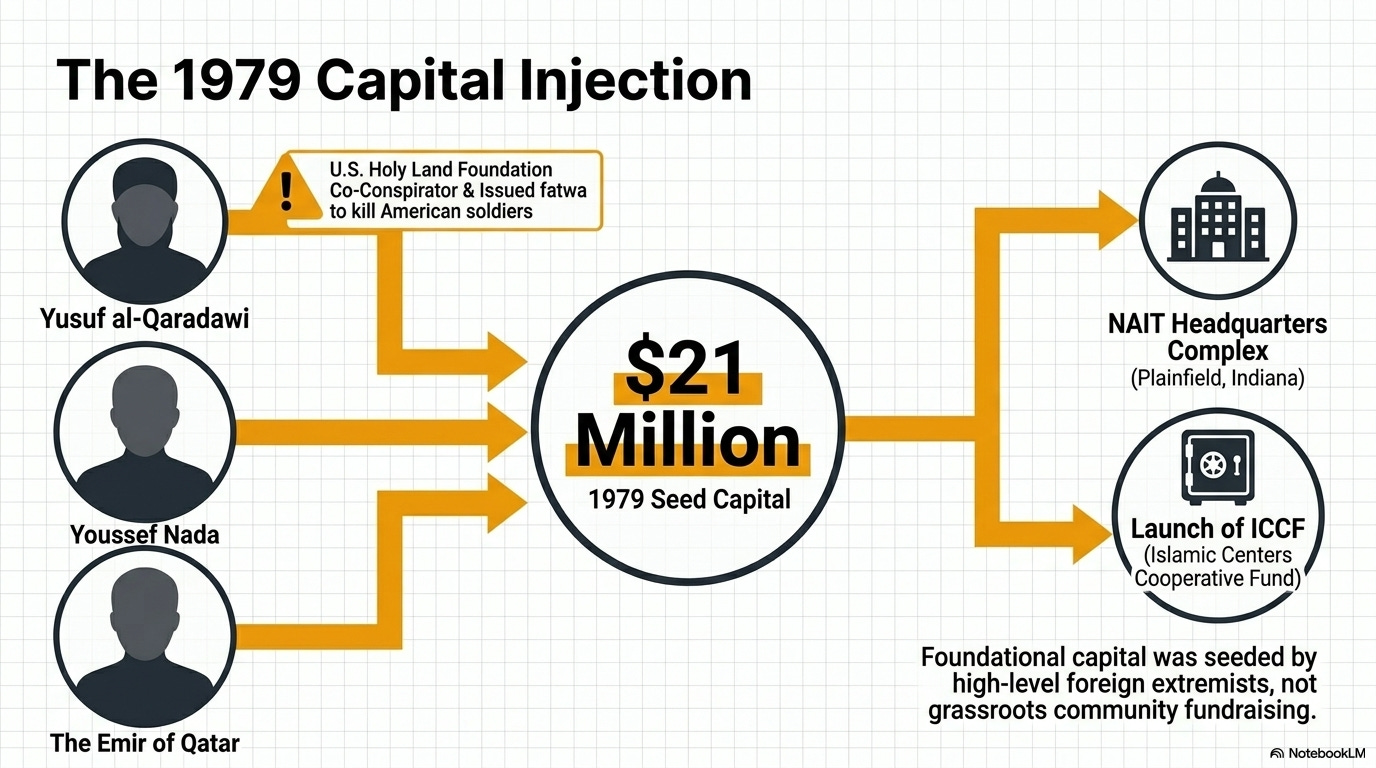
That financial model sits inside a broader institutional history. The Plainfield, Indiana complex associated with MSA, ISNA, NAIT, and related institutions was built with foreign support, including from Yusuf al-Qaradawi, a spiritual leader for the Muslim Brotherhood and one of the Arab world’s most influential Sunni clerics before his death in 2022. The Washington Post reported in 2004 that MSA opened the suburban Indianapolis headquarters complex with $21 million raised in part from Qaradawi, banker Youssef Nada, and the emir of Qatar.
Qaradawi was later listed in the government’s Holy Land Foundation filing under individuals who participated in fundraising activities on behalf of HLF. He was also barred from entering several Western countries after years of controversy over his rulings and statements, including support for attacks on U.S.-led coalition forces in Iraq.
Who Runs It
ICCF is presented by NAIT as one of its own programs, not as an independently governed fund. Its oversight therefore runs through NAIT’s board, chaired by Dr. Gaddoor Saidi. The government’s Holy Land Foundation filing lists a similarly named “Gaddor Ibrahim Saidi” under “individuals/entities who are and/or were members of the US Muslim Brotherhood.”
Dr. Bassam Osman has served on NAIT’s board since 1980. He also previously served as director of the Quranic Literacy Institute, which was later held liable in civil litigation under the Anti-Terrorism Act over support linked to Hamas’s murder of American teenager David Boim. The institute also employed Mohammed Salah, a convicted Hamas operative, as a computer analyst.
Dr. Muzammil Siddiqi, who has publicly described ICCF, translated a 1992 lecture by Sheikh Omar Abdel Rahman. Abdel Rahman was later convicted of seditious conspiracy in a plot to bomb New York City landmarks. In the lecture, he rejected nonviolent jihad as “weak” and described fighting Muslims’ enemies as obligatory.
How the Money Flows
Former FBI agent Robert Stauffer, who led a 1980s investigation into Muslim Brotherhood finances, later alleged that NAIT served as a financial holding company for Muslim Brotherhood-linked groups and that millions of dollars were wired through it from countries including Saudi Arabia, Kuwait, Afghanistan, Egypt, Malaysia, Libya, and reportedly Iran.
Federal prosecutors in the Holy Land Foundation case introduced evidence involving ISNA/NAIT accounts and checks made payable to “the Palestinian Mujahideen,” as part of a prosecution that resulted in HLF and five leaders being convicted of providing material support to Hamas.
Unlike a separately filing nonprofit, ICCF’s reported asset pool is disclosed through NAIT and AHI materials rather than annual public Form 990 filings.
The Mosque Network It Sustains
ICCF supports mosques and Islamic institutions within NAIT’s broader waqf ecosystem. That property network has included mosques later connected in public records or reporting to several high-profile terror cases.
The Bridgeview Mosque Foundation in Illinois transferred its deed to NAIT in 1981; its imam Jamal Said was later named an unindicted co-conspirator in the Holy Land Foundation case, and Hamas financier Mohammed Salah sat on the mosque’s eight-member executive committee.
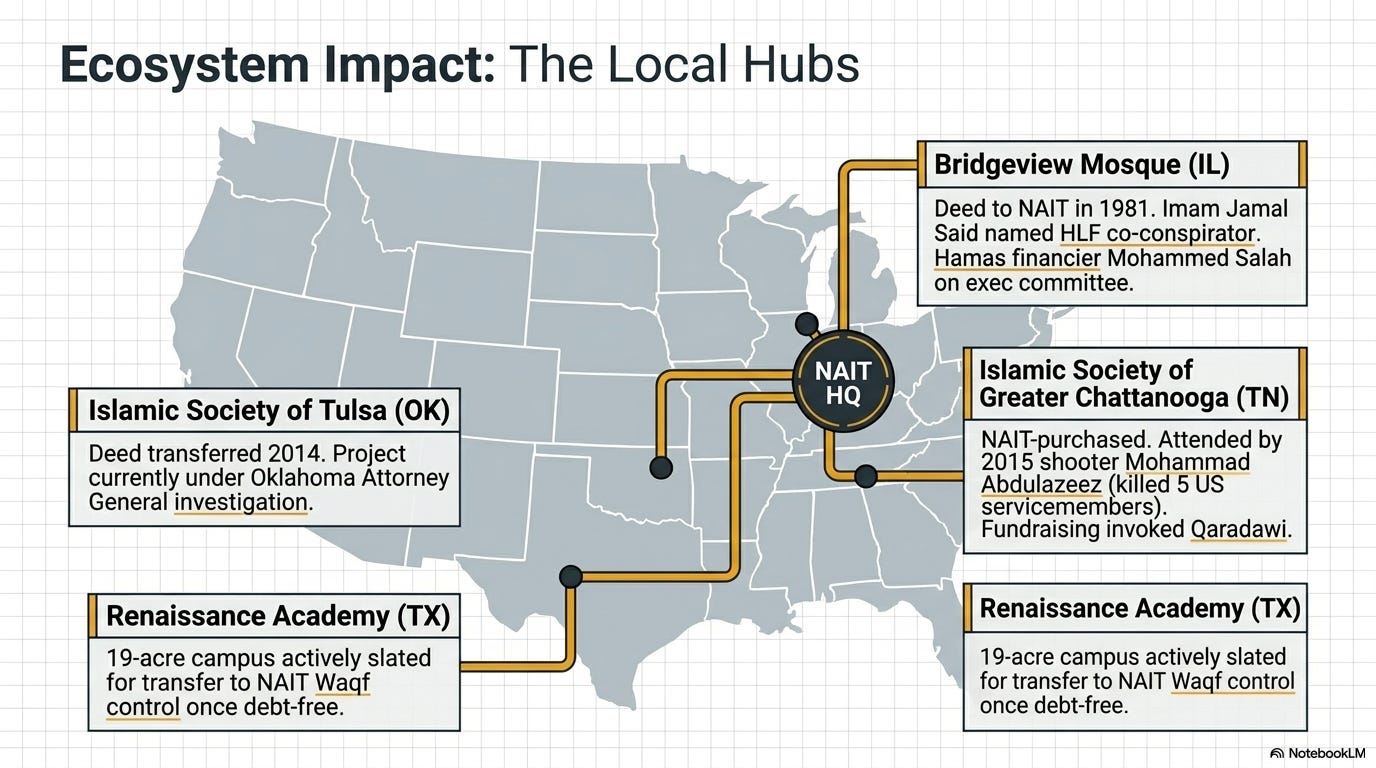
The Islamic Society of Greater Chattanooga grew out of a mosque whose property was reportedly purchased by NAIT in 1997. Mohammad Youssef Abdulazeez, who killed five people at two Chattanooga military sites in 2015, was later reported to have attended Friday prayers there. Fundraising materials associated with the mosque also invoked Yusuf al-Qaradawi by name.
In Oklahoma, reporting on the proposed Broken Arrow mosque says the land was purchased in 2014 by NAIT for the Islamic Society of Tulsa. Oklahoma Attorney General Gentner Drummond later opened an investigation into the project’s ownership, governance, and financing. Near Austin, Renaissance Academy says its new 19-acre campus will be placed into waqf once the real estate assets are free of loans, either under NAIT or a similar organization.
How ICCF Fits Inside the NAIT Machine
ICCF appears to fit into NAIT’s broader institutional structure. The waqf program holds property titles in trust, while ICCF pools mosque reserves and channels them into investments and interest-free loans.
The Iman Fund, managed by NAIT’s for-profit subsidiary Allied Asset Advisors and chaired by Bassam Osman, reported $120 million in net assets by September 2022. A 2004 SEC filing for the Dow Jones Islamic Fund listed NAIT as the record owner of 76.83% of the fund’s outstanding Class K shares. The same filing identified Allied Asset Advisors, the fund’s investment adviser, as a wholly owned subsidiary of NAIT, showing NAIT’s controlling role in the fund structure at the time.
NAIT’s ecosystem also extends into publishing. American Trust Publications appears to function as its publishing arm and is listed as entity number twelve in the 1991 Brotherhood memo. Its catalog includes works by Muslim Brotherhood figures and other major Islamist thinkers, including Hassan al-Banna, Sayyid Qutb, Yusuf al-Qaradawi, and Maududi.
The American Halal Institute, established by NAIT in 2020, places halal certification inside the same NAIT-linked institutional ecosystem. NAIT and related materials show overlapping leadership across multiple divisions, including Saidi, Siddiqi, Osman, Cheema, and Malik.

The Big Picture
ICCF appears to be one mechanism that helped make the 1991 memo’s institutional vision durable. It pools mosque capital, invests it through NAIT, and lends it back into Islamic centers, mosques, and schools. The result is a closed-loop financial structure inside a trust network built in part with foreign support from figures including Qaradawi, and overseen by leaders whose names or affiliated institutions have surfaced in federal terror-financing records and litigation.