


The Council of Islamic Schools in North America (CISNA) is a centralized accreditation body positioning itself to "serve as a unifying organization for all Islamic schools" across the United States and Canada.
CISNA describes its accreditation program, launched in 2012, as providing "a means to review and evaluate all aspects of a school's program with an Islamic lens." The organization states that its process is based on what it characterizes as "rigorous standards" designed to measure schools' progress toward continuous improvement.
CISNA’s documented connections to the Islamic Society of North America (ISNA)—which was listed as organization #1 in the 1991 memorandum—have raised concerns about what appears to be the institutional evolution of alleged Brotherhood-aligned educational infrastructure. These connections are particularly significant given ISNA’s designation as an unindicted co-conspirator in the Holy Land Foundation terrorism financing trial.
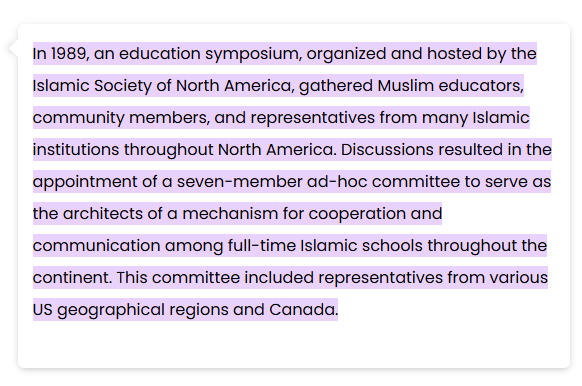
CISNA Members Promoting Alleged Brotherhood Symbol
CISNA's Advisory Council includes members with ties to alleged U.S. Brotherhood-linked organizations who have publicly promoted apparent Brotherhood symbols.
According to Zarzour's biography on the CISNA website, in addition to serving on the organization's advisory council, he currently serves as President of ISNA and Superintendent of Universal Schools in Illinois and Indiana. Documentation cited by the Global Influence Operations Report indicates that Zarzour has also served as Secretary General of ISNA, General Counsel and Chief Operations Officer of the Zakat Foundation, and Chief Executive Officer of the IQRA International Foundation. Additio
This leadership trajectory across multiple entities identified as part of the alleged U.S. Muslim Brotherhood-linked organizational structure appears to exemplify what can be characterized as coordinated network governance through interlocking directorates.
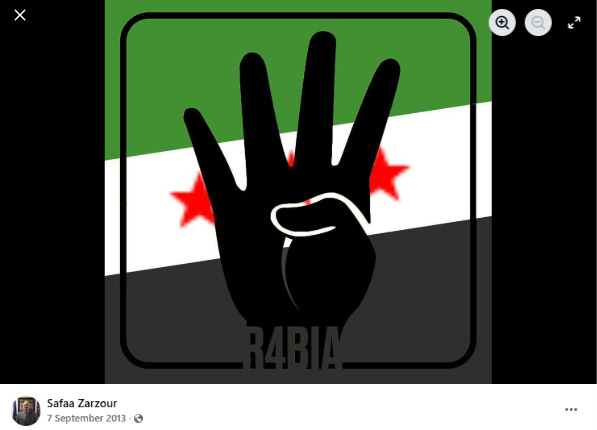
Zarzour has also publicly displayed the four-fingered “Rabia” symbol on social media, which researchers at George Washington University’s Program on Extremism identify as “a gesture of support for the Muslim Brotherhood.”
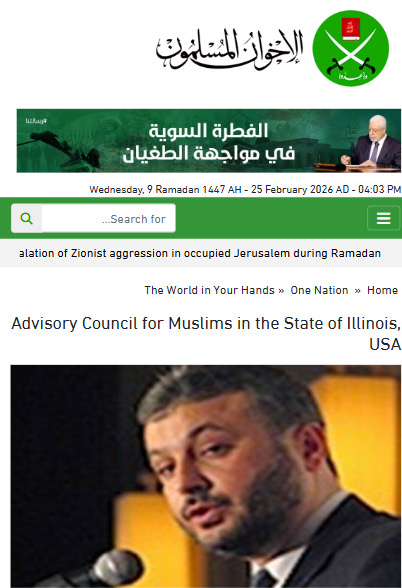
In 2011, the Muslim Brotherhood's official website reported that the state of Illinois had created a State Advisory Council for American Muslims and had appointed Safaa Zarzour—then Secretary General of ISNA and head of CAIR's Chicago chapter—as one of its members. This announcement on the Brotherhood's own platform demonstrates what appears to be the Brotherhood’s direct tracking and promotion of Zarzour's institutional advancement.
In August 2014, Zarzour posted on Facebook: "O God, take revenge on all those who conspired against the people of Gaza...Especially the Bedouins, who are the most hardened in disbelief and hypocrisy."

The 1991 Strategic Framework and Alleged Educational Control
The Muslim Brotherhood’s 1991 strategic memorandum outlined what it termed a “Civilization-Jihadist Process” for transforming American society through institutional influence, explicitly identifying education as a central pillar. The document, Government Exhibit 3-85 in the Holy Land Foundation case, stated the Brotherhood’s goal was to establish “a kind of grand Jihad in eliminating and destroying the Western civilization from within.”
While CISNA was not among the organizations listed in the 1991 memorandum, critics who study Brotherhood influence operations argue that its role in Islamic-school accreditation resembles the kind of educational institution-building described in that broader strategic framework.
Analysis by the Center for Security Policy asserts that CISNA was established directly by the Islamic Society of North America, which the Center characterizes as a Muslim Brotherhood front organization.
Of particular concern to researchers studying these networks is the documented overlap between both CISNA and Islamic Schools League of America (ISLA) with AdvancED (now Cognia), a mainstream secular accreditation body.
The Center raises concerns about what it describes as “interlinked and mutually legitimizing relationships” between these educational accreditation organizations, suggesting that this structure allows entities they characterize as ideologically aligned to gain institutional credibility through partnerships with established educational bodies.
CISNA's organizational bylaws reveal formal structural ties to Brotherhood-linked entities that extend beyond individual personnel connections. According to reporting by the Clarion Project, the council's bylaws explicitly state it is affiliated with the Islamic Society of North America (ISNA) and specify that the North American Islamic Trust (NAIT) will hold its assets in the event of dissolution.
Institutional Ties and Public Scrutiny
The findings point to what appears to be the systematic integration of individuals with alleged links to Brotherhood-associated organizations into CISNA's advisory structure, combined with the organization's centralized control over accreditation, suggesting what may be deep ideological alignment with the alleged U.S. Muslim Brotherhood network.