


Jewish Onliner is an independent publication. If you find our work valuable, please consider becoming a paid subscriber.

When federal prosecutors tried the Holy Land Foundation case, one of the documents that entered the public record was a 1991 Muslim Brotherhood memorandum titled “An Explanatory Memorandum on the General Strategic Goal for the Group in North America.” The document described the Brotherhood’s work in North America as a “Civilization-Jihadist Process” and referred to “a kind of grand Jihad” aimed at “eliminating and destroying the Western civilization from within.” The Investigative Project on Terrorism identifies the memo as written by Mohamed Akram for the Shura Council of the Muslim Brotherhood.
Attached to the memorandum was a list of “our organizations and the organizations of our friends.” Listed at No. 27 was “BMI = BAITUL MAL INC.” The same list also named organizations including the Islamic Society of North America, the Muslim Students Association, the North American Islamic Trust, the Islamic Association for Palestine, the Occupied Land Fund, the Islamic Circle of North America, and the International Institute of Islamic Thought.
The Federal Court Record on BMI
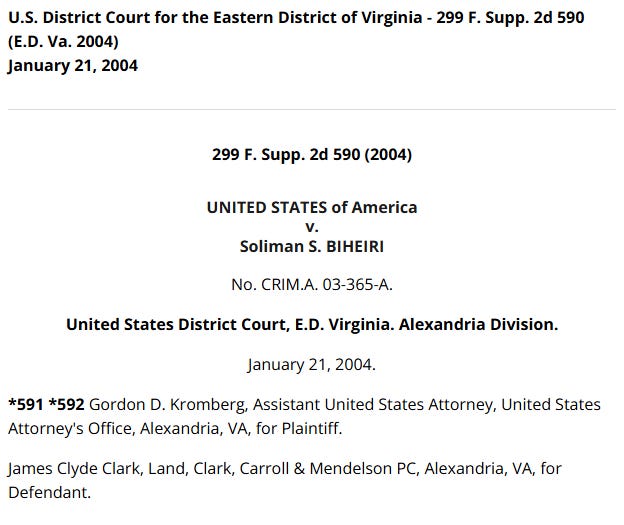
A 2004 federal court opinion in United States v. Biheiri described BMI, Inc. as an Islamic investment firm incorporated in New Jersey in 1986 by Soliman Biheiri, who operated the company and served as its president until BMI went bankrupt in the late 1990s. The court said Biheiri used BMI as a holding company for several related entities, including BMI Leasing, BMI Real Estate Development, and BMI Trade and Investment, and that BMI-related entities invested in housing-development projects in Maryland.
More than a decade later, H.R. 3892, a 2015 bill titled the “Muslim Brotherhood Terrorist Designation Act,” cited Baitul Mal, Incorporated as an example of alleged Muslim Brotherhood-linked financial infrastructure in the United States. The bill stated that federal prosecutors had described Biheiri as “the United States banker for the Muslim Brotherhood,” but that characterization should be understood as a congressional citation to prosecutorial allegations, not as a judicial finding.
The Marzook Connection
The Biheiri record tied BMI’s investment network to Mousa Abu Marzook, a senior Hamas political figure. Hamas was listed as a terrorist organization under Executive Order 12947 in 1995, and the court record states that persons and organizations designated under the executive order were treated as Specially Designated Terrorists.
According to the Biheiri sentencing opinion, Marzook invested money with BMI before his designation. The court also found that Biheiri incorporated Mostan International Corporation in 1988, that Marzook was listed as Mostan’s president on bank documents, and that Mostan shared an address with BMI-related entities. Bank records reviewed by the court showed transactions in a Mostan account managed by BMI after Hamas and Marzook had been designated.
The court concluded that the evidence showed Biheiri had dealt in property in which a Specially Designated Terrorist had an interest, and had provided services to a Specially Designated Terrorist, in violation of the International Emergency Economic Powers Act.

BMI’s Place in the Broader Record
Within that broader record, BMI’s appearance in the Brotherhood memorandum places it among the organizations that the memo’s author identified as part of, or adjacent to, the Brotherhood’s alleged North American network. The Biheiri record separately establishes that BMI-linked entities handled transactions involving property connected to Marzook after his designation. Taken together, those records justify scrutiny of BMI’s role in Islamist-linked financial networks in the United States.
Shamim Siddiqi and the Ideological Context
The ideological context surrounding BMI has also drawn attention because of Shamim Siddiqi, whom secondary sources have identified as a former BMI chairman. Siddiqi was also an ICNA figure whose writings have been cited by the Investigative Project on Terrorism. IPT described Siddiqi as having served as director of ICNA’s Da’wah and Publications Department and quoted his writings as calling on Muslims to reject man-made law in favor of Sharia and to work toward the “total establishment of Islam” in America.
The Holy Land Foundation Context
The Holy Land Foundation case provides the broader context for why the Brotherhood memorandum became significant. In 2008, a federal jury convicted the Holy Land Foundation and five of its leaders on charges including providing material support to Hamas, a designated terrorist organization. The Justice Department said HLF had used the guise of charity to raise and funnel money to Hamas-linked committees and organizations.
According to the Justice Department, the government’s case included evidence that in the early 1990s, Hamas’s parent organization, the Muslim Brotherhood, planned to establish a network of organizations in the United States to spread a militant Islamist message and raise money for Hamas. DOJ also said HLF became the chief fundraising arm for the Palestine Committee in the U.S., which it described as having been created by the Muslim Brotherhood to support Hamas.
Together, the HLF prosecution, the Brotherhood memorandum, and later federal records on BMI show why Baitul Mal’s appearance on the list of “our organizations and the organizations of our friends” has drawn continued scrutiny in discussions of Muslim Brotherhood-linked infrastructure in the United States.
Editor's Note: This article has been edited to more correctly reflect findings on Baitul Mal, Inc. (BMI), based on research from watchdog organizations and publicly available federal court documents entered as evidence during the Holy Land Foundation trial.