


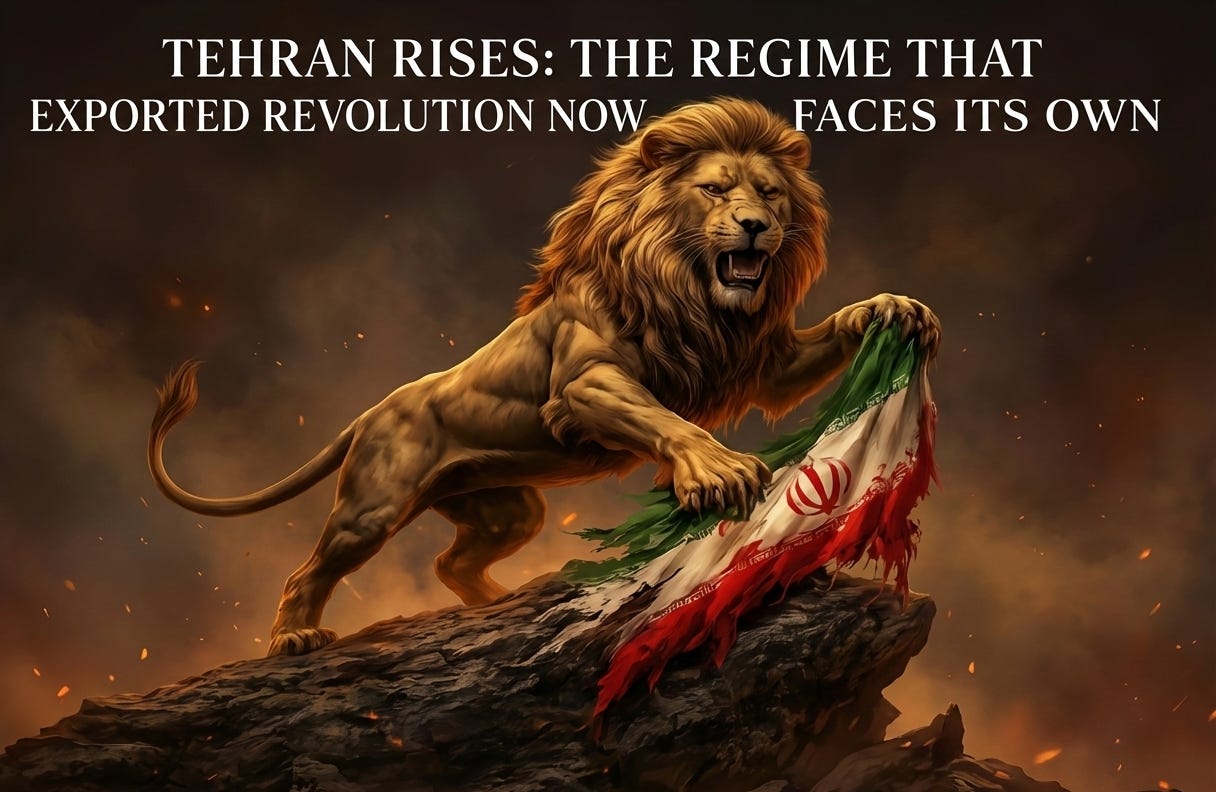
Iran’s nationwide uprising entered its ninth day Monday with at least 35 people dead—including four children—as protesters in more than 250 locations across 27 provinces chant “Neither Gaza, nor Lebanon, my life for Iran!” The demonstrations, sparked by Iran’s currency collapsing to 1.4 million rials per dollar and inflation reaching 42-52%, have evolved from economic grievances into explicit demands for regime change.
What began in Tehran’s Grand Bazaar has become the Islamic Republic’s most serious domestic threat since the 2022 Mahsa Amini protests, compounded by an unprecedented U.S.-Israeli coordination strategy that captured Venezuela’s Nicolás Maduro days before President Trump posted in Farsi: “Don’t play games with President Trump.”
Trump’s Warning and the Maduro Precedent
Days after U.S. special forces seized Venezuela’s president on January 3, Secretary of State Marco Rubio explicitly linked the operation to Iran, stating the mission aimed to end “Iran Hezbollah presence” in Venezuela. Trump warned aboard Air Force One that if Tehran “starts killing people like they did in the past,” Iran will be “hit very hard by the United States.”
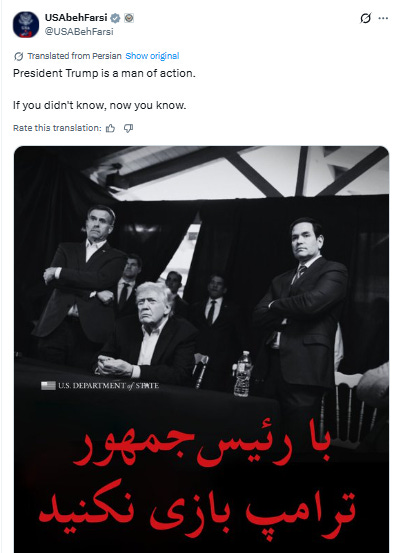
The U.S. State Department’s Farsi account amplified the message Sunday with Trump’s image captioned: “President Trump is a man of action. If you didn’t know, now you know.”
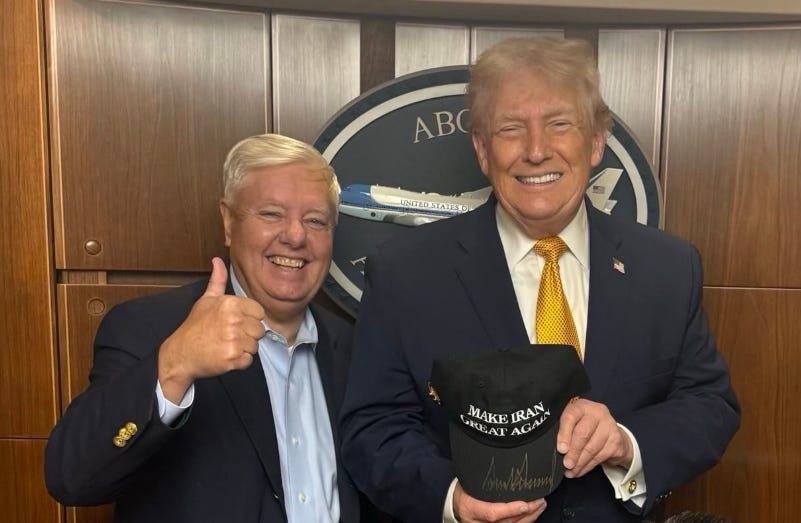
On Monday, Trump signed a “Make Iran Great Again” hat alongside Senator Lindsey Graham, who wrote: “God bless and protect the brave people of Iran who are standing up to tyranny.”
The Economic Collapse that Sparked the Rage
Iran possesses 10% of world’s oil reserves and projects $114 billion in 2025 exports, yet average Iranian salaries stand at $200-254 monthly while minimum wage collapsed to $73-100. The government’s response: a monthly payment of $7—approximately 3% of average salary.
Meanwhile, Iran spends $16 billion annually on proxy groups, with Hezbollah alone receiving $1 billion this year and Syria consuming $50 billion total. Carnegie Endowment documented Iran’s “severe energy crisis due to decades of mismanagement, excessive subsidies, corruption.”
Ayatollah Khomeini’s founding vision mandates “export of revolution” until “the cry ‘There is no god but Allah’ resounds over the whole world.” This constitutional mandate to fund global jihad while domestic wages sit at $200 monthly has become protesters’ rallying cry against the regime.
Street Battles and State Brutality
The IRGC stormed Khomeini Hospital in Ilam on January 4, firing tear gas inside wards to abduct wounded protesters—an act condemned as a war crime. .Video circulating January 6 shows street battles in Tehran with gunfire, smoke, and protesters confronting security forces. Journalist Nioh Berg, who shared the footage, wrote: "There are already street battles in Tehran. Curse this rotten regime." The video can be seen below.
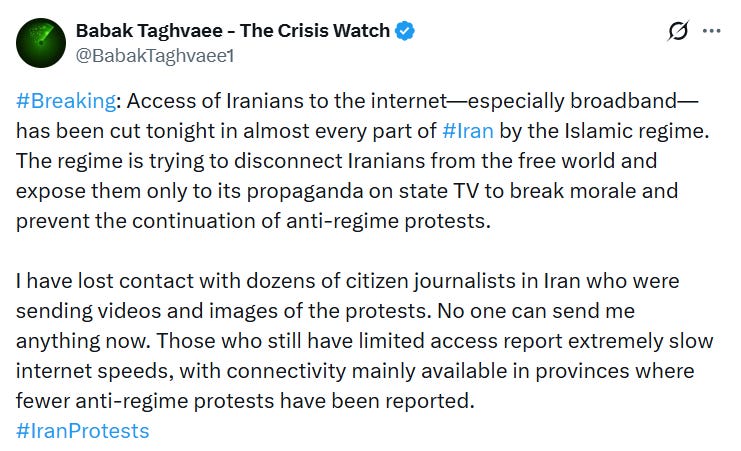
HRANA reported at least 1,203 arrested and 64 injured, mostly by pellet and rubber bullets, while 314 security forces were wounded. The regime cut broadband internet nationwide on January 5, with reporter Babak Taghvaee noting he “lost contact with dozens of citizen journalists” sending protest footage.
Israel’s Coordinated Response
Prime Minister Benjamin Netanyahu told his Cabinet Sunday: “We stand in solidarity with the struggle of the Iranian people... It is very possible that we are standing at the moment when the Iranian people are taking their fate into their own hands.” Israel’s Mossad posted in Farsi on December 29: “Go out together into the streets. The time has come. We are with you. Not only from a distance and verbally. We are with you in the field.”
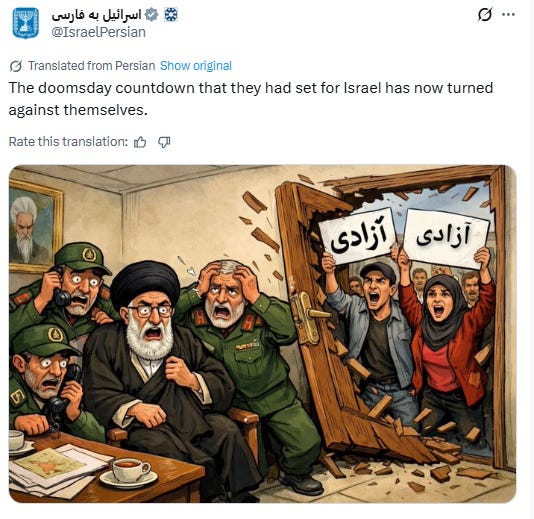
The Israeli Foreign Ministry’s Persian account shared cartoons mocking Khamenei cowering from protesters, captioned: “The destruction calendar they had set for Israel has now been set for themselves.”
A History of Uprising
Iran’s protest movements trace back to the 2009 Green Movement, where dozens died demanding “Where is my vote?” In November 2019, security forces killed at least 1,500 protesters after fuel price hikes, imposing Iran’s first near-total internet blackout.
The 2022 Mahsa Amini uprising resulted in 551+ deaths under the “Woman, Life, Freedom” banner. Washington Post analysis notes current protests are “broader and deeper in their early phase,” with economic desperation pushing society from social reform demands to explicit regime change.
Silence from the Pro-Palestine Left
As Iranians face live ammunition, actor Michael Rapaport asked: “Where the f**k is everybody on Iran? I’ve seen endless protests for Gaza... But Iran? Crickets.” Iranian activist Mani Basharzad wrote: “I know you want to ‘free Palestine.’ But perhaps you should start by wanting to free Iran from the regime financing so much of the tragedy you claim to oppose.”
Campus encampments and street blockades that dominated Western cities for Gaza remain absent as Iranians die for freedom, exposing what critics argue is the ideological alignment between pro-Palestinian activists and the Islamic Republic that funds Hamas with $100 million annually.
As Supreme Leader Khamenei reportedly plans an escape to Russia and street battles rage in Tehran, the 47-year-old Islamic Republic faces what may be its final reckoning—not from foreign intervention, but from its own people demanding the oil wealth and national dignity squandered on global terrorism finally serve Iran itself.
I love this picture! I think of The Lion of Judah taking down Islam! ⚔️🛡️ Can. Not. Wait!