


Jewish Onliner is an independent publication. If you find our work valuable, please consider becoming a paid subscriber. You can also subscribe to us on WhatsApp and Telegram. Follow us on Instagram, Discord, and X.
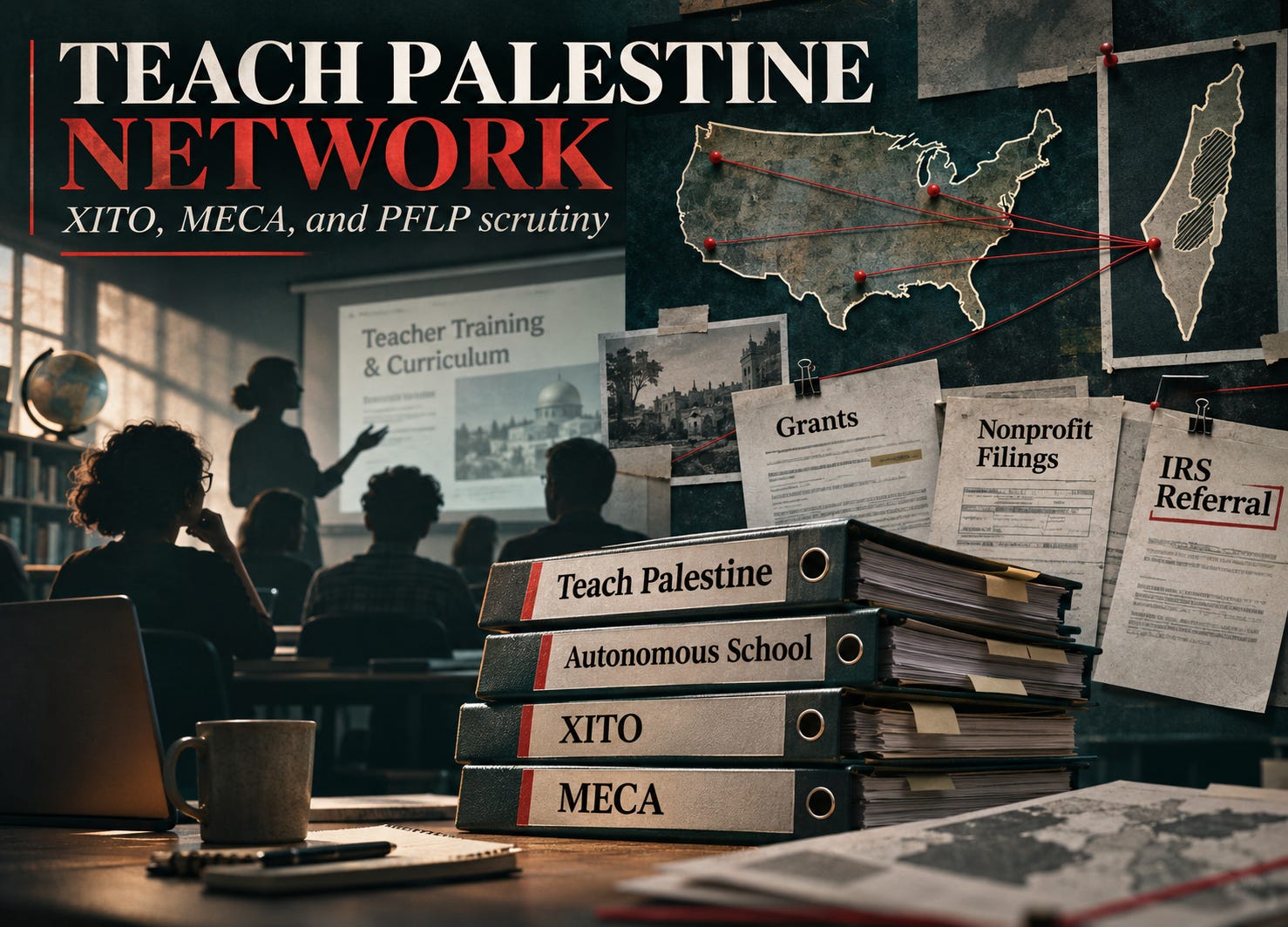
An Arizona-based organization that has trained American public-school teachers is developing an “Autonomous School” to expand its ethnic-studies programs beyond traditional educational institutions. The Xicanx Institute for Teaching and Organizing (XITO) has partnered for more than six years with the Middle East Children’s Alliance (MECA) on programs training educators to teach about the Israeli-Palestinian conflict.
MECA, meanwhile, faces congressional scrutiny over its overseas funding. In September 2026, Republican lawmakers referred the nonprofit to the IRS over historical grants to Palestinian organizations designated by Israel as fronts for the Popular Front for the Liberation of Palestine (PFLP), a U.S.-designated Foreign Terrorist Organization.
XITO also previously lost a California school-district contract following litigation over alleged antisemitism in ethnic-studies curricula. Its new initiative is intended to continue training educators outside conventional institutional structures while its longstanding partnership with MECA’s Teach Palestine Project remains active.
A New School to Train American Educators
According to XITO’s official announcement, the Autonomous School is being developed in response to what the organization describes as growing political and legal opposition to teaching decolonial ethnic studies, including lessons about the Israeli-Palestinian conflict.
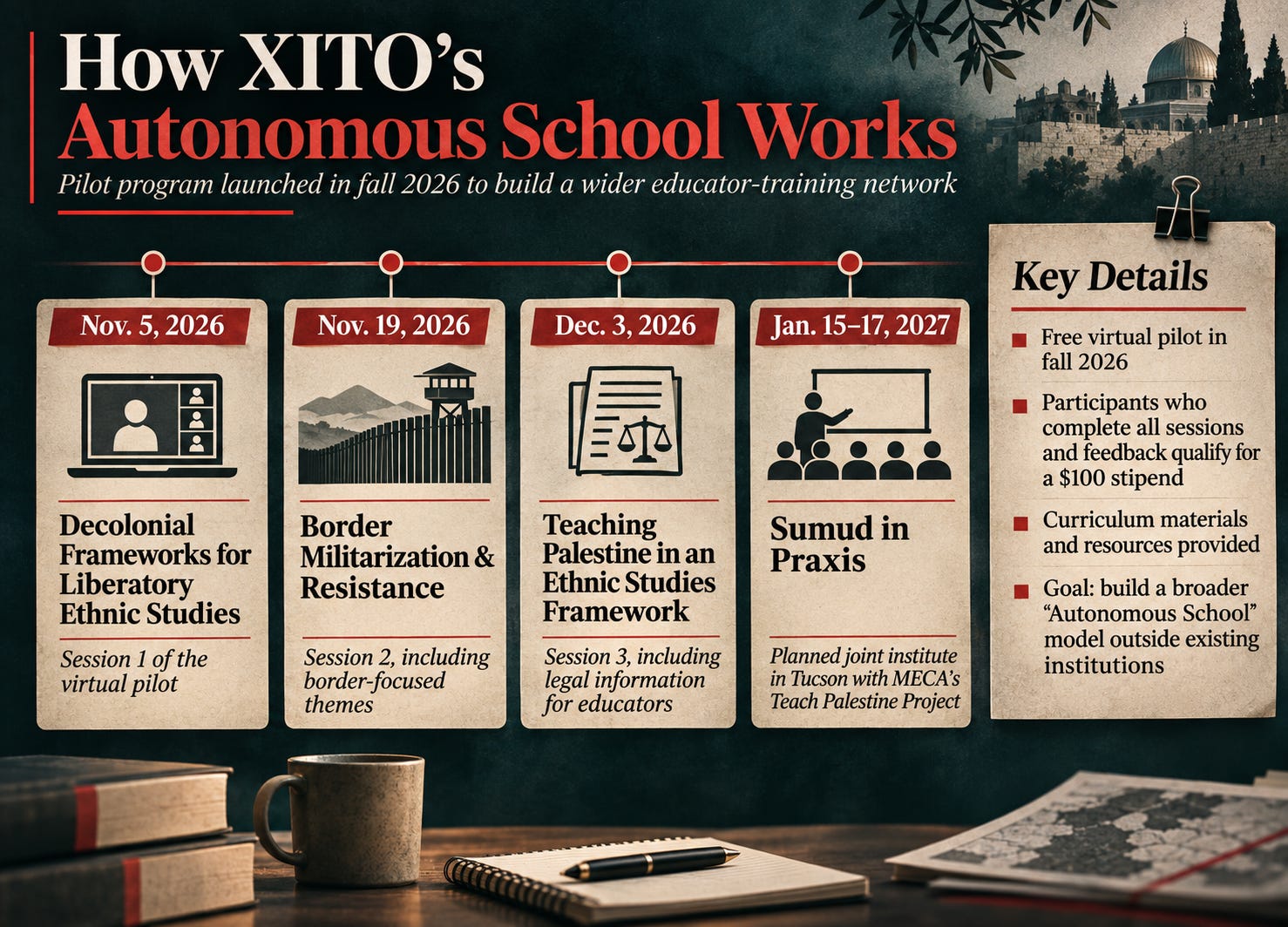
The project began with a free three-part virtual professional-development series on November 5, with additional sessions scheduled for November 19 and December 3, 2026.
The December 3 session, titled “Teaching Palestine in an Ethnic Studies Framework,” will explore the conflict through concepts including imperialism, empire, and settler colonialism. The workshop will also provide legal information concerning educators’ rights to teach about the conflict. Participants who attend all three sessions and complete the required feedback surveys are promised a $100 stipend and access to educational resources, including sample curricula.
XITO says the pilot will help develop a broader educational network offering future training institutes, fieldwork, youth programming, and collaborative organizing opportunities. The organization describes its ambition as creating an educational structure “outside of existing educational institutions and protected from ongoing legal attacks and repression.”
It also envisions a model that other organizations could replicate, allowing them to continue educational activities independently of conventional institutional systems. The Autonomous School’s proposed expansion builds upon XITO’s established teacher-training operations, including programs conducted with MECA.
The Teach Palestine Partnership
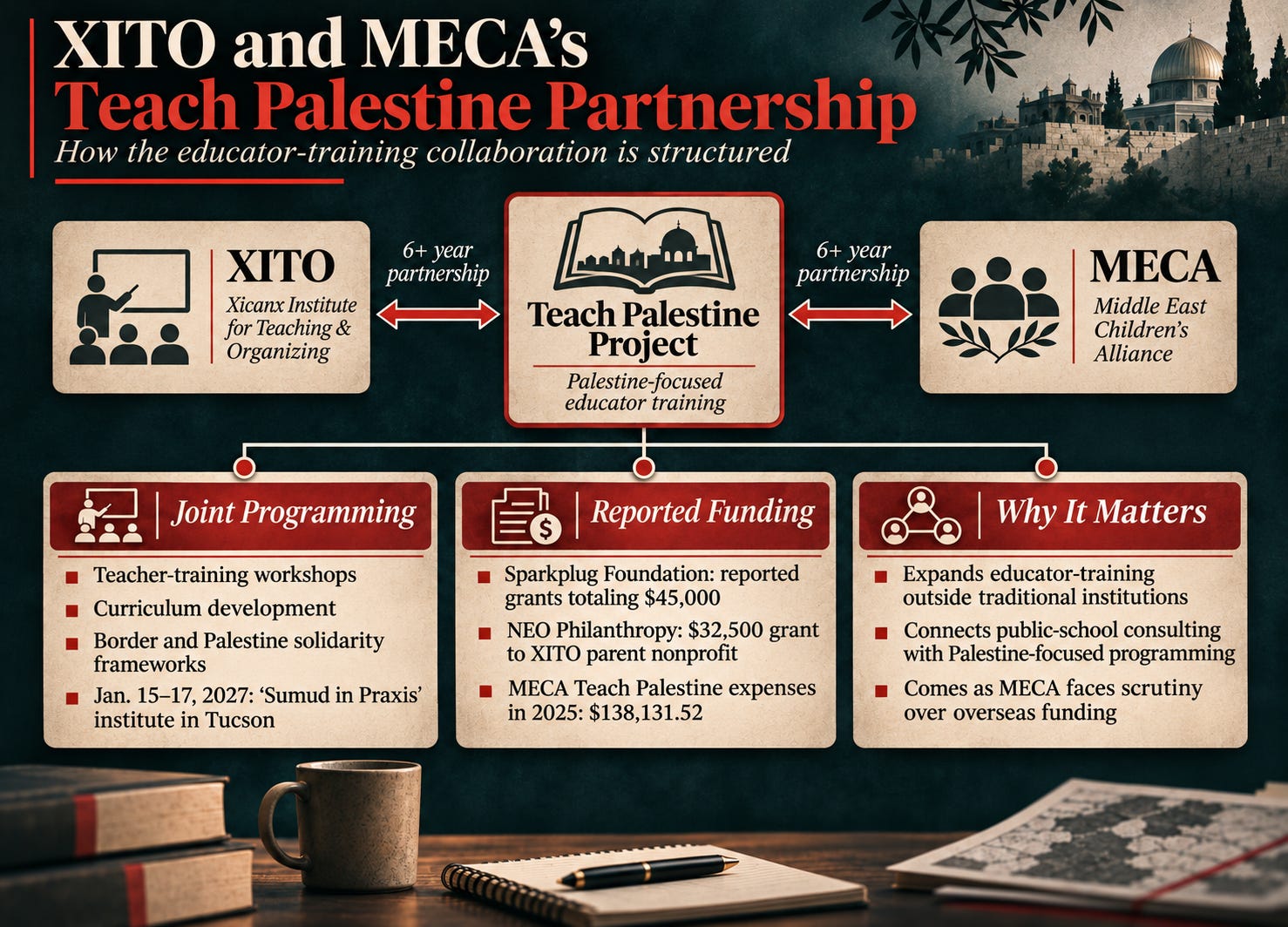
XITO’s relationship with the Middle East Children’s Alliance, a Berkeley-based nonprofit that funds Palestinian humanitarian initiatives and operates educational programs in the United States, extends back more than six years.
Through MECA’s Teach Palestine Project, the organizations have jointly developed training programs connecting the Israeli-Palestinian conflict with the U.S.–Mexico border, Indigenous history, and settler-colonial frameworks.
Their collaboration is continuing with a three-day institute advertised for January 15–17, 2027, in Tucson, Arizona.
The program, titled “Sumud in Praxis: Teaching for Solidarity from Turtle Island to Palestine,” is designed for up to 30 educators and educational leaders, with registration fees ranging from $500 to $800.
Its curriculum includes fieldwork along the U.S.–Mexico border and activities intended to help participants develop classroom materials about the Israeli-Palestinian conflict.
XITO identifies the event as a joint initiative with MECA’s Teach Palestine Project, describing their relationship as an ongoing partnership involving intensive workshops and educator training.
The collaboration has also received philanthropic backing. The Sparkplug Foundation has supported XITO’s educational initiatives through three grants totaling $45,000, according to its grant listings, including projects connecting Palestinian issues with the U.S.–Mexico border.
Separately, NEO Philanthropy’s 2023 tax filing records a $32,500 program grant to XITO’s parent organization, the Center for Community Education.
MECA’s Funding of Israeli-Designated PFLP Fronts
The partnership has attracted additional significance amid scrutiny of MECA’s overseas grantmaking.
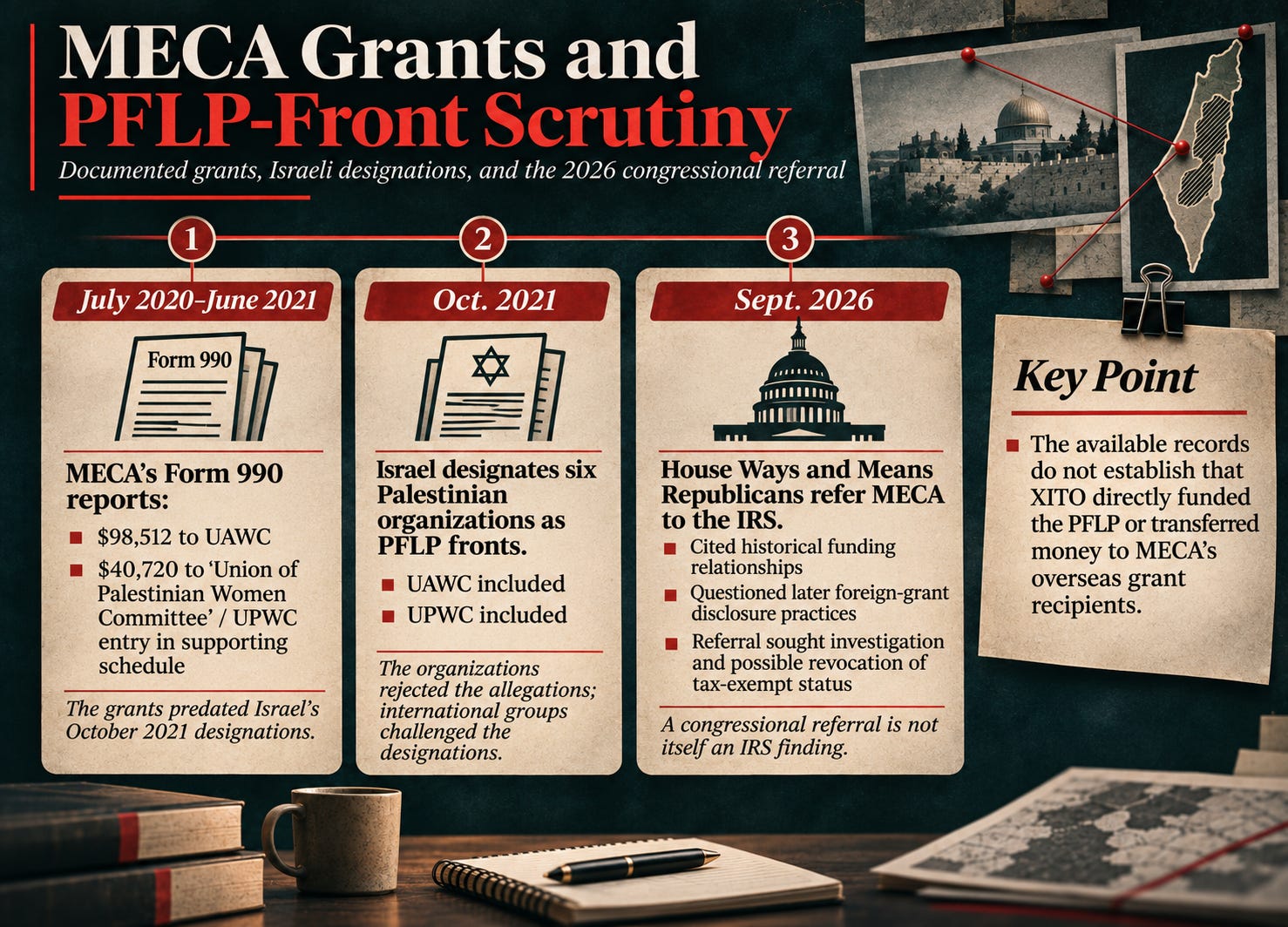
According to MECA’s 2020 tax return, covering July 2020 through June 2021, the nonprofit made a $98,512 grant to the Union of Agricultural Work Committees (UAWC), a Palestinian organization subsequently designated by Israel as a terrorist organization.
The same return’s supplementary recipient schedule identifies another $40,720 grant to the “Union of Palestinian Women Committee.” Elsewhere, the filing names the Union of Palestinian Women’s Committees (UPWC) among MECA’s grant recipients. The corresponding entry in the main Schedule F table leaves the recipient’s name blank but records the matching amount and location.
Both UAWC and UPWC were among six Palestinian organizations designated by Israel in October 2021 for allegedly operating as branches of the PFLP.
Israel’s National Bureau for Counter Terror Financing described the organizations as an interconnected network operating under the guise of independent civil-society institutions while supporting PFLP activities, recruitment, and fundraising.
UAWC’s activities have also attracted international scrutiny through a separate Dutch funding relationship.
An independent investigation commissioned by the Dutch government identified 34 individuals with connections to both UAWC and the PFLP between 2007 and 2020, including 12 cases involving overlapping leadership positions.
MECA’s 2020 tax return also confirms grants to the Union of Health Work Committees (UHWC). In their September 2026 IRS referral, House Ways and Means Committee Republicans identified UHWC among organizations described as PFLP-affiliated in a 1993 report prepared for the U.S. Agency for International Development (USAID).
Congressional Scrutiny Over Overseas Funding
On September 28, 2026, House Ways and Means Committee Republicans announced that they had referred MECA to the IRS for investigation and potential revocation of its tax-exempt status.
Their 14-page referral letter, dated September 25 and addressed to IRS Chief Executive Officer Frank Bisignano, cited MECA’s historical financial relationships with organizations allegedly connected to the PFLP.
The lawmakers also questioned changes in MECA’s overseas grant disclosures.
According to the committee, MECA reported approximately $10.69 million in foreign grants for fiscal 2024 without identifying any recipient organizations in its Schedule F entries. For fiscal 2025, it reported another $11.46 million in foreign grants without stating the purposes of the individual payments.
Federal tax instructions do not require the public identification of foreign grant recipients but do require descriptions of grant purposes. The lawmakers argued that MECA’s changing disclosures made its overseas financing increasingly difficult to trace.
The referral called on the IRS to investigate MECA’s tax-exempt status and its financial relationships with the organizations identified by the committeee changes made it increasingly difficult to trace MECA’s overseas financing.
XITO’s Public-School Relationships and Previous Litigation
XITO’s activities extend beyond its partnership with MECA.
The organization operates under the Center for Community Education, a Tucson-based registered nonprofit. Its co-founder and executive director is educator Anita Fernández.
Its collective includes Norma “Mictlani” Gonzalez, Jose Gonzalez, and Curtis Acosta. XITO identifies Jose Gonzalez as a Tucson Unified School District master teacher and coach, while Acosta is listed as an assistant professor at the University of Arizona.
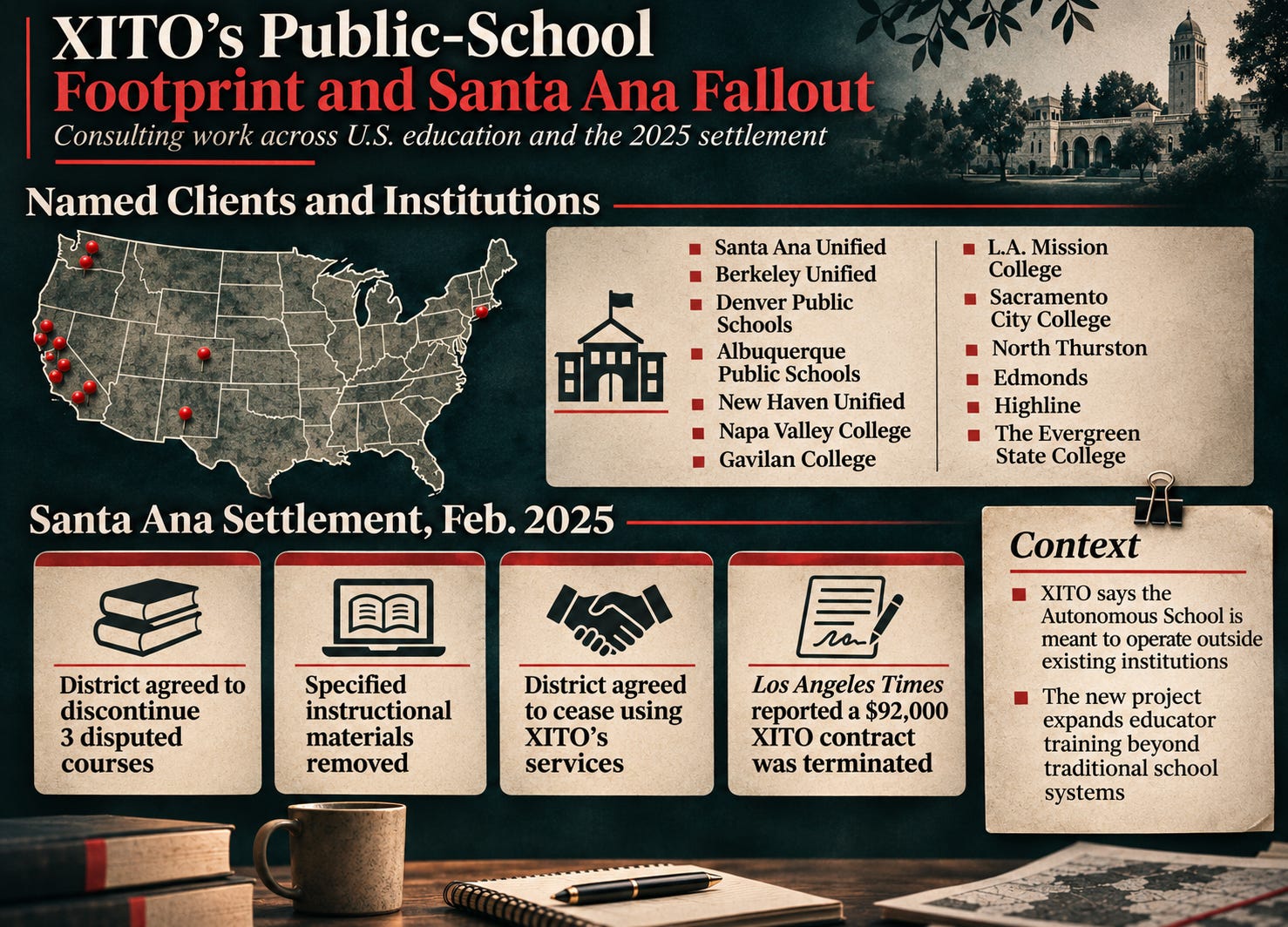
The organization has previously provided consulting and teacher-training services to public educational institutions across the United States, including Santa Ana Unified, Berkeley Unified, Denver Public Schools, and Albuquerque Public Schools, according to its website.
One of those relationships ended following a lawsuit challenging ethnic-studies curricula in California.
In February 2025, Santa Ana Unified School District reached a settlement with Jewish advocacy organizations that had challenged the development and content of several ethnic-studies courses.
The plaintiffs alleged that the district had improperly developed courses containing antisemitic and anti-Israel materials. Under the settlement, the district agreed to discontinue three disputed courses unless they were reapproved through specified public procedures. Two courses were permitted to finish the 2024–25 school year with certain instructional materials removed.
The district also agreed to immediately cease using XITO and individuals associated with it. The Los Angeles Times reported that the agreement terminated a $92,000 XITO contract.
The lawsuit and subsequent termination of XITO’s contract provide context for the institutional challenges the organization now cites in promoting its Autonomous School, which it presents as an alternative structure for continuing its educational work.
Expanding the Teacher-Training Network
XITO’s expansion also highlights the financial relationships supporting its educational programs.
The Center for Community Education’s nonprofit filings show that educational consulting and other program services have accounted for most of its declared revenue, while private grants have supported particular educational initiatives.
Separately, MECA’s published finances identify $138,131.52 in expenses for its Teach Palestine program in 2025.
The organizations’ overlapping educational activities include teacher-training institutes, curriculum development, and workshops connecting pro-Palestinian issues with Indigenous movements and U.S. border politics.