


Jewish Onliner is an independent publication. If you find our work valuable, please consider becoming a paid subscriber. You can also subscribe to us on WhatsApp and Telegram. Follow us on Facebook, YouTube, TikTok, Instagram, Discord, and X.
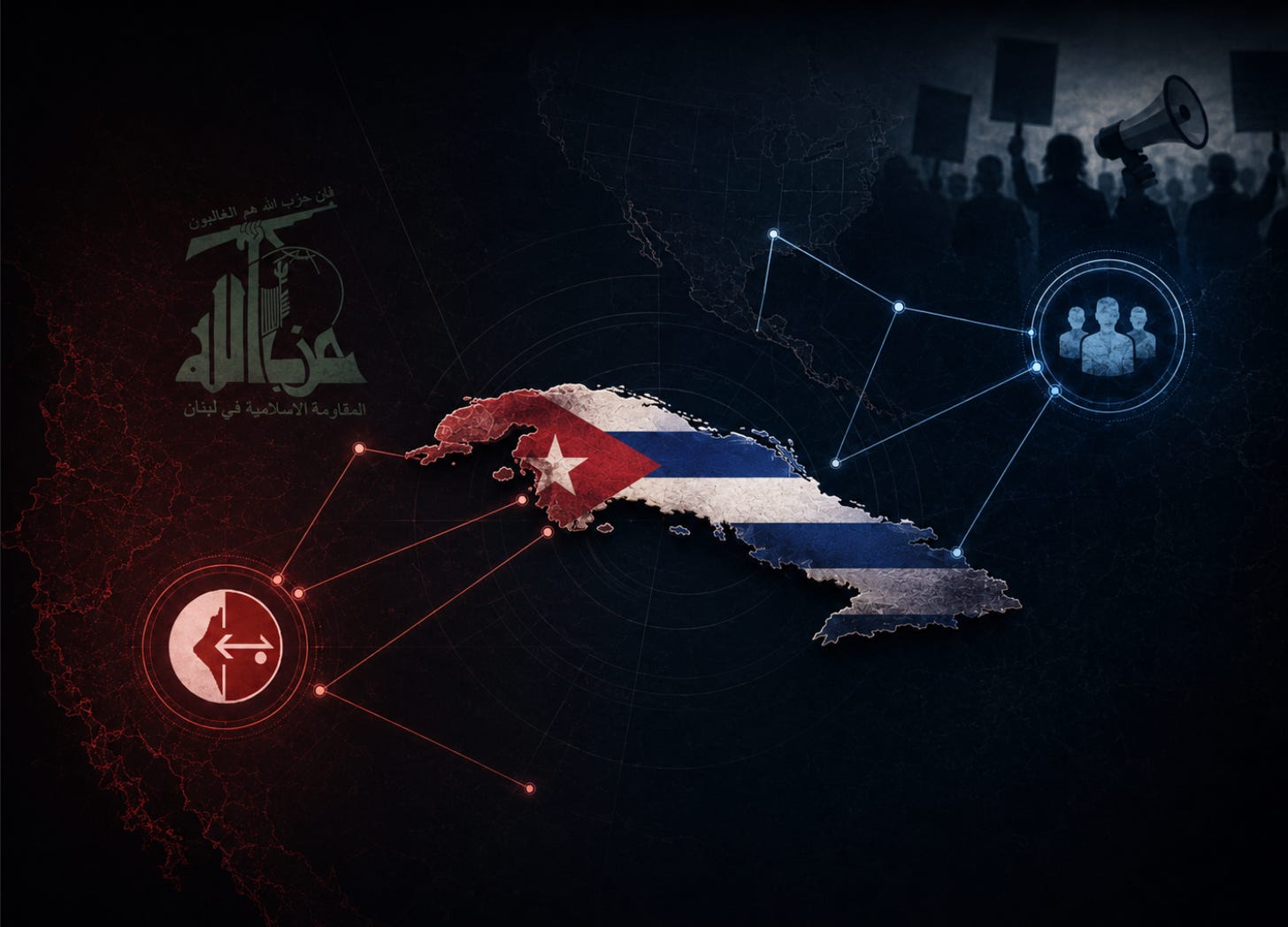
A comprehensive State Department report released in July 2026—titled “Cuba: The Capital of 21st Century Communism“—documents Cuba’s role as a central operational hub for Iran-backed terrorist networks—including Hamas and Hezbollah—with radical left-wing organizations operating inside the United States. The findings closely align with investigative work published by Jewish Onliner in January 2026, which previously mapped elements of the overlapping networks and funding relationships linking Cuban solidarity groups, Palestinian terror advocates, and U.S.-based activist infrastructure.
The report, produced by the State Department’s intelligence division, traces decades of Cuban regime activity funneling weapons, training, and operational support to designated terror groups while simultaneously building what it describes as “one of the single largest, most sophisticated and dangerous vectors for hostile foreign influence in modern American history.”

Cuba’s Terror Network Architecture
According to the report, Cuba has maintained formal partnerships with the Popular Front for the Liberation of Palestine (PFLP) and other Palestinian militant groups since the 1970s. The arrangement expanded significantly following the 1979 Iranian Revolution, when Havana deepened its intelligence and military cooperation with Tehran.
The document details how Cuba trained Palestinian guerrillas at camps in South Yemen, provided hundreds of hours of weapons and explosives instruction to PLO cadres, and established a permanent Palestinian Liberation Organization office in Havana. More recently, Cuban officials met with Hamas representatives just eight months before the October 7, 2023 attacks on Israel—meetings the report characterizes as part of a “longstanding partnership” rooted in anti-American and anti-Western ideology.
The State Department identifies Iran’s “Axis of Resistance” umbrella coalition—which includes Hamas, Hezbollah, Palestinian Islamic Jihad, and the PFLP—as directly integrated into Cuba’s North American influence operations. In 2022, Cuba’s state-affiliated ICAP (Instituto Cubano de Amistad con los Pueblos) formally signed a cooperation agreement with Al-Tajammu, the Iranian-backed international network coordinating terror group activities across 86 countries, including 39 established nodes in the United States, Canada, Australia, Europe, Africa, India, and Latin America.


The U.S. Footprint
Paul Larudee, identified by the report as Al-Tajammu’s North American branch coordinator, serves as treasurer of the San Francisco-based Association for Investment in Popular Action Committees—a shadowy nonprofit that functions as fiscal sponsor for Latin American leftist media and coordinates “volunteer delegations to Cuba and Venezuela.”
The organization’s revenue more than tripled from 2023 to 2025, according to IRS filings cited in the report, coinciding with expanded coordination between Iran-aligned networks and U.S. radical left infrastructure.
Jewish Onliner’s January 2026 investigation identified similar patterns, documenting how organizations like the People’s Forum, Code Pink, and Democratic Socialists of America maintained interlocking relationships with Cuba-aligned groups while simultaneously hosting or supporting pro-Palestinian activism on U.S. campuses and in urban centers.

The People’s Forum and Code Pink Nexus
The State Department report documents the People’s Forum’s emergence as a “centralized hub for anti-Trump, anti-ICE, and pro-Cuban agitation” since 2018, with funding increasing from $486,926 in 2021 to $4.4 million in 2022—a more than 800 percent spike.
The organization has served as fiscal sponsor for the Venceremos Brigade, Cuba’s principal vehicle for recruiting and radicalizing American activists. The report notes that People’s Forum leaders met with Cuban President Miguel Díaz-Canel during his September 2023 trip to New York for the UN General Assembly, and the organization went on to organize the March 2026 “Nuestra América Convoy,” which transported over 120 organizations from 33 countries to Cuba in violation of U.S. sanctions.
Code Pink, co-founded by Medea Benjamin and Jodie Evans, receives approximately 25 percent of its funding from networks connected to billionaire Neville Roy Singham, according to the report. Since Evans’ 2017 marriage to Singham, the organization has shifted from anti-war activism to comprehensive advocacy for hostile regimes including Cuba, China, Venezuela, Iran, and Gaza-based terror networks.


In March 2026, Code Pink chartered dedicated aircraft for over 100 participants to the Nuestra América Convoy, transporting $433,000 worth of medical supplies. The Singham network has reportedly funded approximately 100 overseas trips by Code Pink members to hostile nations, with 65 trips specifically targeting Cuba, Venezuela, Iran, and Gaza.
Academic and Institutional Integration
The report identifies Cuban intelligence agents strategically embedded within U.S. universities, targeting “politically-engaged leftist students at elite universities who will go on to occupy positions of importance in the private sector and in the government.” The University of Havana maintains educational exchange agreements with nearly 80 U.S. universities as of 2023, including Harvard and the University of Alabama.
IFCO (Interreligious Foundation for Community Organization), which serves as the sole U.S. administrator of scholarships for Cuba’s Latin American School of Medicine (ELAM), has historically sponsored organizations tied to terror financing. Previous fiscal sponsorship relationships included Viva Palestina US, which distributed vehicles and cash directly to Hamas leadership—with British MP George Galloway filmed handing a bag of cash to Hamas Prime Minister Ismail Haniyeh in 2009.
The report documents ELAM graduates now working across 30 U.S. states after receiving full-ride scholarships conditioned on returning to America, representing what it characterizes as a deliberate infiltration strategy targeting American medical and educational institutions.

Rapid Response Planning and Domestic Coordination
In June 2026, the National Network on Cuba (NNOC)—a coalition of 60 American groups including the Democratic Socialists of America, National Lawyers Guild, and CodePink—distributed a detailed “National Rapid Response Plan” outlining coordinated nationwide actions against federal institutions, U.S. military bases, and ICE detention centers within 24 hours of any threatened U.S. military action against Cuba.
The plan explicitly links “Cuba solidarity to anti-ICE/immigrant defense work,” identifying specific targeting priorities and tactical guidance organized by geography and population density. The document directs activists to resources mapping U.S. military installations, bases, and training facilities—a project developed by the Black Alliance for Peace, which the report identifies as a frequent NNOC collaborator.
Intelligence and Financial Flows
The State Department designated ICAP for sanctions in June 2026, identifying it as “an instrumentality of the Cuban government that supports Cuban intelligence and counterintelligence activities.” The same action sanctioned Amistur Cuba SA, the regime-linked “socio-political tourism” travel agency coordinating delegations to the island.

According to the report, roughly 90 percent of ICAP staff are affiliated with Cuban intelligence, with two specialized DI (Cuban intelligence) officers “assigned to ICAP to help screen and assess members of the Venceremos Brigade and other sympathetic organizations.”
The analysis aligns with Jewish Onliner’s January 2026 reporting, which documented how organizations ostensibly focused on “solidarity” and “humanitarian aid” function as intelligence-gathering and asset-recruitment mechanisms for hostile regimes while simultaneously mobilizing campus and street-level activism.