


Jewish Onliner is an independent publication. If you find our work valuable, please consider becoming a paid subscriber. You can also subscribe to us on WhatsApp and Telegram. Follow us on Instagram, Discord, and X.
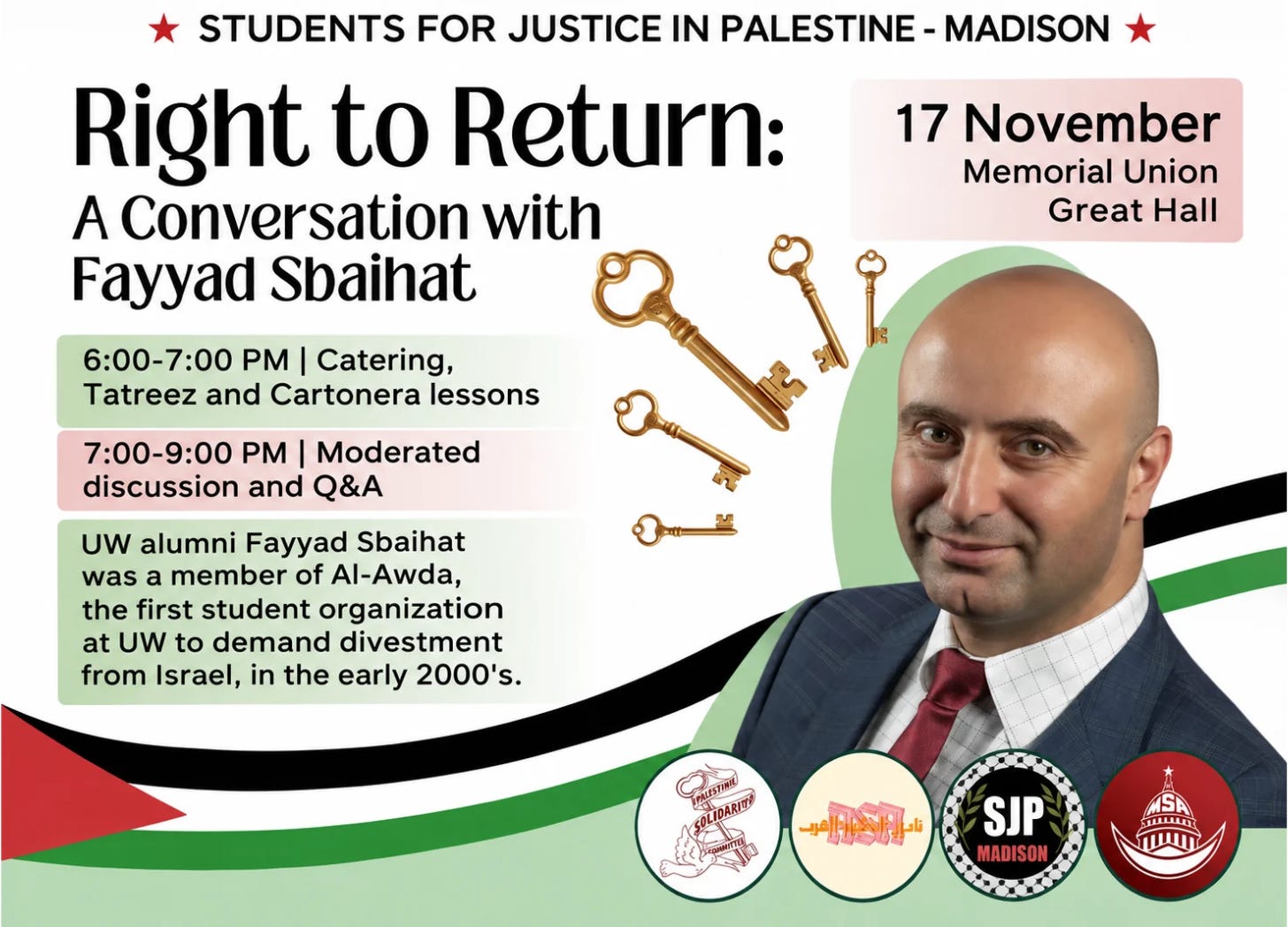
The University of Wisconsin–Madison chapter of Students for Justice in Palestine (SJP) is scheduled to host alumnus Fayyad Sbaihat on November 17, bringing a veteran of the early campus divestment movement back to a university where he helped organize campaigns against Israel more than two decades ago. The event, titled “Right to Return,” is scheduled for 7 p.m. at the Memorial Union’s Great Hall.
Sbaihat’s appearance comes amid renewed scrutiny of the hosting chapter’s activities, including its promotion of writings by figures associated with Palestinian terrorist organizations and previous disciplinary action by the university. The event has also been publicized by UW–Madison’s Middle East Studies Program, which is separately organizing an upcoming lecture featuring a professor who has publicly defended Hamas’s actions.
Sbaihat’s History With Al-Awda and Its Samidoun Connections
Sbaihat’s history at UW–Madison dates back to the early 2000s, when he was involved in some of the university’s first campaigns to divest from Israel. He was a leading member of Al-Awda Wisconsin, according to a 2010 interview, and helped advance early efforts to pressure the university into divesting from companies doing business with Israel. In April 2005, he was named as a contact in a campaign backed by the Association of University of Wisconsin Professionals, which called on the university’s Board of Regents to divest from seven companies, including Boeing, Caterpillar and Lockheed Martin.
Al-Awda’s national coalition has also maintained documented associations with figures connected to the PFLP. During an April 2001 rally in New York, an activist read a translated message from George Habash, the PFLP’s former secretary-general and founding leader. More than two decades later, Al-Awda identified Charlotte Kates as both a member of its national committee and the international coordinator of Samidoun, an organization sanctioned by the U.S. Treasury Department in October 2024. Treasury described Samidoun as a PFLP front that raised money internationally for the terrorist organization.
Al-Awda has also published statements praising the Hamas-led October 7 attack on Israel. In an October 9, 2026, statement, the coalition characterized the attack as “the great uprising of October 7, 2023.”


The Palestine Solidarity Movement and Its ISM Connections
Beyond Al-Awda, Sbaihat served as national spokesman and lead organizer for the Palestine Solidarity Movement (PSM), a North American campus divestment network whose conferences brought together student activists and organizers associated with the International Solidarity Movement (ISM). In 2003, Sbaihat and Noura Erakat spoke at a divestment workshop at Ohio State University. The following year, he appeared at a PSM conference hosted by Duke University, where he defended organizers’ refusal to sign a proposed statement condemning terrorism.
The Duke gathering also served as a recruitment opportunity for ISM. According to a 2006 account by Eric Adler and Jack Langer published in The Washington Post, ISM co-founder Huwaida Arraf distributed recruitment brochures at the conference and encouraged students to volunteer for the organization. ISM has faced scrutiny over its interactions with Palestinian terrorist organizations, including Hamas, Palestinian Islamic Jihad and the PFLP.
In a separate 2006 letter, Arraf acknowledged that ISM had cooperated with all three organizations, although she described those activities as nonviolent. Another incident involved the 2003 arrest of Shadi Sukiya at ISM’s office in Jenin. A 2010 report by Israel’s Meir Amit Intelligence and Terrorism Information Center cited the Israeli military’s allegation that two ISM volunteers attempted to conceal him from pursuing troops.

A separate U.S. federal case involved Richard David Hupper, an American who had worked alongside ISM activists. According to a State Department report, Hupper encountered a suspected Hamas member through those contacts. His own attorney acknowledged that Hupper provided approximately $20,000 knowing the money would go directly to Hamas. In 2008, Hupper was sentenced to 46 months in prison after pleading guilty to attempting to provide material support to the organization.
That same year, activists participating in the Free Gaza Movement’s voyage to Gaza met Hamas leader Ismail Haniyeh. Among those involved was Paul Larudee, a co-founder of ISM’s Northern California chapter, who later recalled visiting Haniyeh’s home during the trip. ISM subsequently announced that the voyage had enabled it to reestablish a presence in Gaza.
Sbaihat Pictured With Nation of Islam and New Black Panther Party Figures
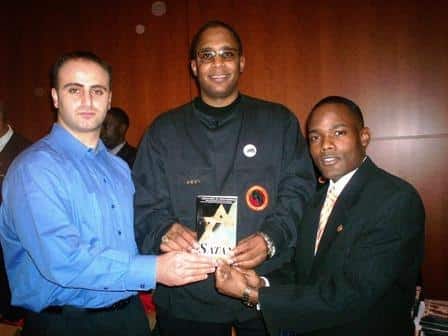
A 2015 report published a photograph identifying Sbaihat alongside Nation of Islam member Ashahed Muhammad and Malik Zulu Shabazz, former chairman of the New Black Panther Party. Sbaihat is pictured holding a copy of Muhammad’s book The Synagogue of Satan, which contains a foreword by Shabazz. The Anti-Defamation League has condemned the book for promoting antisemitic conspiracy theories and Holocaust denial.
Madison SJP’s History of Controversial Programming and Discipline
The student chapter organizing Sbaihat’s appearance has itself faced repeated controversies over its campus activities and programming. In March 2025, Madison SJP advertised an April fundraising initiative with Workshops4Gaza centered on The Revolution of 1936–1939 in Palestine: Background, Details, & Analysis, a book by Ghassan Kanafani, one of the PFLP’s founders. Kanafani was a Palestinian novelist who helped establish the PFLP in 1967 and subsequently served on its political bureau and as its official spokesman, according to his biography. The Madison organizers planned four weekly reading sessions and said proceeds from book purchases would go to Palestinians in Gaza.

The fundraiser was announced while the chapter was serving a ten-month disciplinary probation imposed by UW–Madison in October 2024. Following a university investigation, the Committee on Student Organizations found SJP responsible for five conduct violations connected to the Library Mall encampment, including harmful behavior and disruptive conduct. The chapter denied responsibility.
Further disciplinary action followed in July 2025, when university officials suspended the organization over an April protest outside a lecture by former U.S. Ambassador to the United Nations Linda Thomas-Greenfield. The hearing committee had recommended extending the group’s probation and credited SJP leaders with attempting to defuse the protest. Nevertheless, the university imposed a suspension lasting until January 15, 2026, followed by probation through May 15.
The chapter returned to similar political reading-group activities in June 2026. As reported by The Jerusalem Post, Madison SJP advertised weekly sessions at Madison’s Central Library devoted to the writings of Bassel al-Araj, whom the organization described as “a Palestinian revolutionary and writer.” Bassel al-Araj was killed in a 2017 gunfight with Israeli forces near Ramallah. Israeli officials alleged that he led a terrorist cell planning attacks against Israeli targets.


Middle East Studies Program Promotes Another Controversial Speaker
The upcoming Sbaihat appearance is also among the events publicized by UW–Madison’s Middle East Studies Program, which is separately organizing a lecture by a professor who has defended Hamas’s actions in published writing.
The program promoted Tuesday’s SJP-organized event on its official website and is listed as the organizer of an upcoming February 22, 2027, lecture featuring Whitman College professor Zahi Zalloua, titled To Exist as a Problem: Being Black, Being Palestinian.
In a July 2024 essay in Crisis & Critique, Zalloua wrote, “Hamas is defending the rights of the Palestinians against an eliminationist Zionist settler regime.” Later in the same essay, he characterized the Hamas-led October 7 attack as “better understood as an act of armed resistance.”